- Year
- 1932
- By
- Graffigny, Henry de (Raoul Marquis)
- Published
- Paris: Éditions SPES.
- Edition
- French. First edition, stiff wraps.
- Ciancone
- 90.
- Shelf
- L3
- Catalog
- Catalog A · Early Pioneers
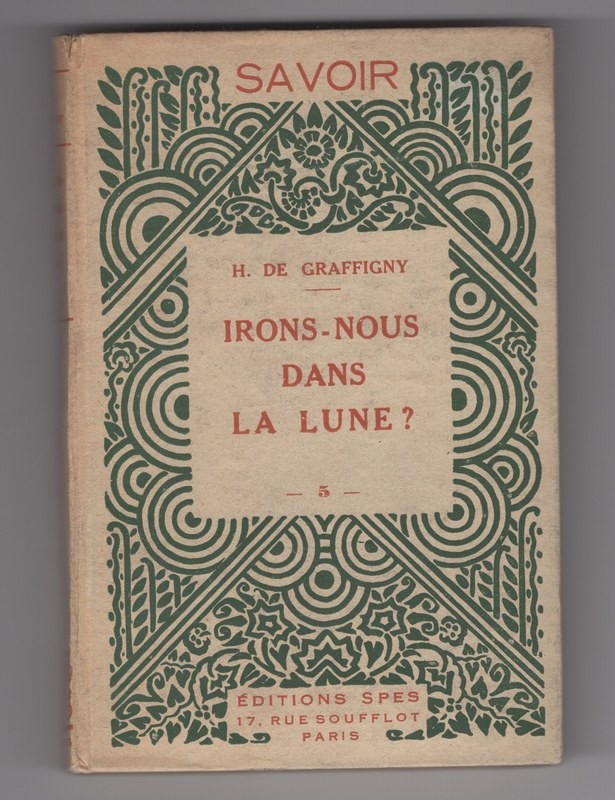
Number 5 in the Savoir series of Éditions SPES, with a preface by Abbé Théophile Moreux, director of the Bourges Observatory, who presents it as the first book by a French author to popularize astronautics. Graffigny, a balloonist and science editor of Ouest-Éclair, devotes seven chapters to the Moon’s physical state and habitability, the atmosphere and its exploration (Piccard’s record balloon ascent, sounding balloons, kites), proposed launch systems (Verne’s cannon, a rotating catapult, an underground launching railway), exploratory rockets, and life in space, with drawings by the author.
In the rocket chapter he reprints his own 1904 “fusée-aéroplane,” a 320-gram model glider driven by a slow-burning powder charge, tested at Mers (Somme) on 17 September 1904 and reported in the Revue Scientifique, with a best flight of 1,100 m in 84 seconds. He then surveys the field from Eyraud’s 1864 novel through Goddard (the Guggenheim-backed high-altitude project), Tsiolkovsky, Esnault-Pelterie, Oberth, Valier’s rocket car and aircraft trials with Opel and Zander, Nebel’s test rockets near Berlin (Fig. 18), and Mas and Drouet’s steering rocket. He works out a Moon shot using 9 km/s exhaust and Hohmann’s spiral descent (Fig. 20), and closes by weighing the physiological effects of weightlessness and the food, air, and heat needs of a three-man crew.
Esnault-Pelterie’s L’Astronautique, Oberth’s Wege zur Raumschiffahrt, and Hohmann’s monograph are also in this collection.