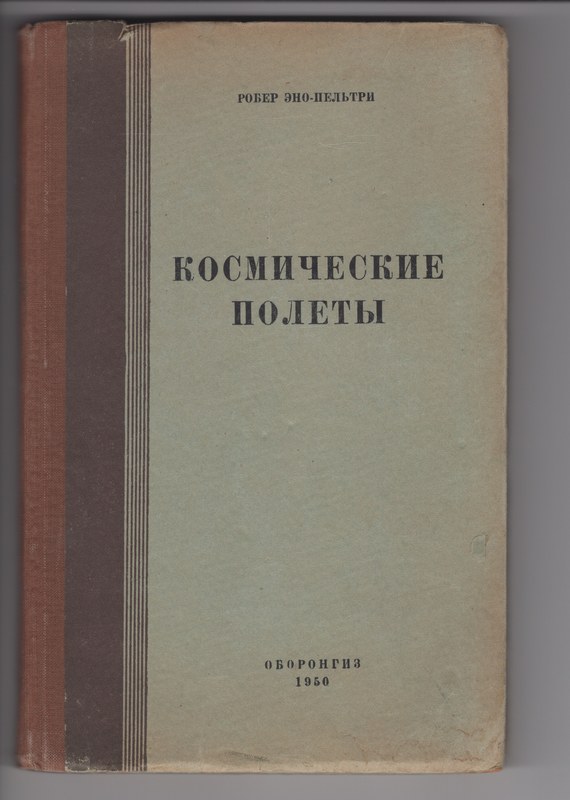
Space Flight.
An abridged Russian translation, by L. L. Sabsovich, of Esnault-Pelterie’s L’Astronautique (1930) and its 1935 supplement (both in Catalog A), edited by Prof. A. A. Kosmodemyansky. The editor’s foreword names Tsiolkovsky as the founder of the theory of space travel. Five chapters cover rocket motion in a vacuum and in air, possible uses of rockets (including Goddard’s 1913 proposal to send a projectile to the Moon), interplanetary voyages, and problems of the future such as speeds near that of light and atomic energy. An errata slip is tipped in.
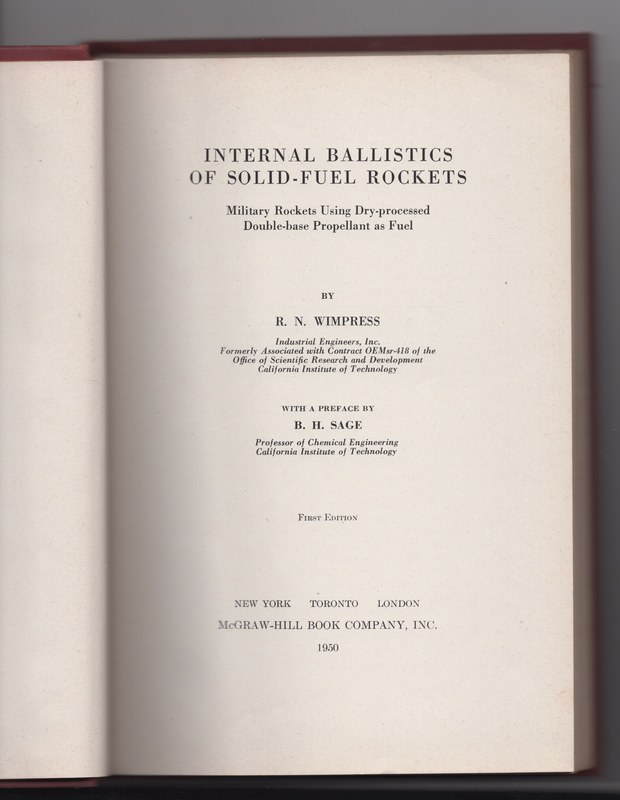
Internal Ballistics of Solid-Fuel Rockets.
Book on solid-fuel military rockets based on work done by the Propellants Group at the California Institute Of Technology (1941-1945). Stated first edition on front page (later editions do not have the notice).
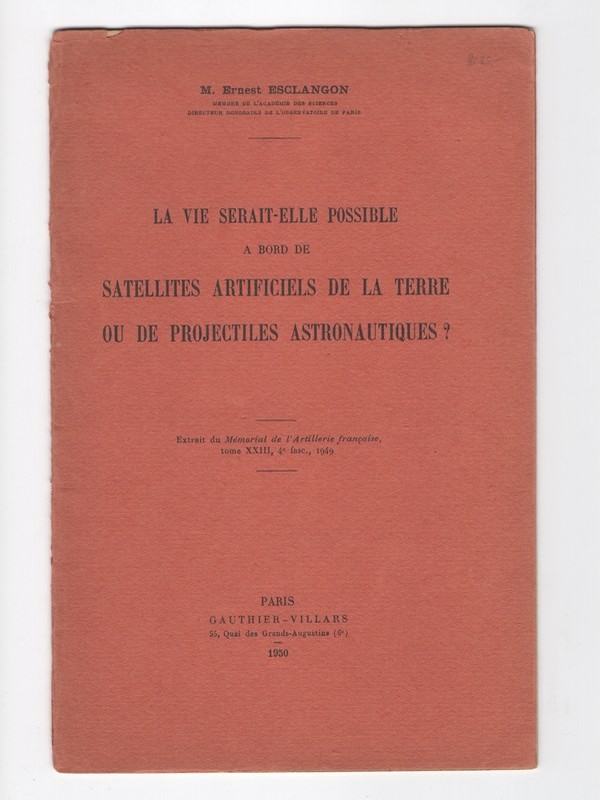
La Vie Serait-elle Possible A Bord De Satellites Artificiels.
Discusses the possibility of manned space flights and the military and civilian uses of satellites.
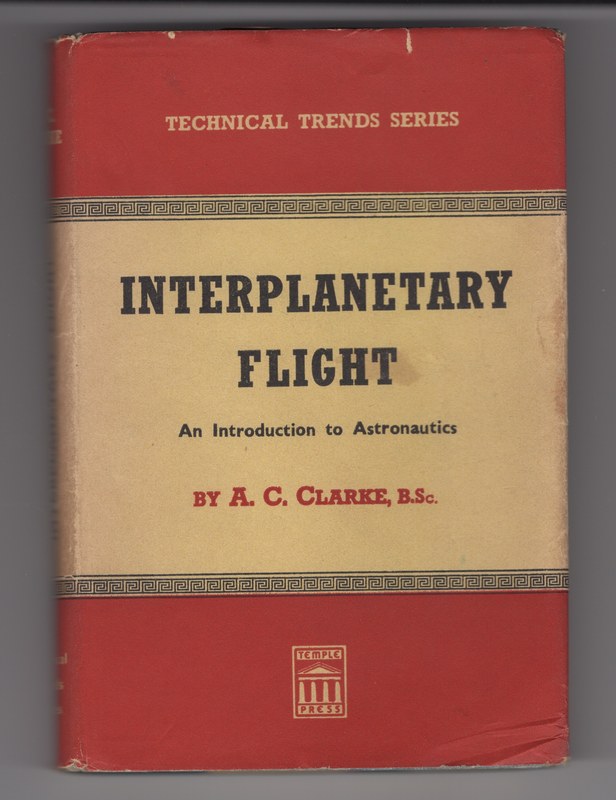
Interplanetary Flight An Introduction To Astronautics.
Clarke's first book of nonfiction, written while he was assistant secretary of the British Interplanetary Society. In the Preface he states this is the first English-language book to develop the theory of astronautics in any detail, deliberately taking the astronomer's rather than the engineer's approach and relegating the mathematics to an appendix, and thanks A. V. Cleaver for critically reading the manuscript. Chapters work through escape by rocket, the Earth-Moon journey, interplanetary flight proper, and the atomic rocket, including the solid- and gaseous-core nuclear reactor schemes that Cleaver and L. R. Shepherd had proposed as an alternative to chemical propellants. The plates illustrate the BIS's 1949 multi-stage "expendable" spaceship design and H. E. Ross and R. A. Smith's rotating wheel space station, early technical concepts that anticipated the space-station imagery later popularized by the von Braun/Collier's series and, eventually, 2001: A Space Odyssey. First printing, with the dust jacket showing "B.Sc." after Clarke's name; later printings would add his FRAS title. The book belongs to Temple Press’s Technical Trends Series and carries fifteen plates plus a frontispiece, a U.S. Navy photograph of the Earth from a height of 57 miles.
 Featured
Arthur C. Clarke
›
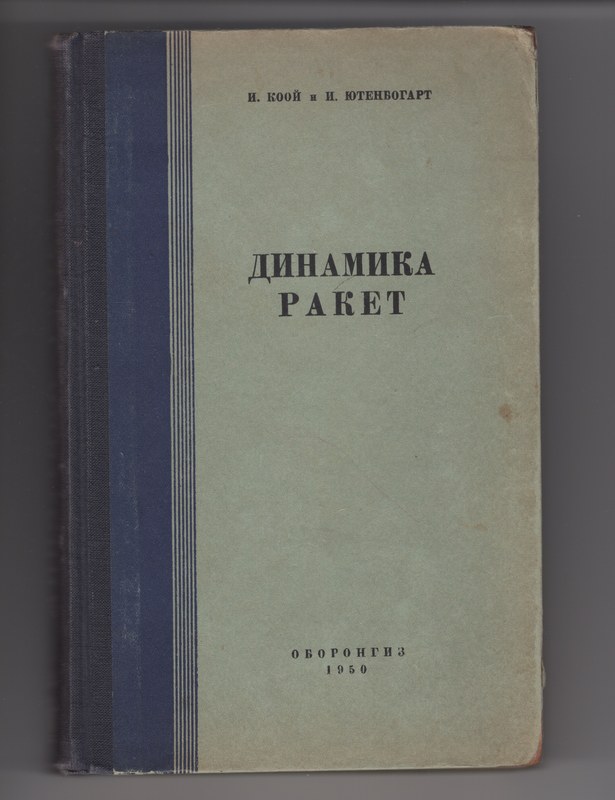
Dynamics Of Rockets.
Russian edition of “Ballistics of the Future.” Translated from English by Rubashov. Edited by A. A. Kosmodemyansky.
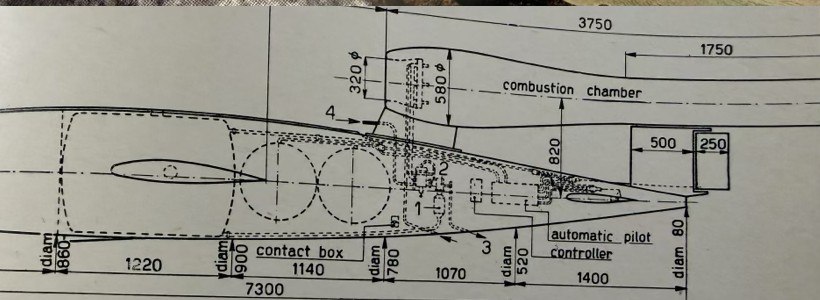 Featured
Ballistics of the Future. Three Editions.
›
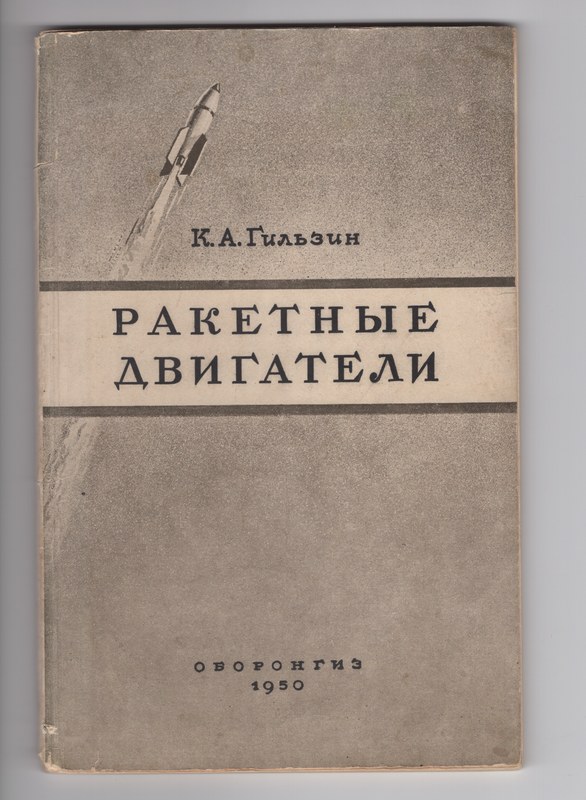
Rocket Engines.
A popular introduction by a Candidate of Technical Sciences, with a Tsiolkovsky portrait as frontispiece. Its five chapters cover the principle of direct reaction, thrust, power and efficiency, solid-propellant (powder) engines, and liquid-propellant engines, with a section on Tsiolkovsky’s work and on fuels. It closes with a chapter on the future of rocket engines. The introduction opens with the March 1946 Supreme Soviet session on the postwar five-year plan. Gilzin reissued it in 1954 as From Rocket To Spacecraft, also in this catalog.
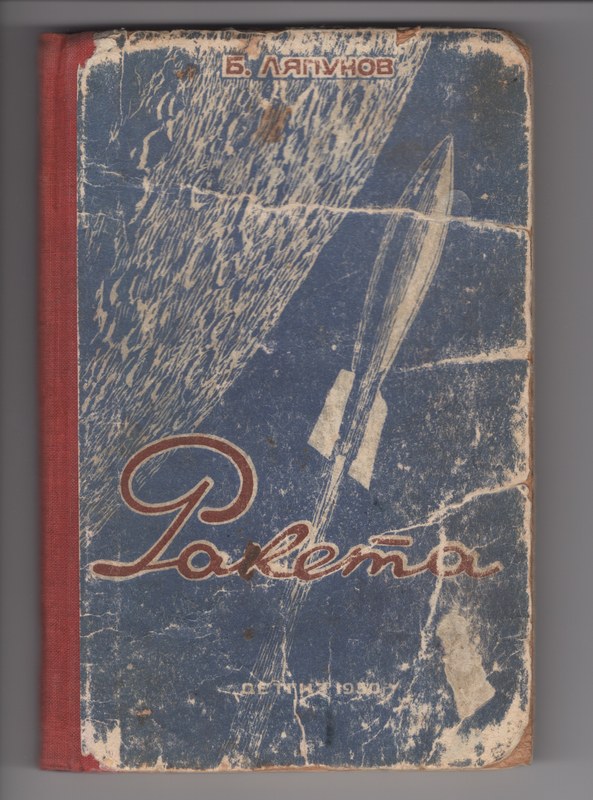
Rockets.
A youth book in Detgiz’s School Library series, with cover and drawings by N. Kolchitsky and technical drawings by A. Katkovsky. The preface presents jet engines and rockets as a proud Russian achievement, crediting Konstantinov, Kibalchich, Tsiolkovsky, Tsander and others. Nine chapters trace the rocket, its history and its creators, the new rocket and the rocket projectile, new aircraft engines, “a thousand kilometres an hour” jet flight, the conquest of altitude, and the conquest of interplanetary space, where the author describes light-sail propulsion and aerobraking. The conclusion reproduces Tsiolkovsky’s 1935 letter to Stalin and the reply, and calls on young readers to prepare for careers in rocketry. Liapunov’s earlier Rocket (1948, Catalog C) from the same publisher is also in the collection.
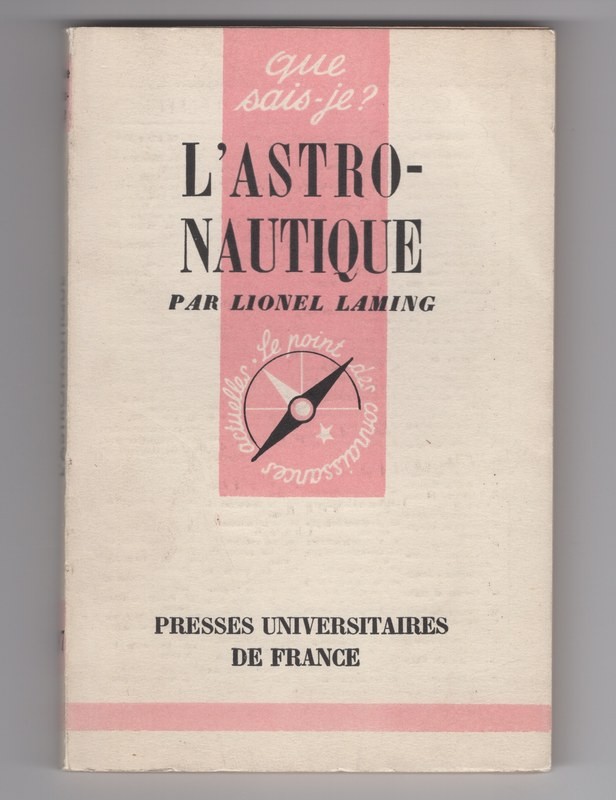
L'Astronautique.
A non technical book introducing Astronautics to the general reader with discussions of physical and physiological aspects of space flight, propulsion, and navigation. Includes report on Nikolai Rynin’s experiments on acceleration with animals.
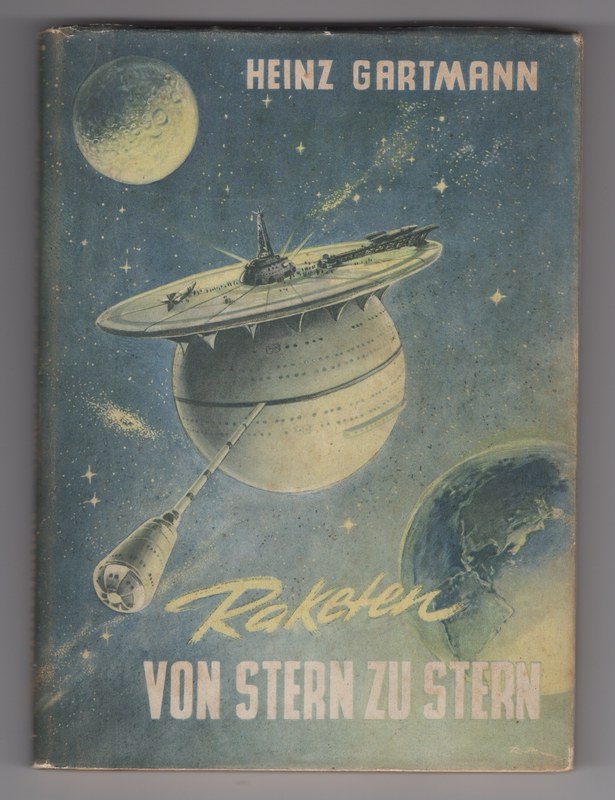
Raketen Von Stern Zu Stern.
A popular account of rocket propulsion and future spaceflight, framed as running conversations with a skeptical layman friend, “Jackele,” who tours a rocket test stand and imagines journeys to the Moon, Mars, and Venus. Carries a foreword (Geleitwort) by Hermann Oberth. This copy is the second printing (Zweite Auflage) of the 1949 Lot-Verlag edition. Inscribed by A. E. Slater (Munich, 1 July 1951), who went on to serve on the British Interplanetary Society’s postwar Council alongside Val Cleaver, Leslie Shepherd, and Ralph Smith. Gartmann — editor of Weltraumfahrt and publisher of von Braun’s Das Marsprojekt at Umschau Verlag, and later author of the foreword to Oberth’s The Moon Car — is represented elsewhere in the collection by those items.
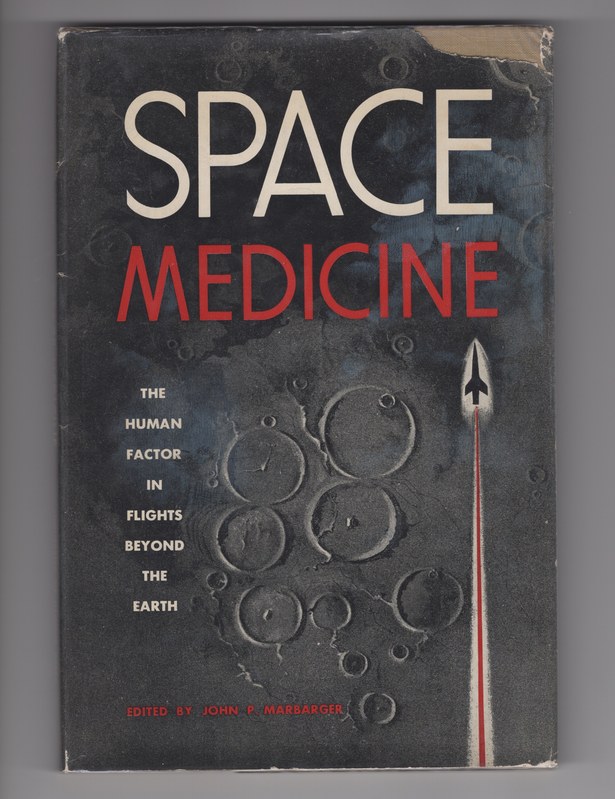
Space Medicine.
Grew out of a space-medicine symposium held at the University of Illinois College of Medicine, Chicago, on March 3, 1950. Contains Wernher von Braun's first article in English, "Multi-Stage Rockets and Artificial Satellites," which lays out a three-stage ferry ship, a rotating wheel-shaped space station, and a lunar-flyby trajectory departing from and returning to that station. Also includes Harry Armstrong's account of founding the USAF Department of Space Medicine and Heinz Haber's essay linking astrophysics (solar radiation, flares, the corona) to the hazards of space flight. Armstrong recruited Haber during Project Paperclip. Another book by Haber (1953) is also available in the collection.
The Assisted Take-Off Of Aircraft.
Survey of methods to assist aircraft during take off. Describes catapults and rocket-assisted take-off for military and commercial applications. First edition, wraps. Admiral Bolster was a key figure in the Navy's JATO program in the 1940s.
 Featured
The Assisted Take-Off of Aircraft
›
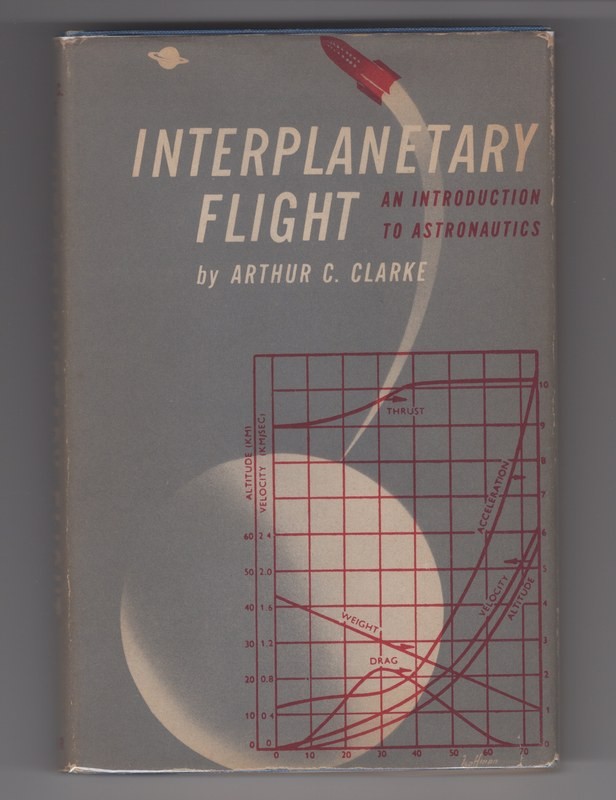
Interplanetary Flight An Introduction To Astronautics.
Contents are identical to the British edition (1950) that is also available in this collection.
Featured
Arthur C. Clarke
›
Hochfrequenztechnik Und Weltraumfahrt.
Articles on electronics and space travel.
200 Miles Up.
200 Miles Up: The Conquest of the Upper Air, by J. Gordon Vaeth, aeronautical engineer at the U.S. Navy Special Devices Center, Office of Naval Research. Copyright 1951 by the Ronald Press Company; dedicated to Joanne Corell Vaeth. The Preface calls it a non-technical but strictly accurate summary of high-altitude research by rocket and plastic balloon, with illustrations some of which had never been published, and conducts the reader step by step through the firing of a V-2. Vaeth’s acknowledgments thank the Navy, the Air Force and the Department of Defense Office of Public Information for security clearance of the manuscript and illustrations. Eleven chapters run from “The Upper Atmosphere—A Frontier of Scientific Exploration,” “The Atmospheric Ocean,” “Upper Air Research Instruments” and “Vehicles for Upper Air Research” through “Project Skyhook—Upper Air Research by Balloon,” “The White Sands Proving Ground” and “Principles of Rocket Flight,” to the V-2 (“Inaugurator of Modern High Altitude Rocketry” and “How a V-2 Is Fired”), “The High-Flying Aerobee,” and “The Viking—Latest Upper Air Research Vehicle.” It closes with indexes of subjects and names. Photographs and drawings show the rocket installations, instrument payloads and cloud photographs taken from altitude. The Viking chapter anticipates Milton Rosen’s The Viking Rocket Story (1955), also in this catalog, and Krause’s V-2 research report (Catalog C) covers the same V-2 Panel work.
The Problem Of Interplanetary Voyages In The Works Of Native Scientists.
Collection of works from Russian scientists edited by Liapunov.
Raketenflug Ins Weltall.
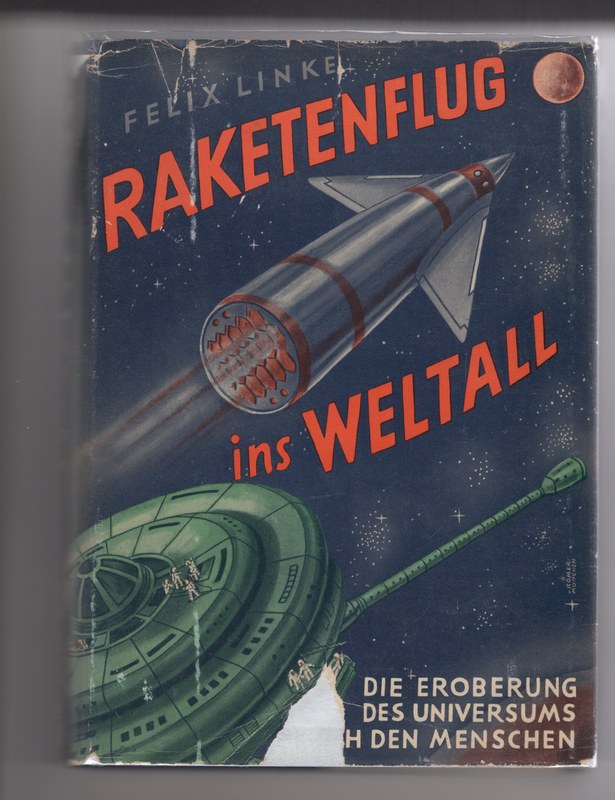
A popular but technically grounded account of the road to the planets, subtitled Die Eroberung des Universums durch den Menschen, “with 150 pictures in the text and on 16 plates.” The book is dedicated to Hermann Oberth “in cordial veneration” and opens with a Faust epigraph; the preface is signed Munich, November 1952, and the copyright page gives 1952, with jacket and binding by B. and R. von Römer, text drawings by Günther Burgfeld, Heinz Gellert, Julius Schmidt and Erich Schülzke, and printing by G. Franz’sche Buchdruckerei G. Emil Mayer. The jacket flap singles out von Braun’s Mars project as the kind of discussion the lay reader wants to follow on a factual footing. The first part, “Die Grundlagen,” teaches the physics through questions: how to build an artificial moon, Kepler ellipses, weightlessness and artificial gravity, friction, and why Jules Verne’s gun-fired passengers would not survive. A section on curious launchers revisits the solenoid gun, the pneumatic-tube plan and Ulinski’s electron rocket, all also treated in Linke’s 1928 Das Raketen-Weltraumschiff (Catalog A). Conic sections, escape velocity, the path of a moon rocket, and the biological effects of acceleration follow. “Die Rakete” covers Goddard’s powder rocket and Oberth’s liquid rocket, steering, landing, travel schedules to Venus and Mars, propellants, atomic and electric rockets, and recent American sounding-rocket ascents. Closing chapters weigh rocket against aircraft, an hour’s flight to the antipodes, a space observatory, cosmic radiation, and a “Résumé of a rocket engineer.” Plates show rockets on the stand and aircraft and spaceship cutaways.
Rockets Beyond The Earth.
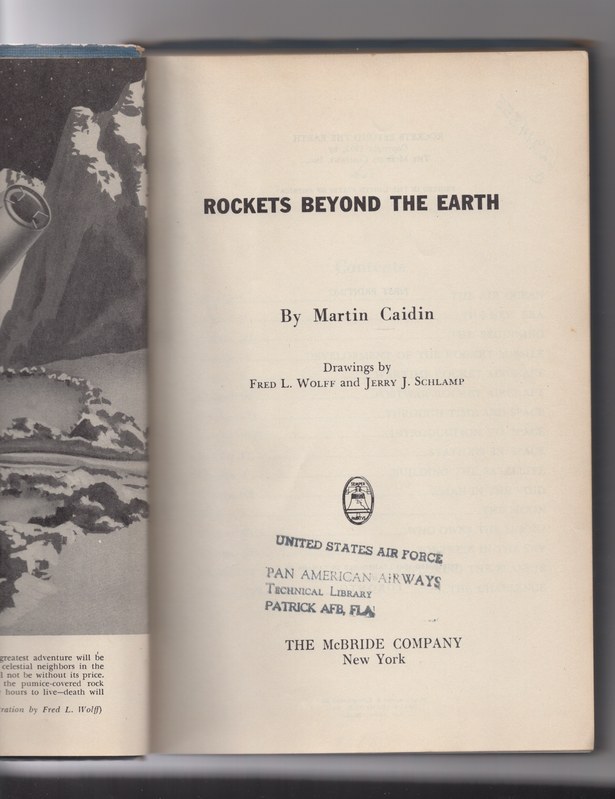
Martin Caidin’s first space-flight survey, copyright 1952 by The McBride Company, New York, with the imprint line “First Printing” and simultaneous Canadian publication by McClelland & Stewart, Toronto; photolithoprinted by Braun-Brumfield, Ann Arbor. Drawings are by Fred L. Wolff and Jerry J. Schlamp, and the Acknowledgment thanks, among others, James L. H. Peck for technical advice, Lt. Col. Clair E. Towne, U.S. Army, for photographs, Lt. Col. C. B. Whitehead of Air University, and Frank Forrester of the Hayden Planetarium. Sixteen chapters run from “The Air Ocean” and “The New Era” through “The Beginning,” “Development of the Rocket Missile,” and chapters on wartime and postwar rocket aircraft, to “Through Time and Space,” “Introduction to Space,” “Stations in Space,” “Building the Satellite,” “Man in the Void,” “The Moon,” “Who Owns the Moon?,” “Fortress in the Sky,” “Exploring the Planets,” and “The Challenge.” The wartime section narrates the German Me 163 Komet in action against B-17 and B-24 formations and the vertical-launch Bachem Ba 349 Natter, shown in a Schlamp drawing with its caption noting the pilot was killed on the only test flight. Photographs and drawings run throughout, including rocket launches, rocket aircraft and spaceship concepts. This copy is ex-library, stamped “United States Air Force, Pan American Airways, Technical Library, Patrick AFB, Fla.,” on the title page and inside the rear board, with shelf marks and accession numbers in ink.
A Rocket Drive For Long Range Bombers.
Hamermesh, M. (Translator) The first commercially available translation of Über Einen Raketenantrieb Für Fernbomber (1944). Before this translation, only the translation from the Navy was available.
 Featured
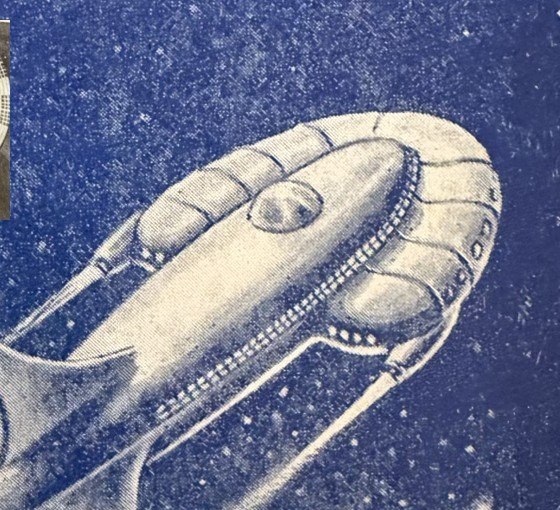
Visions of the Space Station and the Rocket Bomber
›
L’Astronautica.
The first Italian edition of Ananoff’s encyclopedic L’Astronautique (French, 1950, also in this catalog), translated by Armando Silvestri and issued in Garzanti’s Piccola Biblioteca Scientifica. Eight parts and 26 chapters of about 460 pages cover the astronaut’s vehicle, life and temperature control in a limited space, trajectories and durations of interplanetary journeys, free-fall and constant-acceleration flight, relativity, and a closing “defense of astronautics.” Printed 20 March 1952.
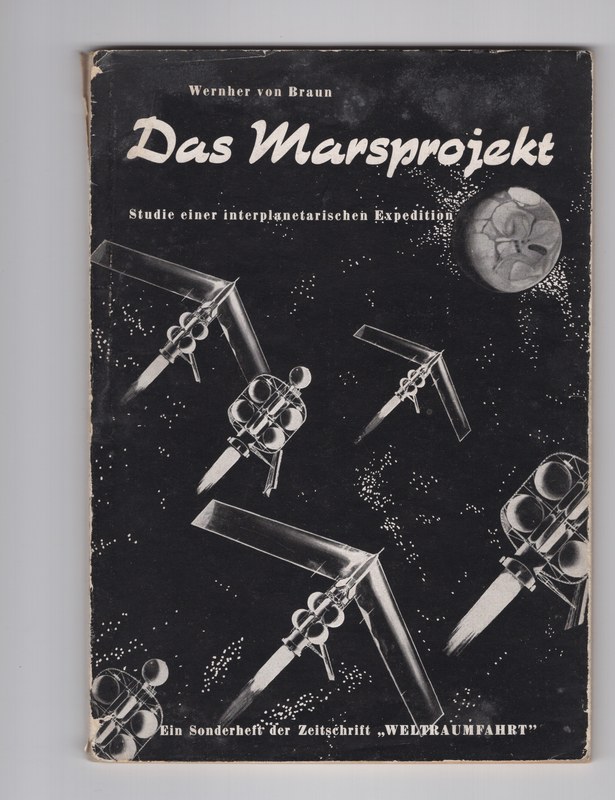
Das Marsprojekt.
Von Braun’s engineering study for a Mars expedition of ten ships and seventy crew, relying on conventional chemical propellants (hydrazine and nitric acid) rather than speculative nuclear drives: three-stage ferry rockets to assemble the fleet in Earth orbit, the interplanetary vessels themselves for the outbound and return legs, and wingless landing boats for three of the ten ships to reach the Martian surface. Von Braun wrote it in 1948–49 at Fort Bliss, Texas, as the technical appendix to an unpublished science-fiction novel; unable to place the appendix with a publisher on its own, he saw it appear instead as a Sonderheft (special issue) of the journal Weltraumfahrt, edited by Heinz Gartmann for Umschau Verlag — the same magazine, publisher, and year as the collection’s run of Weltraumfahrt issues, also in this collection. An English translation followed in 1953 as The Mars Project (University of Illinois Press).
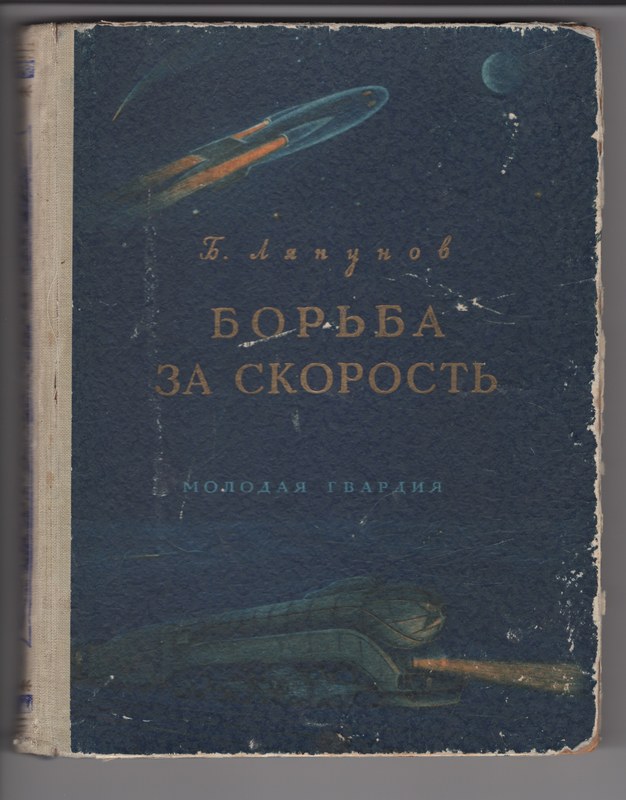
Struggle For Speed.
A popular-science survey of the technology of high speed for young readers, in eleven sections: the birth of materials, victory over metal, the enemies of fast machines, thousands of revolutions per minute, the assault on the sound barrier, “Cosmic Flight,” the conquered electron and the world of automata. The sections run from jet aircraft and turbines to electronics and automation, with a fold-out plate of an automated factory. The rocket material is the 24-page chapter “Cosmic Flight” (pp.140–163). It opens at Tsiolkovsky’s memorial obelisk in Kaluga and explains orbital and escape velocities, then the fuel problem: Kondratyuk’s figure of 55 times the rocket’s weight, and Esnault-Pelterie’s view that only atomic energy would do (his L’Astronautique of 1930 is in this collection). It answers with Tsiolkovsky’s rocket train and a “squadron” of 512 rockets transferring fuel in flight, then turns to the stratospheric research rocket, the artificial satellite and the space station. The chapter closes by contrasting these peaceful aims with the American film Destination Moon and what it calls imperialist military designs. Drawings by A. Katkovsky, color plates by A. Orlov and L. Vladimirsky, cover and title page by M. Bolshakov; edited by V. Pekelis. Signed to press 2 October 1952, in an edition of 50,000 copies. The author thanks M. K. Tikhonravov among others.
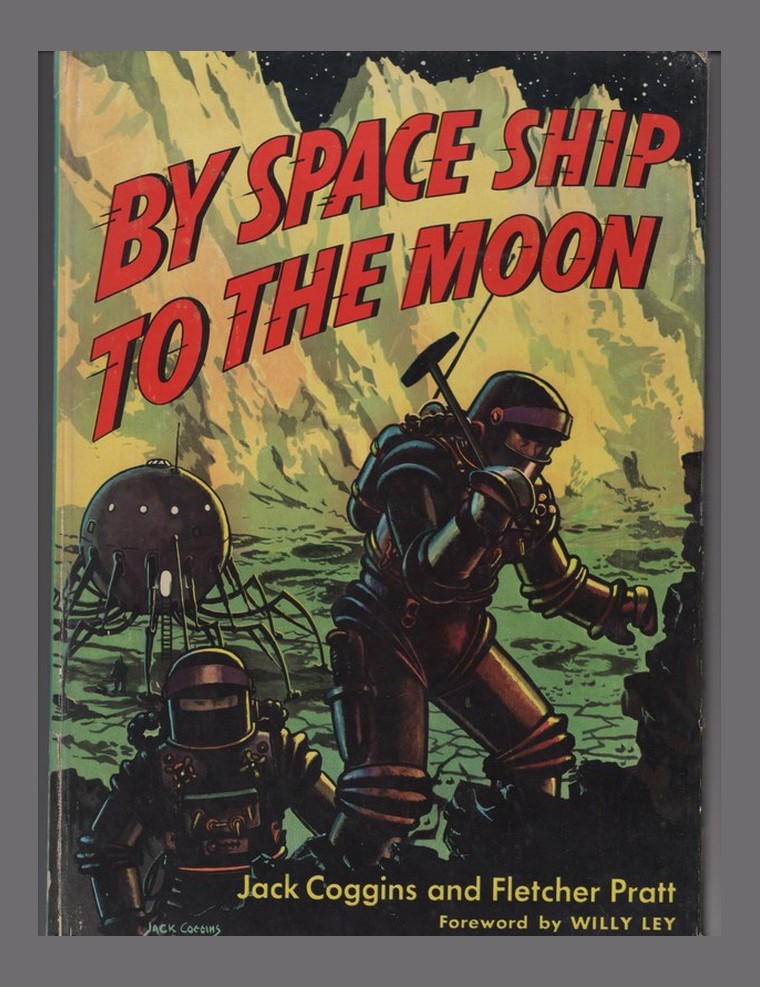
By Space Ship To The Moon.
A young reader’s picture book of the trip to the Moon, illustrated by Coggins in color and black and white, with an introduction by Willy Ley. It opens with “Who Pays For It?” and walks through the supply ship, the space station, building and launching the Moon ship from “Project X,” the voyage, and the explorers’ Moon base, including its air supply and later uses. Like Across the Space Frontier (also 1952), it makes the space station the first step toward the Moon.
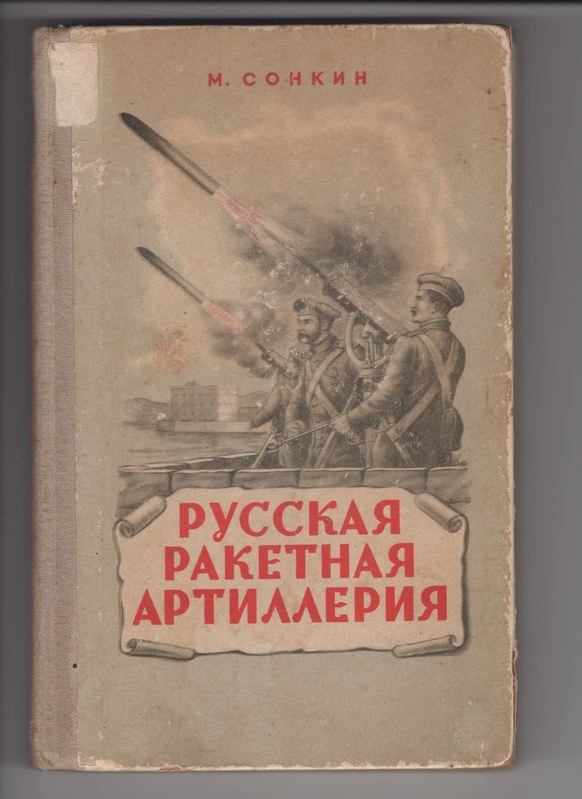
Russian Missile Artillery.
Subtitled Historical Essays and written for Soviet Army soldiers, sergeants and officers as well as general readers. Most of the book is about artillery, with the rocket material at its core: nine chapters follow Russian military rockets through the 18th and 19th centuries, including Zasyadko’s rocket designs, Congreve’s “commercial secrets” (a facsimile of his rocket manual is in Catalog E), the Russo-Turkish war of 1828–29, the Crimean War and Caucasus expeditions, K. I. Konstantinov’s electro-ballistic pendulum, and V. V. Nechaev. Rockets used underwater and for coastal defense are also covered. This is the revised and enlarged second edition.
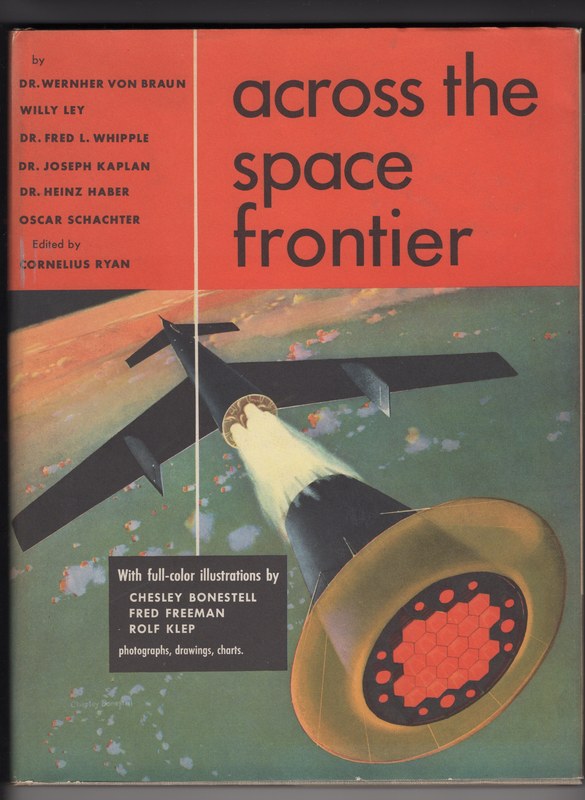
Across The Space Frontier.
Long-format version of the Collier’s symposium “Man Will Conquer Space Soon!” (22 March 1952), expanded with more text and illustrations by Bonestell, Rolf Klep and Fred Freeman. Chapters by Joseph Kaplan, Wernher von Braun (“Prelude to Space Travel,” the three-stage rocket and the wheel-shaped space station), Heinz Haber (“Can We Survive in Space?”), Willy Ley, Oscar Schachter on space law and Fred Whipple. Von Braun and Haber were both brought from Germany by the U.S. government under Project Paperclip: von Braun in 1945 with the V-2 team, then at the Army’s Redstone Arsenal; Haber in 1946–47 (the jacket says 1947), working in the Air Force’s space medicine program before moving to UCLA. Haber’s own Man in Space (1953) is also in this catalog.
Featured
Visions of the Space Station and the Rocket Bomber
›
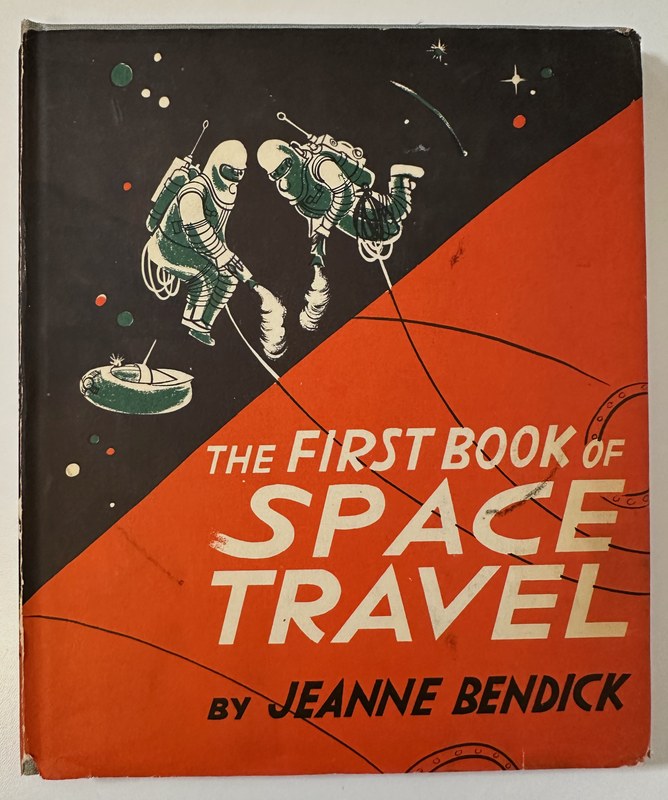
The First Book Of Space Travel.
Written and illustrated by Bendick for young readers, with Hal Goodwin, author of The Real Book of Space Travel (also in this catalog), thanked as space consultant and Hugh S. Rice of the Hayden Planetarium for reading the manuscript. It opens by telling children that many scientists expect people to be traveling in space within about twenty years, then moves from what and where space is, through how a rocket works and a space rocket’s design, to weightlessness, the space wardrobe, work in space, a space platform and station, the Moon, Venus and other destinations, and the return to Earth. Illustrated throughout in stylized orange, green and black; the dust jacket flaps carry a “space wardrobe” illustration. This copy is the fourth printing of the 1953 first edition.
Teleskope, Raketen, Gestirne.
A popular survey in three parts—telescopes, rockets and stars—by Werner Büdeler, issued as Volume IV of Verlag Paul Müller’s general-interest series Die Welt von Heute. Illustrations and jacket were by Fritz Irmhof. The frontispiece epigraph is Raymond B. Fosdick’s remark at the dedication of the Palomar Observatory. Teleskope (pp. 7–123) tours the great observatories and the astronomy done with them, from Mount Wilson to the Palomar giant. Raketen (pp. 125–183) opens with a look behind the scenes and an interview, then covers rockets at the threshold of space, the recoil principle, a visit to a rocket test field, a conversation with a skeptic, artificial satellites, the human factor, the cold of space, navigation between the stars and atomic propulsion. Gestirne (from p. 185) turns to life elsewhere in the universe, the Moon and the planets. This copy is a book-club issue: a pasted label on the front endpaper reads “Sonderausgabe” (special edition) for Freunde der Weltliteratur, Lesergemeinschaft GmbH, Hamburg, Bielefeld and Stuttgart. The yellow cloth boards are lettered in black; there is no dust jacket.
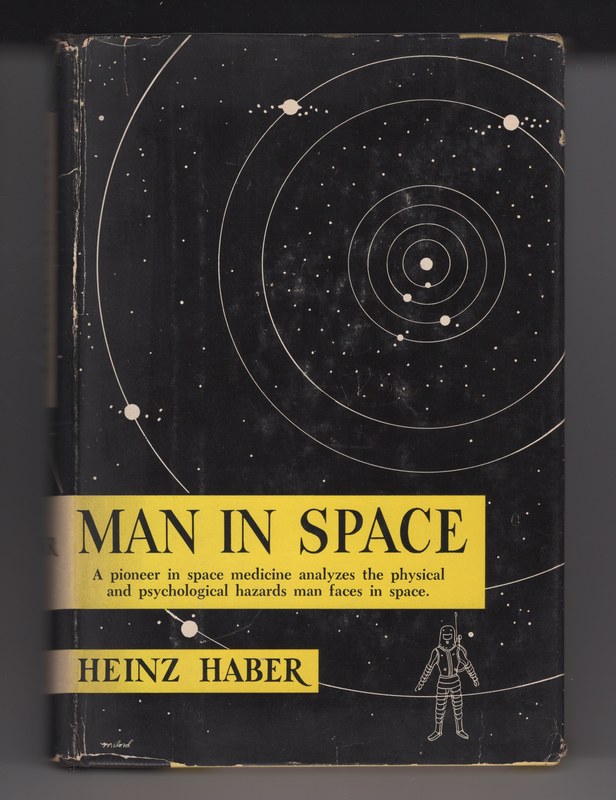
Man In Space.
Haber's popular-science study of the physical and psychological hazards of spaceflight, illustrated by Jerry Milord. Draws technical details and drawings of Wernher von Braun's three-stage rocketship, space station, and space suit from the 1952 Collier's symposium on space travel and Across the Space Frontier. Quotes von Braun, developer of the German V-2 rocket, arguing that chemically propelled multi-stage rockets, not atomic drives, are the realistic near-term path to orbit, and models the g-forces of a three-stage ascent on the V-2's own acceleration profile.
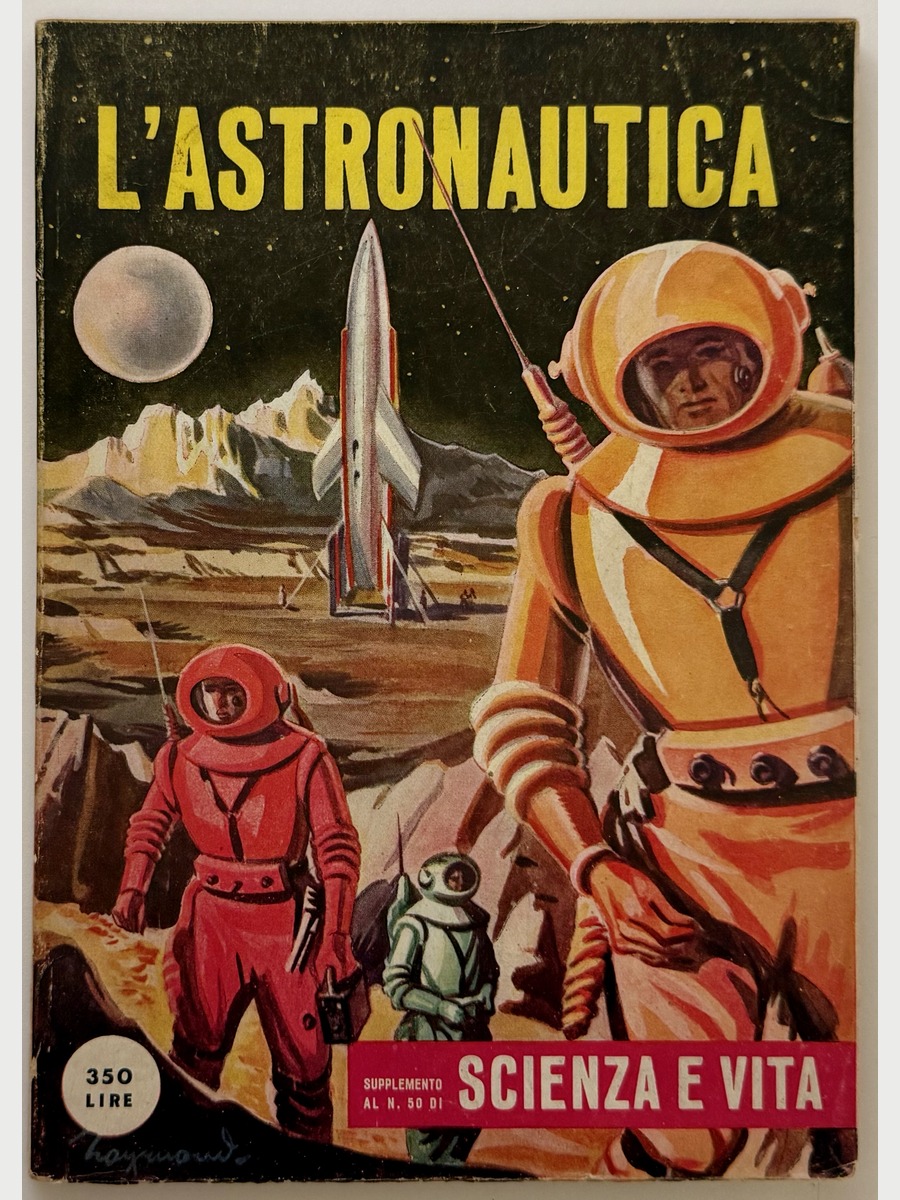
L’Astronautica.
A 160-page special number issued as a supplement to no. 50 of the Rome popular-science monthly Scienza e Vita and edited by Ignazio Contu, with contributions by Alexandre Ananoff and a group of French and Italian astronomers and engineers. Its preface argues that space travel has moved from speculation to engineering thanks to the wartime progress of rockets, predicts a lunar expedition within a generation and an artificial satellite within 10 to 15 years, and notes that astronautics has already held three international congresses. The chapters cover extraterrestrial journeys and the solar system, the history of astronautics from Daedalus and Icarus through Tsiolkovsky, Goddard, Oberth and Valier, conditions in interplanetary space, the Moon and planets, a thousand years of rocket history from the V-2 and the American WAC Corporal to multi-stage rockets and an Italian rocket association, rocket propulsion and fuels, a nuclear-powered spaceship, whether people can live aboard a space vessel (with a cutaway cabin drawn after Ananoff), and artificial satellites. It is lavishly illustrated with drawings, diagrams and photographs, and its cover shows spacesuited explorers on the Moon beside a landed rocket. Also in the collection: Ananoff’s L’Astronautica (Garzanti, 1952).

V-2.
Account of the development of the V- weapons by the head of the Peenemünde rocket station.
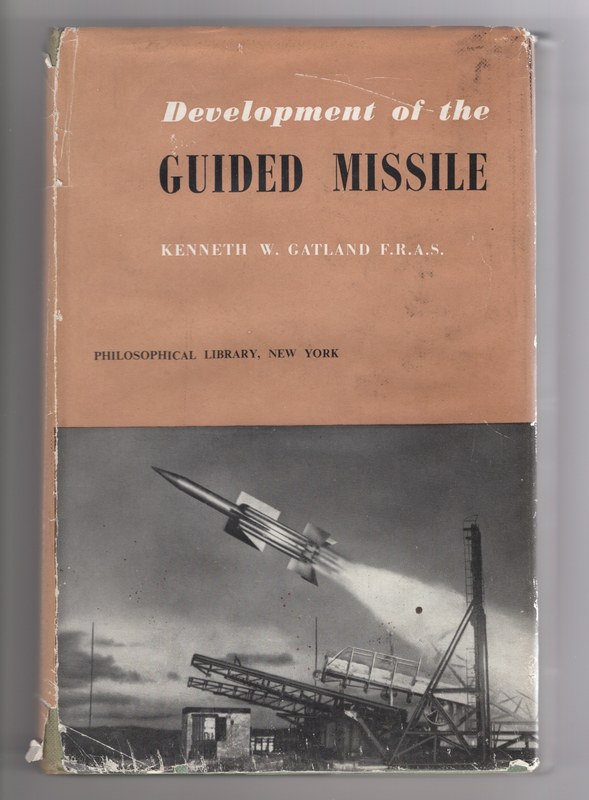
Development Of The Guided Missile.
Second, completely revised and enlarged edition of Kenneth W. Gatland’s survey, published for Flight magazine by Iliffe & Sons, London, with the New York imprint of the Philosophical Library on the title page (over 100 illustrations). The Author’s Preface is dated July 1954 at Whitton, Middlesex, and explains that the first edition of 1952 had grown out of a series of articles in Flight. The Foreword, dated June 1952, is by Air Chief Marshal Sir W. Alec Coryton, Chief Executive (Guided Weapons) at the Ministry of Supply in 1950–51. The jacket describes Gatland as an aircraft design engineer and a founder-member of the British Interplanetary Society. The Introduction deals largely with Britain’s vulnerability to air attack in the Atomic Age. Nine chapters follow: Propulsion; Research and Development; The New Armament; Air-to-Air Missiles; The Guided Bomb; Problems of the Long-Range Missile (including an evaluation of Soviet missile potentialities); Rockets for High-Altitude Research; Space-Satellite Vehicles; and Interplanetary Flight. The first three of these (propulsion, research and development, and the guided bomb) are new to this edition, and the Preface notes that British projects could not be discussed because of Ministry of Supply security restrictions. Three appendices cover telemetering systems (made possible by declassified Ministry of Supply material), notable missiles compared in scale photographs of over 40 rockets, and a table of significant powered missiles that now covers about 140 rockets from eight countries. A bibliography and index close the volume. The first frontispiece shows the Corporal surface-to-surface missile being prepared for launching, and the jacket shows a missile rising from a launcher.

Menschen Im Weltraum.
An introduction by Dr. Wilhelm Meyer-Cords (Düsseldorf, December 1954) traces Oberth's career from his 1923 Die Rakete zu den Planetenräumen through his 1929 Wege zur Raumschiffahrt (also in this collection) to the Bumper-WAC rocket's 403 km flight of February 1949, and cites Heinz Gartmann's Oberth biography Träumer, Forscher, Konstrukteure — Gartmann, also represented in this collection, later wrote the foreword to Oberth's The Moon Car (also here). Across eight chapters Oberth surveys satellite rockets, including an unmanned three-stage design he proposes for carrying rhesus monkeys on a 60-day orbital research flight; types of space stations; a wire-mesh space mirror (Weltraumspiegel) for redirecting sunlight to Earth; electric spacecraft; and, in Chapter 7, the jumping, compressed-air-legged “Mondauto” that Oberth expanded five years later into the standalone The Moon Car. From the library of Heyward E. Canney, Jr., represented elsewhere in the collection.
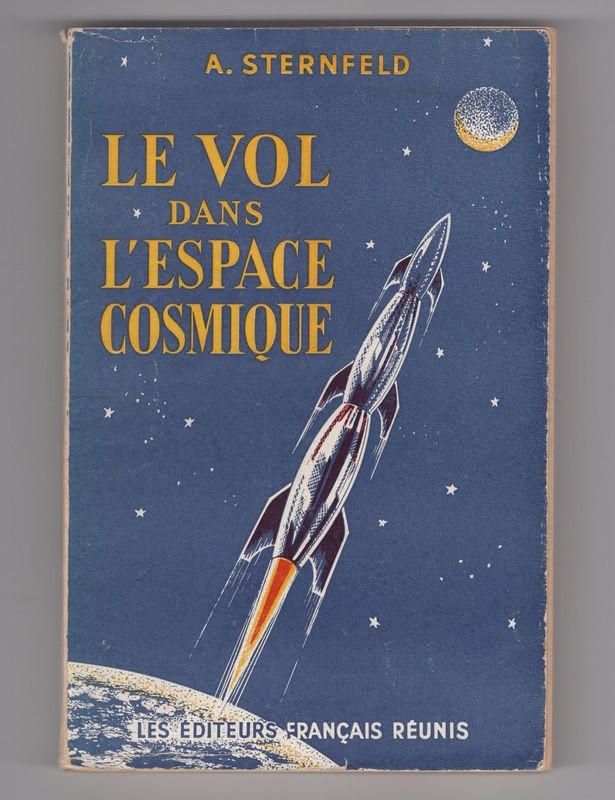
Le Vol Dans L'Espace Cosmique.
Introduction to astronautics. Probably a French edition of “Flight into Universal Space” (1949) also available in this collection. Illustrated, wraps.
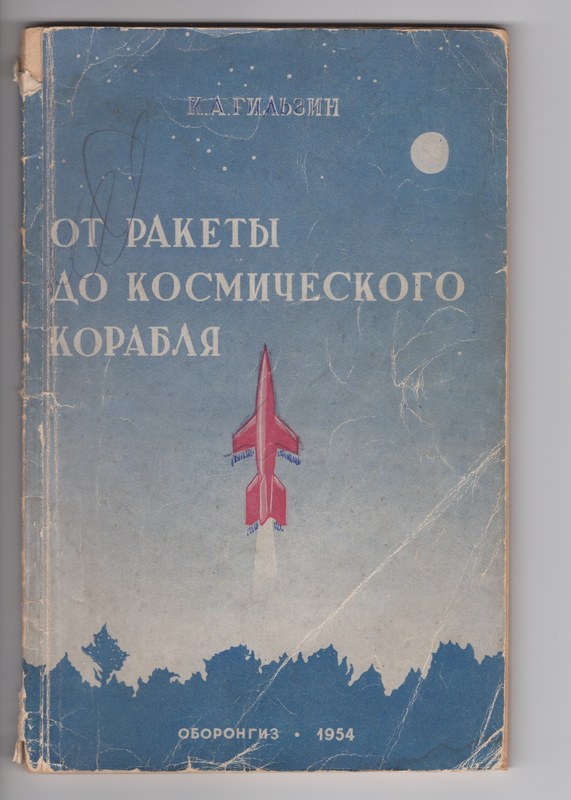
From Rocket To Spacecraft.
The second, revised edition of Gilzin’s 1950 Rocket Engines, retitled and expanded from five chapters to six, in a printing of 50,000. The new chapter covers new propellants, engine improvements and staged rockets, and the final chapter on the future treats ultra-long-range flight, interplanetary travel and atomic rocketry. Tsiolkovsky’s portrait again serves as frontispiece. The first edition is also in this catalog.
Rocket Exploration Of The Upper Atmosphere.
Review of sounding rocket results. Includes a section on rocket techniques.

Forschung Zwischen Luftfahrt Und Raumfahrt.
Signed and inscribed by Sänger on the front wrapper, in blue ink, to Dr. L. R. Shepherd, President of the British Interplanetary Society, “with kindest regards from the author.” The title page credits Sänger as lecturer in rocket propulsion at the Technische Hochschule Stuttgart and first president of the International Astronautical Federation. The minutes of the First International Astronautical Congress (Paris, 1950), where he was elected provisional president, are in the collection (see the First Astronautical Congress feature). The verso states “Erste Auflage / Ausgabe 1954,” published and printed by Verlag Walter Pustet, Tittmoning/Obb. Part A, “Zur Lage der Raumfahrt,” is a programmatic essay on the motives for spaceflight, its fields of work (promotion, research, engineering, practice), the two technical paths to it, and the tasks of the International Astronautical Federation, with an organization chart (Tafel 3) linking industry, aviation authorities and UNESCO to a proposed International Academy for Space Research. Part B, “Angewandte Forschung zwischen Luftfahrt und Raumfahrt,” surveys the uses of jet propulsion from piston and turbine engines through ramjets, solid and liquid rockets to thermal atomic and photon rockets, and sets out a research program in problems of the first to fourth order. A drawing of a supersonic ramjet transport (Abb. 5) shows the sectioned fuselage with pilot space and heating grid. The back matter carries Pustet advertisements, including one for Koelle and Kaeppeler’s Literaturverzeichnis der Astronautik / Literature-Index of Astronautics, 1,633 titles arranged according to Sänger’s proposed 999-point classification of space research.
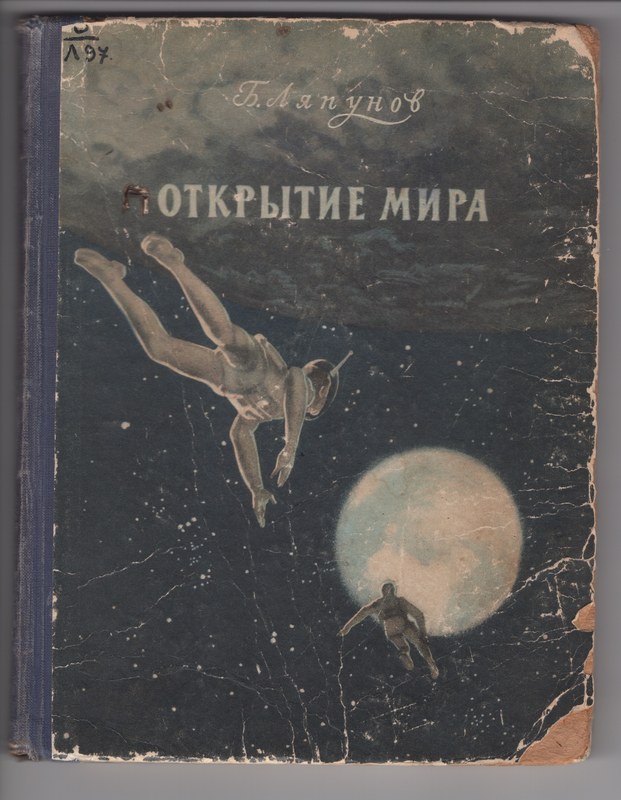
Discovering The World.
A popular-science book for young readers on spaceflight and the planets. The unsigned preface presents it as a book that teaches the reader to dream the way Tsiolkovsky did, with fantasy checked by scientific calculation, and contrasts Soviet optimism with the pessimism of Western writers such as Wells. Twenty-eight short chapters fall into six parts: the Earth’s hold (rocket trains, energy sources, atomic power), high-altitude research and stratospheric jumps, rocket flight (acceleration, weightlessness, the three dangers, the spacesuit, radio waves), the artificial satellite and space station, the Moon, Mars, Venus and the giant and dwarf stars, and the road to the stars. A bibliography of popular literature closes the book, listing Liapunov’s own Stories About Rockets and Kooy and Uytenbogaart’s Dynamics of Rockets, both in this collection. Illustrated with seven color plates and black-and-white text drawings; cover and plates by N. Grishin, text drawings by Grishin and V. Noskov, edited by V. Pekelis. Signed to press 15 October 1954, in an edition of 90,000 copies. The second edition (1956) is also in the collection. It reprints the first edition’s text and illustrators, with the same chapters, and contents references that run one page later in three places. It was signed to press on 3 January 1956 in 75,000 copies, noted as printed from matrices, and its acknowledgments page now calls M. K. Tikhonravov an engineer-colonel where the first edition names him a candidate of technical sciences. Liapunov’s earlier Rocket (1948, Catalog C) and Rockets (1950) are also here.
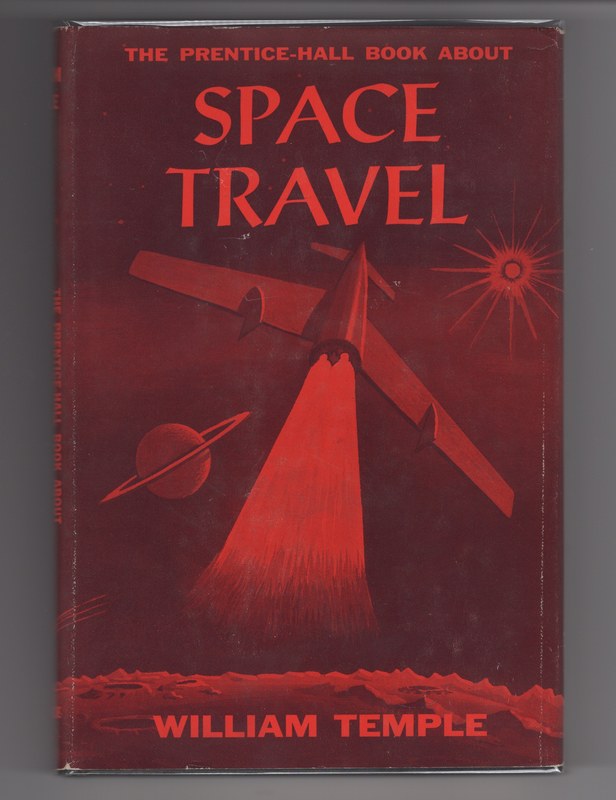
Space Travel.
The first U.S. edition of William Temple’s introduction to space travel, issued as The Prentice-Hall Book About Space Travel and illustrated with black-and-white drawings by Harry Billings. The British edition (The True Book About Space Travel) was adapted here with minor changes to suit American readers; the book is dedicated “For Cliff.” Twelve chapters run from “The Flying Carpet” and “The Squib Grows Up” through “The Man-Carrying Rocket,” “Between Heaven and Earth,” “Is Anybody Home?” and “The Atomic Space-Ship” to “To Be a Spaceman,” “Brush Up Your Martianese!” and “A Letter from Tomorrow.” The jacket promises the story from the Chinese invention of the rocket around 1200 A.D. to the German rockets of WWII and the space ships of the future, with sections on flying saucers, the Moon and space-suits, radio-astronomy, the possibility of life on other planets, and where space stations will be located. The jacket describes Temple as an authoritative writer on interplanetary flight in England, one of the earliest members of the British Interplanetary Society and at one time editor of its Journal, as well as a science-fiction author. The Society’s Arthur C. Clarke, whose Interplanetary Flight is also in this catalog, belonged to the same circle.
L’Aeroplano.
Survey of aeronautics. This fourth edition is interesting because it has a new section with an introduction to astronautics (two chapters).
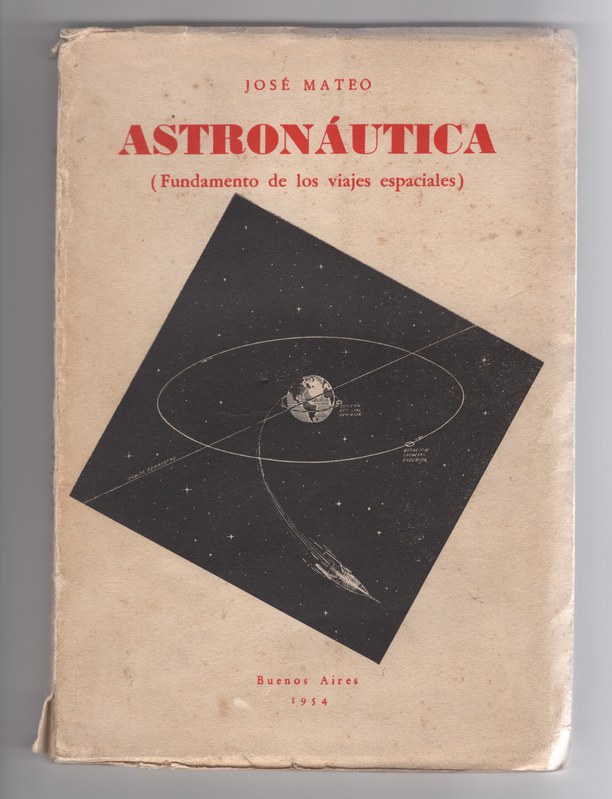
Astronáutica (Fundamento De Los Viajes Espaciales).
A rigorous but non-fiction introduction to space flight by the Argentine engineer José Mateo, formerly geophysicist and professor at the Astronomical Observatory of the National University of La Plata (then styled “Eva Perón”). The wrapper cover reads Buenos Aires 1954 and the colophon records that printing was finished on 21 December 1954 at Talleres Gráficos Domínguez, Bignone y Cía., while the title page is dated 1955. The Prologue is by Prof. Carlos María Ramos Mejía, and the wrapper flap carries a portrait and biographical note on the author, written by the publisher. Mateo states in the Introduction that astronautics is a matter of rational mechanics and applied astronomy, and warns readers to expect no novelistic tale. Eight chapters and forty numbered sections run from the principles of mechanics (gravity, escape velocity, action and reaction) through first solutions (exhaust velocities, the stepped rocket), weightless bodies, orbits and Kepler’s laws, the voyage to the Moon via space stations and transfer orbits, life aboard a space station, and interplanetary voyages to Mars and Venus, closing with “Ciencia y técnica.” The text is supported by numerous mathematical tables, orbit diagrams and a few photographic plates. The publisher notes at the end that Mateo was preparing another work, Ave Fénix, a memoir of his scientific life.
Flight Into Space: The Facts, Fancies and Philosophy.
Popular account of the coming space age by Time magazine’s science editor, from guided-missile test firings to the prospect of orbiting satellite stations and travel to other planets, in twenty-five brisk chapters. Signet Key paperback, first printing November 1954, reprinting the 1953 Random House hardcover.
The Viking Rocket Story.
Milton W. Rosen’s account of the Viking rocket, the largest American research rocket of its day, by the Naval Research Laboratory engineer who headed its development. The copyright page reads “First Edition,” copyright 1955 (Library of Congress card 55-6592), published by Harper & Brothers, and the book is dedicated “To the men of Viking.” The jacket, in blues with a photograph of a Viking, promises the story of how the rocket was conceived, designed and built, then follows the reader to White Sands Proving Ground and the blockhouse for the countdown and takeoff. The Preface thanks the U.S. Navy, the Martin Company and Reaction Motors for permission to use their photographs, and the Naval Research Laboratory. Fourteen chapters run from “Now This Rocket,” “Background and Tradition,” “The Genesis of a Rocket,” “The Upper Atmosphere,” “White Sands” and “Design and Construction” through “The First Flight,” “Christmas Island” (Viking 4, launched from the deck of a ship at sea), “In Quest of the Record,” “We Learn a Lesson,” “Emulsions” and “Stand Clear, Take Cover,” to “From the Brink of Disaster” (Viking 10) and a “Postlude.” The jacket also singles out Viking 6, launched at midnight, and Viking 8. A thirty-two page photographic section after page 82 shows V-2 launches at White Sands, the blockhouse, the Viking on its gantry and Barr cart, and the ship-launch tests aboard the Norton Sound, with diagrams in the text. Vaeth’s 200 Miles Up (1951) in this catalog treats Viking in its last chapter.
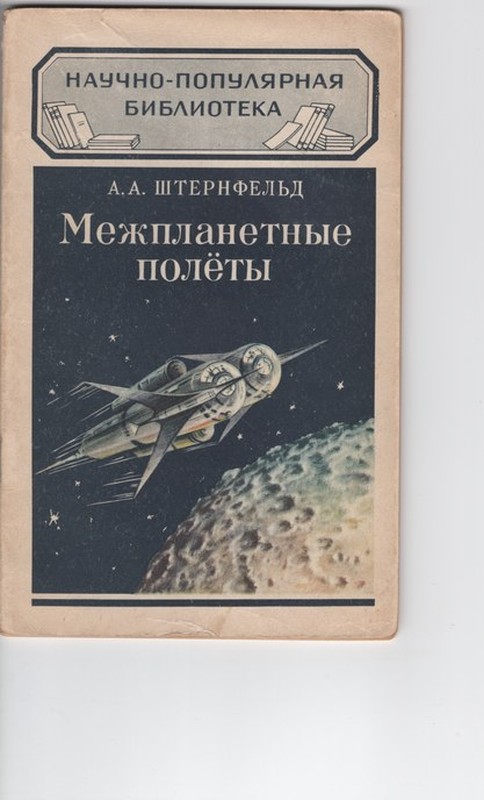
Interplanetary Flights.
Issue 82 of the Scientific-Popular Library series, a slim 50-odd-page primer by Ari Sternfeld, printed in 100,000 copies. It opens with the legends of flight beyond the Earth and then covers the spaceship, life on board, the artificial satellite, and flights to the Moon, Mars, Venus and other bodies. Sternfeld enlarged it into From Artificial Satellites To Interplanetary Flights (1957), also in this catalog.
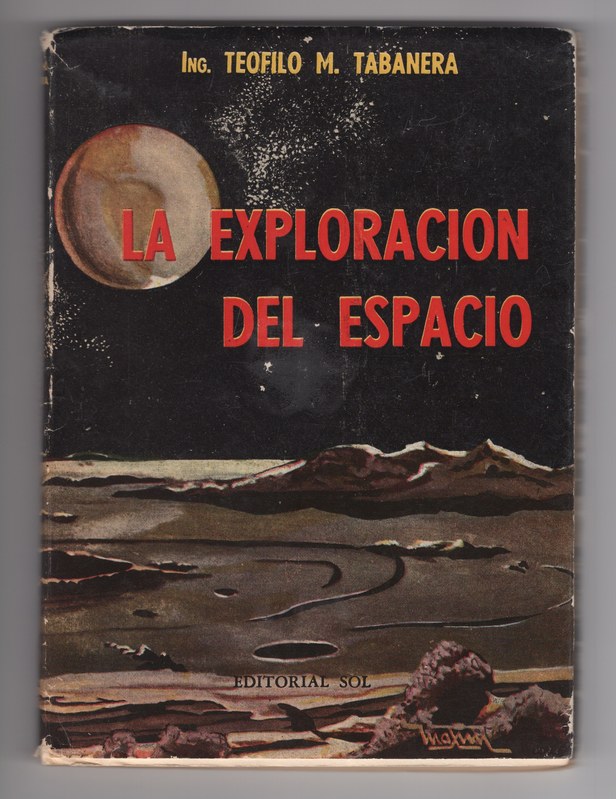
La Exploración Del Espacio.
Inscribed and signed by the author on the front free endpaper, in Spanish: “A mi estimado amigo Heyward E. Canney, pionero de la astronáutica, con todo aprecio,” dated August 1956. Canney is represented elsewhere in the collection. A second, unsigned copy is also held. Copyright Teófilo M. Tabanera, Buenos Aires, 1955; printed 18 November 1955 at Talleres Gráficos Imprenta Chile. A popular introduction to astronautics by the engineer who helped found the Sociedad Argentina Interplanetaria and, per the jacket biography, was elected a vice-president of the International Astronautical Federation at the Innsbruck congress. Sixteen chapters run from “La tierra y sus vecinos” and conditions for life on Earth and other planets, through the history and rationale of astronautics, forces and velocities, rocket propulsion and energy, to the requirements of space voyages, the multistage rocket, artificial satellites and space stations, and rocket ships. Black-and-white photographs, diagrams and color plates, including a rotating wheel station, a lunar landing craft and a V-2 on the launch stand, illustrate the text. An appendix describes the IAF and lists the national societies with addresses and August 1954 membership, such as the American Rocket Society (3,660), the British Interplanetary Society (2,521) and the Asociación Argentina Interplanetaria (280). A long multilingual bibliography follows. The jacket flap gives Tabanera’s career as an electromechanical engineer in the oil industry and records his first astronautics article in 1930. His shorter Cohetes y Satélites (1957) and Qué Es La Astronáutica (1958) are also in this catalog.
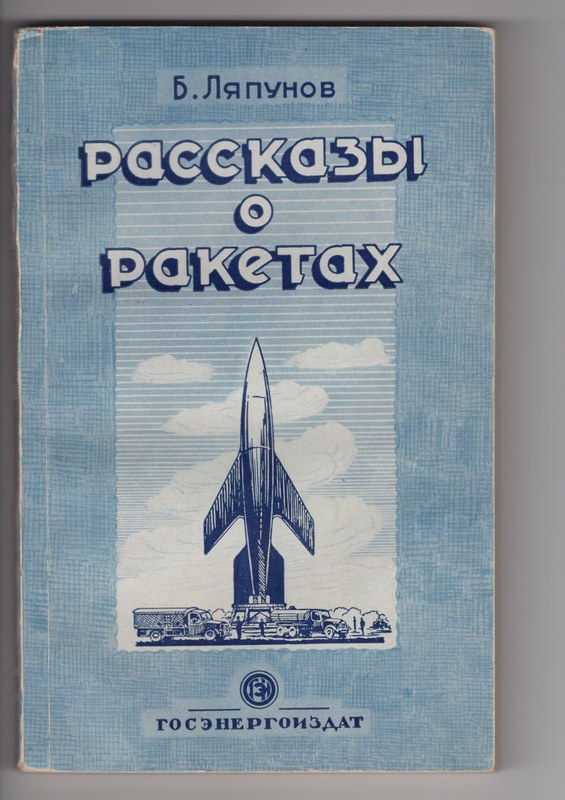
Stories About Rockets.
The second, expanded edition of Liapunov’s popular survey of rocket technology, printed in 10,000 copies. Five “stories” cover what a rocket is, Soviet powder rockets and rocket artillery, the rebirth of the rocket with liquid fuel, rockets in the national economy, and finally the road from fantasy to science, with sections on Tsiolkovsky and the other founders, the artificial satellite, and the extraterrestrial station. Liapunov’s earlier Rockets (1950) is also in this catalog.
High Speed Aerodynamics.
Russian translation of Hilton’s 1952 English textbook, edited by G. I. Petrov. Its 20 chapters and about 500 pages fall into four parts: subsonic and transonic flow, supersonic flow, wind tunnels, and general topics. Chapter XIII treats very high supersonic speeds and rarefied gases, and Chapter XVIII compares jet and propeller thrust, with sections on turbojets, ramjets and rocket engines.
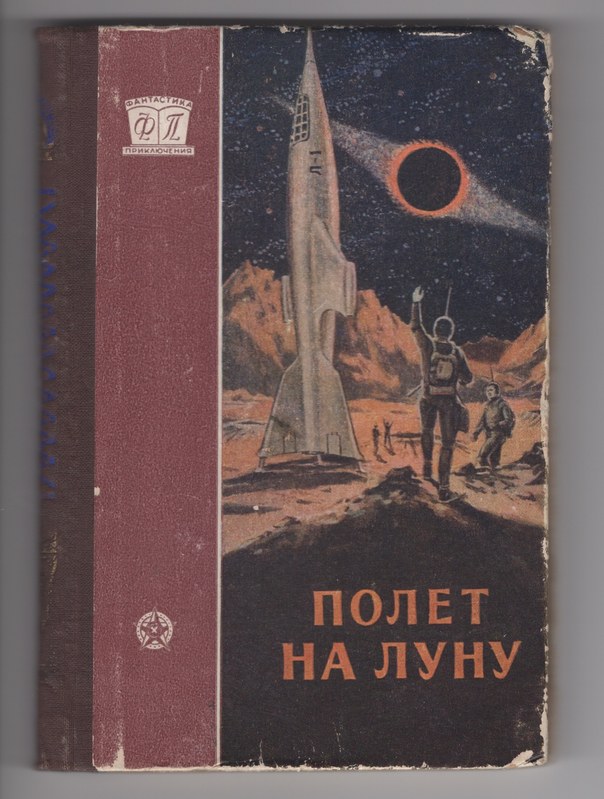
Flight To The Moon.
A popular-science anthology told as fiction: the first Moon flight, launched on 25 November 1974. The frontispiece reproduces a mock front page of Izvestia, Pravda and Komsomolskaya Pravda for Tuesday 26 November 1974, announcing the launch of the ship “Luna-1” from the Caucasus with a crew of four. The title page calls the book Earth–Moon 1974, Collection One and ascribes the editing to the chairman of an “Interplanetary Committee,” Prof. V. N. Khomenko. The publisher’s note says the material was taken from the journal Znanie—sila No. 10 for 1954, with articles by K. Gilzin, Yu. Khlebtsevich, V. Levin, L. Orlov, Yu. Stepanov, I. Fridman, G. Gurevich, Yu. Dolgushin, B. Liapunov and M. Popovsky, and an afterword by N. Varvarov. Three parts follow the flight: “Difficulties Behind” (the birth of astronautics, radio-controlled rockets, the atomic engine, the ship on the pad), “Between Earth and the Moon” (the trajectory, weightlessness, radio and electronic helpers) and “On the Moon,” which includes Liapunov’s “The First Hour on the Moon.” Illustrated by Yu. P. Rebrov, in the Fantastika. Priklyucheniya series; signed to press 16 September 1955 in an edition of 90,000 copies. The collection holds two copies with the same colophon, but the second copy’s title page is dated 1956 where the first is dated 1955. Its contents page also corrects the introduction to page 3, where the first copy prints page 11, and its back cover is grey-green paper rather than beige. Liapunov’s Discovering the World (1954) is also in the collection.
Voyages Into Space.
A popular account in eight chapters, starting with the ancient astronomers and Copernicus, then dismissing earlier schemes for reaching space (the cannon, the electric gun, the space sling) before turning to Tsiolkovsky, rocket engines, artificial satellites and expeditions to the Moon and planets. The publisher’s note says it was issued in response to reports that several countries would soon launch Earth satellites, as an aid for lecturers popularizing astronautics. Scientific editor V. V. Dobronravov; the plates and drawings are by several artists, among them N. M. Kolchitsky. The endpapers show rockets and a space station in cream on blue. Printed in 45,000 copies.
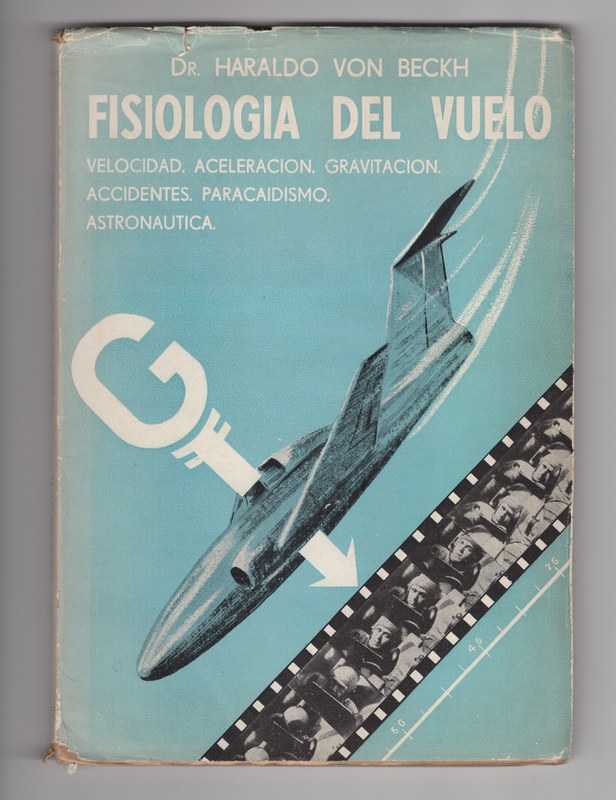
Fisiología Del Vuelo.
Written by Dr. Haraldo J. A. von Beckh, an Austrian physician who served in the Luftwaffe and continued his aeromedical research in Argentina after WWII. Billed as the first book from South America on space medicine and the physiological aspects of spaceflight. In his Prólogo the author sets out to survey the whole field of acceleration, its biological effects and the protective measures devised so far, addressing physicians, pilots and parachutists as well as anyone engaged in fast sport or travel. Four parts treat linear accelerations (crash prevention, harnesses, parachuting, ejection seats and J. P. Stapp’s rocket-sled experiments), radial accelerations (centrifuges, grey-out, blackout and red-out, anti-G suits), angular and Coriolis accelerations, and zero gravity, including V-2 and Aerobee rocket experiments and the author’s own parabolic and vertical-dive flights. Two annexes cover motion sickness (cinetosis) and the physiological aspects of space flight, from escape velocity and weightlessness to the spacecraft’s microclimate, Chlorella algae as an oxygen source, cosmic radiation and meteorite impact. A forward look at vertical takeoff, a comparative historical table, bibliography and index follow. Each legitimate copy was numbered and signed by the author; this is copy no. 656, hand-signed by von Beckh. Editorial Alfa announces a companion volume in preparation, El factor humano en vuelos de alta cota.
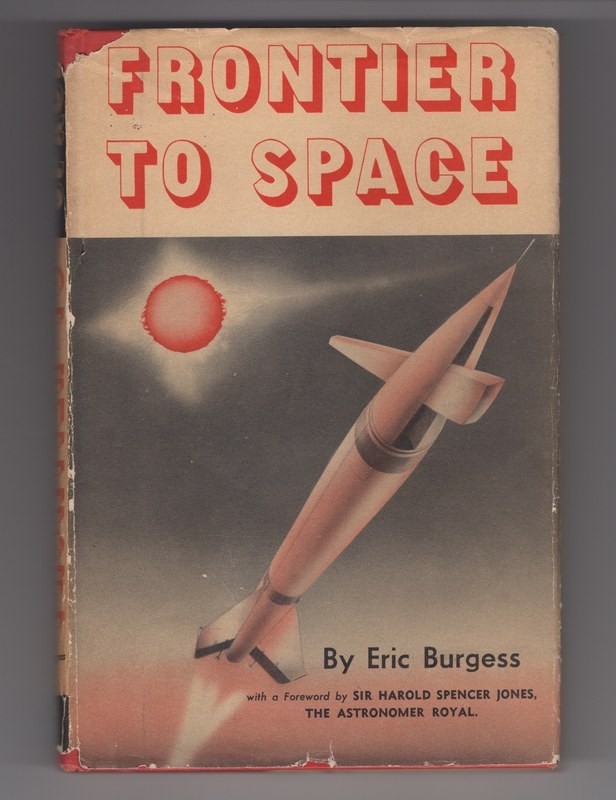
Frontier To Space.
The first American edition (copyright 1955; the English edition came from Chapman & Hall) of Eric Burgess’s survey of how rockets have extended knowledge of the Earth’s upper atmosphere. In his Foreword Sir Harold Spencer Jones, then Astronomer Royal, praises it as the first connected account of the various fields of rocket investigation; Burgess’s Preface is dated Manchester, February 1954, and cites papers from the August 1953 Oxford conference on rocket high-altitude research. Eight chapters—Probing the Frontier, The Story Unfolds, Rockets Take Over, Laboratory in the Sky, The Ionosphere, Solar Radiation, Cosmic Rays and the Debris of Space, and Beyond the Exosphere—each end with reference lists, followed by a bibliography and index. The frontispiece is a chart of altitude regimes from the stratosphere to interplanetary space. The Russian edition (1957) is also available in this collection, as is Burgess’s Guided Weapons in Russian.
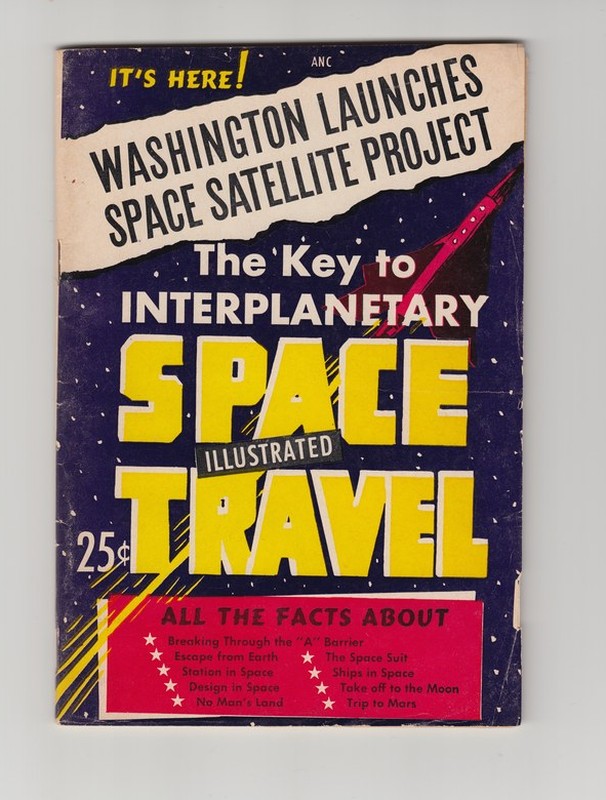
The Key To Interplanetary Space Travel.
Introduction to space travel, space suits, space stations, and trips to the Moon and Mars. Illustrated.
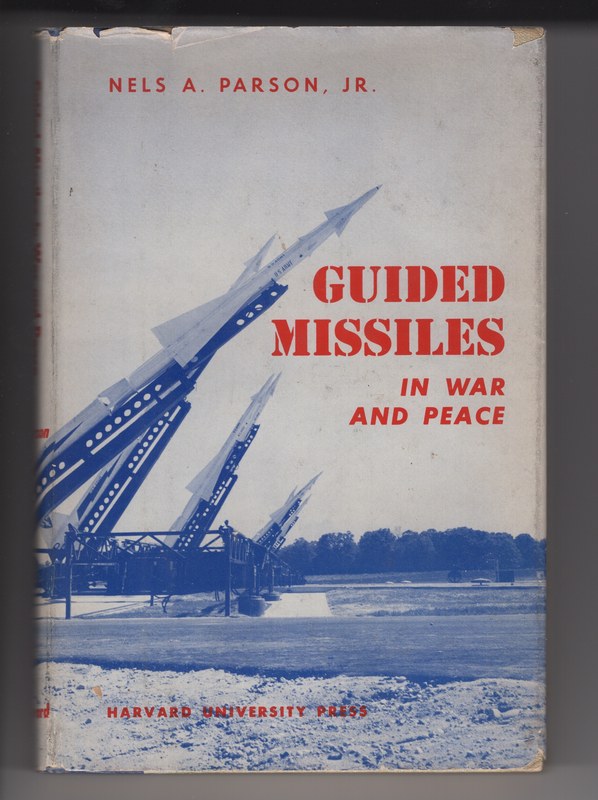
Guided Missiles In War And Peace.
Historical development of missiles.
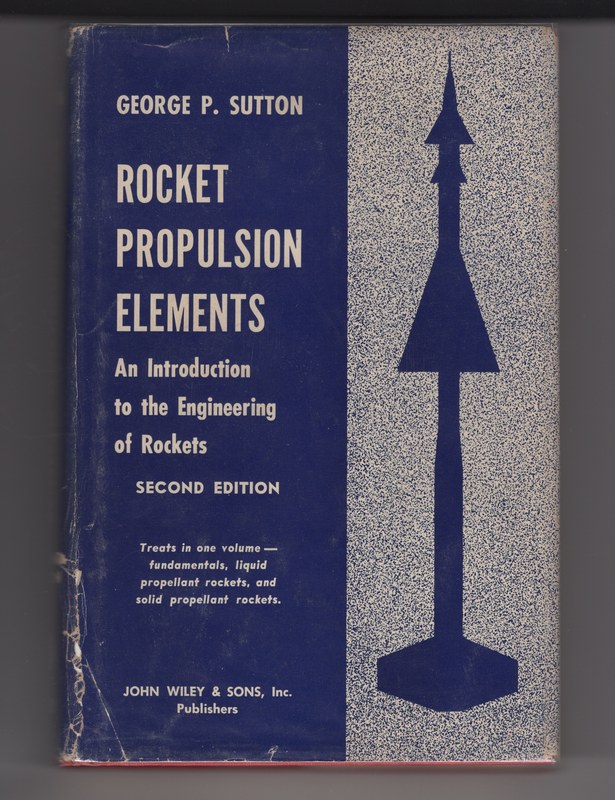
Rocket Propulsion Elements.
Revised and about 60 percent larger than the 1949 first edition (Catalog C), with a preface dated July 1956. Three new chapters cover solid propellant rockets and a new chapter covers heat transfer, with added data, problems and a bibliography of some 650 references. The 13 chapters run from classification and rocket history through nozzle theory, liquid propellant thrust chambers and systems, to flight performance and testing. Sutton was then Engineering Section Chief at Rocketdyne, a Division of North American Aviation, and still taught at the University of California Extension. This copy is the third printing of March 1958.
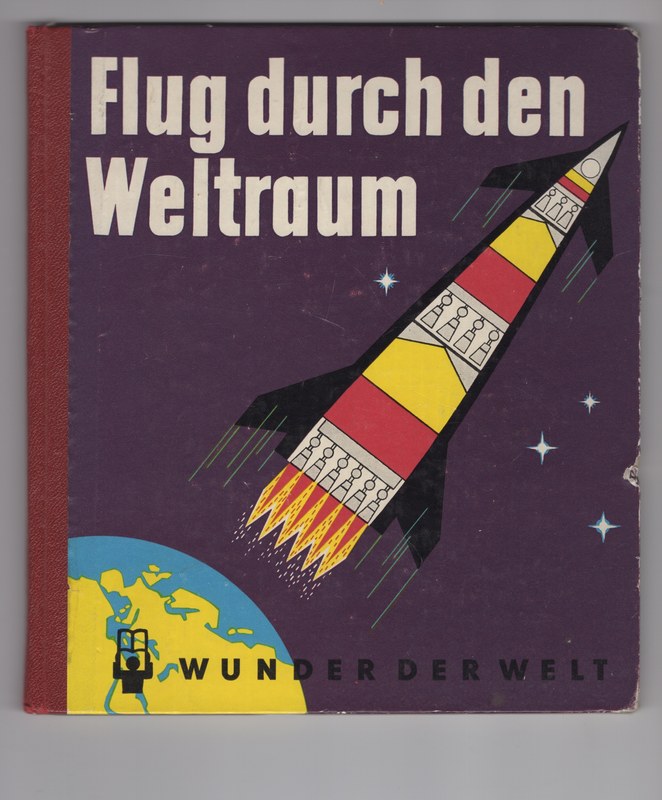
Flug Durch Den Weltraum.
Marie Neurath, together with her husband Otto Neurath and designer Gerd Arntz, developed Isotype (International System of Typographic Picture Education) in 1920s Vienna — a pictorial-statistics method using repeated, standardized symbols in place of free illustration. She continued running the Isotype Institute in London after Otto’s death. This Schönbrunn-Verlag German edition is one of the “Wunder der Welt” series explicitly following “Methode Neurath”: simple, standardized picture-tables aimed at children from about age 10. Through repeated pictograms — identical suited figures, staged rocket silhouettes, arrows — it explains how a ship escapes Earth’s gravity, sheds spent fuel stages, coasts weightless, and lands on other worlds. Text and pictures were checked by Kenneth W. Gatland, a founding member of the British Interplanetary Society, represented elsewhere in the collection by his Development of the Guided Missile.
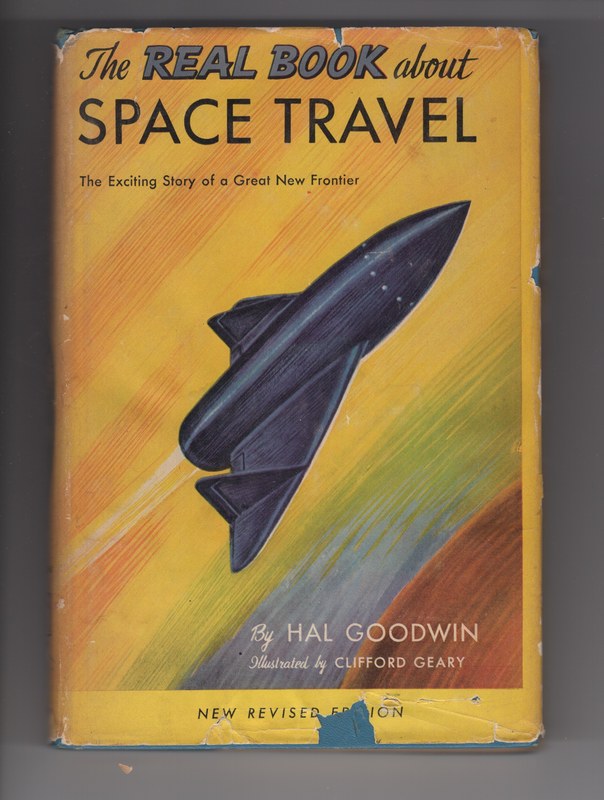
The Real Book Of Space Travel.
For young readers. Second revised edition.
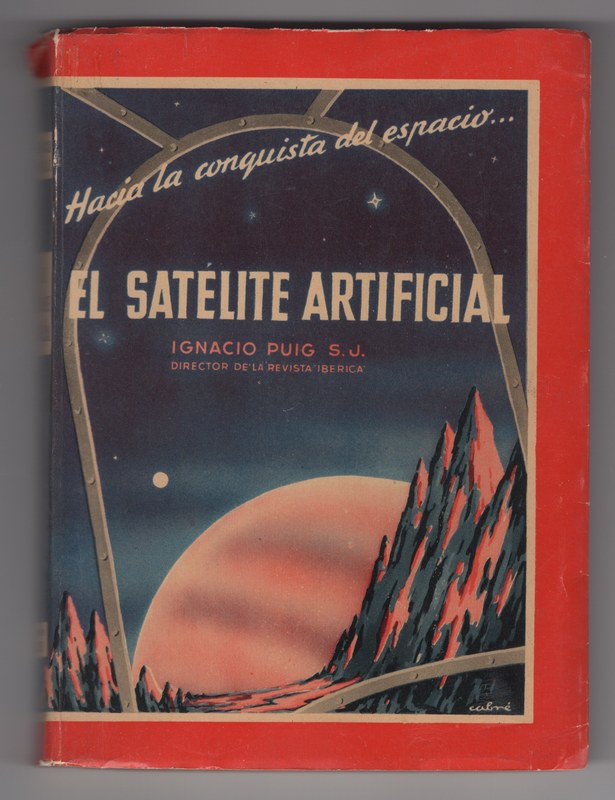
El Satélite Artificial.
Discusses rockets, interplanetary travel and satellites. Of note, last chapter is a theological discussion on life in another worlds, and the Virgin Mary in relation to interstellar travel. The author was a Jesuit priest.
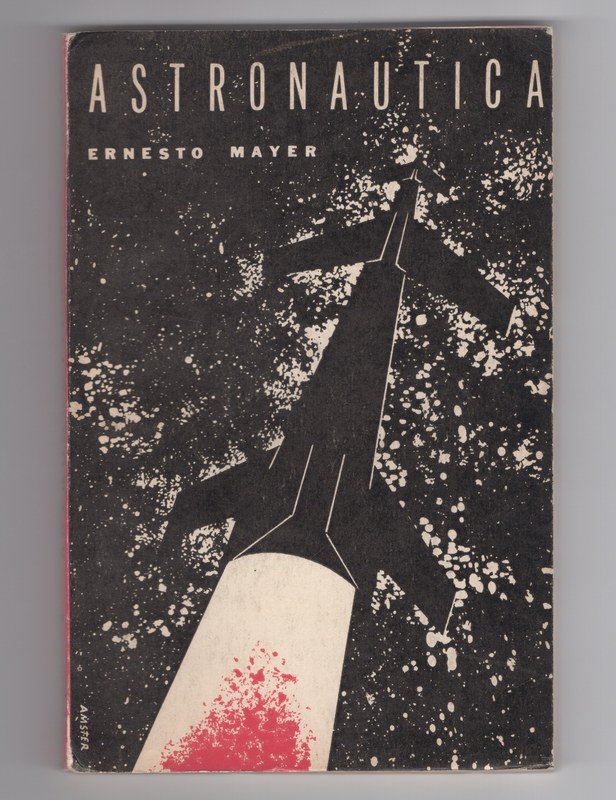
Astronáutica.
Full title Astronautica (Teoría de los viajes extra-terrestres), by Ernesto Mayer C., identified on the title page as Ingeniero Coordinador of the Sociedad Interplanetaria Chilena. Copyright 1956 (registration no. 16802). The cover is a stark black-and-white rocket against a star field, with a red exhaust. The Introduction says the aim is to trace, simply and clearly, the road from the stammerings of mythology to current research related to astronautics, with mathematics kept to a minimum for the general reader. The book is organized in four parts: the stages of the new science (pre-astronautics, precursors, the birth of the astronautical era, and its development); extraterrestrial voyages (dominion of the solar system, escape from the Earth, artificial satellites, and weightlessness in free orbit); rocket thrust outside the atmosphere (the action principle, mass ratio, the step rocket, nuclear energy, and fuels and exhaust velocities); and cosmic voyages. The last covers the interest of an artificial satellite, biological effects of cosmic rays and weightlessness, satellite mechanics, the Ross and Smith and von Braun satellites, voyages to the Moon and planets, meteorites and interstellar flight. Twenty-seven figures include a human centrifuge, the Ross and Smith satellite, a pressurized-suit astronaut, and von Braun’s three-stage transport rocket, with tables of the solar system and propellants. An Appendix discusses flying saucers (the 1947 Kenneth Arnold case, the 1948 Mantell case, astronomers’ sightings) and life on other worlds, followed by a bibliography that includes Esnault-Pelterie, Oberth and Gougerot. Compare the 1954 Argentine Astronáutica by José Mateo in this catalog.
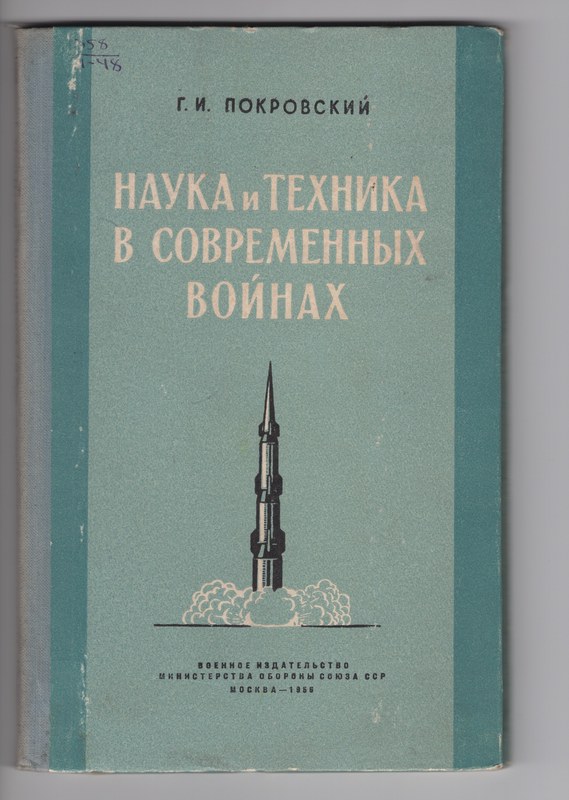
Science And Technology In Modern Wars.
A short essay of about 60 pages by Maj. Gen. Georgy Pokrovsky, an engineer-general and Doctor of Technical Sciences, issued by the Ministry of Defense’s Military Publishing House. It has three chapters, on the role of the different branches of knowledge in military affairs, the role of military technology in modern wars, and “military-technical culture.” Opening with Engels on the dependence of arms on production, it argues that atomic weapons, long-range rockets, guided missiles, supersonic aircraft and radar have changed warfare so much that the experience of 1941–45 and Korea is only a historical landmark. It is a political-military tract rather than a technical survey, and the rocket material is brief. An errata slip is tipped in.
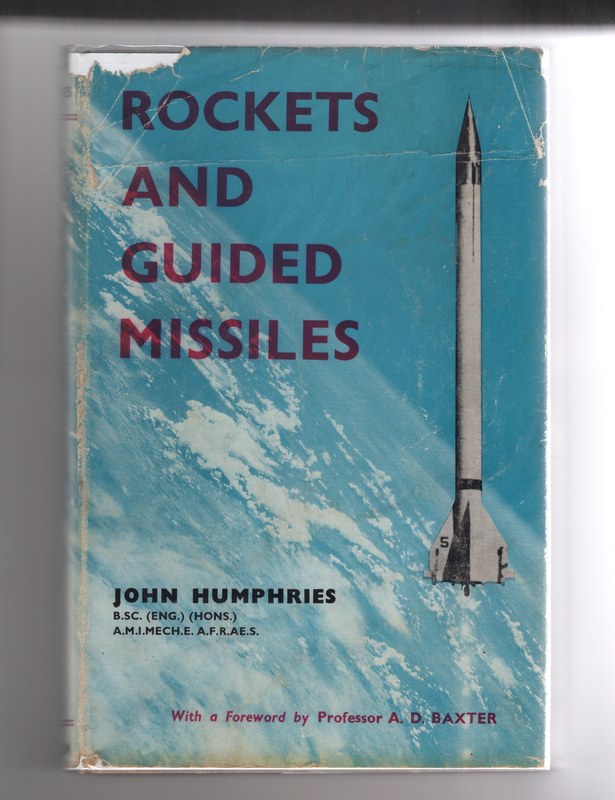
Rockets And Guided Missiles.
The Macmillan Company’s New York edition of John Humphries’s survey of rocket propulsion and guided missiles, with contents identical to the British edition of 1956. The jacket contents list runs from the Introduction and History through solid-propellant motors (a chapter contributed by A. R. Shalders), liquid propellants and liquid-propellant motors, testing, missile guidance and aerodynamics, short-range and long-range ballistic missiles, research missiles, aircraft propulsion and miscellaneous rocket applications, to a closing chapter on the future. The jacket back advertises other Macmillan titles, including Eric Burgess’s Frontier to Space, which is also in this catalog. The final chapter, “The Future—Nuclear Energy—Space-Flight,” treats space flight as the next step beyond high-altitude sounding, with a table of escape velocities for the solar system and a graph of the Earth–Moon “gravitational pit.” The text is illustrated throughout with line figures, graphs and tables. An Appendix Bibliography of annotated books (Section A), journals (Section B) and reports and periodicals (Section C) notes that over 150 volumes had been published on rockets, and points readers to the library of the British Interplanetary Society. Among the early entries are Koelle and Kaeppeler’s Literature-Index of Astronautics (1954) and Goddard’s Rockets (American Rocket Society, 1946), the latter also in Catalog C.
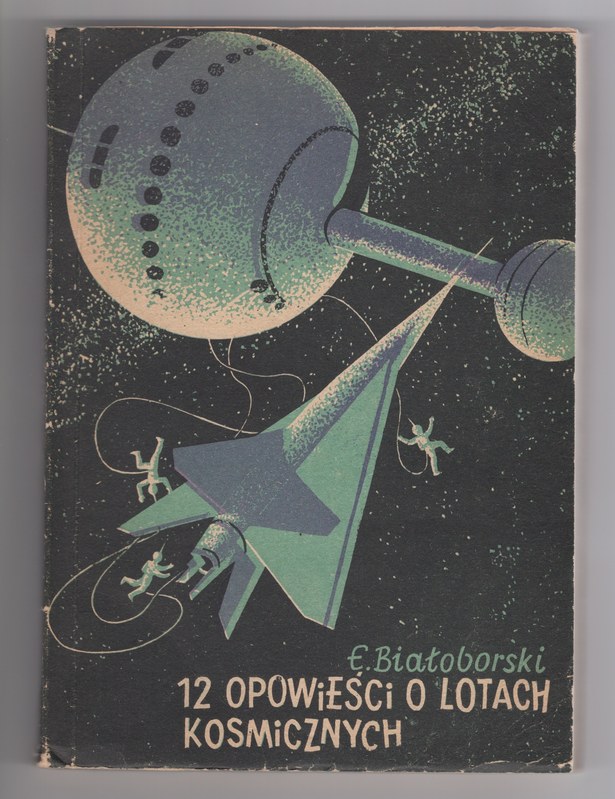
Twelve Stories About Space Travel.
Polish title Dwanaście opowieści o lotach kosmicznych (the cover reads “12 opowieści o lotach kosmicznych”). Signed in ink on the half-title by the author, Eustachy Bialoborski, then Vice President of the Polish Astronautical Society and a member of the British Interplanetary Society. Published by the Ministry of National Defense press, Warsaw, in 1957 (first edition, a run of 6,000 copies, printed at the Wojskowe Zakłady Graficzne), with a cover by Zbigniew Weiss; a printed errata slip is tipped in at the front. The Introduction notes that after the Second World War the V-2 had shown what a rocket could do, and that in 1955 four countries announced artificial satellites. Twelve “tales” follow, covering the rocket as a weapon of science and war, ancient dreams of space flight, the nature of rocket motion, the journey to Mars, Tsiolkovsky and the mass ratio, jet and rocket engines, the construction of a rocket vehicle (multistage rockets, the V-2, the transcontinental rocket), atomic propulsion, and building a space station (Tsiolkovsky’s island, Noordung’s station, Ross’s artificial moon). The last tales deal with interplanetary travel, weightlessness (“what Jules Verne did not know”) and a vision of the future. A physical-astronomical-rocket appendix gives twelve tables, followed by a name index and bibliography. Illustrated with photographs and drawings. The author’s German-language Raketen Satelliten Raumschiffe (1958) is also in this catalog.
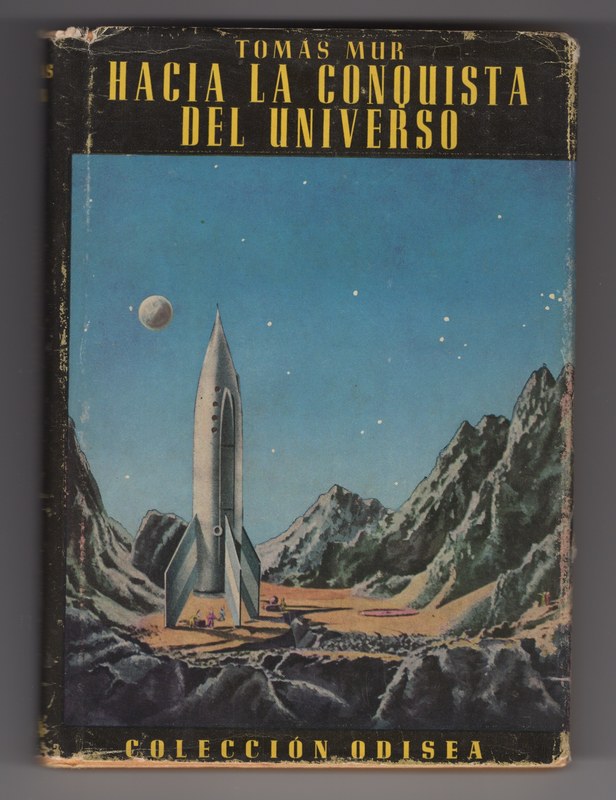
Hacia La Conquista Del Universo.
A Spanish popular survey of astronautics in the Colección Odisea of Aymá, “illustrated with photographs,” first edition, October 1957. The author is a civil engineer and honorary president of the Agrupación Astronáutica Española and a life member of the British Interplanetary Society. His prologue warns against both scepticism and the sensationalism of “interplanetary agencies,” arguing that space will be conquered step by step through sacrifices and failures, not by a sudden invention. He avoids formulas in the text and gathers technical notes in an appendix. Four parts and 16 chapters run from the “prehistory” of astronautics, reaction propulsion and the great rockets, through artificial satellites, automatic and manned vehicles, orbital refuelling, space stations and the conquest of the Moon, to distant stages: the planets, nuclear propulsion, colonisation of the solar system and a closing look at the stars.
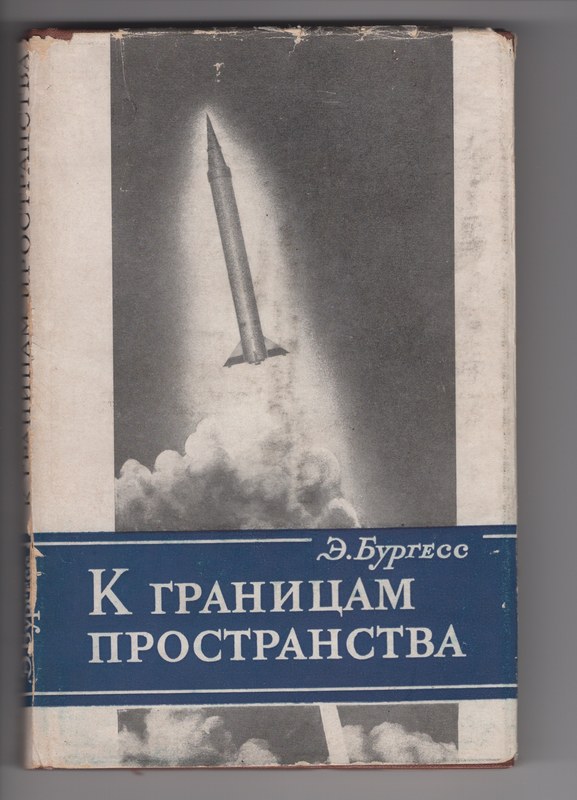
Frontier To Space.
The Russian translation (by S. I. Kuznetsov and N. A. Zaks) of Burgess’s 1955 Chapman & Hall book, edited by Prof. D. L. Timrot, who adds a preface. Its eight chapters take in rocket probing of the upper atmosphere, the ionosphere, solar radiation, cosmic rays, and the region beyond the exosphere. The endpapers carry a chart of rocket, balloon and aircraft altitude records, and the bibliography cites Kooy and Uytenbogaart’s Ballistics of the Future. The English original is also in this catalog.
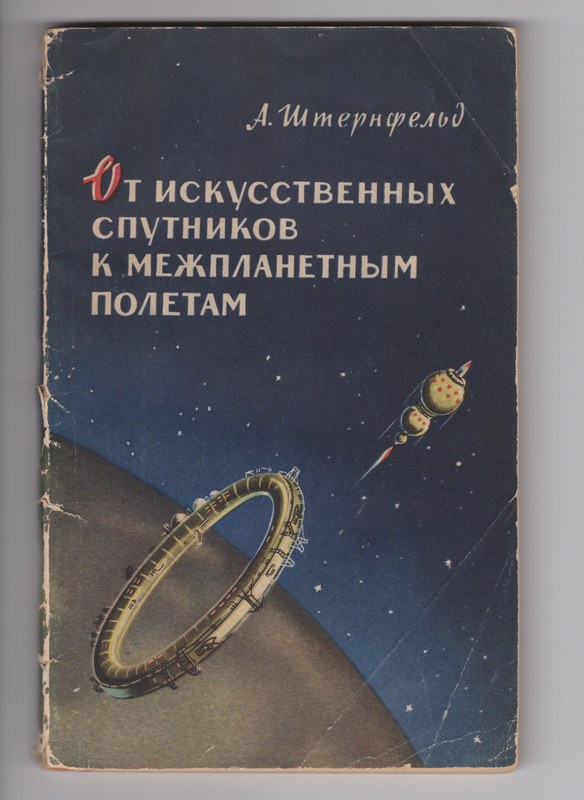
From Artificial Satellites To Interplanetary Flights.
A popular book of about 125 pages by the astronautics laureate Ari Sternfeld, printed in 100,000 copies. Its six chapters cover the space vehicle, man in space, the motion and observation of satellites, their uses, life aboard a spaceship, and flights to the Moon, Mars, Venus and other bodies. It appears to be an expanded edition of Interplanetary Flights (1955), and Part I of the English-language Soviet Writings on Earth Satellites and Space Travel (1958) appears to be a translation of it; both are in this catalog.
Earth Satellites And The Race For Space Superiority.
Introduction to artificial satellites for general audiences.
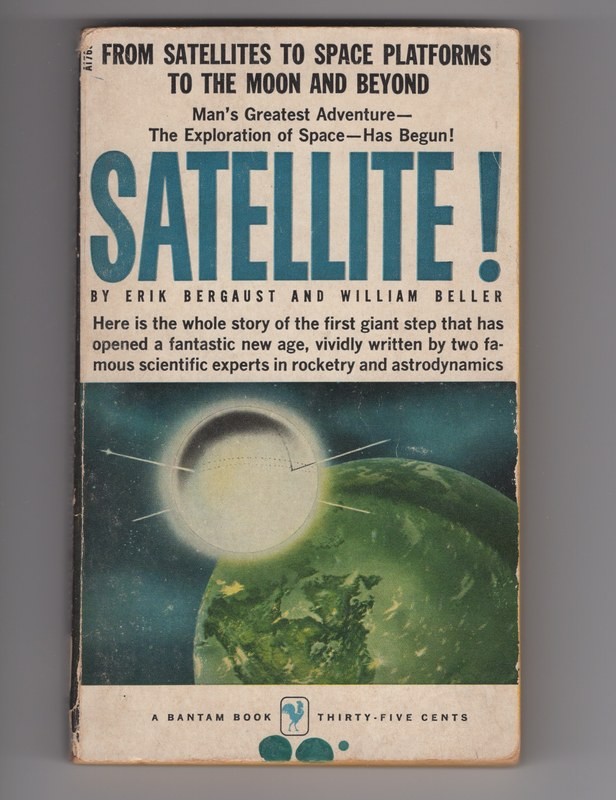
Satellite!
Paperback version of the 1956 book (US edition). Discusses artificial satellites.
Cohetes Y Satélites.
Offprint (separata) from the Boletín de la Real Sociedad Geográfica, Madrid, 1957, (12 pages) in custom blue wrappers with a typed label reading “Teófilo M. Tabanera / Cohetes y Satélites.” A footnote on the first page gives the origin: a lecture delivered at the Real Sociedad Geográfica on 14 October 1957, ten days after Sputnik 1, at the invitation of the Asociación Española Astronáutica and the Society. Tabanera opens by saying he is “simply a technician” rather than a sage, and that a lecture on the artificial satellite had been given a few days earlier by Sr. Baltá. He traces the satellite idea back to Guido von Pirquet as the first concrete step in astronautics, recalls that the International Astronautical Federation founded at Paris in 1950 resolved to devote its London congress to satellite work, and notes Eisenhower’s 1955 announcement of satellites for the International Geophysical Year and the Soviet follow-up. He argues that sounding rockets are limited to a few launch sites and very brief observation time, which is the case for the satellite as a scientific instrument. The closing pages analyze the Soviet satellite from what was then known: an orbit inclined 65 degrees to the equator against 40 degrees for the American plan, a payload that must be heavier than the roughly 5–6 kilograms of instruments of the Vanguard, and a probable apogee of 900 and perigee of 300 kilometers. Tabanera’s book La Exploración Del Espacio (1955) and Qué Es La Astronáutica (1958) are in this catalog.
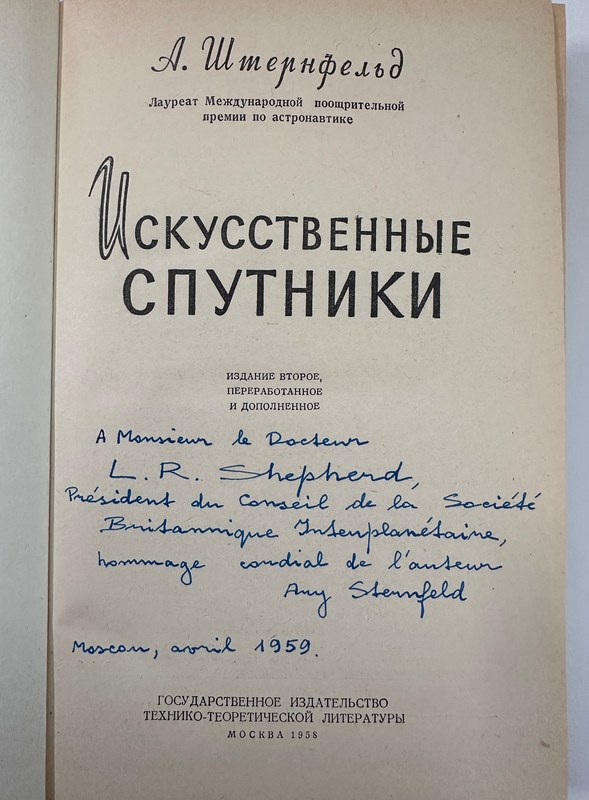
Artificial Satellites.
The title page states “second edition, revised and enlarged” of Sternfeld’s treatise on artificial satellites, published in Moscow the year after Sputnik, and credits him as laureate of the International Encouragement Prize in Astronautics. Eleven chapters of about 300 pages cover the laws of satellite motion, the satellite as seen from Earth, the launch rocket, launch trajectories, construction of large satellites, man in space, life aboard, observation and communication, return to Earth, satellites of the Moon, planets and comets, and the uses of satellites, with an appendix on the spread of astronautical ideas. Illustrated with tables, diagrams and photographs. Inscribed in French on the title page by Sternfeld, “hommage cordial de l’auteur,” to Dr. L. R. Shepherd, Chairman of the Council of the British Interplanetary Society, and signed “Ary Sternfeld,” Moscow, April 1959. Sternfeld’s earlier Russian books on the subject are also in the collection.
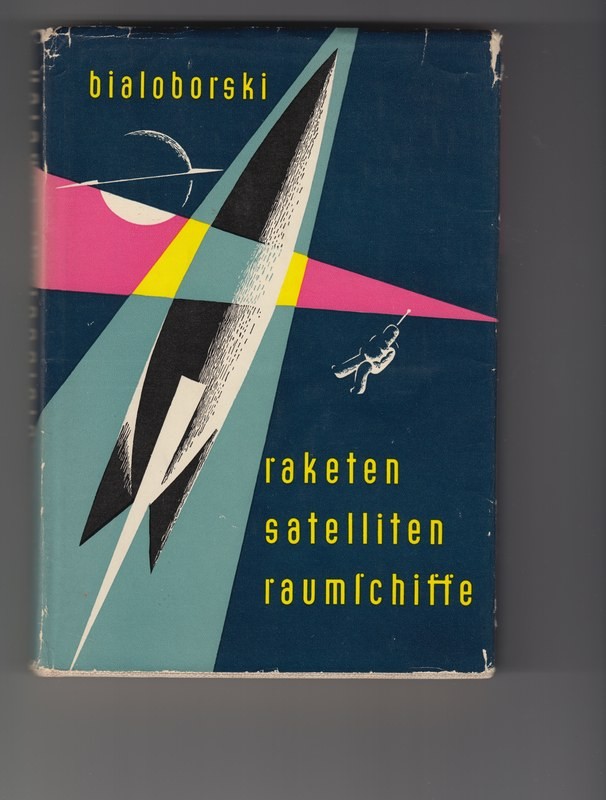
Raketen Satelliten Raumschiffe.
German edition of Eustachy Bialoborski’s popular astronautics book, with a contribution by Diedrich Wattenberg of the Archenhold Observatory, Berlin-Treptow, on artificial earth satellites. Published by Urania-Verlag, Leipzig/Jena (“Verlag für populärwissenschaftliche Literatur”), with 102 illustrations and 10 tables. The jacket is a colorful rocket design in teal, pink and yellow. Facing the title page is a portrait of the author, identified there as Vice President of the Polish Astronautical Society in Kraków, with his printed signature. Signed and inscribed by the author on the title page in green ink: “for the Library of the General Astronautics Corporation with best regards,” Kraków, Poland, 22nd May 1958. The publisher’s foreword (end of January 1958) says the book was already one-third printed when Sputnik 1 and 2 were announced in autumn 1957, which is why Wattenberg added a summary of the results to January 1958. Part I, “Richtung Mond: Bitte einsteigen!,” is a popular dialogue with a skeptical character, Bonifazius, covering the history of the rocket, rocket and projectile, the multistage rocket, artificial moons, space stations, weightlessness, space suits and the race to the Moon. Part II covers the physical and technical problems of the spaceship (gravitation, ballistics, mass ratio, the V-2, landing, a trip to Mars), and Part III is Wattenberg’s section on Sputnik 1 and 2, Explorer, orbits and early research results. An appendix solves the “desert riddle,” with a source list of illustrations and a bibliography. Bialoborski’s Polish Dwanaście opowieści o lotach kosmicznych (1957) is also in this catalog.
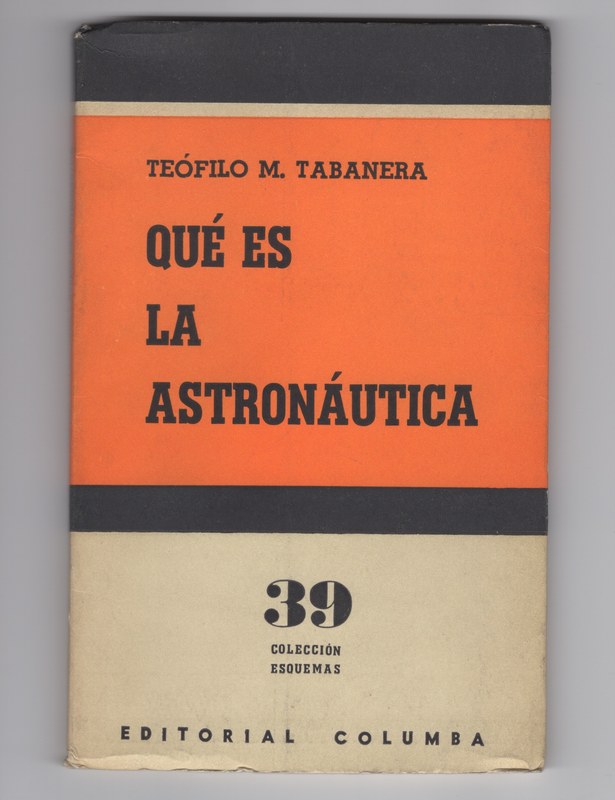
Qué Es La Astronáutica.
General introduction to astronautics. First edition was published in 1952.
A Guide To The Study Of Space Law.
RAND Corporation Paper P-1290 (revised April 1, 1958) by John C. Hogan, Research Editor at RAND, reprinted from the Spring 1958 issue of the Saint Louis University Law Journal, a symposium volume devoted to the laws of space. Builds on Hogan's earlier "Space Law Bibliography" (Journal of Air Law and Commerce, Summer 1956) with a list of "Forty Questions on Space Law," an outline of the technical, legal, political, and military aspects of space policy, reading lists of scientific books and periodicals for lawyers, a survey of a University of Oklahoma space-law project, and a bibliography of more than 250 titles. One of the earliest attempts to organize space law as a distinct legal field, published less than a year after Sputnik and nearly a decade before any nation signed a space treaty.
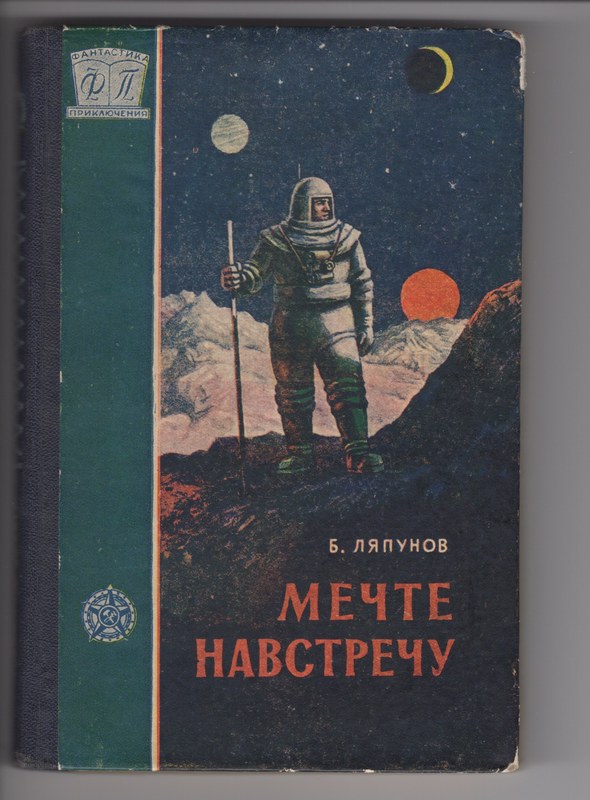
Dream Towards.
Six science-fantasy essays set in a near-future Soviet space program. The editor’s note presents the book as a sequel to the collection Flight to the Moon (1955, also in this collection), which ended with the astronauts landing on the Moon. The opening essay, “The 21st Century,” takes the reader to the Tsiolkovsky All-Union Institute of Interplanetary Communications (VIMS) and tells how the first lunar expedition ended; “Earth–Moon–Earth” follows. Liapunov’s later essays turn to a construction site in the void (the extraterrestrial station), “We Are on Mars,” “Nearest the Sun,” and the title essay on interstellar flight. The note adds that the first automatic Earth satellites are already in orbit, so the fantasy is only slightly ahead of the science. Liapunov’s scientific books, such as Discovering the World (1954), are also in the collection. Illustrated by E. I. Seleznev, with color plates, in the Fantastika. Priklyucheniya series. Signed to press 6 February 1958 in an edition of 90,000 copies; the colophon marks this copy as part of the second batch (copies 15,001–55,000).
Theory Of Combustion Instability In Liquid Propellant Rocket Motors.
Russian translation of Theory of Combustion Instability in Liquid Propellant Rocket Motors, published in 1956 by Butterworths for the Advisory Group for Aeronautical Research and Development (AGARD) of NATO, as the title page, which reproduces the English original’s imprint, records. The Russian edition was translated by T. F. Altukhova and M. O. Lerner and edited by Prof. Yu. Kh. Shaulov, signed to press 17 November 1958 and printed at the University Press in Budapest. The publisher’s annotation describes the authors as creators of the mathematical theory of unstable combustion, who analyze oscillations in the liquid rocket engine as a dynamic system using methods of automatic control theory, and says published experimental data are compared with theory for the first time. A lengthy editorial introduction precedes the text. Chapter I covers combustion processes, time and space lag, nonlinear effects, and the mechanisms of low-frequency (“chugging”) and high-frequency (“screaming”) instability. Chapter II analyzes low-frequency instability, with sections on the feed system, constant-flow and constant-pressure feeds, servostabilization and two-component systems, followed by high-frequency analysis, appendices and a bibliography citing Tsien, Crocco, Cheng and Elias and Gordon, among others.
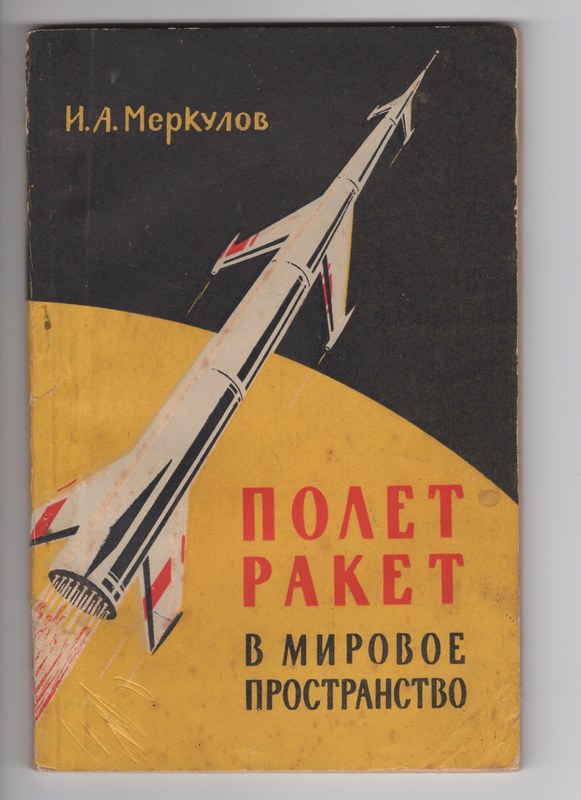
Flying Rockets Into World Space.
A short popular account of rocket flight by Igor Merkulov, issued by DOSAAF in a printing of 40,000. Its twelve short chapters cover the reactive engine, atomic energy in rocketry, rocket trains, Tsiolkovsky’s “ether island,” artificial-satellite projects, flight routes and schedules, and spaceships. Merkulov was one of the editors of the 1935 Jet Propulsion collection in Catalog A.
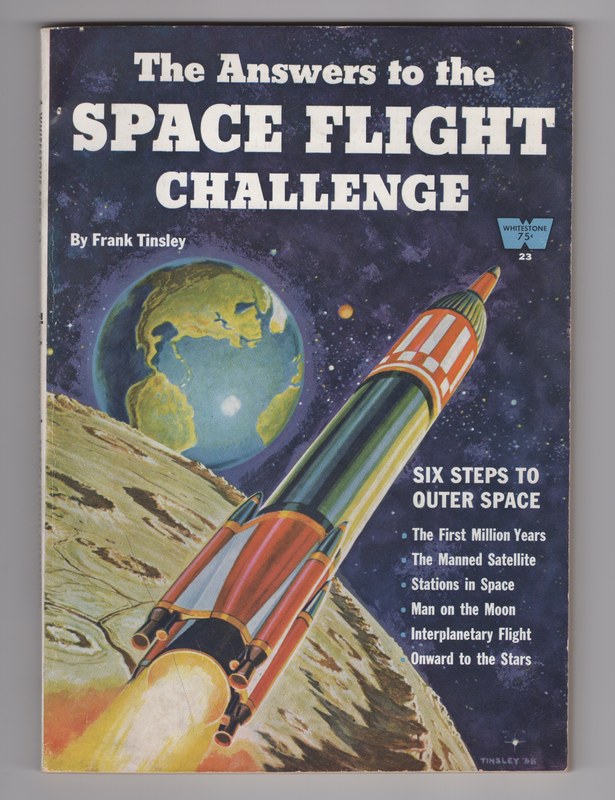
The Answers To The Space Flight Challenge.
Written by a renowned illustrator, discusses voyages to the moon, satellites, space stations, and interplanetary and interstellar travel. Very imaginative and profusely illustrated.
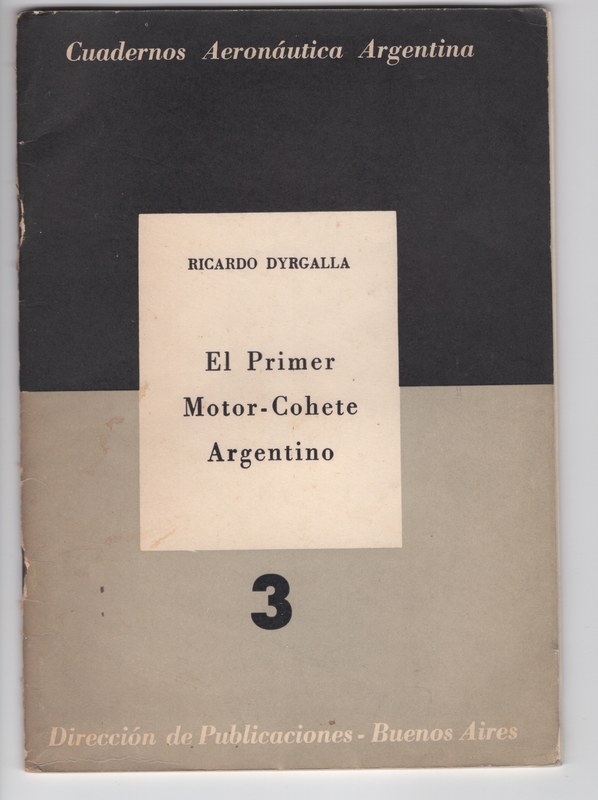
El Primer Motor-Cohete Argentino.
Number 3 of the series Cuadernos Aeronáutica Argentina, printed in Buenos Aires on 5 March 1958. A technical description of the AN-1, the first liquid-propellant rocket engine built in Argentina, burning nitric acid and aniline. It was built in 1947–48 by the armed forces’ scientific and technical research institute in Córdoba under Dyrgalla’s direction and design, to power the AM-1 Tábano guided aircraft, a redesign of the German Enzian. The engine’s existence was first made public in a lecture Dyrgalla gave in Córdoba in October 1950. Sections cover the aircraft, propellant choice, the motor unit, chamber and nozzle, injection, tanks, cooling, and the test stand, with photographs and drawings. The preface by Teófilo Tabanera, president of the Asociación Argentina Interplanetaria, notes the engine ran for only a few seconds. Dyrgalla (1910–1970) was a Polish engineer and RAF reconnaissance pilot who later worked on the Prosón M1 sounding rocket and taught in Brazil. His earlier book on German guided missiles is in Catalog C (Aircraft as Fighter Robots, 1948).
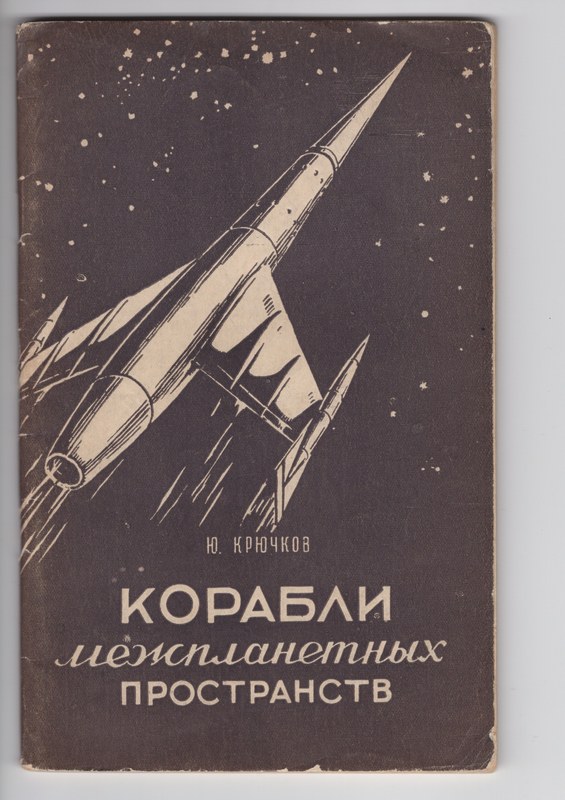
Ships Of Interplanetary Spaces.
A popular booklet in nine chapters, from the obstacles to space flight and the means of reaching the planets to spacecraft dynamics, the evolution of the rocket from gunpowder to interplanetary ships, current space rockets and flights between planets. The preface cites the Soviet ICBM and Earth satellites as signs that landings on the Moon, Mars and Venus are near, and stresses the leading role of Russian scientists. It ends with a list of 12 recommended titles, among them Vasilev’s Voyages Into Space and Gilzin’s Rocket Engines (both in this catalog). Printed in 25,000 copies.
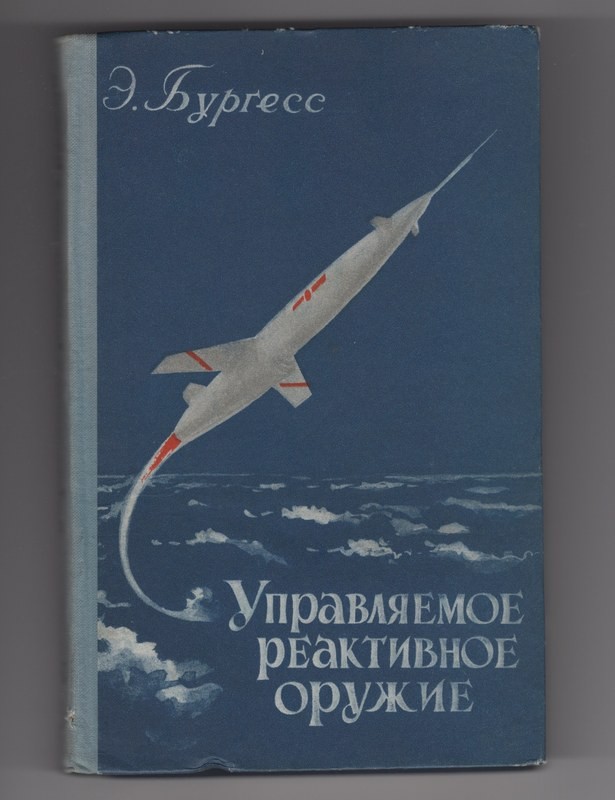
Guided Weapons.
Russian translation of Eric Burgess’s Guided Weapons (London: Chapman & Hall, 1957, as the title-page verso records), translated by N. A. Pavlov and edited by Yu. Kh. Vermishev, candidate of technical sciences. Signed to press 20 August 1958, and printed at the First Model Printing House in Moscow; the cover and binding were designed by A. I. Shcherbakov. The publisher’s annotation calls it a brief popular-scientific account of the problems of developing and using guided missiles, for readers interested in rocketry. The editor’s eight-page preface to the Russian edition (pp. 5–12) frames the book as a technical survey by a leading research worker at an American guided-weapons research center in Los Angeles, recalls that Soviet readers already knew Burgess from Frontier to Space (1957), and disputes the author’s Cold War politics and some of his figures in footnotes, saying the book is issued for information only. Eight chapters cover guided missiles in the defense system, engines and fuels, guidance and control, testing and test equipment, surface-to-air, air-launched and surface-to-surface missiles (the last including V-2, Viking, Atlas and Hermes), and development and production. The back matter has a literature list, an alphabetical index of the missiles and engines named in the text, and an index of firms; photographs and diagrams of launches and test stands are tipped through the text. Burgess’s Frontier to Space, in Russian, is also in this catalog.
Towards The Mechanics Of Photons.
Russian translation of Sänger’s Zur Mechanik der Photonen-Strahlantriebe (Oldenbourg, Munich, January 1956), number 5 in the series of his Stuttgart research institute for the physics of jet propulsion; the German title page is reproduced. In an editor’s foreword the physicist I. M. Khalatnikov calls it the first complete study of the mechanics of photon-rocket flight based on relativity, noting that Sänger leaves aside the engineering of such a rocket and its energy source, and that time dilation could let a crew return after several decades of Earth time. Fourteen chapters treat the relativistic mechanics of the drive, including a ramjet-type photon drive, first from the crew’s and then from an outside observer’s viewpoint: mass intake and ejection, adiabatic and diabatic acceleration, kinematics, dynamics, and the processes of setting the rocket in motion. Followed by a bibliography. Printed in Budapest.
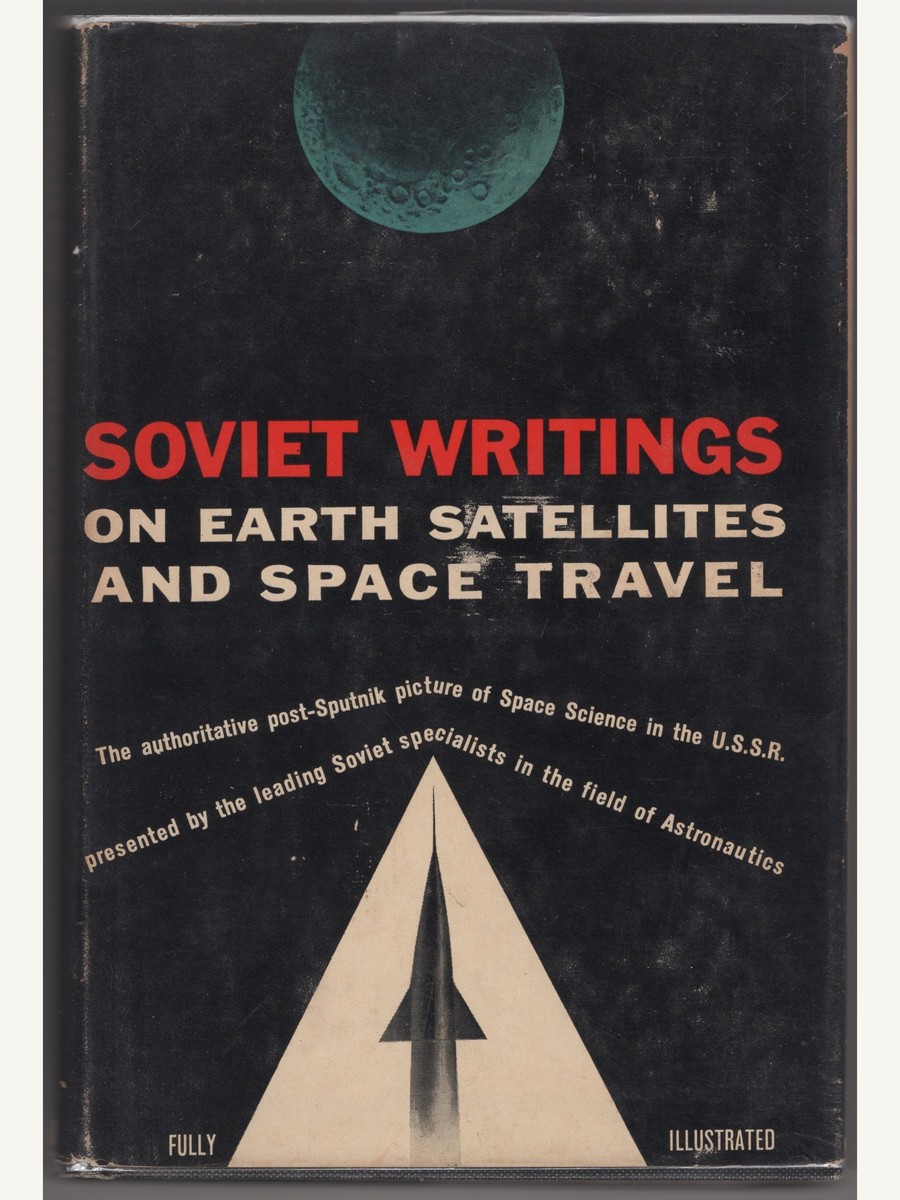
Soviet Writings on Earth Satellites and Space Travel.
Anthology assembled within weeks of Sputnik. Part I is Ari Sternfeld’s own book-length essay “From Earth Satellites to Interplanetary Travel,” its preface dated Moscow, November 1957, a month after Sputnik I and days after Sputnik II. Part II, “The Sputniks,” gathers translated Pravda and Izvestia reports on all three Sputnik launches alongside contributed pieces by leading Soviet specialists — astronomer V. Ambartsumyan, geophysicist Alexander Obukhov, and Academician A. I. Berg on Sputnik radio tracking among them — closing with a comparison of Soviet and American satellite designs, again by Sternfeld. Sternfeld, Polish-born, coined the term “cosmonautics” in a French-language book that won the Prix REP-Hirsch of the French Astronomical Society in 1934, then moved to Moscow in 1935; here he appears as one of the first Soviet voices to reach English-language readers after the launches he had spent decades anticipating.