Entries by year
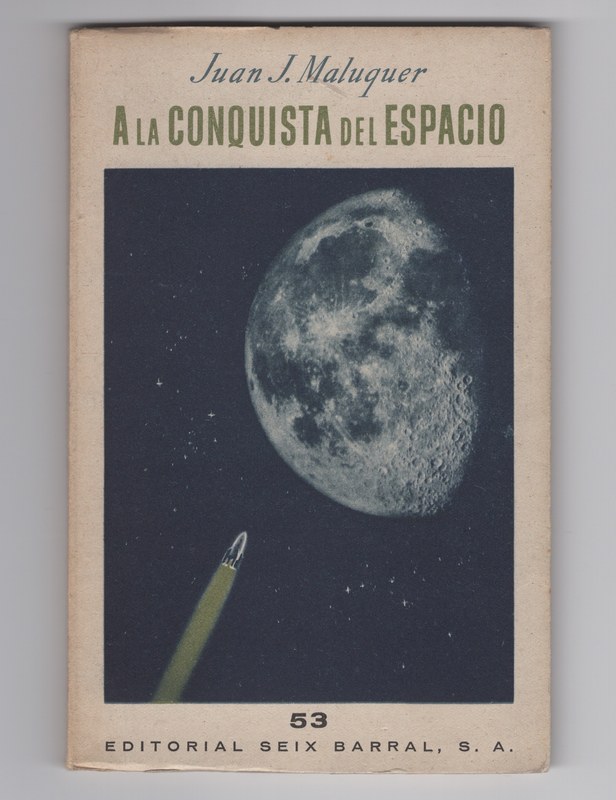
A La Conquista Del Espacio.
Number 53 in the Colección Estudio de Conocimientos Generales, Editorial Seix Barral, Barcelona, 1946. Maluquer, who wrote several earlier titles in the same series on gliding, balloons and airships, and aviation, opens by presenting astronautics as the natural next step after the conquest of the air. It carries the first descriptions of Germany’s V-weapons in a Spanish-language book.The twelve sections cover terrestrial attraction, reaction propulsion and the rocket motor, the spaceship and the interplanetary voyage, an artificial satellite, the possibility of reaching some celestial bodies, terrestrial applications of the rocket, a historical review of the rocket, and the reaction engine and its development. Photographs and drawings include a V-2 on the launching site, rocket launchers and aircraft.
Full entry ›
Navigation Interplanétaire.
Number 6 in the Problèmes series of Éditions Elzévir (64 pages, printed 5 September 1946), by the director of the Astronautics Section of the Aéro-Clubs Universitaires et Scolaires de France—Ananoff’s first book; his earlier publications were pamphlets or reprinted lectures. In the introduction he recalls that his first astronautics lecture, in 1929, was received as entertainment, at a time when the international astronautics prize of Hirsch and Esnault-Pelterie had barely been created and no one knew of the V-2, the atomic bomb or radar.The short chapters cover Jules Verne’s role, the atmosphere, the principle of the reaction motor, propulsive energy, giant rockets, stability and steering, the cabin, onboard instruments (including his old idea of an “Astronavigraphe”), free-fall Earth–Moon trajectories and arrival on another planet. The conclusion calls for collective, international work and notes the new Astronautics Section and its bulletin L’Astronef. Plates include a still from Lang’s Frau im Mond and a Valier-type ship with lateral nozzles.The short bibliography lists Ananoff’s own articles and works by Esnault-Pelterie, Gussalli, Lasser, Perelman, Roy and Tsiolkovsky, several of them in this collection; his 1935 lectures of the same title are also in Catalog A.
Full entry ›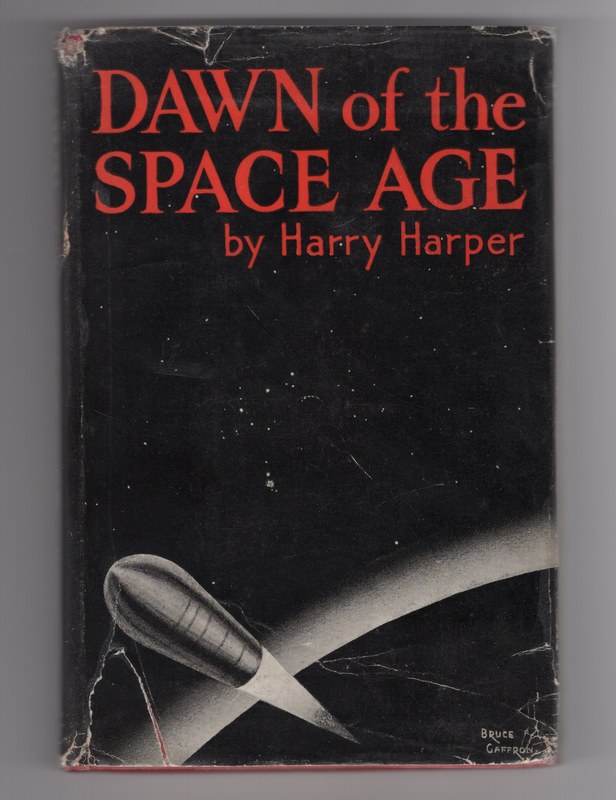
Dawn Of The Space Age.
Harry Harper, described on the title page as “First Air Reporter” and author of Man’s Conquest of the Air and The Evolution of the Flying Machine, and a member of the British Interplanetary Society. The title page states “Approved as a Non-technical Presentation by the Technical Advisory Committee of the British Interplanetary Society,” and the foreword is by Kenneth W. Gatland, Co-Founder of the Combined British Astronautical Societies. Printed by Purnell and Sons at Paulton (Somerset) and London, under the “Book Production War Economy Standard.”Three parts: “The Story of the Rocket, and the Coming of Atomic Power” (23 chapters, from the release of atomic power and the history of the rocket to the German Raketenflugplatz, the V-2 and “Our British Astronautical Pioneers”); “Objectives of Space-Flight — the Moon, Mars, and Venus” (14 chapters, including Oberth’s solar mirror, Lowell and the Martian controversy); and “Design and Construction of Vessels for the Navigation of Space” (19 chapters on fuels, the cellular step principle, landing on the Moon, space suits, rocket mail and the passenger-carrying rocket). A list of illustrations follows the contents.
Full entry ›
U.S. Rocket Ordnance Development And Use In World War II.
A 57-page illustrated account of American rocket ordnance in World War II, released in 1946 by the Joint Board on Scientific Information Policy for the Office of Scientific Research and Development, the War Department and the Navy Department, and printed by the Government Printing Office in teal-green wraps. The Foreword, “Rockets at War,” notes that when Pearl Harbor was attacked the Army and Navy had not a single rocket in service, yet by VJ-day the Army was procuring rockets at $150,000,000 a year and the Navy had 1,200 plants producing them. It opens with a photograph of a Navy F6F carrying a pair of “Tiny Tim” rockets.Nine chapters follow: “The Rockets’ Red Glare,” rocket fundamentals, the organization of the rocket laboratories, rocket versus submarine (the “Mousetrap” and the rocket that fired backward), rocket armament for aircraft, rockets for amphibious warfare (Okinawa, barrage rockets, rocket-firing PT boats and the “spinner” family), the bazooka versus the tank, rockets for ground warfare, and specialized uses. Photographs show rocket-armed fighters, launchers on landing craft and the results of rocket attacks, with a cutaway of single- and double-based rockets in the fundamentals chapter.The closing pages describe how wartime work was handed on to peacetime laboratories, including the Naval Ordnance Test Station at Inyokern and the Allegany Ballistics Laboratory, and end with “Weapons of the Future.” See also the Navy’s ordnance pamphlet Rocket Assemblies (Catalog B) and Rosser’s Mathematical Theory of Rocket Flight (below), both products of the same wartime programs.
Full entry ›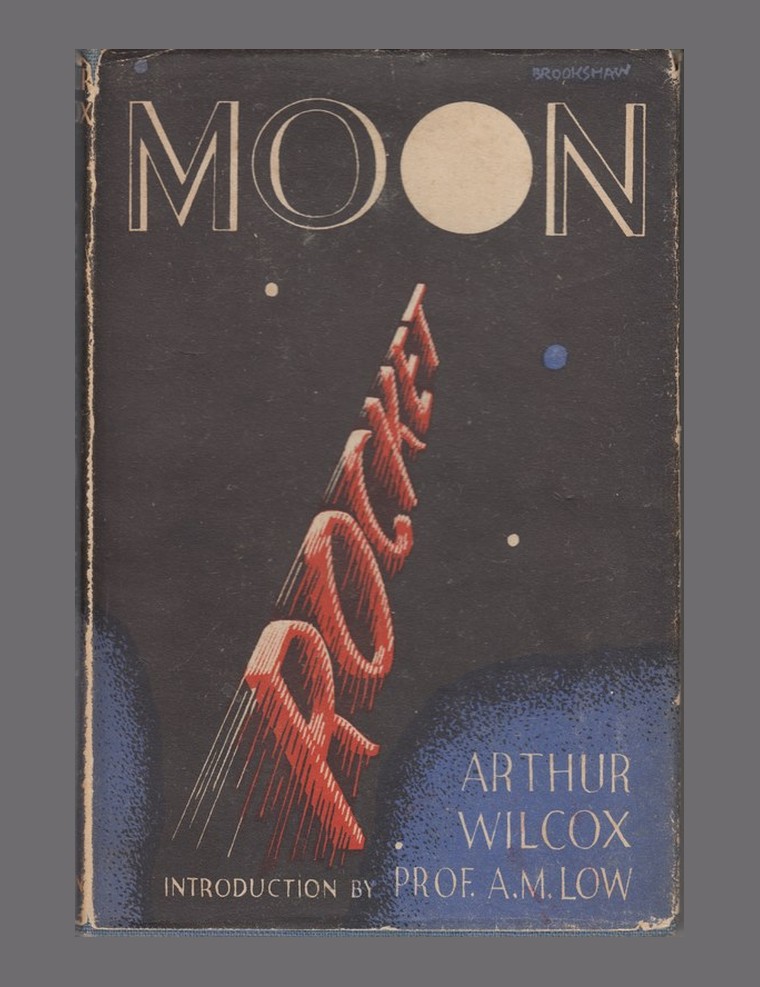
The Moon Rocket.
A popular account of the British Interplanetary Society’s lunar-ship studies. It carries an introduction by Prof. A. M. Low, who calls it “a very important book.”Sixteen chapters move from the history of flight and the case for the rocket, through gravity, speed and acceleration, fuels and motors, to the “stepping-stones” of space, two chapters on the B.I.S. rocket, and then the journey itself: thin air, the void, the Moon and the return to Earth. Appendices give answers to the puzzles posed in the text and a table for reference. Illustrations include a Max Valier rocket-car frontispiece, American rocket-society test photographs (an experimental rocket, a liquid-fuel test, the Greenwood Lake rocket-plane flight), John Shesta’s rocket-motor diagram, and diagrams of the B.I.S. spaceship.It complements Harry Harper’s Dawn of the Space Age of the same year (also in this catalog), likewise approved by the B.I.S. Two copies in the collection.
Full entry ›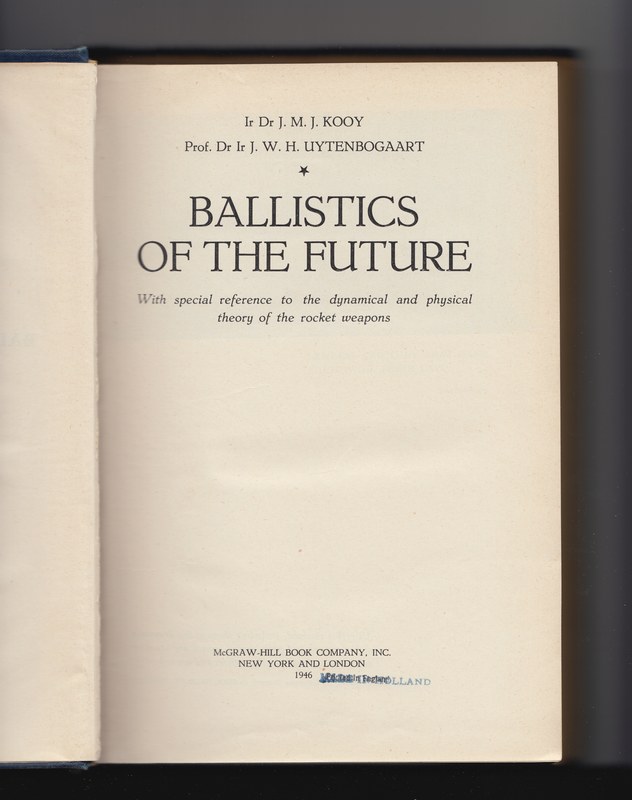
Ballistics Of The Future.
Highly detailed report on the V2 weapons. Available in this collection in three exemplars: European first edition (1946), U.S. first edition (1946), and Russian first edition (1950).
Full entry ›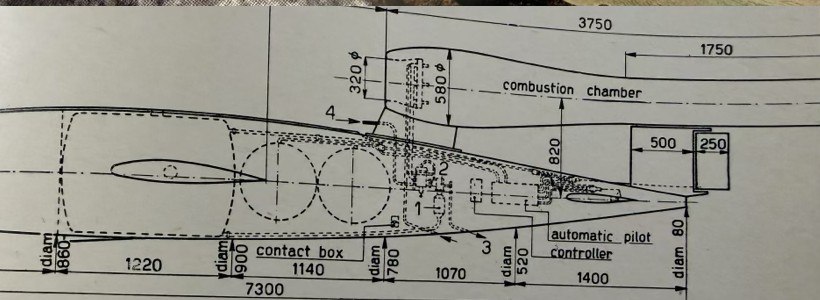 FeaturedBallistics of the Future. Three Editions.
›
Rockets.
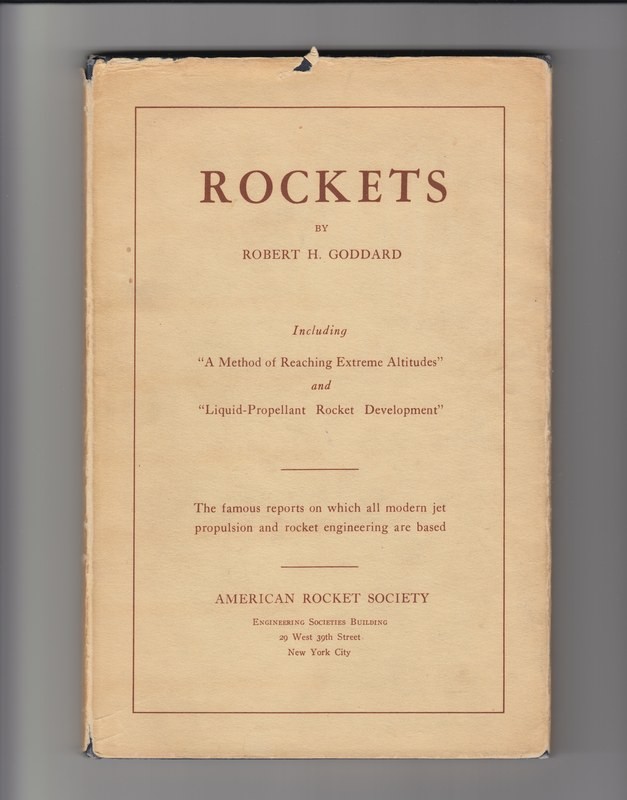
The American Rocket Society’s 1946 reprint, in a single volume, of the two Smithsonian papers on which, as the jacket puts it, all modern jet propulsion and rocket engineering are based: A Method of Reaching Extreme Altitudes (first published 1919) and Liquid-Propellant Rocket Development (first published 1936). The title page is faced by a portrait of Dr. Goddard. The reprint appeared after Goddard’s death in August 1945.A new Foreword by Goddard, written in 1945, compares the state of the art in 1919 with the achievements of the war years. He observes that smokeless-powder rockets had grown in size and control but not in jet velocity, that liquid-fuel rockets had advanced considerably, and that his conclusions on high jet velocity, light construction and the step-rocket principle remained sound. Separate prefaces introduce each paper, and the original plates and figures are reproduced.The book ends with “Dr. Robert H. Goddard — A Biographical Note and Appreciation” by G. Edward Pendray, which does not appear in the Smithsonian originals. Compare the later ARS publication of Goddard’s Rocket Development (1948), also in Catalog C, and the original Smithsonian pamphlet Liquid-Propellant Rocket Development (1936), also in the collection, in Catalog A. The jacket back reprints a passage from the Preface and an ARS statement of purpose.
Full entry ›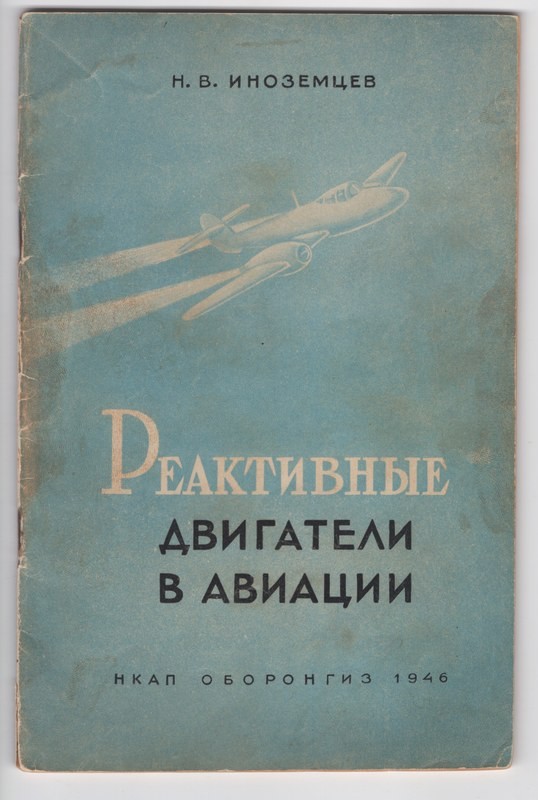
Jet Engines In Aviation.
A short illustrated primer by a professor at the Moscow Aviation Institute, issued by the People’s Commissariat of the Aviation Industry’s publishing house in a printing of 5,000. It opens with Hero’s aeolipile and surveys liquid-fuel rockets, ramjets, and compressor-equipped turbojets. A closing section of about twenty pages of diagrams covers engine layouts and their installation in aircraft, and the book ends with a jet-rotor helicopter. Its conclusion calls jet aviation only at the start of practical use. Compare Kolesnikov’s 1947 textbook in this catalog.
Full entry ›
Firing Of Rockets From Aircraft.
Restricted OSRD report on aircraft rocket launchers, sights, and flight tests, prepared for the Aircraft Launcher Group under Nobel laureate Carl D. Anderson (Physics, 1936), with Chapter 5 by William R. Smythe and sections of Chapter 3 by Leverett Davis, Jr. Edited by Catherine Campbell. Profusely illustrated with photographic plates and diagrams.
Full entry ›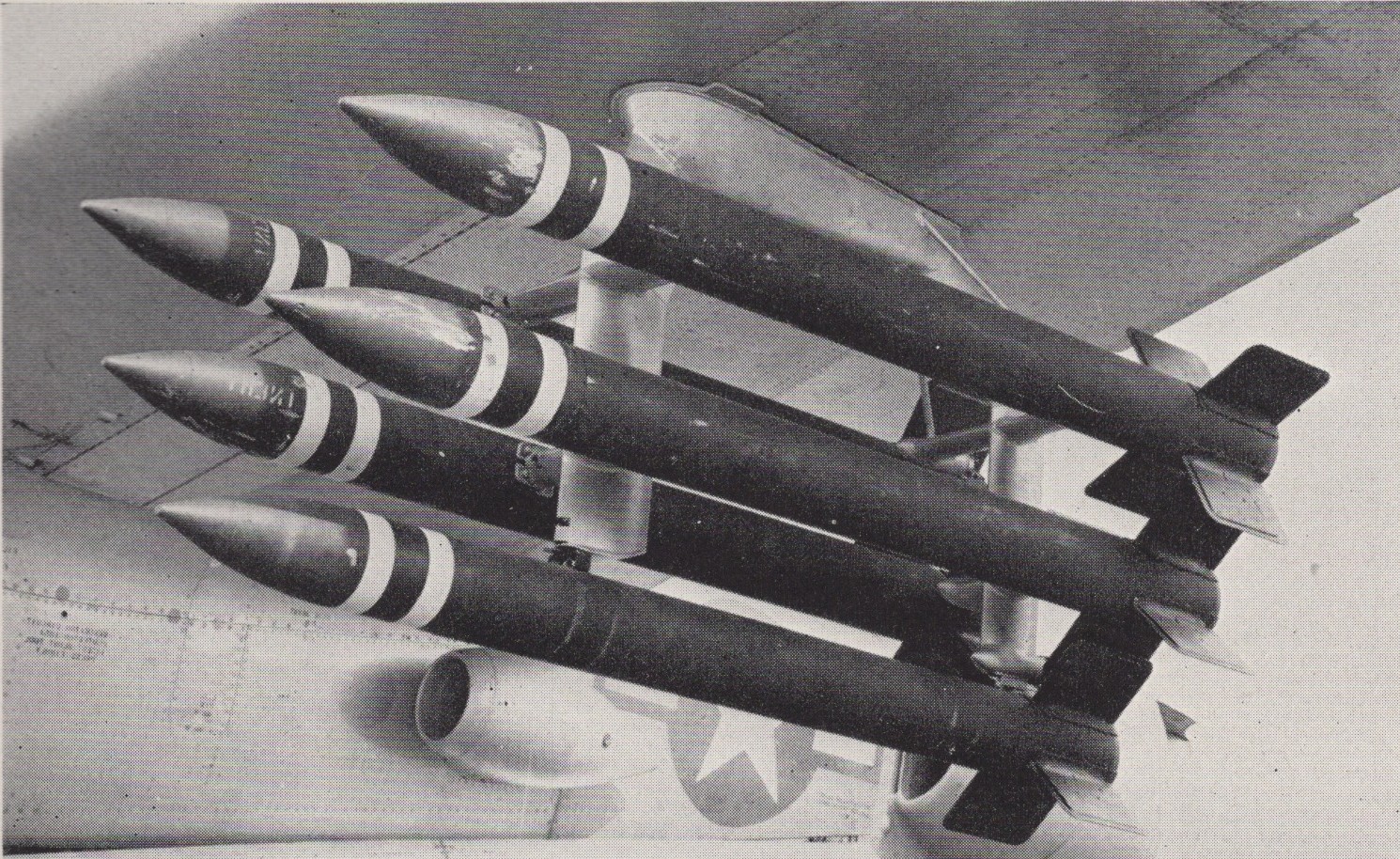 FeaturedFiring of Rockets from Aircraft
›
L’Humanité Devant La Navigation Interplanétaire.
Published by Calmann-Lévy in the series Science et Humanité (directed by Roger Simonet), “illustré de nombreux croquis et de 10 hors-texte.” The title page credits Ducrocq as Technical Adviser of the French Astronautical Section, and the colophon records that it was finished printing at Étampes on 20 October 1947.Eleven chapters run from “On navigue dans le vide” and the interplanetary rockets, through life aboard the spaceship, Mars and its moons Deimos and Phobos, the role of radar and the Moon (“ce roc inaccessible et ingrat”), to the other worlds of the solar system, life in the universe and “Désintégration macroscopique?” An appendix on dematerialization, atomic energy and nuclear engines closes the book, followed by a list of illustrations. Ducrocq returned to the same themes, with the German rockets as his starting point, in Les Armes Secrètes Allemandes, also in this catalog.
Full entry ›
The Boys’ Book Of Rockets.
An illustrated introduction to rocketry and space travel for young readers by Raymond F. Yates, a prolific popular-science writer (the jacket credits him with over seventy books, and past editorships at Popular Science Monthly and Popular Radio). Illustrated with the author’s drawings and with photographs, several lent by the American Rocket Society and its former president Cedric Giles; the acknowledgments also thank the late Dr. Robert H. Goddard for illustrations, V. D. Angerman of Science and Mechanics and the National Geographic Society.The book is dedicated to the members of the American Rocket Society and to the memory of Goddard. Its ten chapters run from “Adventures High above the Earth” and “Escape through the Stratosphere” through “And So to the Moon,” “What Makes Rockets Rocket,” “Fuel, the Rocket’s Big Problem,” “What Buck Rogers Forgot,” “The ‘Big Push’ into Space” and “Adrift in the Sea of Space” to “The Story of the Squirt Plane” and “The Men behind the Rockets.” The jacket shows the author beside the cyclotron at the University of Rochester.
Full entry ›
German Research In World War II.
Colonel Leslie E. Simon of the U.S. Army Ordnance Department, director of the Ballistic Research Laboratories at Aberdeen Proving Ground, set out to describe how German weapons research was actually conducted, treating it as “a completed experiment” whose methods, successes and failures could be judged coldly. The Foreword is dated August 15, 1945; it explains that the book is a publishable generalization of his 200-page Report on German Scientific Establishments, a declassified form of which was available from the Office of Technical Services, U.S. Department of Commerce.The twelve chapters survey German research at the end of the war—the Air Force research establishments near Braunschweig (LFA) and Stuttgart (LGZ), the artillery proving ground, army long-range rocket research and the Luftwaffe’s Technical Academy—then the background and organization of German research, the Speer ministry and the Reichsforschungsrat. Technical chapters summarize interior and terminal ballistics, exterior ballistics (including rockets fired from aircraft and long-range rockets), aerodynamics (jet, turbo-jet and Athodyd motors, supersonic wind tunnels, the Kochel and Mach 10 tunnels, the Ötztal tunnel), instrumentation including rocket-flight instruments, and development work, closing with comments and criticisms applicable to research in general. Photographs show bomb-damaged German laboratories and equipment.Dedicated to the Ordnance Department and to the junior officers who interviewed German scientists with the author.
Full entry ›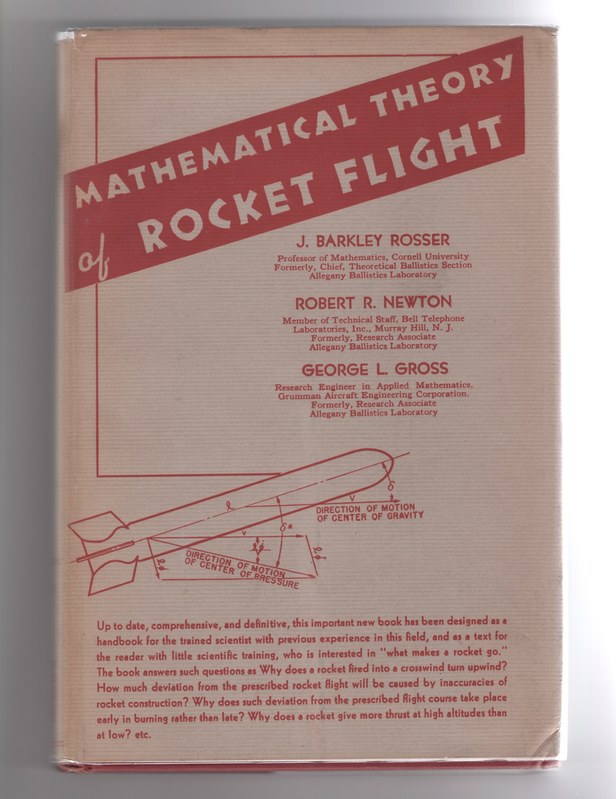
Mathematical Theory Of Rocket Flight.
The official final report to the Office of Scientific Research and Development on the exterior ballistics of fin-stabilized rocket projectiles, produced under Section H of Division 3 of the National Defense Research Committee at the Allegany Ballistics Laboratory in 1944–45 (Final Report No. B2.2, OSRD 5878). First edition, McGraw-Hill, 1947, printed by the Maple Press, York, Pa. The authors were J. Barkley Rosser of Cornell, Robert R. Newton of Bell Telephone Laboratories, and George L. Gross of Grumman, all former Allegany associates; the Preface is dated at Ithaca, N.Y., May 1947.After secrecy was lifted, expository material was added so the book could be read by a trained scientist new to rockets, with plain-language explanations to let less mathematical readers skip the equations. Chapters cover the equations of motion of a rocket, motion after burning, motion during burning (with dispersion due to yaw, lift, cross-spin and thrust misalignment, and firing from aircraft), boundary conditions at the launcher, and the properties of the “rocket functions,” with tables of values and appendices running to 629 pages.The Preface notes that about a hundred reports of other workers were used, many still classified, and that the publishers agreed to relinquish copyright ten years after publication, making the work public domain.
Full entry ›
The Problem Of Flight With The Aid Of Reactive Vehicles.
A posthumous collection of Tsander’s rocket writings from 1924–1932, edited by M. K. Tikhonravov, who supplies a 17-page editor’s foreword. It sketches Tsander’s life (born Riga 1887, died Kislovodsk 1933), his early interplanetary calculations, his rocket-aeroplane projects, and his work in GIRD, where his OR-1 gasoline/air engine (1930–31, up to 5 kg thrust) and the liquid-oxygen OR-2, tested on 23 December 1932, are illustrated with photographs and a plant diagram.The core is the long essay The Problem of Flight with the Aid of Jet Apparatus (1932): atmosphere, jet-engine types and efficiencies, fuels, and rocket aeroplanes. Further papers cover supersonic aviation, thermal design of a liquid-fuel engine, and Tsander’s signature idea of burning the rocket’s own metal structure as fuel, plus two articles on flights to other planets.Issued the same year and by the same press as Tikhonravov’s Works on Rocket Technology of Tsiolkovsky (also in this collection); Tsander also appears in the 1936 Russian Flight Into Universal Space (Valier), and his autobiography was first printed in Rynin’s Interplanetary Communication, issue 4 (Leningrad, 1929).
Full entry ›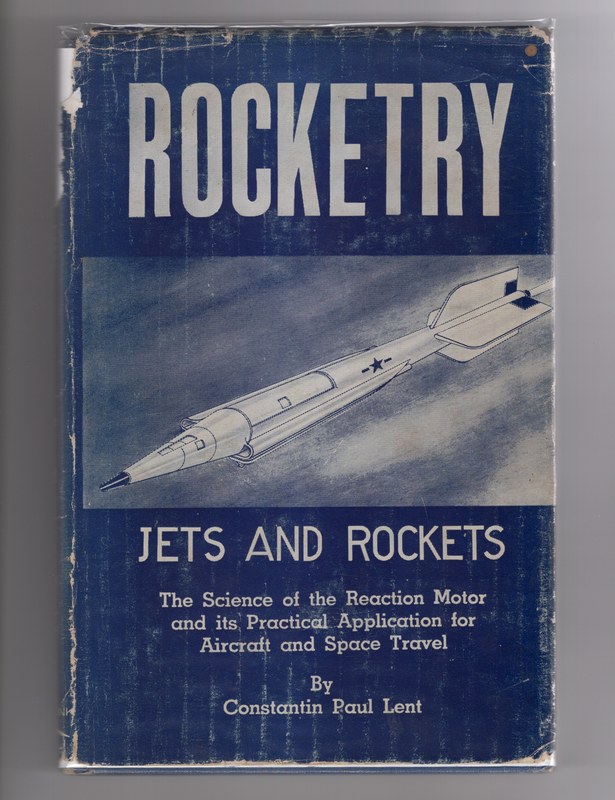
Rocketry - Jets And Rockets.
Lent’s second rocket book, following Rocket Research (1945), and by the jacket’s account a much more advanced work, written because the science had moved quickly since the end of the war. The title page gives the subtitle The Science of the Reaction Motor and its Practical Application for Aircraft and Space Travel, with the imprint “Published and Distributed by Pen-Ink Publishing Co., 130 West 42nd Street, New York 18, N.Y.” and a copyright date of 1947. The Foreword complains that earlier rocket books were mostly narrative, science fiction and Buck Rogers cartoons with little technical value, and that an author must be engineer, draftsman and artist at once. The jacket carries a portrait of Lent and lists his other books, including Food Enough for All and Practical Machine Design and Drafting, and notes he edited Rocket-Jet Flying.Ten chapters run from “The Science of Rocketry,” “The Rocket and Its Motor” and “Rocket Flying” through “The Thermal-Jet Motor” and “Thermal-Jet Flying” to “Is Interplanetary Navigation Possible?” and “Interstellar Rocketways,” the latter two illustrated with plates of nebulae and galaxies. Chapter VIII, “The War Rocket and Its Future,” covers the German V-weapons, the American bazooka, vehicle-mounted rocket launchers, aircraft rocket installations and rocket batteries, with photographs and line drawings. The last chapters are “Rocketor’s Workshop,” a practical section for amateurs, and “The Atom, the Rocket and the United Nations.”A distinctive appendix, “Index and List of Rocket and Jet Patents and Rocket Societies,” tabulates American and British rocket patents, many of them Goddard’s, and lists rocket societies worldwide with their founding dates. Lent’s earlier Rocket Research is in Catalog B; this is the postwar, more ambitious survey, richly illustrated.
Full entry ›
Voyages Interplanétaires et Energie Atomique.
An engineer’s technical assessment of whether atomic energy could power interplanetary travel, prefaced by physicist Maurice de Broglie. Richard-Foy works through the astronomical, dynamical, and thermodynamic constraints on a rocket voyage to Venus, Mars, or the Moon, then models an atomic-pile engine — a uranium fission reactor standing in for the combustion chamber, heating a working fluid that is ejected as reaction mass in place of a chemical propellant. He tabulates fuel consumption for different trajectories (as little as 4 kg of uranium per tonne of payload for a 50-hour lunar round trip, tens of kilograms per tonne for six-month Venus or Mars voyages) and works through problems of weight, atmospheric transit, and thermal protection.His conclusion is notably cautious: interplanetary flight remained tied to conditions — new isothermal nozzles, heat-resistant materials, concentrated uranium-235 piles safe at high temperature — that seemed, in 1947, still very improbable; lunar flight, he judged, was comparatively nearer at hand.
Full entry ›
Des Premières Fusées au V-2.
Number 14 in Elzévir’s Collection Problèmes, published under the scientific direction of Maurice Déribéré, with the cover question “Quelles seront les utilisations pacifiques des fusées?” The title page credits Ananoff as director of the Astronautical Section of the Aéro-Clubs U.S.F., and a note states that the illustrations come from the author’s private collection. The colophon records that it was finished printing on 17 September 1947 by the Imprimeries Paul Dupont.Rather than a study of peaceful uses alone, it is a compact chronological history of the rocket, opening with a short definition of solid- and liquid-fuel rockets and carrying a marginal year beside each event, from Congreve’s attacks on Boulogne and Copenhagen in 1806–07 through the anti-aircraft rockets of the Second World War, the Soviet “Katyusha” and the German Nebelwerfer, to the first V-2 launches. Photographic plates include Zücker’s rocket-mail rocket of 1933 and Tiling and his winged rocket. The list of Ananoff’s earlier writings on the verso of the half-title also names his Navigation Interplanétaire (1946), which is in this catalog, as is his L’Astronautique in Catalog D.
Full entry ›
The Technology Of Rocket Flight.
The second, revised and expanded Russian edition of Sänger’s Raketenflugtechnik (1933), edited by V. A. Shtokolov. The editors dropped the most outdated passages and added Sänger’s later work on rocket flight, including appendices on exhaust velocity and the rocket engine and on the gas kinetics of hypervelocity flight. The editorial foreword credits Tsiolkovsky with the mathematical foundation of rocket theory. The first Russian translation (Kharkov, 1936) and the German original are also in the collection.
Full entry ›
Works On Rocket Technology.
A collection of Tsiolkovsky’s principal writings on rocket technology, edited by M. K. Tikhonravov and printed by the military publisher Oborongiz in 1947. Tikhonravov, himself a leading Soviet rocket engineer, opens it with a 21-page introductory essay. He sets out how Tsiolkovsky approached spaceflight as a practical engineering problem, from a stratospheric rocket-assisted aeroplane to an interplanetary ship and settlements among the asteroids, and credits B. N. Vorobev with finding Tsiolkovsky’s 1883 manuscript “Free Space” among his papers.The works are arranged by date. They begin with Raketa v kosmicheskoe prostranstvo (The Rocket into Cosmic Space, 1903) and the successive versions of Issledovanie mirovykh prostranstv reaktivnymi priborami (Exploration of Cosmic Space by Means of Reaction Devices, 1911, 1914 and 1926). Later items include “Cosmic Ship” (1924), “The Cosmic Rocket: Experimental Preparation” (1927), “Cosmic Rocket Trains” (1929), the reactive aeroplane, rocket-plane and semi-reactive stratoplane papers of 1929–1932, “Fuel for the Rocket,” the steam-gas turbine engine, projectiles reaching cosmic velocity on land or water (1933) and “The Greatest Speed of a Rocket” (1935), with tables of rocket velocity against the ratio of propellant to vehicle mass. An appendix reprints F. A. Tsander’s 1934 preface and remarks to Tsiolkovsky’s Selected Works.The volume reproduces Tsiolkovsky’s original drawings and manuscript sketches, a portrait photograph, and the title page of the 1914 edition of his Exploration of Cosmic Space. Its blue cloth boards are stamped in gold and red with a rocket, and the endpapers show a rocket leaving the Earth.Also in the collection: Tsander’s The Problem Of Flight With The Aid Of Reactive Vehicles (1947), likewise edited by Tikhonravov.
Full entry ›
New Weapons For Air Warfare.
One of the eight volumes in the official OSRD’s series Science in World War II. Discusses antiaircraft weapons, whether rocket-propelled or not. The other volume in the series devoted to rocketry (Rockets, Guns And Targets, 1948) is also available in this collection.
Full entry ›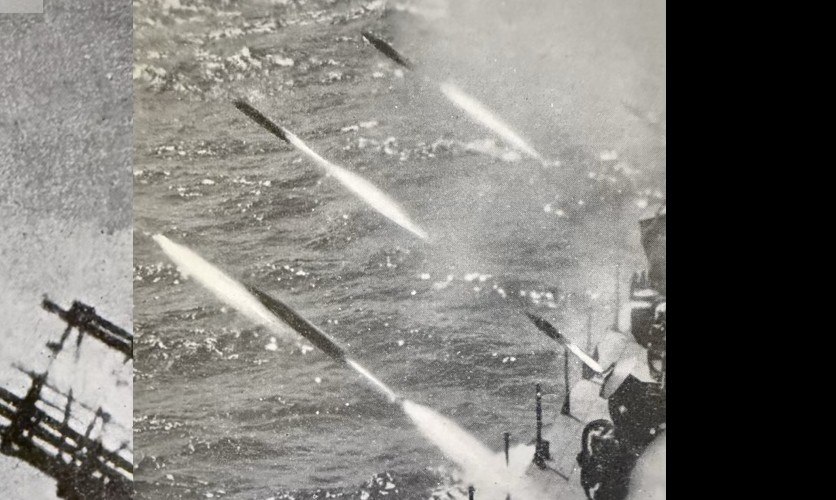 FeaturedRocket Ordnance in Action
›
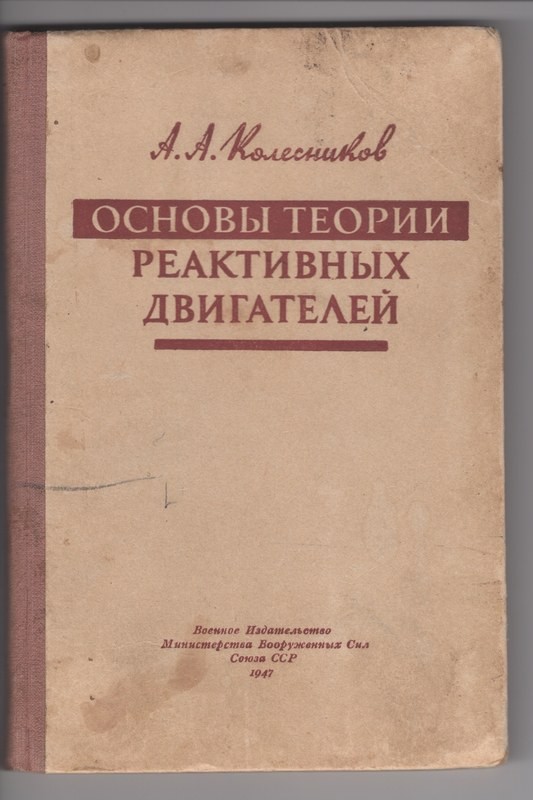
Basic Theory Of Reactive Engines.
A textbook for flying and technical schools and Air Force units, issued by the Ministry of the Armed Forces’ military publishing house (approved for press March 1947), with a tipped-in errata slip. Its six chapters cover general principles and a short history of rocketry, from Chinese fire arrows to Tsiolkovsky; liquid-fuel rocket engines (cycle, nozzle, thrust, efficiencies, propellants); ramjets; turbo-compressor jets; piston-engine-driven jets; and pulsejets, each with its thermal cycle and comparison with the piston engine. Wartime German practice illustrates the text, including the Me-163 rocket fighter with its Walter HWK 109-509 engine, ramjet and flying-wing designs, the V-1 and the V-2.A 16-item bibliography cites Tsander’s 1932 Problem of Flight, Rynin’s 1929 Rockets and Direct-Reaction Engines, Tsiolkovsky’s selected works, and the Russian translation of Sänger’s Raketenflugtechnik (the translation is also in this catalog).
Full entry ›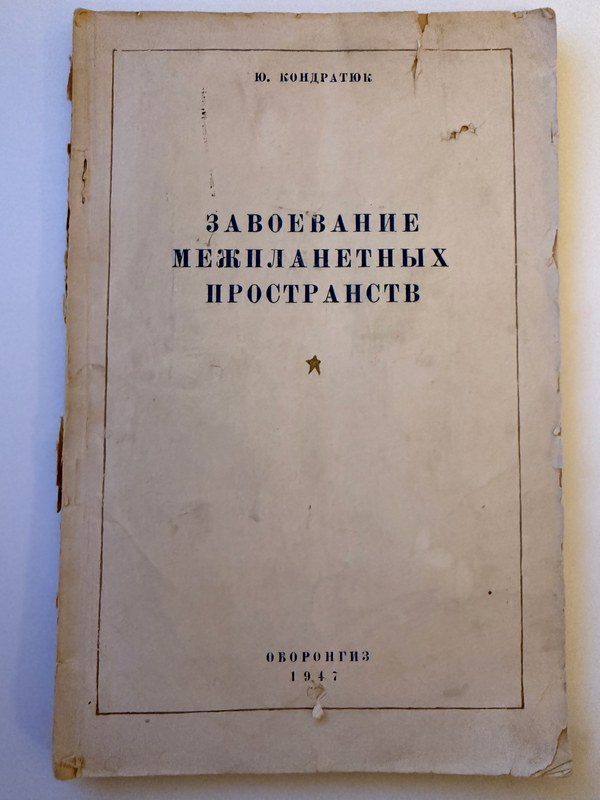
Conquest Of Interplanetary Space.
Title page: “Izdanie vtoroe, pod redaktsiei P. I. Ivanova,” Oborongiz, Moscow, 1947. The imprint states that it was approved for printing on 17 November 1947 in an edition of 5,000 copies, with G. A. Aristov as responsible editor. The editor’s preface notes that the first edition of 1929 ran to only 2,000 copies and had become a bibliographic rarity, and it lists points in which Kondratyuk was first or original: combustion in ozone instead of oxygen, the “proportional passive mass” and the proof that a rocket cannot leave Earth’s gravity without shedding its tanks, the conditions in which wings are useful, and a close study of heating in the atmosphere.Besides the editor’s preface, the book reprints extracts from the author’s letter to Prof. Rynin and from his prefaces to the first edition,. The thirteen chapters cover the rocket’s data and the loading formula, exhaust velocity and propellants, the combustion chamber and nozzle, the proportional passive mass, trajectory types and required velocities, maximum acceleration, the effect of the atmosphere on departure, braking on return by atmospheric resistance, an interplanetary base with rocket-artillery supply, control and orientation instruments, general prospects and experiments. B. V. Liapunov’s 1951 lecture The Problem of Interplanetary Voyages in Catalog D discusses Kondratyuk’s ideas.
Full entry ›
Les Armes Secrètes Allemandes.
Title page: “Avec 23 croquis. Deuxième édition revue et augmentée,” Éditions Berger-Levrault, Paris, 1948, with a copyright notice of 1947 for the first edition and a printing and legal-deposit line of the second quarter of 1948 (Nancy). The facing page lists Ducrocq’s L’Humanité devant la navigation interplanétaire (Calmann-Lévy), also in this catalog. The introduction argues that while the Allies seemed to be winning, Germany was bringing a series of secret weapons to production that marked a revolution in the art of war.Thirteen chapters trace the V-weapons from their conception, with the V-1 and V-2 described and diagrammed, through the German jet aircraft and rocket fighters (“La réaction partout,” “Les V-2 avions,” the “fusée T”), to the final phases of the war, and the contents run to p. 252.The last two chapters turn to the future: “Le satelloïde artificiel” treats the flying island, the stationary space station, life on board, military uses and its construction and transport, and “Héritage de la V-2 et espoirs de la science” asks how the V-2 might travel in interplanetary space (a different fuel, a multiple rocket, atomic energy), the glided flight of the A-9, and what German plans existed for interplanetary journeys.
Full entry ›
Early Tales Of The Atomic Age.
Articles from The New Yorker about the scientific war effort. Chapters 9 and 10 discuss experiments with V2 weapons in New Mexico and seem to be the first mention of Wernher von Braun by name in the U.S. press as leader of the German group that arrived with Project Paperclip. The White Sands chapter, “V2s Among the Rattlers,” originally appeared as “A Reporter At Large: White Sands” in The New Yorker, July 24, 1948, also in this collection.
Full entry ›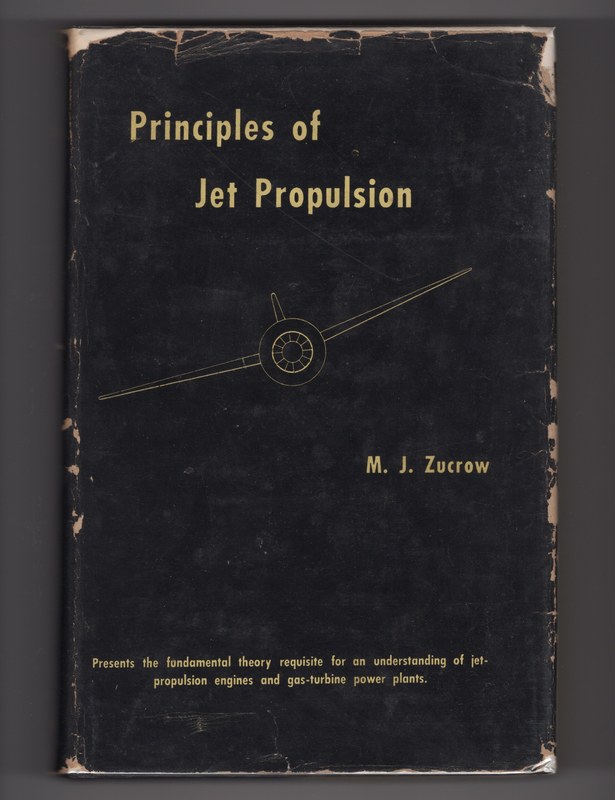
Principles Of Jet Propulsion And Gas Turbines.
Textbook based on a lecture course, “The Principles of Jet Propulsion,” that Zucrow gave in 1943–44 to graduate engineers from Los Angeles-area aircraft companies. Wartime security meant using only unclassified material, so the book keeps to basic principles.Thirteen chapters run from the turbojet through compressors, turbines and combustion chambers to high-temperature metallurgy. Chapter 12, “The Rocket Motor,” about 65 pages, treats nozzle flow, thrust, specific impulse, cooling, propellants and rocket-assisted take-off of aircraft. Zucrow was then Professor of Gas Turbines and Jet Propulsion at Purdue. Compare Clunan’s elementary Gas Turbines and Jet Propulsion (also in this catalog).
Full entry ›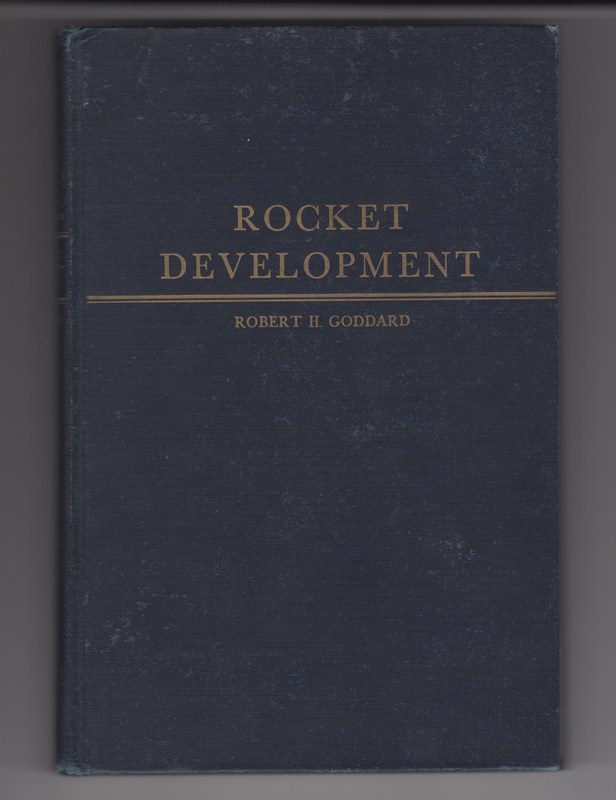
Rocket Development.
Subtitled Liquid-Fuel Rocket Research 1929–1941, edited by Esther C. Goddard and G. Edward Pendray, Prentice-Hall, New York, 1948, copyright 1948 by Esther C. Goddard, with an epigraph from Goethe (“Nicht Kunst und Wissenschaft allein, Geduld will bei dem Werke sein”). The frontispiece shows Goddard at work on a liquid-fuel rocket in his laboratory at Roswell, New Mexico, in November 1935, and a Foreword by Harry F. Guggenheim recalls the Daniel and Florence Guggenheim Foundation’s support of the work.The eleven chapters condense Goddard’s own experimental notebooks, from the tests at Camp Devens, Massachusetts (December 1929–June 1930) and the early experiments in New Mexico, through his work at Clark University, the tests resumed in New Mexico with pressure fuel feed, gyroscope control and parachute, and the more powerful K-, L- and P-series motors, to the pump-driven flight rocket of 1941. An Introduction by the Editors precedes the text, and the book closes with an index (p. 285). A reprint was published in 1961. His Rockets (1946) and Liquid-Propellant Rocket Development are also in the collection.
Full entry ›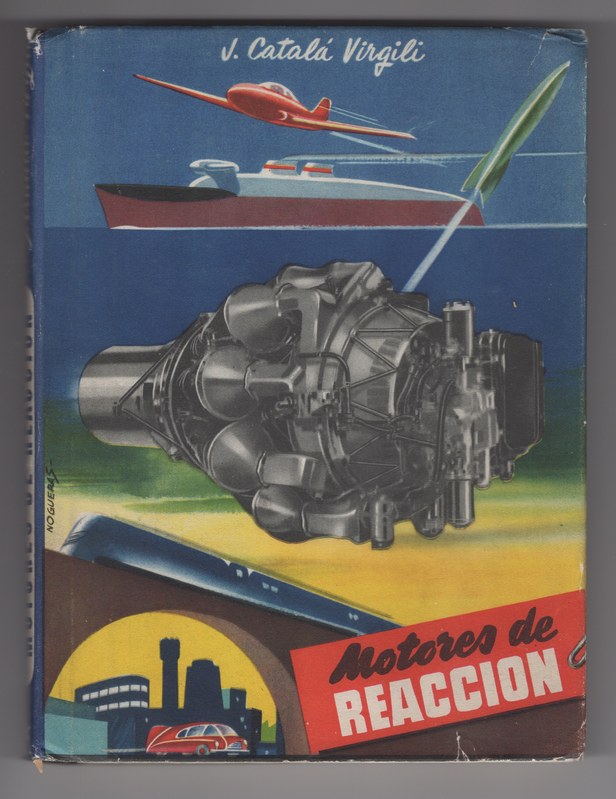
Motores De Reacción.
Subtitled on the title page “con 175 grabados y esquemas, 5 grandes láminas y varias tablas comparativas.” Published by Motores, Aribau 1, Barcelona, 1948. The prologue calls the appearance in Spain of a book on motores de reacción a revelation, noting that Spanish readers had until then had to rely on scattered technical-magazine articles and foreign sources not yet translated, and it asks whether the reaction motor is anything more serious than recreational fireworks and the modern war rocket.After an Introduction and a historical summary (“Resumen histórico”), the book proceeds to the thermodynamics of gas flow and the exhaust nozzle, with formulae and worked examples, then to the individual reaction engines, and it includes some of the first descriptions and illustrations of the V-1 and V-2 weapons in Spanish. Two exemplars are in the collection.
Full entry ›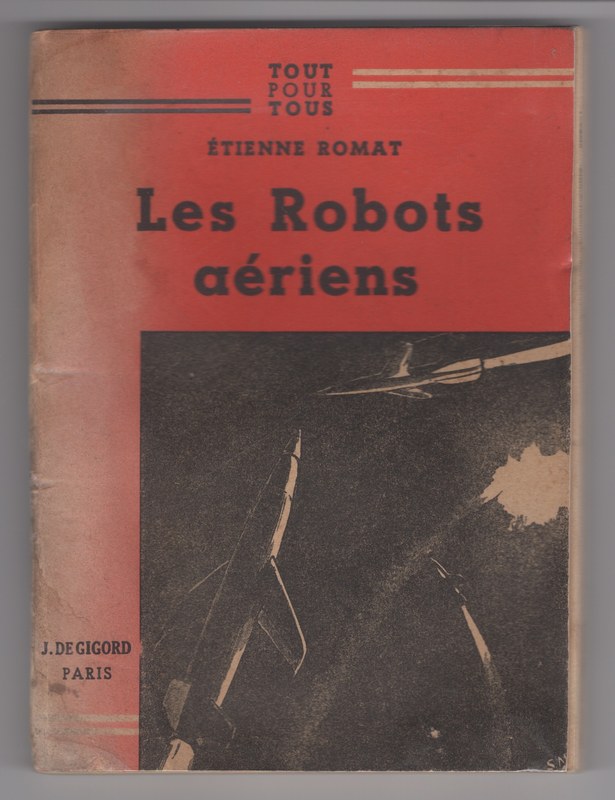
Les Robots Aériens.
Published in the series Tout pour Tous by J. de Gigord, 15 rue Cassette, Paris VI, printed by A. Marchand (edition no. 266). The author is Etienne Romat, as the title page and the series advertisement on the back wrapper both print it. An early French account of the German V-weapons and their successors, first edition.Eight chapters run from “Classification et modes de propulsion” through “La bombe volante V 1,” the Allied air attacks on the V 1 launching sites, “La V 2 et la Super V 2, fusées de bombardement intercontinental,” radio-controlled aircraft, glide bombs, and self-propelled, remote-controlled projectiles, to “L’emploi des engins autopropulsés dans la guerre de demain.” Line drawings and sectioned diagrams of the flying bomb, aircraft and missiles are set in the text, with a few photographs. This copy is stained and has old tape repairs to the endpapers.
Full entry ›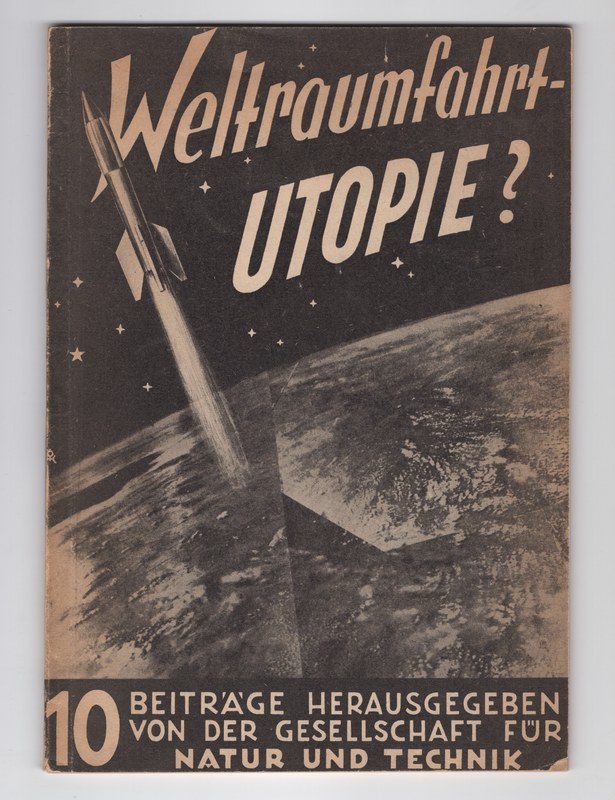
Weltraumfahrt - Utopie?
Zehn Beiträge, herausgegeben von der Gesellschaft für Natur und Technik, with 54 illustrations, copyright 1948 by the Verlagsbuchhandlung Natur und Technik, Vienna, printed by Gloria (R. Kaspar & Co.). The cover design and text drawings are by Prof. Oskar Kaudelka. The publisher’s foreword explains that the papers first appeared in the magazine Natur und Technik and were gathered because no German-language book on spaceflight had appeared since Willy Ley’s Die Möglichkeit der Weltraumfahrt (1929), Oberth’s Wege zur Raumschiffahrt (1929) and Sänger’s Raketenflugtechnik (1933), all of which are in Catalog A. It adds that the cover picture already includes a composite photograph of the Earth from a height of 160 km, showing the curvature of the globe.Part I, “Grundfragen der Weltraumfahrt,” and the closing “Der Zauberlehrling” are by Kurt Pervesler. Part II (projects): Robert Klumak, “Die Rakete zu den Planetenräumen”; Karl Wanka, “Der Schuß zum Mond”; Guido Pirquet, “Die Außenstation, das Sprungbrett ins Weltall”; Ferdinand Cap, “Mit Atomkraft ins Weltall.” Part III (practice): Friedrich Schmiedl on rocket mail, Erich Dolezal on the V-2 and its successors, Manfred Stein on propellants and Viktor Oberguggenberger on the V-2 in upper-atmosphere research. Part IV, by Theodor Wense, is a medical look at human spaceflight. Schmiedl’s rocket mail is also honored in Kessler’s Rocket Airmail Stamps in Catalog A.Schmiedl’s article (pp. 30–32) ends with a dated list of rocket-mail flights by country. Its entry for 2 July 1936, the first international flight, between the United States and Mexico, names “H. Goddard” as the experimenter. The flight was in fact the work of sixteen-year-old Keith E. Rumbel at McAllen, Texas, and is commemorated in the souvenir volume First International Rocket Air Mail Flight in Catalog B. Volume 8 of Billig’s Rocket Mail Catalogue (1955, Catalog E) makes the same attribution to Goddard, and its Volume 8A corrects it. This 1948 list is the earlier of the two, and the page does not show whether either drew on the other. Stephen H. Smith, the author of Billig’s Volume 8, appears in the same list as the experimenter of the Indian flight of 30 September 1934.
Full entry ›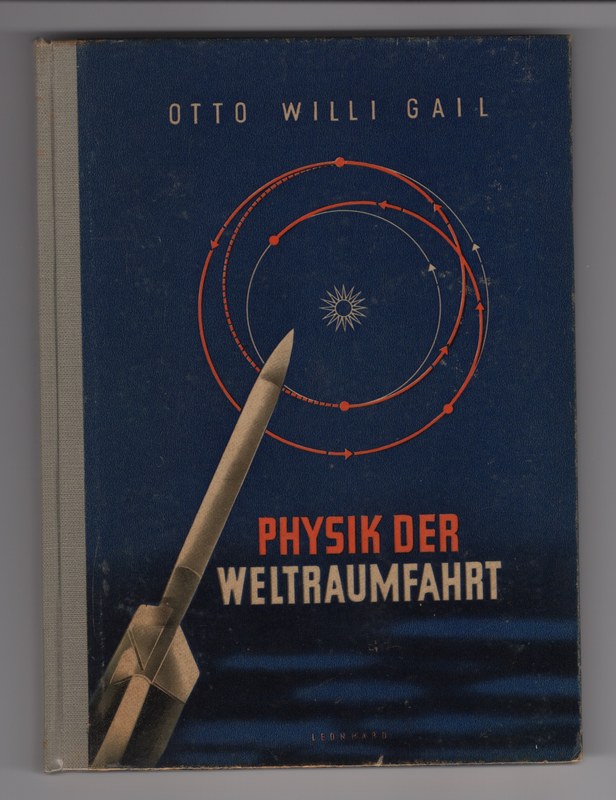
Physik Der Weltraumfahrt.
Volume 2 of the “Erforschte Welt” (Explored World) series, published under Allied Military Government License Nr. US-E-120. Gail’s foreword, dated Munich, summer 1948, reflects on technology’s capacity for both good and destruction in the war’s aftermath.Fourteen chapters work through the physics of rocket flight — recoil, escape velocity (11.2 km/sec), orbital trajectories, propulsion, weight versus mass, and the hazards of space — explicitly rejecting Jules Verne’s cannon-shot Moon voyage as physically impossible in favor of rocket propulsion, and closing with data tables and a glossary covering figures such as Tsiolkovsky and Max Valier.Gail (1896–1966), Munich-trained and a prolific writer of both technical science fiction and popular-science books translated across Europe, is represented elsewhere in the collection by his earlier novels Hans Hardt’s Mondfahrt, Mit Raketenkraft Ins Weltall, and By Rocket To The Moon.
Full entry ›
Voyages To The Moon.
Sequel to Nicolson’s A World in the Moon (1935), which dealt with the Moon as an inhabited world. Here she follows the idea of flying there through the literature of the seventeenth and eighteenth centuries, a project that grew from a 1937 sabbatical at the Huntington Library and the Maggs Brothers aeronautica collection it holds.Six chapters, “The Discovery of a New World,” “Supernatural Voyages,” “Flight by the Help of Fowls,” “Wanton Wings,” “Flying Chariots” and “Variations on a Theme,” follow a prologue and precede an epilogue, a bibliography of some thirty pages and an index. Illustrated with plates of early flying-machine engravings. Dedicated to her Smith College students in “Science and Imagination,” 1936–1941.
Full entry ›
From The Rocket To The Reactive Airplane.
Issued by the Committee on Cultural and Educational Institutions under the Council of Ministers of the RSFSR, Lecture Propaganda Administration, Moscow, 1948. The imprint records that it was approved for printing on 6 April 1948 in an edition of 50,000 copies, printed at Yelets. The epigraph, from N. A. Voznesensky’s report on the 1946–1950 five-year plan, singles out “the development of jet technology” as one of the new fields to be developed.The short introduction, “Vmesto vstupleniya,” presents the jet engine as a revolution in aviation and notes the propeller-aircraft speed record of 755 km/h against 975 km/h for jets. The sections that follow cover “A New Heat Engine,” the liquid-fuel rocket engine, the turbo-compressor engine and a closing “From Rocket to Rocket.” Bulatov’s From Rocket to Jet Aircraft (1949), a similar popular lecture, is also in this catalog.
Full entry ›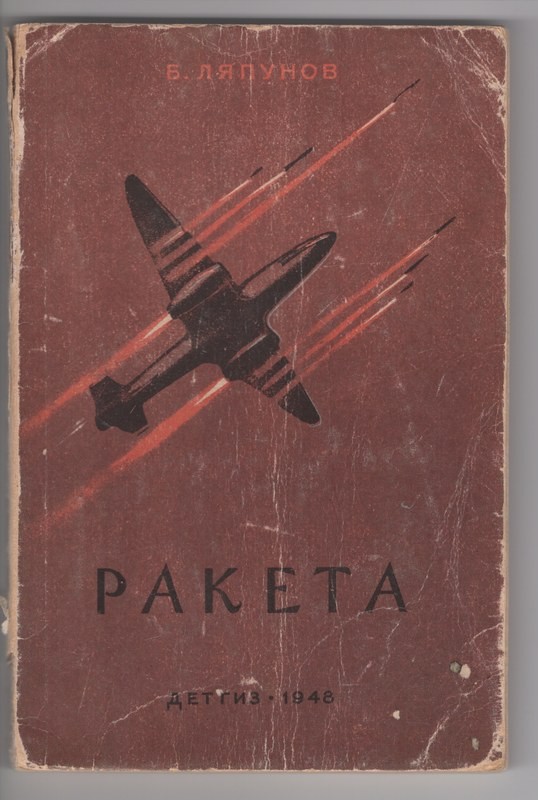
Rocket.
Popular account of jet propulsion for middle and older school-age readers, from the state children’s publishing house. Eight chapters cover the rocket as weapon, the science of the rocket, the rocket engine, the interwar years, the rocket at war, the new aircraft engine, jet aircraft, and a look into the future, with a short conclusion. The preface honors the Russian pioneers Konstantinov and Tsiolkovsky and the wartime Katyusha rocket launchers, and the text carries portraits of Kibalchich and Zhukovsky.Illustrated with photographs of rocket batteries and rocket-armed aircraft, engine diagrams, and a V-1 cutaway. Cover and vignettes by K. Artseulov. Liapunov’s later Rockets (1950, Catalog D) from the same publisher is also in the collection.
Full entry ›
Tsiolkovsky: Stenographed Lectures.
Stenographic record of a public lecture on Tsiolkovsky (1857–1935) given by Prof. A. A. Kosmodemyansky in the central lecture hall of the All-Union Society for the Dissemination of Political and Scientific Knowledge in Moscow, edited by Prof. B. N. Vorobev, in a printing of 100,000 copies. Frontispiece portrait of Tsiolkovsky; the text is illustrated with diagrams of his 1914 and 1915 liquid-propellant rocket designs and a cross-section of a schematic model of his rocket.Kosmodemyansky’s biography of Tsiolkovsky appeared a year later (also in this catalog), and Vorobev wrote his own Tsiolkovsky (Catalog B). Two exemplars in the collection.
Full entry ›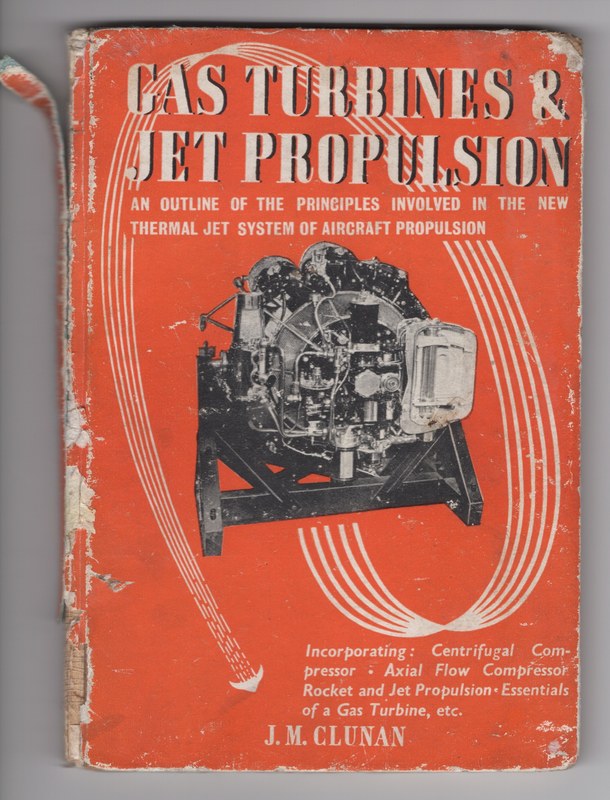
Gas Turbines And Jet Propulsion.
An elementary outline of the gas turbine and the “thermal jet” system of aircraft propulsion, explained by everyday analogies and simple mathematics. The back cover lists its topics, including centrifugal and axial compressors and the Nene and Derwent engines. On pages 10–12 Clunan separates jet propulsion from rocket propulsion: a rocket carries its own propellants and works best in a vacuum, which he says makes interstellar travel by rocket feasible.
Full entry ›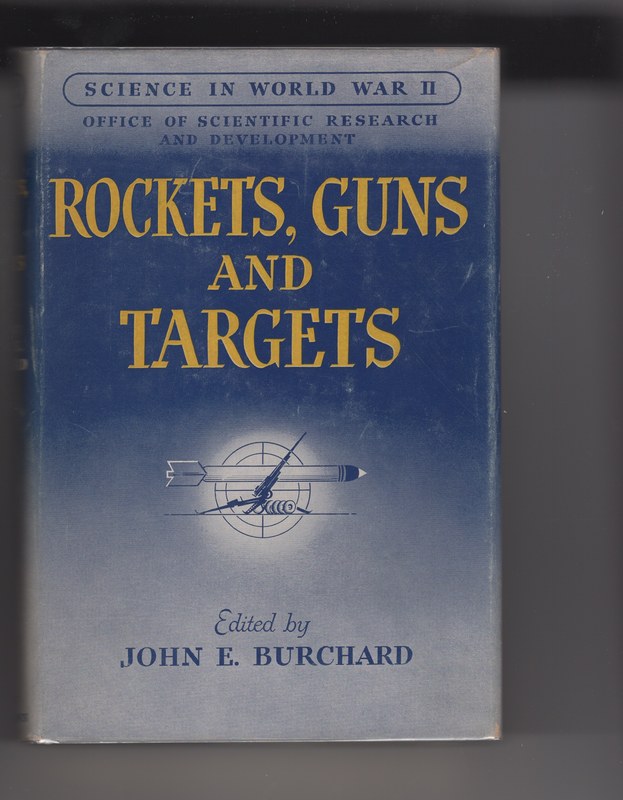
Rockets, Guns And Targets.
One of eight volumes in the official OSRD’s series Science in World War II. Discusses development of rocket weapons in the U.S. such as recoilless guns, hypervelocity projectiles, and describes ballistics of rockets. The other volume in the series devoted to rocketry (New Weapons For Air Warfare, 1947) is also available in this collection.
Full entry ›
FeaturedRocket Ordnance in Action
›
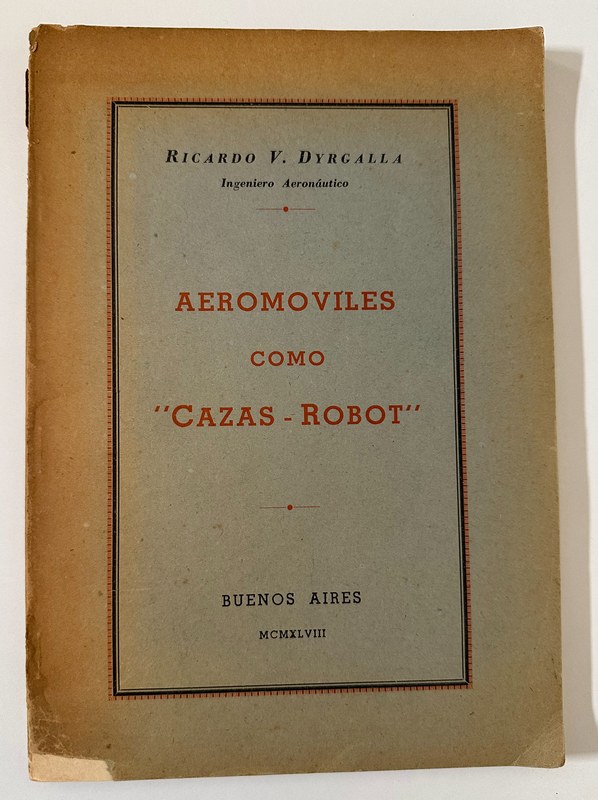
Aircraft as Fighter Robots.
A Spanish-language survey of the German guided missiles of World War II by Ricardo V. Dyrgalla (1910–1970), a Polish aeronautical engineer and glider pilot. He fought in the Polish Air Force in 1939, escaped to France and then Britain, and flew Spitfire photographic-reconnaissance missions with the RAF. After the war he stayed on, joining the Rocket Propulsion Group at the Royal Aircraft Establishment, Farnborough, which studied captured German weapons, including the V-2 and the Enzian missile. In 1946 he was recruited to Argentina and joined the Instituto Aerotécnico in Córdoba, where he wrote this book from the manuals and notes he had brought with him. There he headed the special projects division that redesigned the Enzian as the AM-1 Tábano and built Argentina’s first rocket engine; the project was cancelled in 1951.His prologue says the great powers were in a clandestine race to build guided projectiles, as carriers of atomic bombs or as “robot” interceptors. The first chapter argues that the bomb will be delivered by V-2 type rockets with television homing and that the only defence will be equally fast guided interceptors, and it surveys guidance, fuzing and booster launch.Later chapters cover aerodynamics; individual weapons with specifications and line drawings (Enzian, Wasserfall, the winged A-9 and A-10 versions of the V-2, Rheinbote, Rheintochter, Schmetterling, X-4, Hecht, Feuerlilie, Henschel Hs 293, 294 and 298, Blohm & Voss Bv 246, Natter, and British and American projects such as Bat, Gorgon, Gargoyle, Roc and the Northrop flying wing); rocket motors (Walter HWK 109-509, BMW acid system); and fuels, with appendices including a table of German propellant code names and a large folding cutaway of the V-2. A passage on peaceful uses looks ahead to multi-stage rockets and interplanetary flight and cites the British Interplanetary Society and the American Rocket Society.His later work is in the Catalog D card for El Primer Motor-Cohete Argentino (1958). Dyrgalla’s life is told in Pablo de León’s Historia de la Actividad Espacial en la Argentina, Tomo 1 (Reference Shelf).
Full entry ›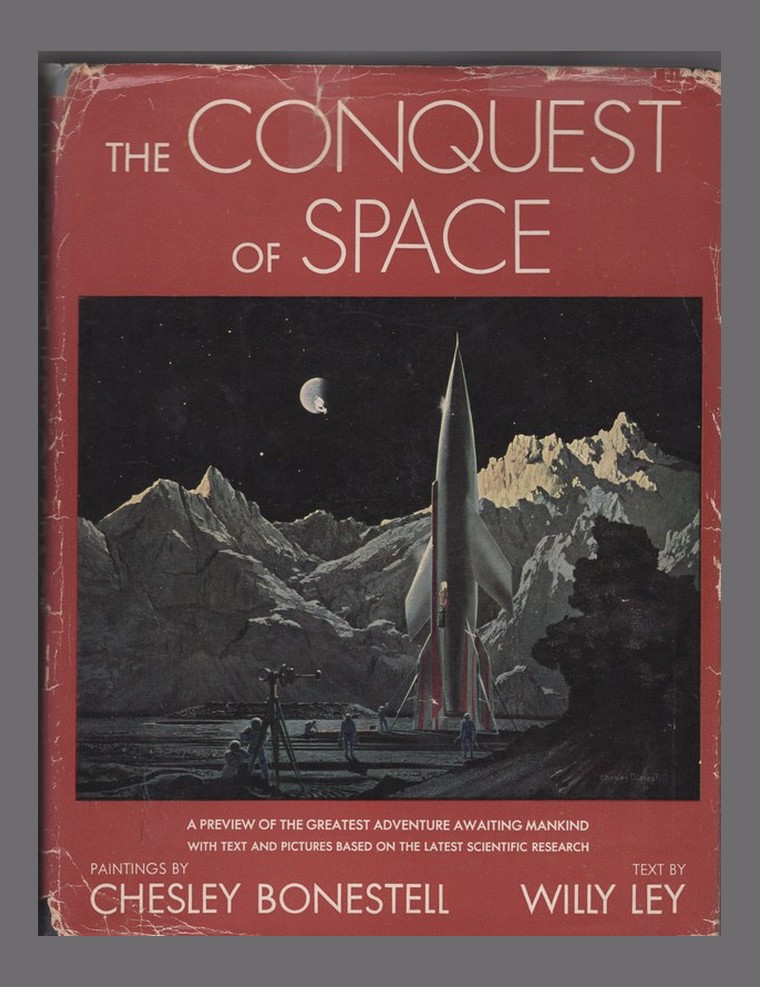
The Conquest Of Space.
More than fifty Bonestell paintings of the Moon, planets and their satellites, set in four sections of plates and made in consultation with astronomers at Mount Wilson and Palomar. Ley’s text, in four chapters, covers the launch and the rocket ship, the Moon, the solar family and the “vermin of the skies” (asteroids, comets and meteors).The introduction explains who did what: the text and line drawings are Ley’s, the paintings Bonestell’s, the captions written by both. This is the classic coffee table book that inspired so many careers in aerospace.
Full entry › FeaturedThe Conquest of Space
›
Weltraumflug.
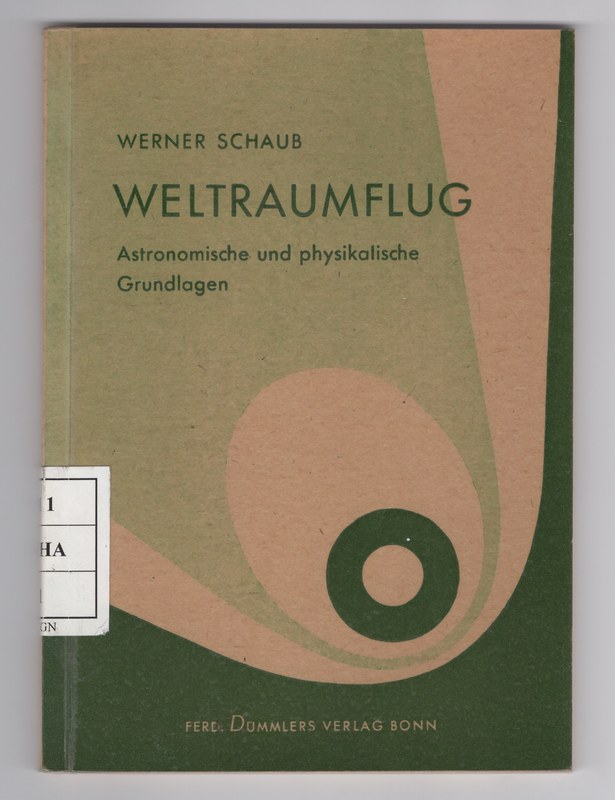
Full title: Weltraumflug: Physikalische und astronomische Grundlagen. Eine Studie zur Himmelsmechanik, by Prof. Dr. Werner Schaub, “mit 20 Abbildungen im Text und einer Formelzusammenstellung im ergänzenden Anhang.” Copyright 1949 by Ferd. Dümmlers Verlag, Bonn, printed by Dr. Fr. Middelhauve, Opladen, on the coarse paper of the postwar years.The eleven sections begin with “Was bindet uns an die Erde?” and the overcoming of gravity, take up the artificial moon, the voyage into space, the atmosphere as protection and hindrance, static, dynamic, projectile and rocket flight, the neutral point between Earth and Moon and the Sun as a fetter, and end with a “Kritischer Ausblick” and an appendix collecting the formulae.
Full entry ›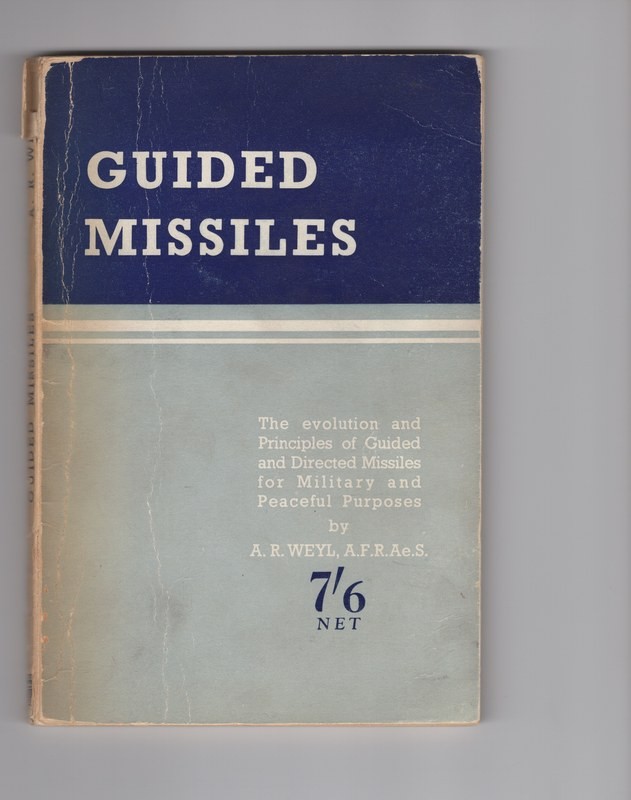
Guided Missiles.
A. R. Weyl’s survey of guided missiles, first published by Temple Press in 1949. The Foreword is by A. V. Cleaver, Chairman of the British Interplanetary Society, dated July 13, 1949: he compares the history of guided missiles to a history of aviation written in 1920, stresses their defensive and research uses, and foresees satellite space stations and eventually interplanetary vehicles growing out of the early rocket projectiles.Six chapters cover the principles and constituents of guided missiles; their origins (British, French and American efforts); the development of operational robot aircraft, including the story of the V-1; operational long-range rockets, including the V-2 and the BMW liquid-propellant engines; the smaller types, among them Russian rocket technique, German guided bombs, flak rockets and air-to-air robots; and the present and future, from defence economy to peaceful applications. Appendices give design characteristics, code names for rocket propellants and a list of belligerent uses of guided missiles.Temple Press also published Arthur C. Clarke’s Interplanetary Flight, held in Catalog D.
Full entry ›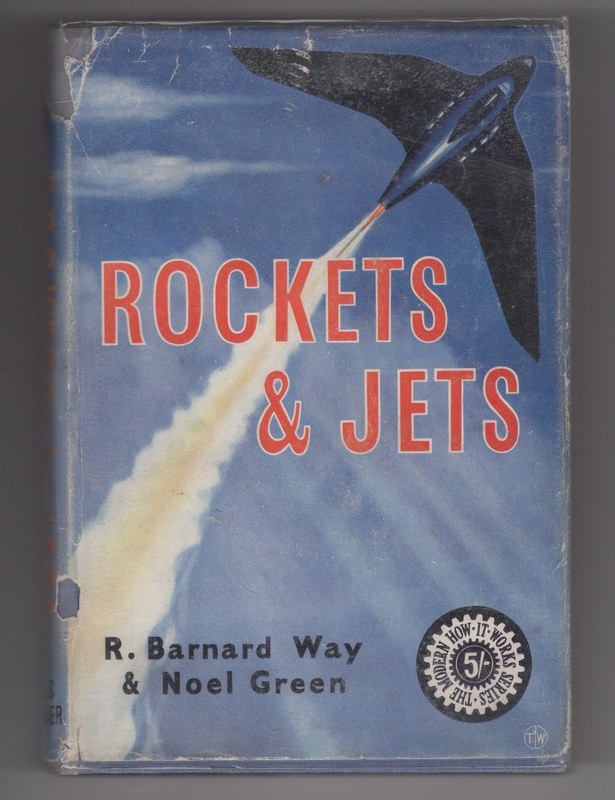
Rockets And Jets.
A popular introduction to rocket and jet propulsion compiled by R. Barnard Way and Noël D. Green, A.M.I.Mech.E., with drawings and diagrams by Way. The authors’ Introduction states at once that it is not a textbook but a book for anyone who wants to know a little more about the “new” forms of transport, which on inspection turn out to apply old principles. A color frontispiece shows jet-powered de Havilland Vampires over the Alps.Eleven chapters cover the rocket in history, how the rocket works, rocket fuels, rocket motors and the rocket voyage, then duct motors, the gas turbine, the jet engine and jet engines in particular, the propeller jet, and a closing look at the future. Many line drawings explain motor layouts and German wartime designs. Not to be confused with Herbert Zim’s Rockets and Jets of 1945, held in Catalog B.
Full entry ›
High-Altitude Research With V-2 Rockets.
Ernst H. Krause of the Naval Research Laboratory’s review of the first year of V-2 upper-atmosphere research in the United States, printed on pages 189–207 of the Annual Report of the Smithsonian Institution for 1948 (with six plates). The note on the first page records that it was read on April 25, 1947 and reprinted by permission from the Proceedings of the American Philosophical Society, vol. 91, no. 5, December 1947. This copy is a rebound offprint, in brown cloth boards with a printed paper label on the cover.Krause argues that rockets overcome both limits of the balloon: a ceiling of 30–40 km and a payload of about 100 pounds, against 1,000 pounds to 200 km or more for a rocket. He describes the V-2 (about 46 feet high, 28,000 pounds fueled, 9,000 empty, carrying about 2,000 pounds of payload) and the V-2 Panel that coordinated the work among the Army Ordnance Department, General Electric, the Naval Research Laboratory, Michigan, Johns Hopkins, Princeton, Harvard, Caltech and others. The experiments covered include solar ultraviolet spectra, cosmic rays, pressure and temperature, and telemetering, illustrated with photographs of the missile and instrument installations and with data plots. A list of 40 references closes the piece.
Full entry ›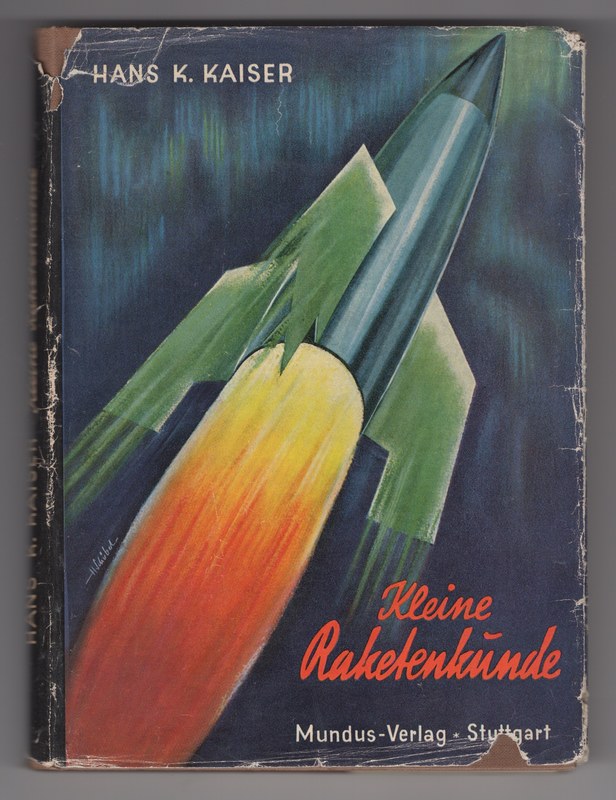
Kleine Raketenkunde.
Volume 5 of the Mundus-Verlag series Quellen des Wissens, printed in October 1949 with 91 illustrations and a jacket by Hermann Schübel. The Introduction recalls that the first reports of German rocket achievements surfaced only in the last year of WWII and were quickly veiled again; the book aims to explain the principles of rocket technology, trace the rocket’s history to the present, and show what further development might bring. A frontispiece portrait of Hermann Oberth is accompanied by an epigraph from him on the inventor’s path.After a short history of the rocket and a chapter on how it works, including a vision of the voyage into space, the book describes the start of scientific rocket research in 1920–1930: Goddard, Oberth, other theorists in Germany and Austria, powder-rocket experiments, liquid-fuel rockets, foreign work and Eugen Sänger’s research. The modern development then covers powder rockets, Germany’s large rockets of the second world war and the latest developments abroad, followed by present and future tasks, an annotated bibliography of books in German, English, French and Russian (plus novels and films), a small rocket lexicon, and name and subject indexes. Two exemplars in the collection.
Full entry ›
Rocket Propulsion Elements.
The first English-language engineering textbook to treat rocket propulsion systematically, grown out of an upper-division course Sutton taught through the UCLA Extension Division. Sutton was Supervisor of Propulsion Development at North American Aviation, and the manuscript was submitted to military authorities for security clearance before publication, since much of the underlying data on rocket engines was still classified.Chapters cover nozzle theory and thermodynamics, propellant performance calculations, liquid and solid propellant systems, feed systems, flight performance, and rocket testing, illustrated with contemporary material including a V-2 power-plant flow diagram and photographs of White Sands test launches. First published in 1949, the book went through repeated revisions over the following decades and remains, in a later edition, the standard English-language textbook on rocket propulsion.This copy is the first printing of the first edition, retaining its dust jacket; the second printing and the second edition (1956) are also in the collection.
Full entry ›
Rocket Propulsion Elements.
Second printing of the first edition. The first printing (also 1949) and the second edition are also available in this collection.
Full entry ›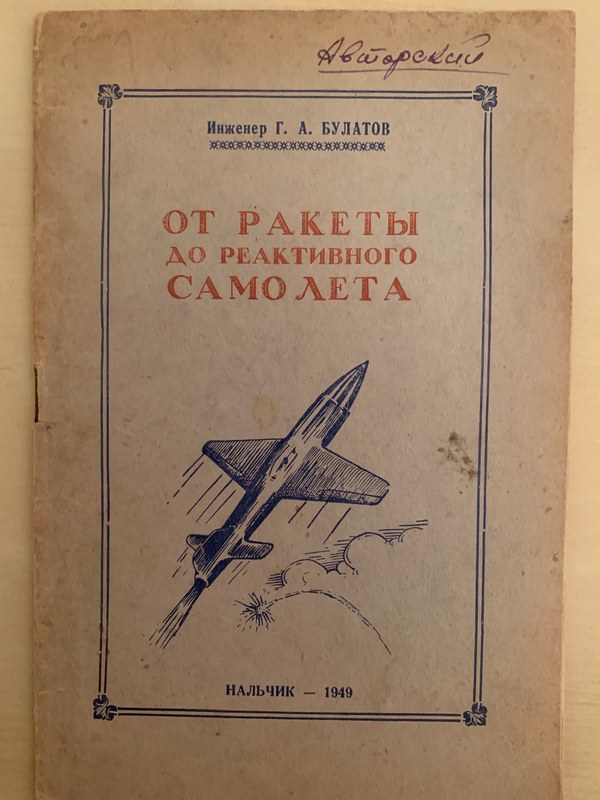
From Rocket To Jet Aircraft.
A provincial popular lecture, subtitled The Application of the Jet Principle in High-Speed Technology, issued by the Republican Lecture Bureau of the Kabardian ASSR’s Council of Ministers and edited by B. E. Tikhomolov, Hero of the Soviet Union. The editor’s foreword presents it as a text for district lecturers and for DOSAV aviation propaganda, the first brochure of its kind in the Kabardian republic, and notes that no such literature existed in the Kabardian language.Its seven short chapters cover the principle of reaction, the history of the rocket, Russia as the birthplace of jet propulsion, rocket artillery, the paths of aviation development, jet engines and jet aviation, with line drawings of rockets, engines and jet aircraft. The bibliography cites Liapunov’s Rocket, Tsiolkovsky’s Works on Rocket Technology and Kosmodemyansky’s lecture on Tsiolkovsky, all in this catalog.Printed by the Kabardinskaya Pravda press (approved for press 12 June 1949); 2,000 copies. This copy bears a pencil dedication from the author.
Full entry ›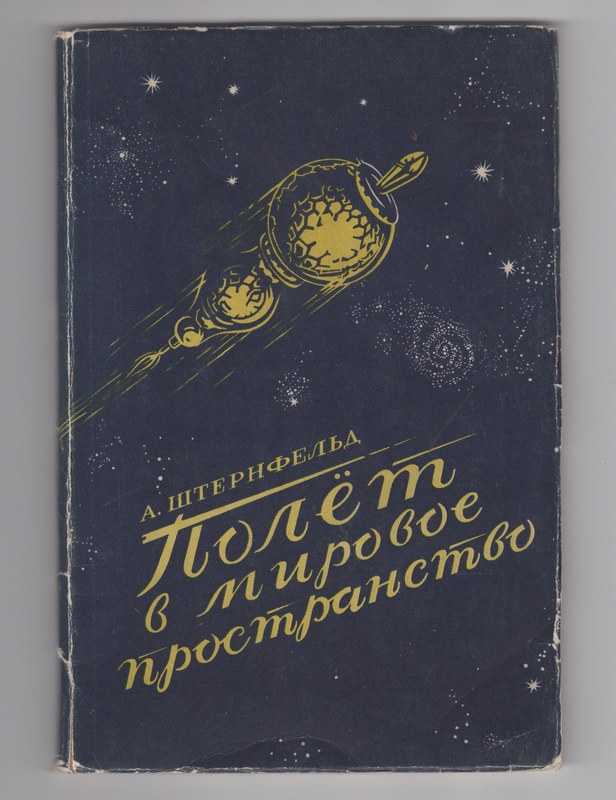
Flight Into Universal Space.
Sternfeld’s popular introduction to cosmonautics, Polyot v mirovoe prostranstvo, published by the State Publishing House of Technical and Theoretical Literature, Moscow-Leningrad, 1949. The verso credits the drawings to the artist N. M. Kolchitsky, made from Sternfeld’s own sketches and instructions, with G. A. Volpert as editor, and the book was sent to press on 31 May 1949. The French edition (1954), Le Vol dans l’espace cosmique, is also in the collection.The short preface sets out the aim: a brief survey of the state of cosmonautics for a wide readership, with the mathematics left out and Tsiolkovsky, Zander, Kondratyuk and Sternfeld’s own 1937 Introduction to Cosmonautics recommended for those who want the calculations. Thirteen chapters follow, from “The Eternally Young Dream of Mankind” and the passage through the atmosphere, through heavy gravity and weightlessness, the path from utopia to the science of space flight, the history of the rocket and its uses on Earth, the stratospheric and cosmic rocket, and life aboard a spaceship, to interplanetary flights, signalling across space, “Toward the Constellation Centaurus,” and a closing chapter titled “Yesterday’s Utopia — Tomorrow’s Reality.”Line drawings and half-tone illustrations are set in the text, including diagrams of orbits and a table of planetary data. The front cover shows a spaceship passing nebulae on a blue-black ground.
Full entry ›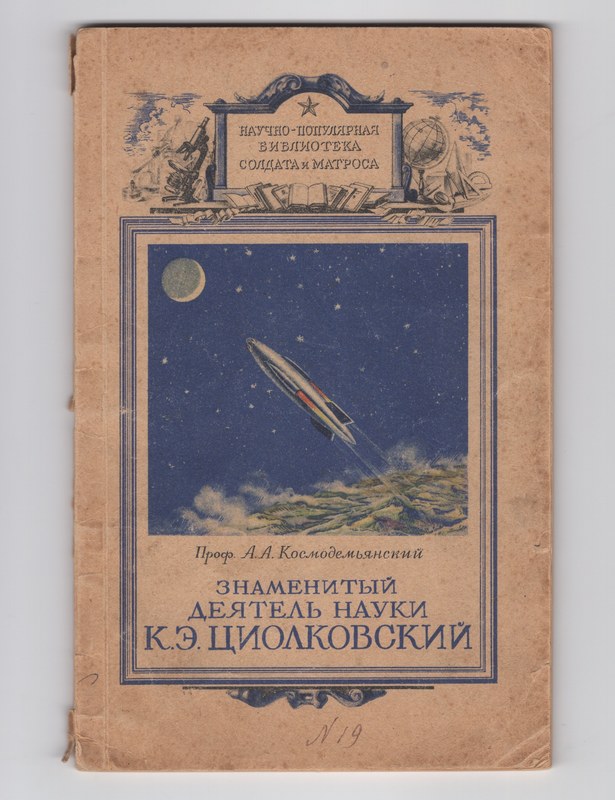
Biography: The famous scientist Konstantin Tsiolkovsky.
Part of the Voenizdat series Scientific-Popular Library of the Soldier and Sailor, written by Kosmodemyansky for Soviet Army personnel (preface dated Moscow 1945–1948; approved for press November 1948). The preface presents Tsiolkovsky as the founder of the modern theory of jet propulsion, whose all-metal dirigible, aeroplane and rocket projects are now being realised in jet aircraft and long-range rockets, and credits his pupils in Soviet aircraft design.The text opens with a frontispiece portrait and a biography from his birth in the village of Izhevskoe, Ryazan province (1857), and the closing page urges soldiers to dream, calculate and experiment, quoting his motto that the impossible of today will be possible tomorrow.Kosmodemyansky’s Stenographed Lectures on Tsiolkovsky (1948, also in this catalog) cover the same subject as a public lecture, and he would edit the Russian edition of Ballistics of the Future a year later. Two copies in the collection.
Full entry ›
Nota Informativa Sulla Propulsione A Reazione E Sul Pilotaggio Dei Velivoli A Reazione.
Quaderno di cultura no. 11, issued by the Air Force General Staff’s Studies Office in June 1949 in 500 copies. Written for flying personnel in plain terms, with the mathematics reduced to a minimum.The first chapter surveys reaction engines, with rocket propulsion given only a short section beside the ramjet, turbojet and turboprop. Further chapters treat thrust, power and propulsive efficiency; turbojet components (compressor, turbine, combustion chambers) and their drawbacks; and a long final chapter on piloting jet aircraft, covering Mach and compressibility effects, takeoff and landing, high-altitude flight, navigation and formation flying. Illustrated with diagrams and graphs, and closing plates of British and American turboprops and turbojets.
Full entry ›
The Atmospheres Of The Earth And Planets.
Papers presented at the 1947 Yerkes Observatory Symposium. Several papers on the study of the upper atmosphere using captured V2 rockets.
Full entry ›
Physics And Chemistry Of Reactive Motion.
Three collections of articles from English, French and German journals, edited by Prof. A. S. Sokolik: Volume 1 (1948), Volumes 2 and 3 (1949). Volume 1 covers rocket theory, combustion, propellants and oxidizers, and the V-2 as a long-range rocket. Volume 2 covers solid and liquid propellants, nitromethane and concentrated hydrogen peroxide, with an essay by Clauser on flight beyond the atmosphere. Volume 3 turns to combustion in aircraft gas turbines and turbojets.
Full entry ›