Mercury
1958 – 1963
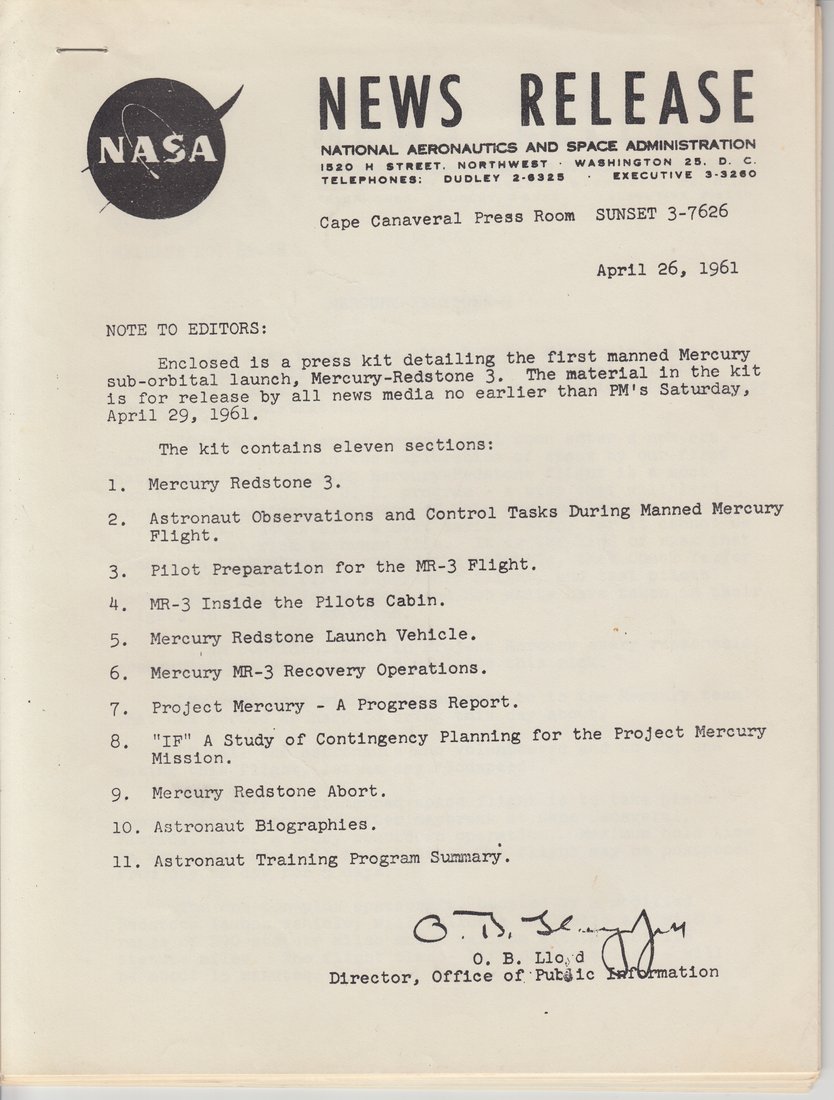
Mercury-Redstone Launch Press Kit (MR-3)
NASA press kit for Mercury-Redstone 3, the first American manned spaceflight (Alan Shepard, May 5 1961). Cover sheet dated April 26 1961, addressed to editors ahead of the embargoed release, listing the kit's eleven sections; section 8, “'IF' A Study of Contingency Planning for the Project Mercury Mission,” reproduces the booklet catalogued separately below.
Cape Canaveral Press Room letterhead, credited to O. B. Lloyd, Director of the Office of Public Information.
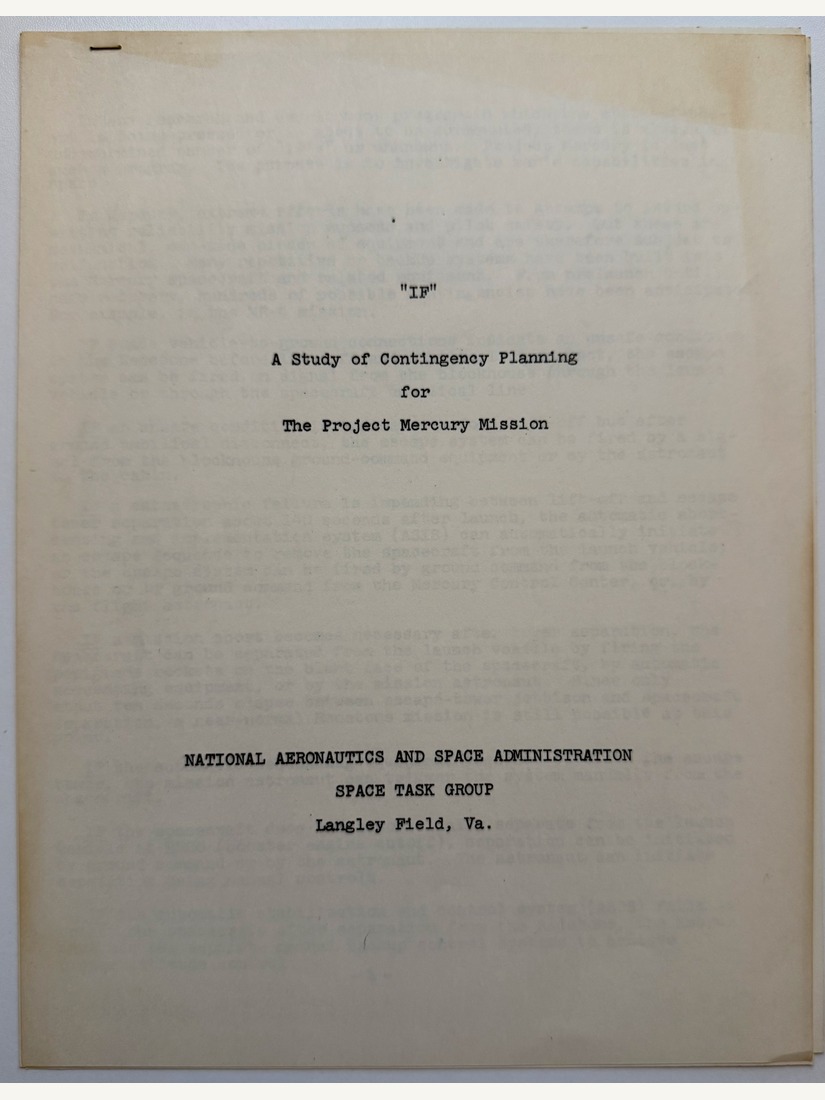
“IF”: A Study of Contingency Planning for the Project Mercury Mission
Undated public-information booklet from the Space Task Group at Langley Field, written as “a primer for the layman” explaining the redundant and manual-backup systems built into the Mercury-Redstone spacecraft, using the MR-4 mission as its running example. Structured as a long series of “IF…then…” contingencies — escape-tower and automatic abort-sensing (ASIS) backups, environmental control, power, and communications redundancy, and the full parachute and recovery-aid sequence — it closes with a step-by-step narrative of the escape-tower firing sequence under the heading “Mercury-Redstone Abort.” Despite the MR-4 example, this booklet was reproduced as section 8 of the MR-3 press kit catalogued just above, issued ahead of Alan Shepard's May 5 1961 flight.
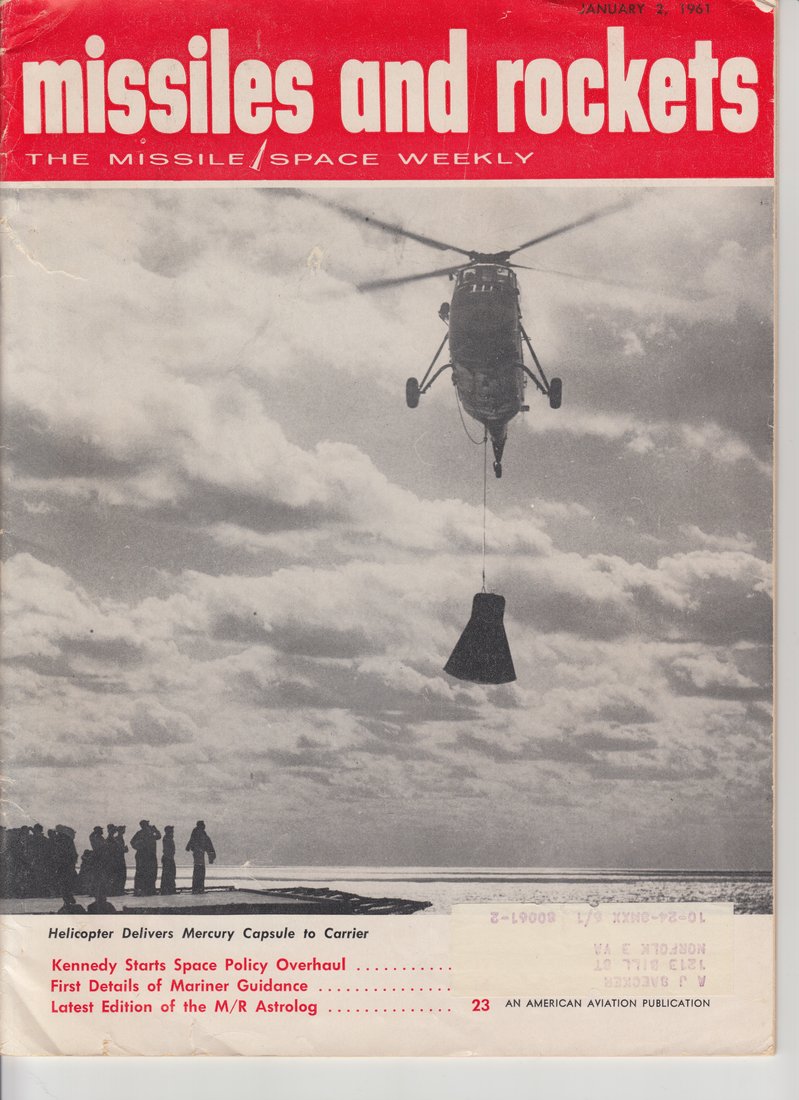
Missiles and Rockets, January 2 1961
Weekly missile/space trade magazine; the cover shows a Marine helicopter delivering the just-recovered MR-1 Mercury capsule to the carrier USS Valley Forge, alongside cover lines on Kennedy's incoming space policy review and the issue's "M/R Astrolog" status report. The lead feature, Jay Holmes's "Chimp to Go in Next Flight Test of Mercury," reports that a chimpanzee — not yet a man — would fly the next Mercury-Redstone ballistic shot (MR-2), with a manned flight (MR-3) still projected for as early as March but more realistically expected by mid-April 1961; it recaps the successful December 19, 1960 MR-1 flight (135-mile altitude, 235-mile range) and quotes NASA operations chief Walter C. Williams on the program's early troubles, the four production capsules then at the Cape, and lingering doubts about Atlas reliability following the July 1960 MA-1 failure. In the event, the chimpanzee flight became Ham's MR-2 mission of January 31, 1961. The issue's "M/R Astrolog" supplement, a running status report on U.S. missile and space programs, opens with a Satellites and Spacecraft table covering Advent, Anna, Aeros, Apollo, Arents, Asp, Bambi, Courier, Csar, Discoverer, Dyna-Soar I, and Echo — including Apollo's earliest published capsule description, a three-man spacecraft "probably winged for lunar flights" then still in six-month contractor studies.
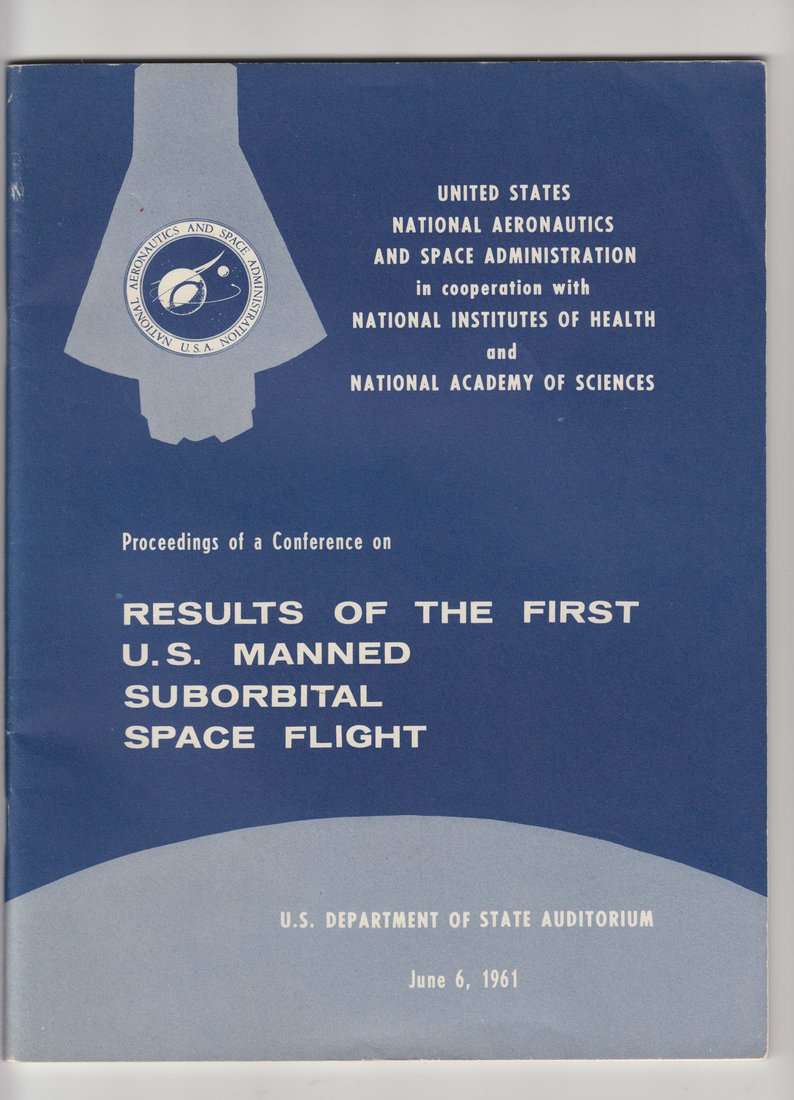
Results of the First U.S. Manned Suborbital Space Flight
Proceedings of the June 6 1961 conference on Alan Shepard's May 5 1961 Mercury-Redstone 3 suborbital flight, held at the US Department of State Auditorium. Opened by NASA Deputy Administrator Hugh L. Dryden and Space Science Board chairman Lloyd V. Berkner, with sessions chaired by Abe Silverstein, C.H. Roadman, and Walter C. Williams; concludes with Shepard's own pilot's flight report, including in-flight films, and Berkner's closing remarks.
Results of the Second U.S. Manned Suborbital Space Flight
NASA's report on the Mercury-Redstone 4 flight of Virgil I. “Gus” Grissom, launched July 21 1961, presented as a continuation of the material from the June 6 1961 public conference on Shepard's MR-3 flight. Seven sections cover Robert Gilruth's introduction, the spacecraft and flight plan (Jerome Hammack), Grissom's preflight and postflight medical examination, his inflight physiological responses, a combined flight surgeon's report for MR-3 and MR-4, inflight pilot performance studies, and Grissom's own pilot's flight report. A flight-plan table logs the mission's timeline from liftoff through the 15:37 splashdown.
We Seven — By the Astronauts Themselves
First printing, published by Simon and Schuster, New York, 1962; text copyrighted by Simon and Schuster, photographs by Time Inc. Opens with "Those Seven — An Introduction," built around the famous 1959 press-conference photograph of all seven Mercury astronauts raising their hands (Schirra and Glenn raising both) when asked who was ready to fly into space immediately. Each astronaut narrates his own chapters in turn — selection and training in "Six to Fill the Team" and "We All Pull Together," Shepard's suborbital flight in "The First American," Grissom's Liberty Bell 7 mission and its hatch mishap in "The Trouble with Liberty Bell," and the buildup to and conduct of Glenn's orbital flight in "Three to Make Ready," "The Mission," and "The Confirmation."
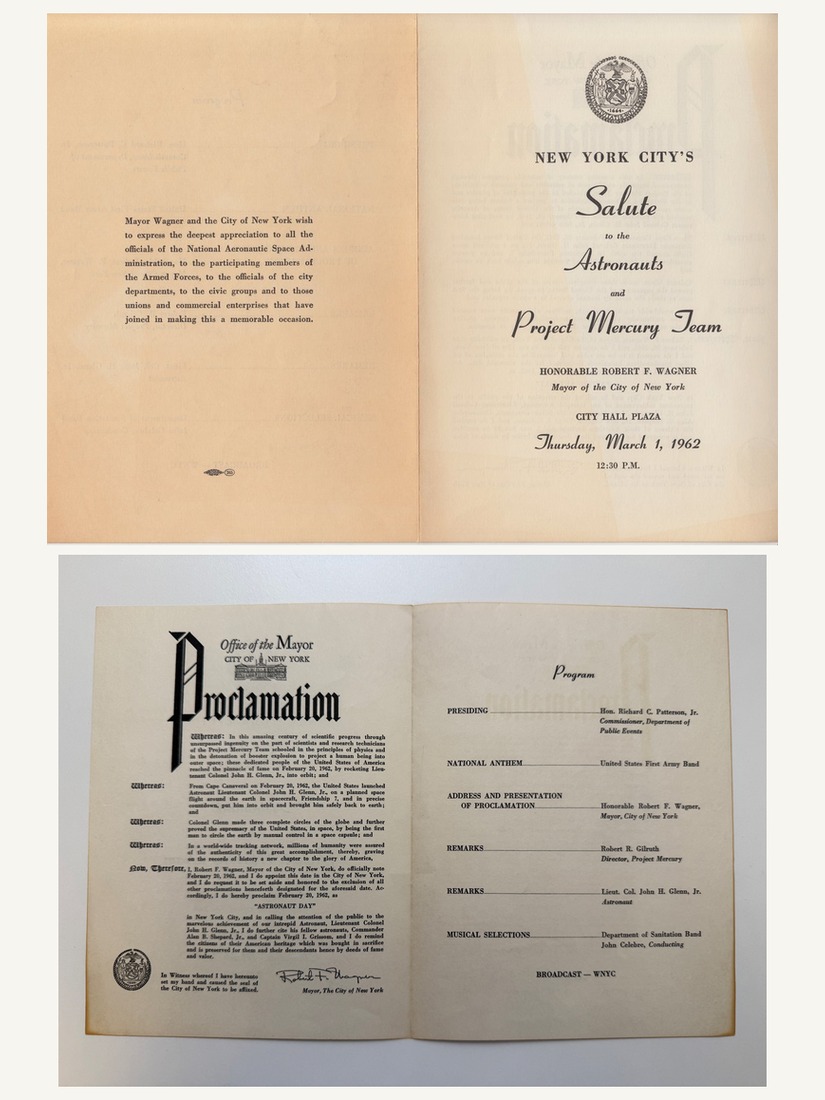
NYC Salutes the Mercury Astronauts, March 1 1962
Official City Hall Plaza program for New York's salute to the Project Mercury team, held eight days after John Glenn's orbital flight. The interior spread carries Mayor Robert F. Wagner's proclamation declaring February 20, 1962 “Astronaut Day” in the city, citing Glenn's three orbits of the earth aboard Friendship 7 and naming his fellow Mercury astronauts Alan B. Shepard, Jr. and Virgil I. Grissom, alongside the event program: the National Anthem performed by the United States First Army Band, an address by Wagner, remarks by Project Mercury director Robert R. Gilruth and by Glenn himself, and musical selections from the Department of Sanitation Band, broadcast over WNYC.
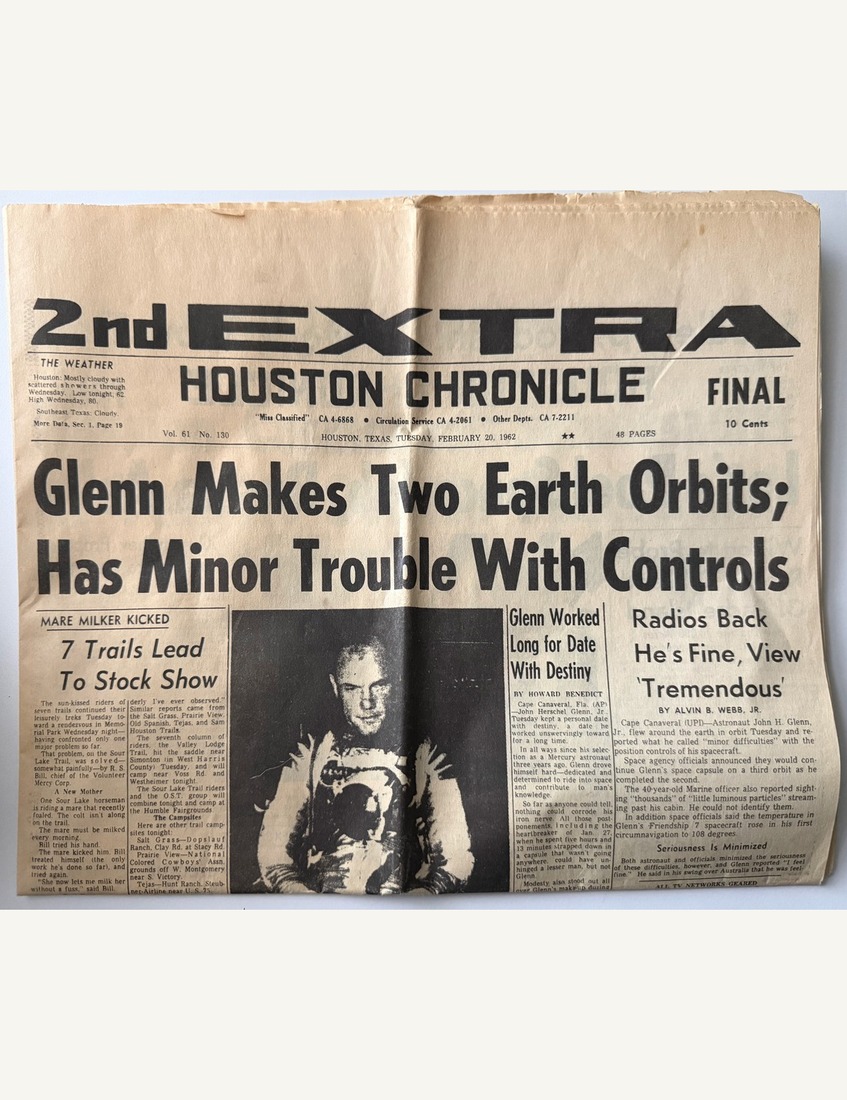
Houston Chronicle, "Glenn Makes Two Earth Orbits"
“2nd Extra” rush edition, published the same afternoon as John Glenn's February 20 1962 Friendship 7 flight, headlined “Glenn Makes Two Earth Orbits; Has Minor Trouble With Controls.” Printed mid-mission (Glenn went on to complete a third orbit), it reports the automatic control system fault that put part of the flight on manual control, the cabin temperature climbing to 108°F, and Glenn's sighting of “thousands of little luminous particles” streaming past the capsule (the “fireflies” observation later traced to ice shed from the spacecraft's exterior). Houston's Manned Spacecraft Center served as mission control for the flight.
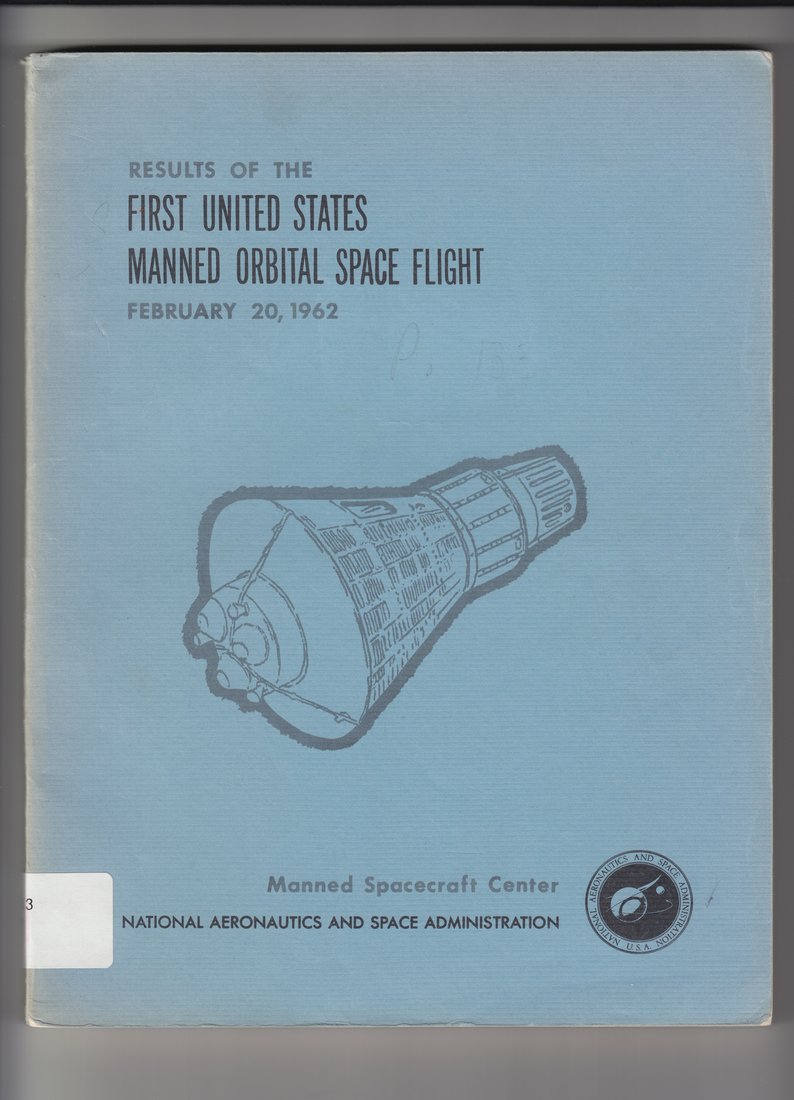
Results of the First U.S. Manned Orbital Space Flight
NASA's official report on John Glenn's February 20 1962 orbital flight, Friendship 7, presented as a continuation of the information already published on the two 1961 suborbital flights. Thirteen sections cover operation requirements and plans, spacecraft and spacecraft systems (by Mercury Project Manager Kenneth S. Kleinknecht and Deputy Manager William M. Bland, Jr.), life support and biomedical instrumentation, launch-complex checkout and launch-vehicle systems, spacecraft preparation, flight control, recovery operations, and aeromedical results, followed by astronaut M. Scott Carpenter's account of Glenn's preflight preparation, pilot-performance analysis, Glenn's own pilot's flight report, and a summary of results by George M. Low. Four appendixes give the Mercury network performance summary, the full MA-6 air-ground voice communications, Glenn's own account of his astronomical, meteorological, and terrestrial observations in orbit, and a preliminary space-science report by Goddard's John A. O'Keefe.
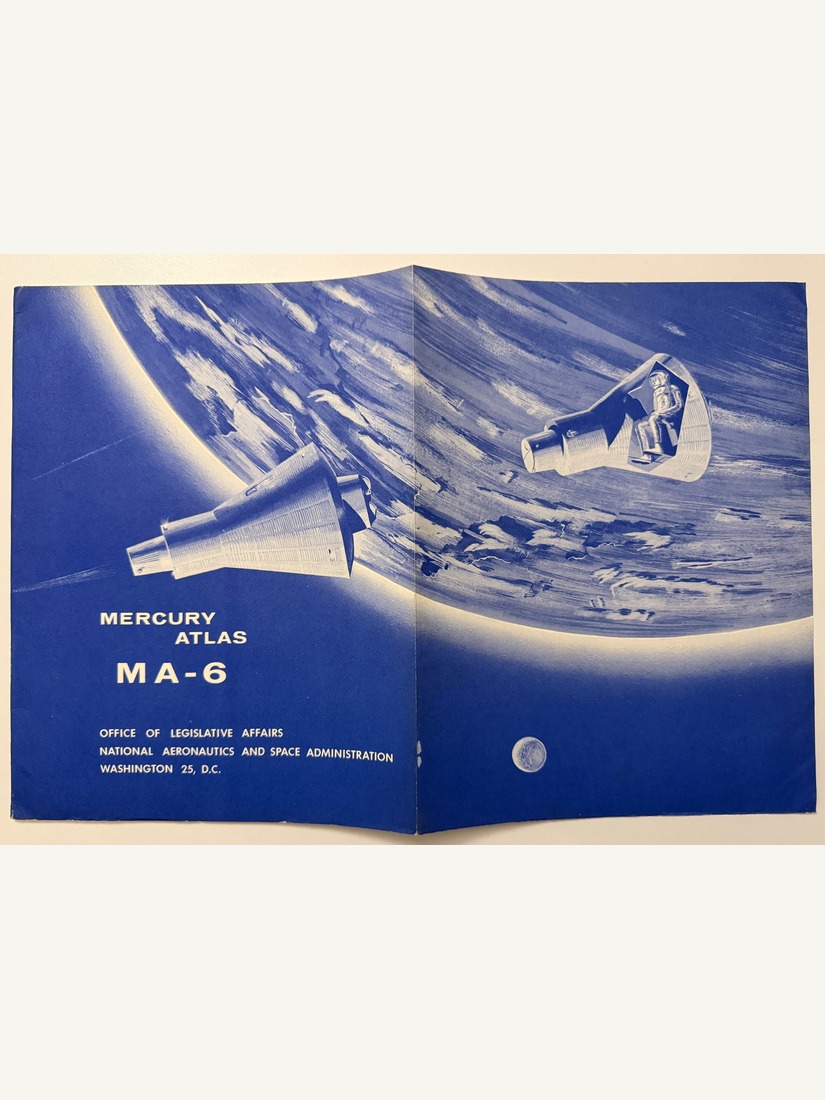
Mercury Atlas MA-6 Briefing Booklet, NASA Office of Legislative Affairs
Dated January 1962 and credited to Paul G. Dembling, Director of the Office of Legislative Affairs, this booklet was prepared for Congress to explain the significance of the coming first American orbital flight. It lays out the mission (evaluate a man-spacecraft system, investigate man's capabilities in space, and get the pilot's opinion on the spacecraft and its supporting systems), a launch date “currently scheduled no earlier than January 24, 1962” (the flight actually went up February 20), and the option of a one-, two-, or three-orbit mission decided only minutes before launch. Pilot John H. Glenn, Jr., a 40-year-old Marine lieutenant colonel, is profiled alongside backup pilot M. Scott Carpenter; the Bell-shaped spacecraft, listed as No. 13 in engineering documents and named Friendship 7 by Glenn, is detailed down to its dimensions and weight, its McDonnell Aircraft Corp. construction, and its Atlas D booster from General Dynamics. Further sections cover the 18-station Mercury Tracking Network, recovery ship deployment under Rear Admiral John L. Chew, and the pilot's onboard tasks, from managing spacecraft systems to keeping a manual navigation log in case ground communications failed. This booklet dates from a full year after Alan Shepard's and Gus Grissom's suborbital flights (May and July 1961) and documents Glenn's own already-assigned orbital mission, not the earlier three-way competition among the two of them and Glenn for the first Mercury flight.
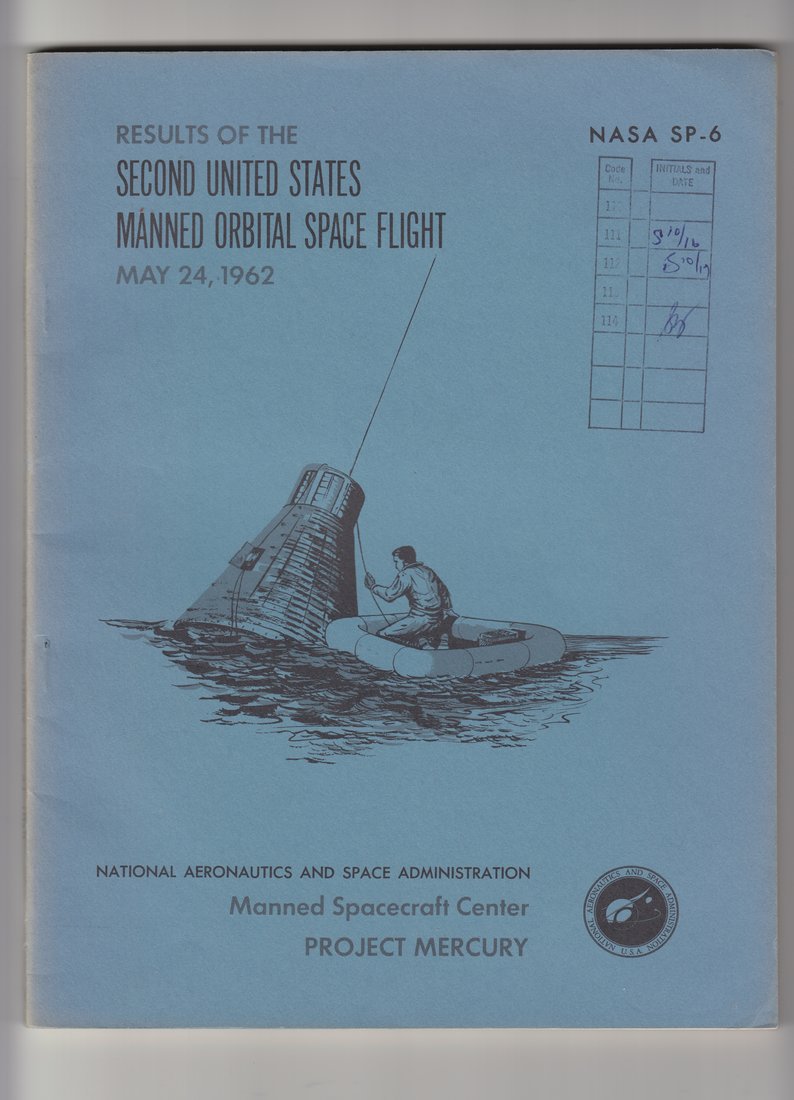
Results of the Second U.S. Manned Orbital Space Flight
NASA's official report on MA-7 (Aurora 7, Scott Carpenter), flown May 24 1962. Seven technical sections cover spacecraft and launch-vehicle performance, network performance, mission operations, space science, and aeromedical studies, followed by Carpenter's own pilot's flight report and an appendix transcribing the full MA-7 air-ground voice communications.
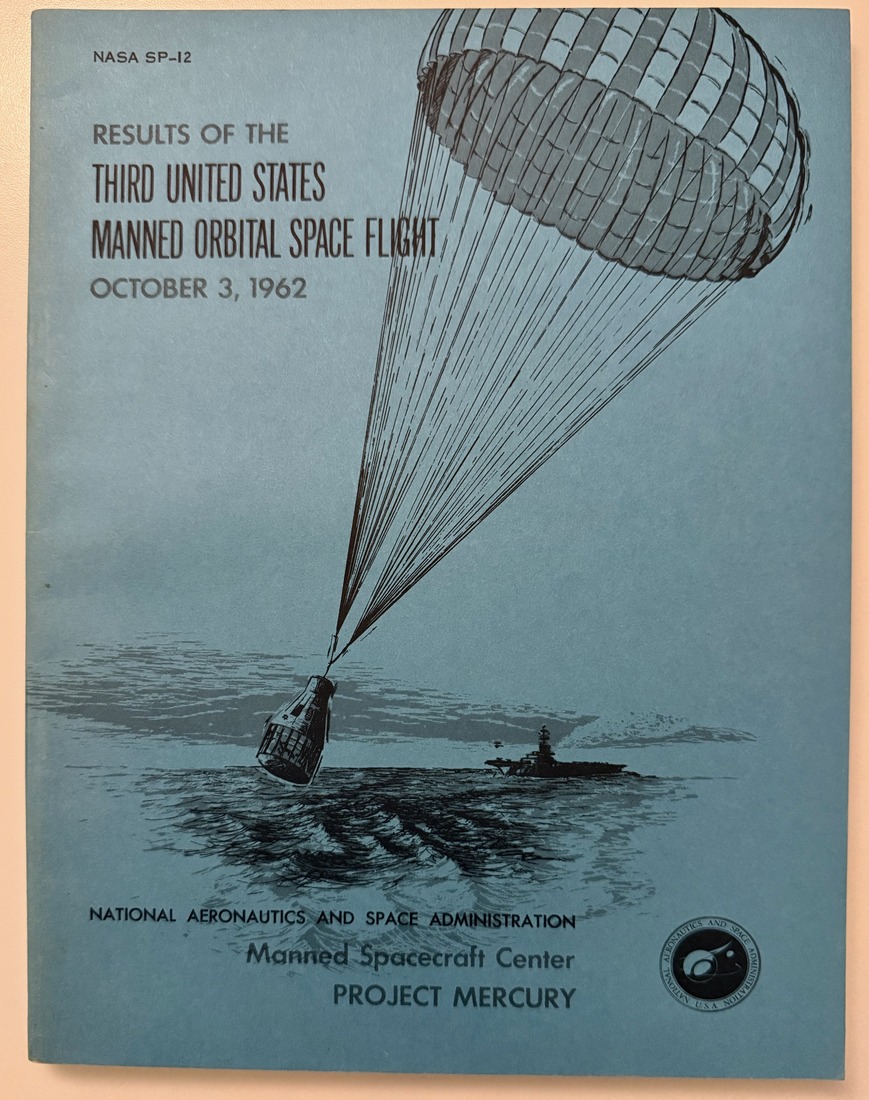
Results of the Third U.S. Manned Orbital Space Flight
NASA's official report (NASA SP-12) on MA-8 (Sigma 7, Walter Schirra), flown October 3 1962, published that December as a continuation of the reports on the first two orbital flights and the two suborbital flights that preceded it. Five sections cover spacecraft and launch-vehicle performance, mission operations, aeromedical analysis, and pilot performance, followed by Schirra's own pilot's flight report and an appendix transcribing the full MA-8 air-ground voice communications.
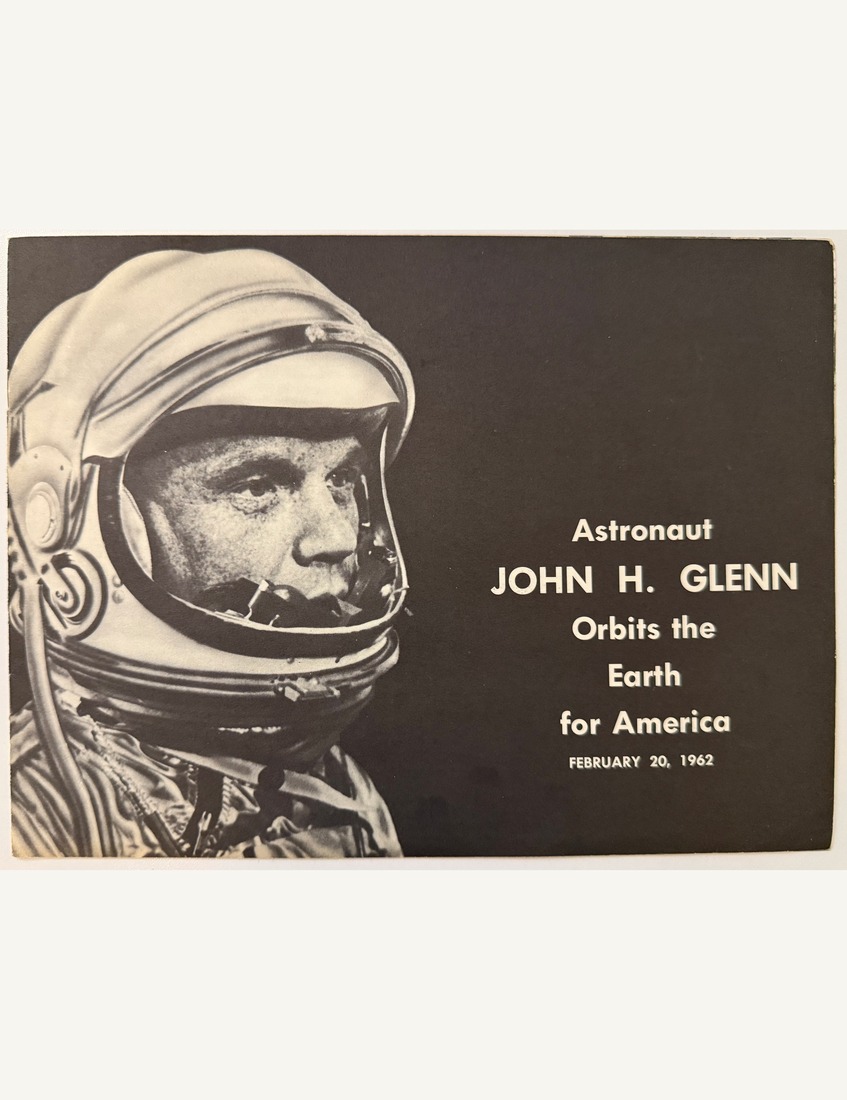
Astronaut John H. Glenn Orbits the Earth for America
Government commemorative booklet on John Glenn's February 20 1962 orbital flight aboard Friendship 7, opening with a full-page portrait of Glenn in his pressure suit. Interior spreads follow the mission from suiting up and the walk to the gantry, through the Atlas D launch, and a condensation of Glenn's own account of the flight from his February 23 press conference at Cape Canaveral (the four sunsets, in-flight eating experiments, and the tense re-entry when a possibly loose heat shield kept the retro-package in place longer than planned). It closes with recovery aboard the USS Noa and transfer to the carrier Randolph, President Kennedy's presentation of NASA's Distinguished Service Medal, and the rain-soaked motorcade up Pennsylvania Avenue with Vice President Johnson, Annie Glenn, and children Lyn and David.
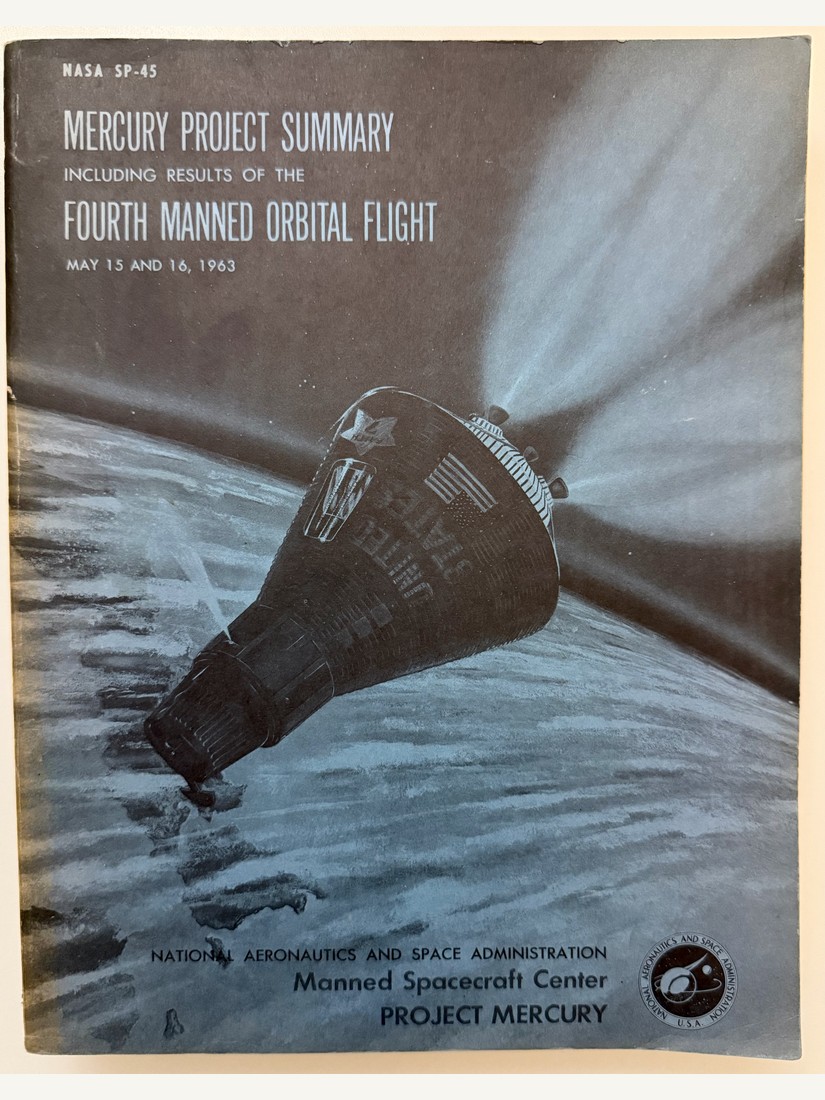
Mercury Project Summary Including Results of the Fourth Manned Orbital Flight, May 15 and 16, 1963
NASA SP-45, published October 1963, covering L. Gordon Cooper, Jr.'s 22-orbit MA-9 “Faith 7” flight and, as its title indicates, summarizing the whole of Project Mercury rather than just this final mission. Foreword by Kenneth S. Kleinknecht (Manager, Mercury Project) and W. M. Bland, Jr. (Deputy Manager), continuing the series of reports on the three earlier orbital flights and two suborbital flights. Organized into four parts — space-vehicle development, mission support development, flight operations, and mission results — across 20 chapters contributed by authors from NASA's Manned Spacecraft Center, Goddard, and Marshall centers along with the Air Force and other DoD participants, closing with Cooper's own “Astronaut's Summary Flight Report.” Appendixes list typical program documents, NASA centers and other government agencies involved, prime contractors and subcontractors, NASA personnel who took part in Project Mercury, and the full MA-9 air-ground voice transcript. This copy includes the laid-in errata slip correcting page 129 and supplying names inadvertently dropped from the Appendix E personnel list, among them Neil Armstrong, Wernher von Braun, Robert C. Seamans, and Abe Silverstein.
Results of the Project Mercury Ballistic and Orbital Chimpanzee Flights
NASA SP-39, the full official account of the Mercury chimpanzee program: planning, training, in-flight measurements, and postflight evaluation for the suborbital ballistic flight of “Ham” (MR-2, January 31 1961), the prelude to Alan Shepard's suborbital flight, and the orbital flight of “Enos” (MA-5, November 29 1961), which preceded John Glenn's orbital flight. Prepared by the Manned Spacecraft Center, Houston; Office of Scientific and Technical Information, NASA, Washington, D.C., 1963. Illustrated in detail throughout, including photographic plates of the flight chimpanzees in their restraint garment (“spacesuit”) before flight and at recovery.
This New Ocean: A History of Project Mercury
NASA SP-4201, the first volume in the NASA Historical Series and the program history against which every later NASA History Office volume in this collection is measured. Prepared with full access to program records and participants but written independently of any NASA editorial line, it opens with the deep background of manned rocket flight—Verne and Wells, Tsiolkovsky, Oberth, and Goddard, wartime and postwar X-series research aircraft—before tracing Mercury in three parts: research (the human-factors and NACA-to-NASA transition work of 1948–1958), development (spacecraft design, man-rating the machines, and machine-rating the men through 1961), and operations (the suborbital and orbital flights themselves, ending with Cooper's 22-orbit Faith 7 mission in May 1963). Extensive appendices tabulate the program's organization, flight data, personnel growth, and costs.
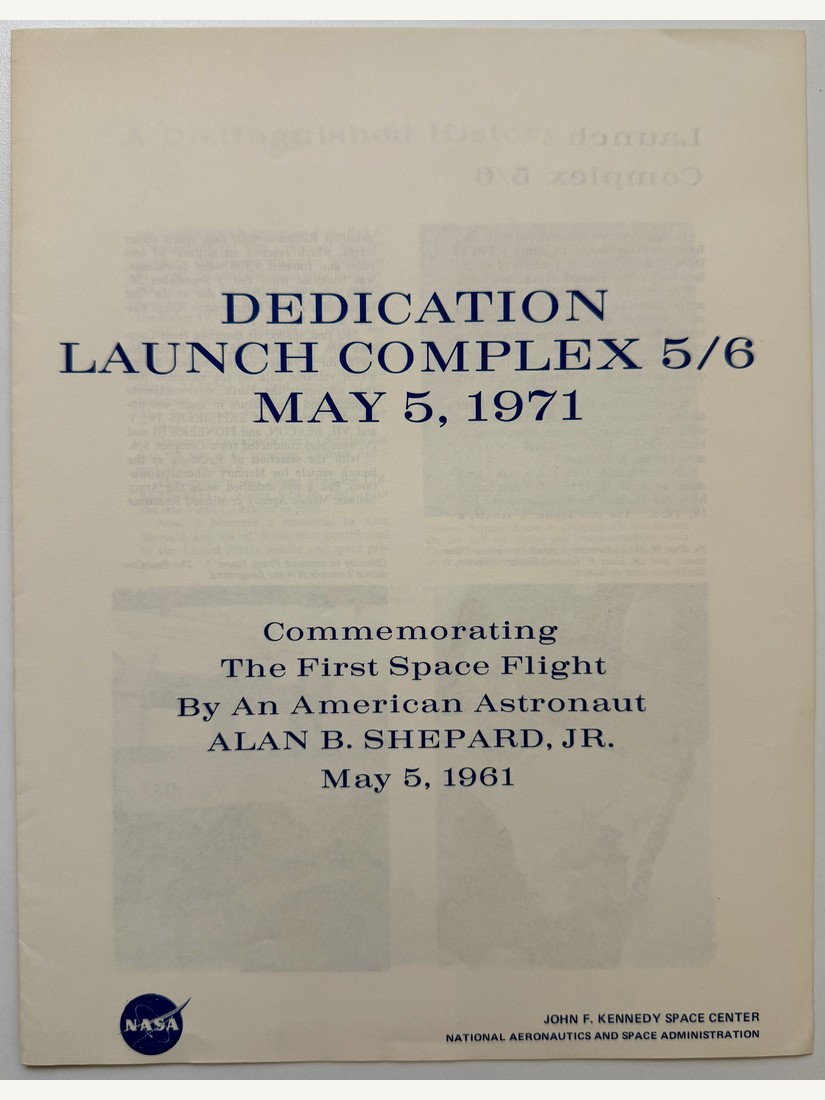
Dedication, Launch Complex 5/6
Commemorative booklet issued May 5, 1971 — the tenth anniversary of Alan Shepard's Freedom 7 flight — dedicating Cape Canaveral Launch Complex 5/6 as a memorial to that flight. Restored to its 1961 configuration, the complex is described as a monument to the astronauts, scientists, engineers, and technicians of the Government-industry team. Traces the pad's history from its 1955 construction by the U.S. Army for Redstone and Jupiter missile testing through 63 launches over six operational years, including Explorer III and the Jupiter/Pioneer series, ending with Virgil Grissom's Liberty Bell 7 in July 1961. A center spread on "Freedom 7" narrates Shepard's May 5, 1961 suborbital flight minute by minute, from suiting up through splashdown 15 minutes later, viewed by 45 million television viewers. A companion biography updates Shepard's career through his February 1971 Apollo 14 moonwalk at Fra Mauro, ten years after Freedom 7. Closes with a list of the government agencies and contractors (NASA, U.S. Army, Air Force, and Navy; Chrysler, McDonnell, North American/Rocketdyne, Pan American, RCA, and Sperry Rand) that made up the launch team.
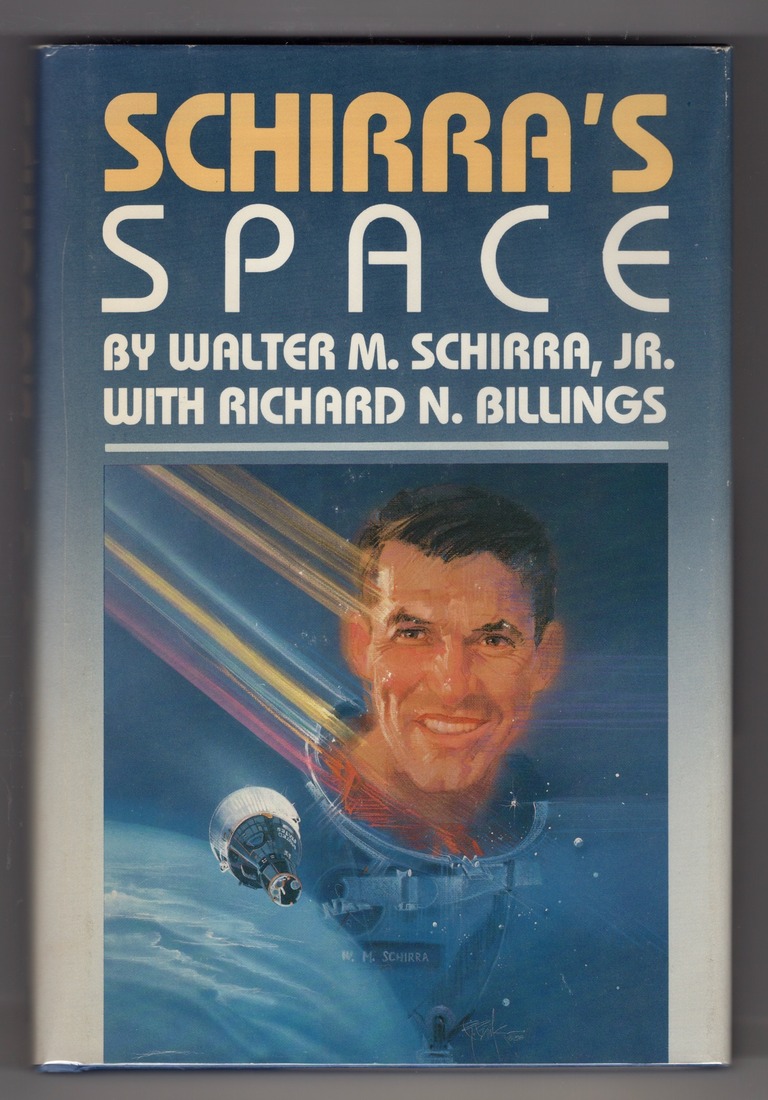
Schirra's Space
Memoir by Wally Schirra, the only astronaut to fly Mercury, Gemini, and Apollo missions (Mercury-Atlas 8's Sigma 7, Gemini 6A, and Apollo 7). Boston: Quinlan Press, 1988. Front flap carries an endorsement from Walter Cronkite; jacket art by Robert Peak. Hardcover with dust jacket.
This copy is signed “Wally Schirra” in ink on the half-title page.
Gemini
1961 – 1966
Duration of an Interrupted Countdown
Technical Report No. 65 (September 27, 1962) from Stanford University's Applied Mathematics and Statistics Laboratories, by Sidney I. Firstman of Stanford and the RAND Corporation, under project director Gerald J. Lieberman; supported by the Army, Navy, and Air Force under Office of Naval Research contract Nonr-225(53). Models a launch countdown as a stochastic "interrupted service process": a countdown could be halted by any of several kinds of problems, and after each interruption could resume under one of seven different policies considered in the paper. Derives expressions for the resulting duration distribution, with the first two moments worked out explicitly — an early piece of operations-research literature applying queueing theory to launch-pad procedure rather than vehicle engineering.
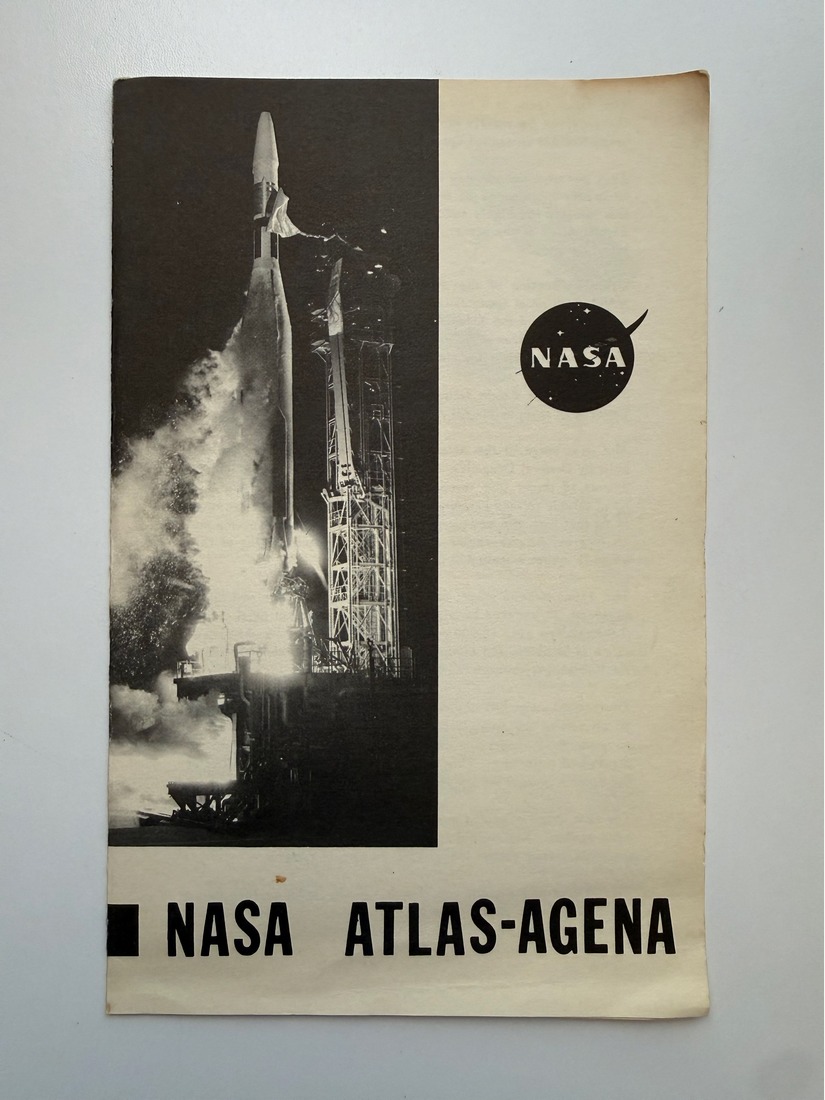
NASA Atlas-Agena
Undated fact-sheet booklet on the Atlas-Agena, the two-stage unmanned launch vehicle behind NASA's early deep-space program: a modified Atlas first stage (three Rocketdyne MA-5 engines, General Dynamics/Astronautics) topped by a restartable Agena second stage (Bell Aerosystems 8096 engine, Lockheed Missiles and Space Company). Recounts its use launching the Ranger lunar-impact series and the 1962 Mariner 2 Venus flyby, and previews upcoming payloads — a Mariner Mars series, the Orbiting Astronomical Observatory, and the Orbiting Geophysical Observatory — putting its likely date in 1963 or early 1964, ahead of those launches.
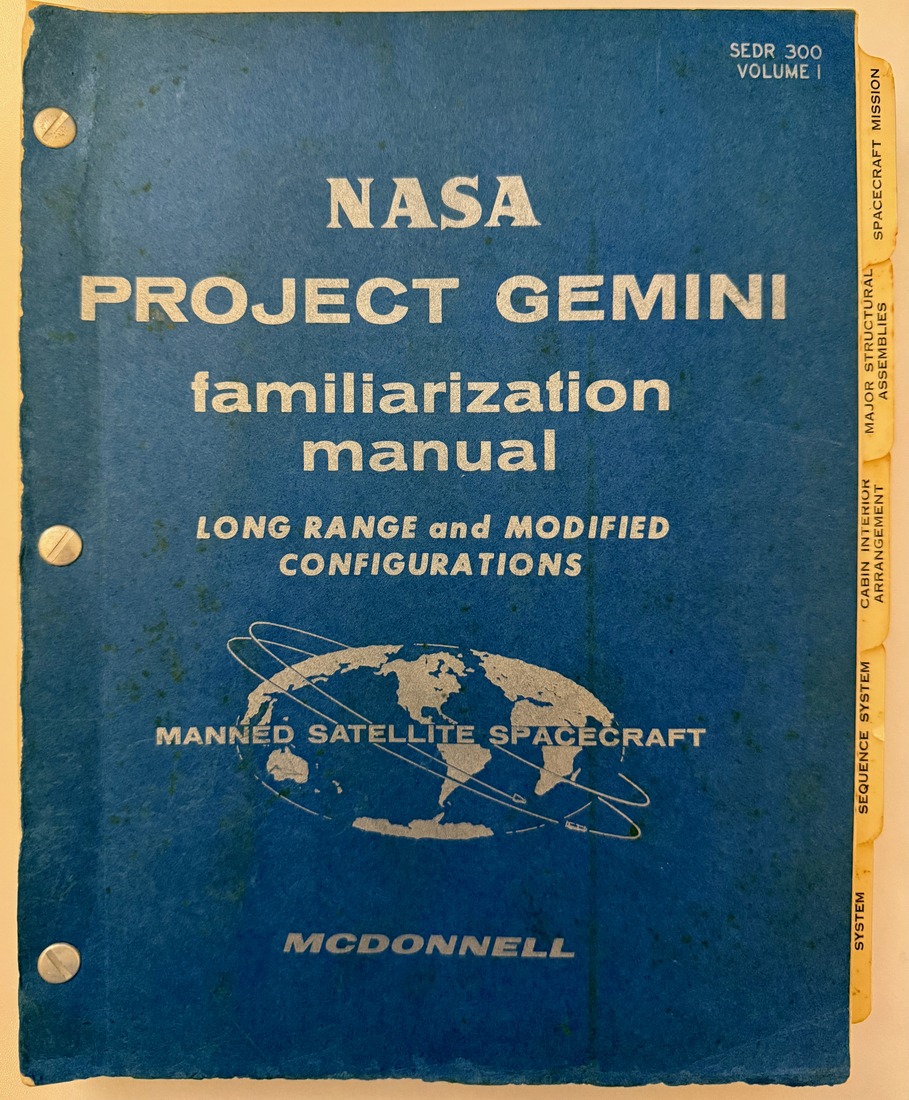
NASA Project Gemini Familiarization Manual
SEDR 300, Volume I, covering the Gemini spacecraft's long-range and modified configurations, prepared by McDonnell's Maintenance Engineering group and accurate as of March 15, 1964, for the three-orbit mission configuration then current. Twelve sections work through the spacecraft system by system: spacecraft mission, major structural assemblies, cabin interior arrangement, sequence system, electrical power, environmental control, cooling, guidance and control, communications, instrumentation and recording, pyrotechnics and the retrograde rocket, and the landing system, the last illustrated with the 57-foot main parachute's 72-line two-point suspension. The approval page carries printed (not hand-signed) review blocks for McDonnell's maintenance-engineering and project-engineering staff and for the NASA resident manager's office.
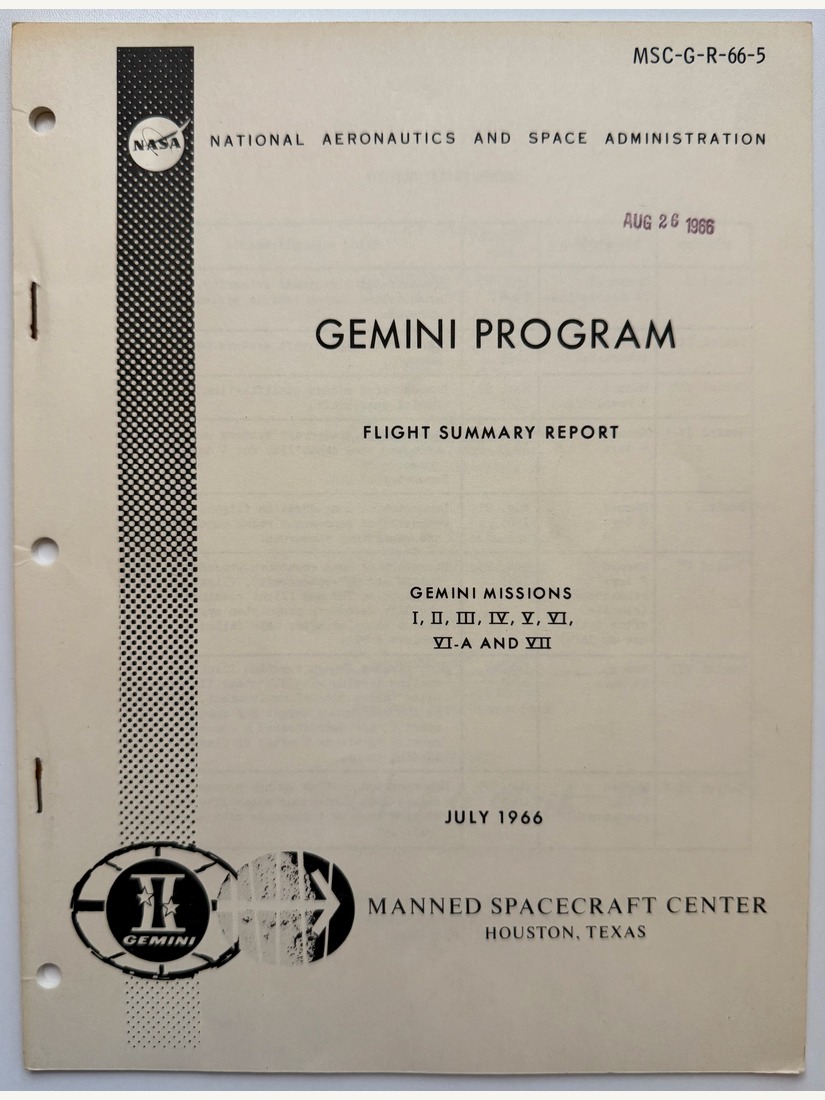
Gemini Program: Flight Summary Report
NASA report MSC-G-R-66-5, issued July 1966, summarizing the first eight Gemini missions — I, II, III, IV, V, VI, VI-A, and VII — each given its own dedicated flight summary running four pages, from Gemini I on page 1 through Gemini VII on page 27.
Earth Photographs from Gemini III, IV, and V
NASA SP-129, a 266-page quarto gathering Earth-observation photography from the first three manned Gemini flights, illustrated in black-and-white and color and indexed by geographic subject.
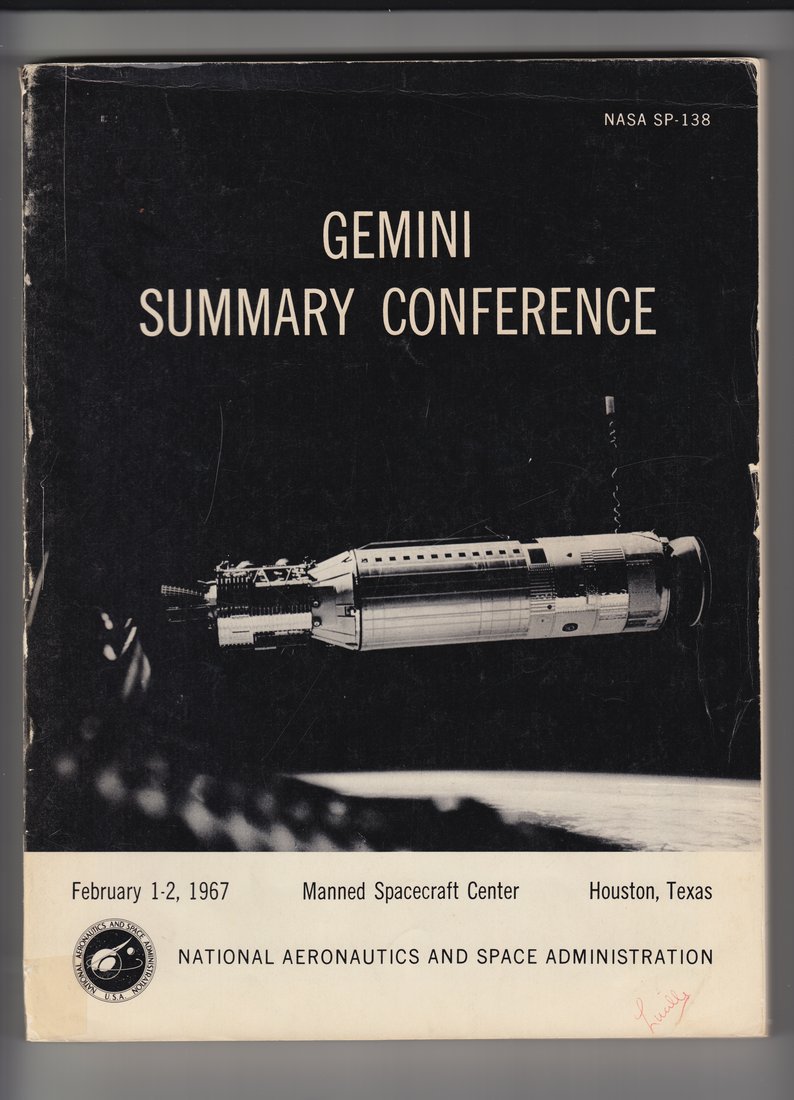
Gemini Summary Conference, February 1–2 1967
NASA SP-138 conference proceedings summarizing results across the entire Gemini program, comprising 21 technical papers plus an introduction by George E. Mueller and concluding remarks by George M. Low. The papers are grouped into five sections, leading with rendezvous, docking, and tethered-vehicle operations, then extravehicular activity, mission operational support, onboard experiments, and astronaut flight and simulation experience relating Gemini to Apollo.
Cover signed “Kelly” in red ink.
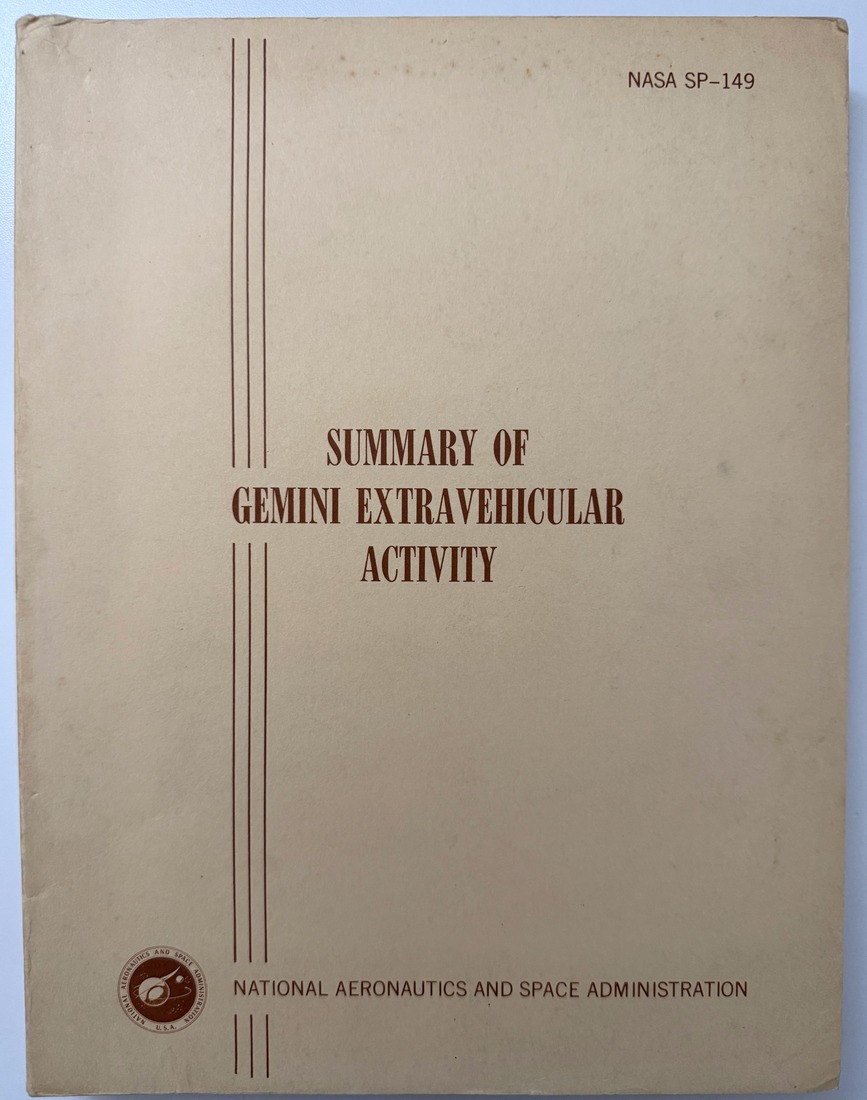
Summary of Gemini Extravehicular Activity
NASA SP-149, published by the Office of Technology Utilization's Scientific and Technical Information Division. Edited by Reginald M. Machell of the Manned Spacecraft Center, Houston, it works mission by mission through the six Gemini EVAs (IV, VIII, IX-A, X, XI, and XII), then treats the life support hardware built for them: the pressure suits developed for each flight, the Ventilation Control Module system, the chestpack-mounted Extravehicular Life Support System, and the backpack-mounted Extravehicular Support Package, along with the umbilical and tether combinations that connected astronauts to the spacecraft (a 25-foot umbilical, 30- and 50-foot assemblies, a 75-foot electrical tether for Gemini VIII, and a 125-foot tether for the Astronaut Maneuvering Unit). A closing section on body positioning and restraints covers the handholds, handrails, waist tethers, and Velcro- and pip-pin-mounted attachment devices developed and refined mission to mission. The concluding section notes that ease of completing EVA tasks correlated with how they were sequenced, that pilots who first completed a standup EVA were more at ease during the umbilical EVA that followed, that equipment lanyards curbed the loss of untethered gear on the final two missions, and that underwater zero-g simulation using the actual flight hardware did the most to catch human-engineering problems with foot restraints and handholds before flight.
On the Shoulders of Titans: A History of Project Gemini
NASA SP-4203, the official program history of the ten-flight manned Gemini program that bridged Mercury and Apollo, with a foreword by Charles W. Mathews, who had headed the Gemini Program Office. The narrative runs from Gemini's origins as a scaled-up two-man Mercury capsule through its near-cancellation crises, the loss of an Agena target vehicle to a launch failure, the improvised Gemini VI/VII rendezvous flown as each other's target, Gemini VIII's uncontrolled spin after the first docking in space, and the extravehicular-activity difficulties worked out mission by mission, closing with an epilogue on the Gemini Earth-photography program. This copy carries the elaborate personal bookplate of Robert C. Seamans Jr., who as NASA's Associate Administrator (1960–1965) and then Deputy Administrator (1965–1968) had direct responsibility for the program the book documents, before going on to serve as Secretary of the Air Force and president of the National Academy of Engineering.
Apollo
1961 – 1975
Mission reports & chronologies
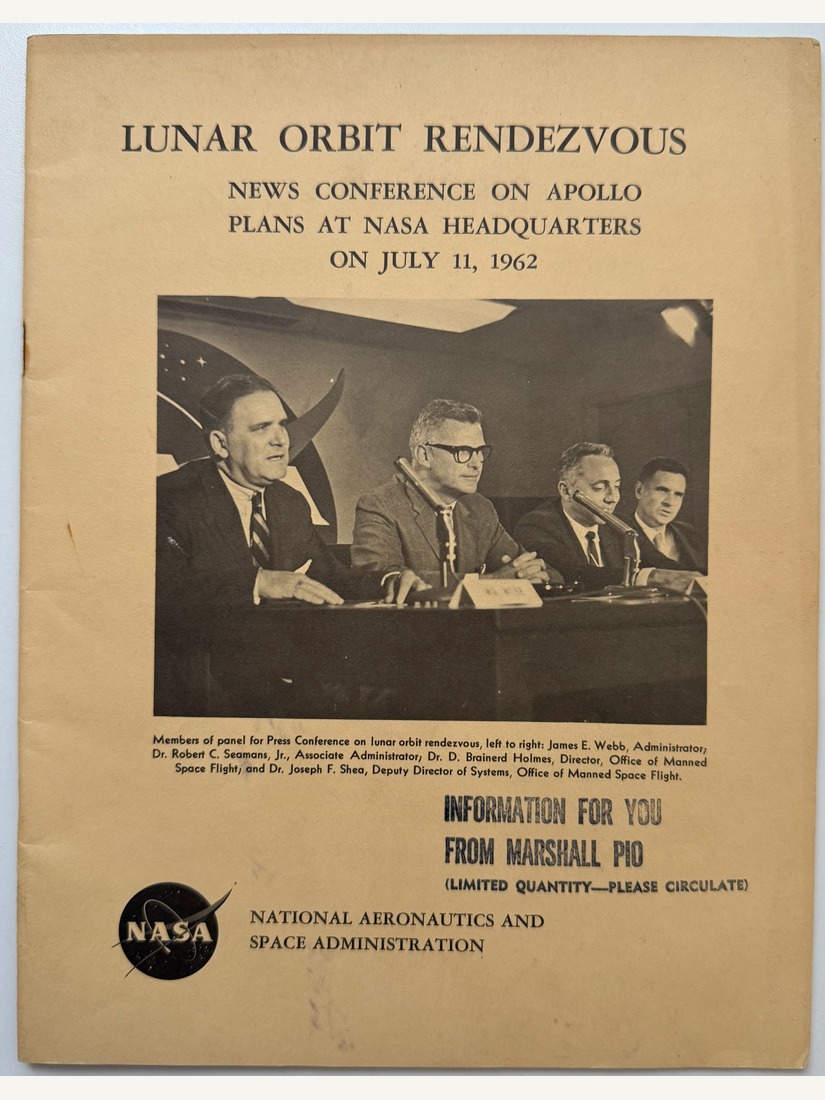
Lunar Orbit Rendezvous: News Conference on Apollo Plans at NASA Headquarters
Transcript booklet ("Information for You from Marshall PIO," limited circulation) of the July 11, 1962 press conference at NASA Headquarters where Administrator James E. Webb announced that Apollo would proceed primarily on the lunar orbit rendezvous (LOR) mode, using an advanced Saturn C-5 to launch a three-module spacecraft and a separate lunar excursion vehicle, while continuing secondary studies of Earth orbit rendezvous and direct ascent. Includes statements by Associate Administrator Robert C. Seamans Jr., Office of Manned Space Flight director D. Brainerd Holmes, and Deputy Director of Systems Joseph F. Shea — who explains the LOR mission profile in detail using scale models — followed by a question-and-answer session and Webb's concluding summary. NASA's Manned Space Flight Management Council had recommended LOR unanimously as offering the highest probability of mission success at the lowest cost and technical risk; the decision announced here would shape the separate command/service module and lunar module design later credited with making the 1969 landing possible.
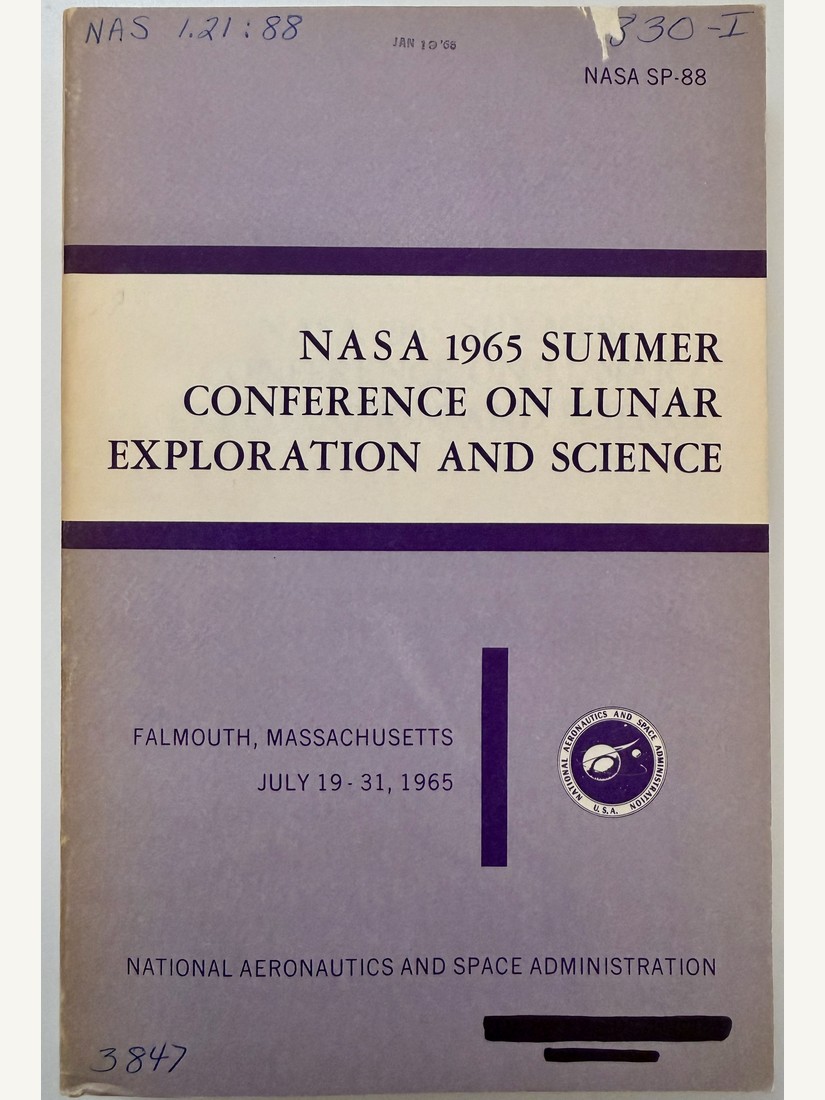
NASA 1965 Summer Conference on Lunar Exploration and Science
NASA SP-88, the report of a conference held July 19–31 1965 at Lawrence High School in Falmouth, Massachusetts, immediately following the National Academy of Sciences' Space Science Summer Study at nearby Woods Hole. Convened under the Manned Space Science Coordinating Committee chaired by Richard J. Allenby, it gathered seven discipline working groups—geodesy/cartography, geology, geophysics, bioscience, geochemistry-petrology, particles and fields, and lunar atmospheres—plus a separate astronomy study group under Nancy Roman, to recommend a ten-year lunar science program spanning the early Apollo missions, the proposed Apollo Extension System, and a hypothetical post-AES lunar base. Working-group chairmen included geologist Eugene M. Shoemaker (U.S. Geological Survey) and MIT geophysicist Frank Press. The report states plainly that its recommendations reflect the working groups' own opinions rather than official NASA policy.
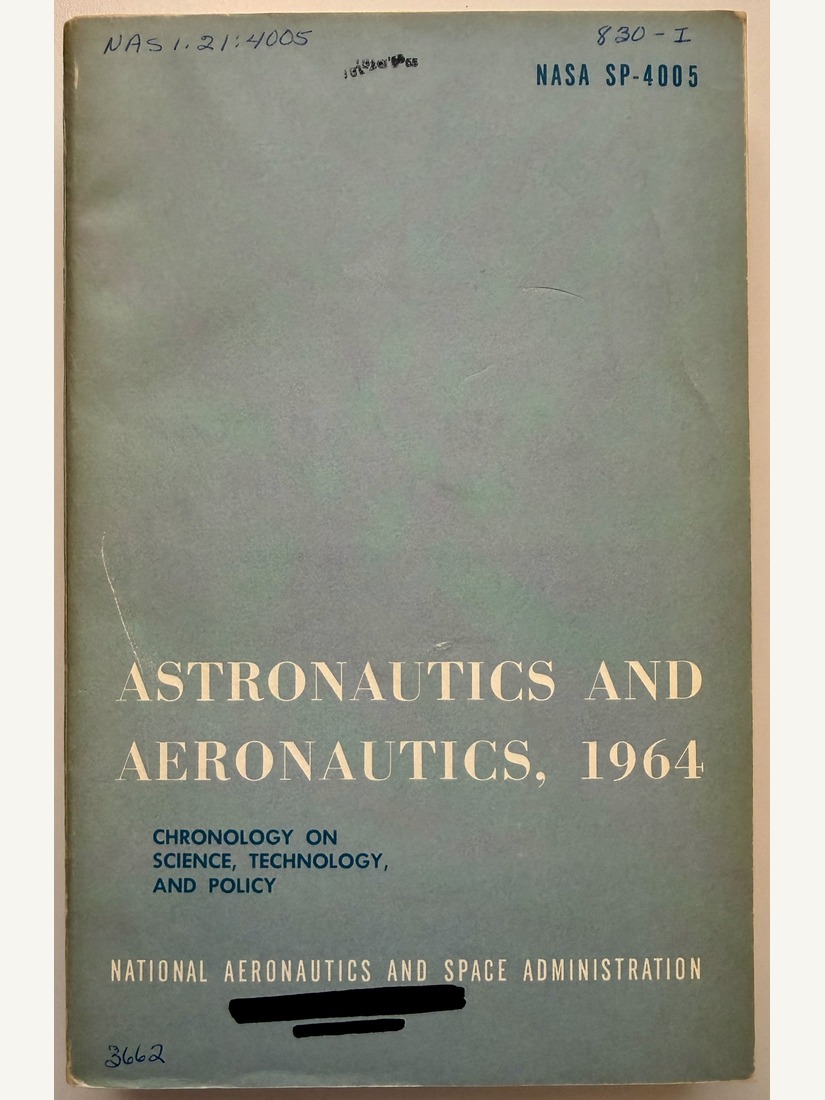
Astronautics and Aeronautics, 1964: Chronology on Science, Technology, and Policy
NASA SP-4005, a month-by-month chronology of the agency's seventh year, prepared from open public sources and issued in 1965 by the Scientific and Technical Information Division. Robert C. Seamans, Jr., Associate Administrator, opens the volume citing Ranger VII's more than 4,000 close-up lunar photographs, Mariner IV's midcourse correction en route to Mars, Nimbus I's day-and-night weather imaging, the seventh successful Saturn I test flight, and the completion of unmanned Gemini capsule testing as the year's milestones building toward the Apollo landings. NASA Historian Eugene M. Emme's preface notes this as the third volume in the series, following Aeronautics and Astronautics, 1915–1960 and Astronautics and Aeronautics, 1963 (SP-4004), credits Frank W. Anderson and Helen T. Wells with drafting the bulk of the text, and records that the Library of Congress Science and Technology Division took over the text's preparation for the year's final two months. Organized into monthly chapters from January through December, followed by appendices listing 1964 satellites, space probes, and manned flights; major NASA launchings; and abbreviations of references.
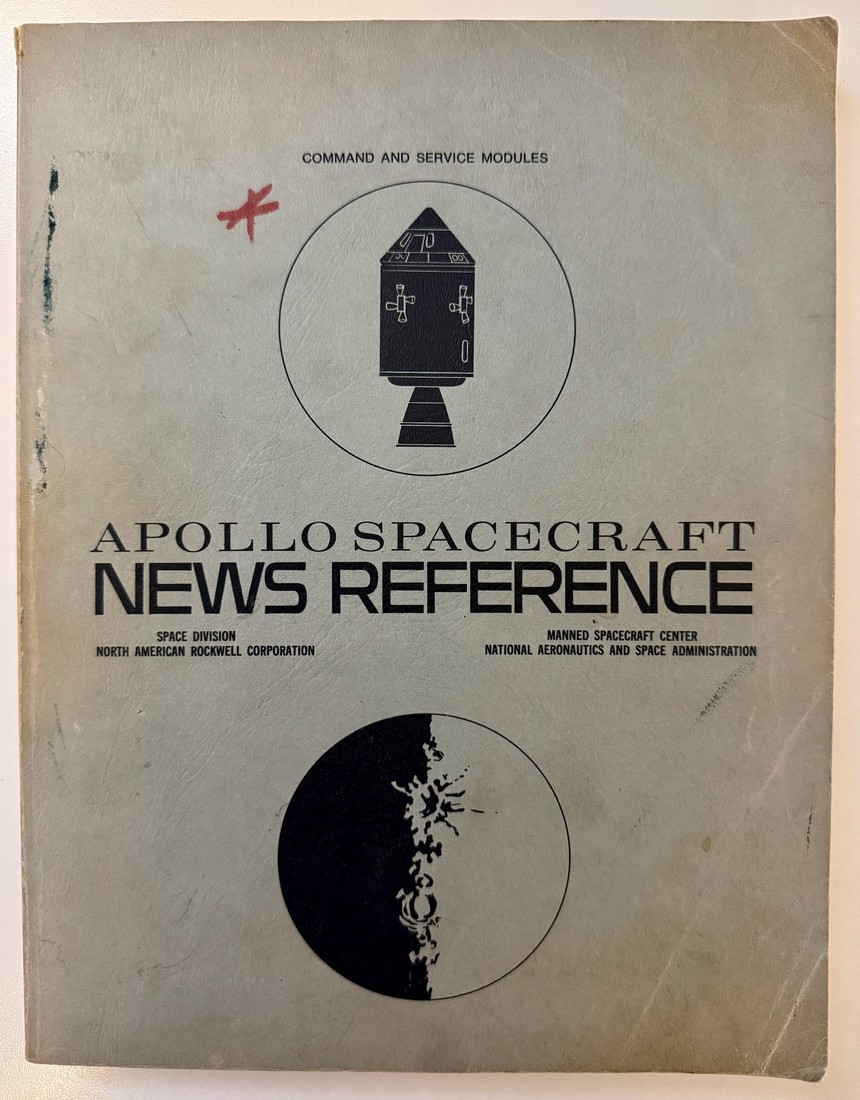
Apollo Spacecraft News Reference: Command and Service Modules
Comprehensive press reference book on the Apollo Command and Service Module systems, issued jointly by North American Rockwell's Space Division (the CSM's prime contractor) and NASA's Manned Spacecraft Center ahead of missions. Undated in its printed text, but its Saturn V and lunar-landing sections describe the mission entirely in the future tense with no reference to any completed Saturn V or Apollo flight, placing this copy in the book's original 1968 printing, ahead of Apollo 8. Includes fold-out plates among its illustrations, among them a labeled cutaway diagram of the full CSM vehicle and an equipment-bay panel diagram showing the interior arrangement of the command module.
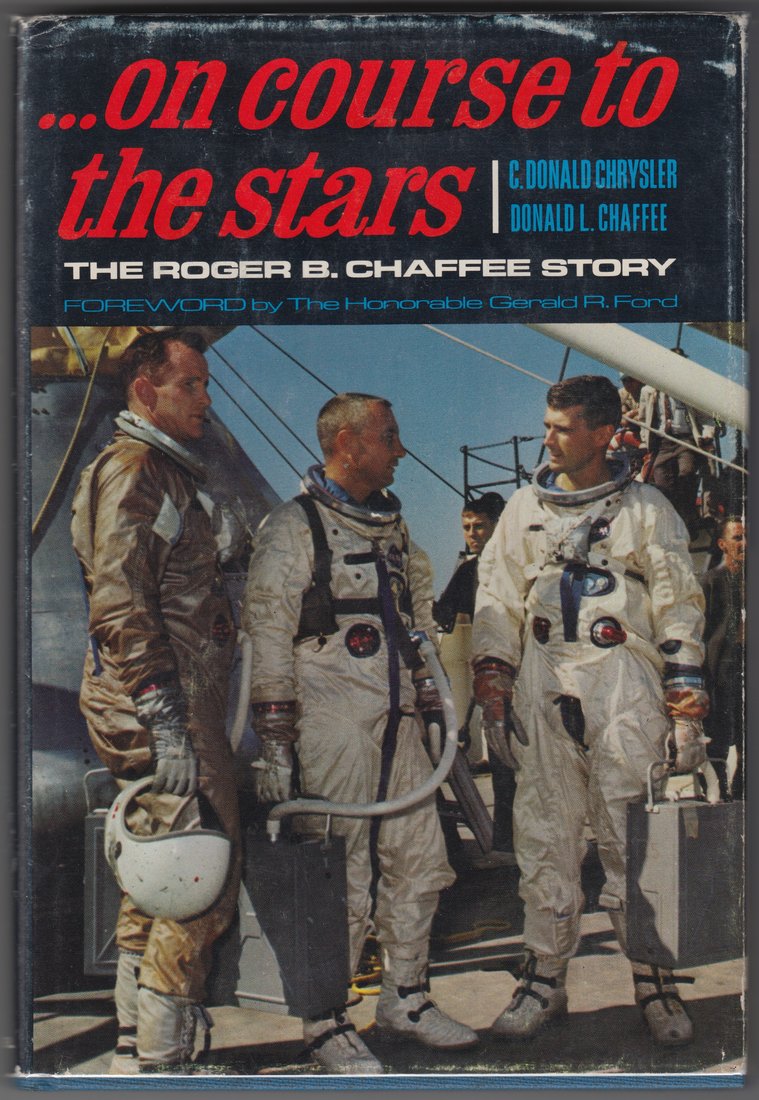
On Course to the Stars: The Roger B. Chaffee Story
Biography of Apollo 1 astronaut Roger B. Chaffee, copyrighted in 1968 by Chaffee's father, Don L. Chaffee, and published by Kregel Publications of Grand Rapids, Michigan, as told to C. Donald Chrysler by Don L. Chaffee and family. First edition, printed in the United States. The foreword is by then-Congressman Gerald R. Ford, a fellow Grand Rapids native who wrote of the parallels between his own life and Chaffee's: both grew up in Grand Rapids, belonged to the same Boy Scout troop in different eras, became Eagle Scouts, played high school football, and served in the Navy as lieutenant commanders. The book's fourteen chapters trace Chaffee from infancy (“The Quarantine Baby—And How He Grew”) through Boy Scouts, college, his courtship of his wife Martha, Navy service, and astronaut training, closing with chapters on the January 27 1967 Apollo 1 fire, “In Memoriam,” and “Aftermath.” The author's acknowledgments thank Chaffee's widow, Martha, for many of the book's personal recollections, along with Grand Rapids Press staffer Bob Day and Public Affairs Office personnel at the Kennedy Space Center. A portion of the book's royalties were designated to Roger B. Chaffee memorial scholarship funds at Central High School in Grand Rapids and at Purdue University. The dust jacket shows White, Grissom, and Chaffee during water-egress training on the front cover, the Apollo 1 crew patch on the front flap, and an Agena liftoff on the back flap.
Title page signed by author C. Donald Chrysler and by Roger Chaffee's parents, Blanche M. and Don L. Chaffee.
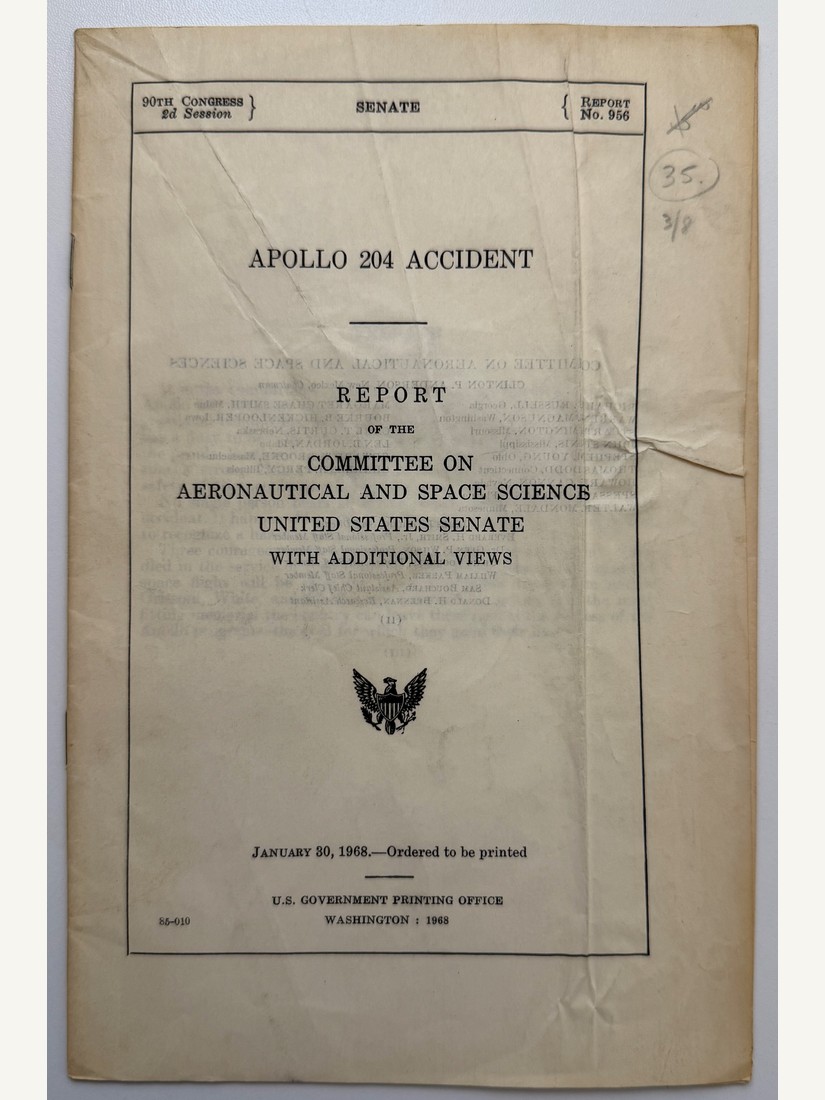
Apollo 204 Accident
Senate Report No. 956, 90th Congress, 2nd Session, “with Additional Views,” ordered printed January 30 1968 under Chairman Clinton P. Anderson. Reviews the January 27 1967 plugs-out test fire aboard Apollo Command Module 012 at Complex 34, Kennedy Space Center, that killed Virgil I. Grissom, Edward H. White II, and Roger B. Chaffee. The preface states that “no single person bears all of the responsibility” for the accident and pays tribute to the three astronauts. The introduction traces NASA Administrator James E. Webb's same-day formation of the Apollo 204 Review Board, chaired by Dr. Floyd L. Thompson of Langley Research Center with seven additional members drawn from NASA, the Air Force, and the Bureau of Mines, and the Senate committee's own concurrent review, undertaken with the agreement of ranking minority member Margaret Chase Smith. The report covers seven areas of committee inquiry and concludes that the Review Board's investigation, submitted April 9 1967 with a final appendix that November, was “exhaustive and thorough” and its findings objective. North American Aviation, prime contractor for the Command and Service Module, is referred to throughout by its new name, North American Rockwell Corporation, adopted September 22 1967.
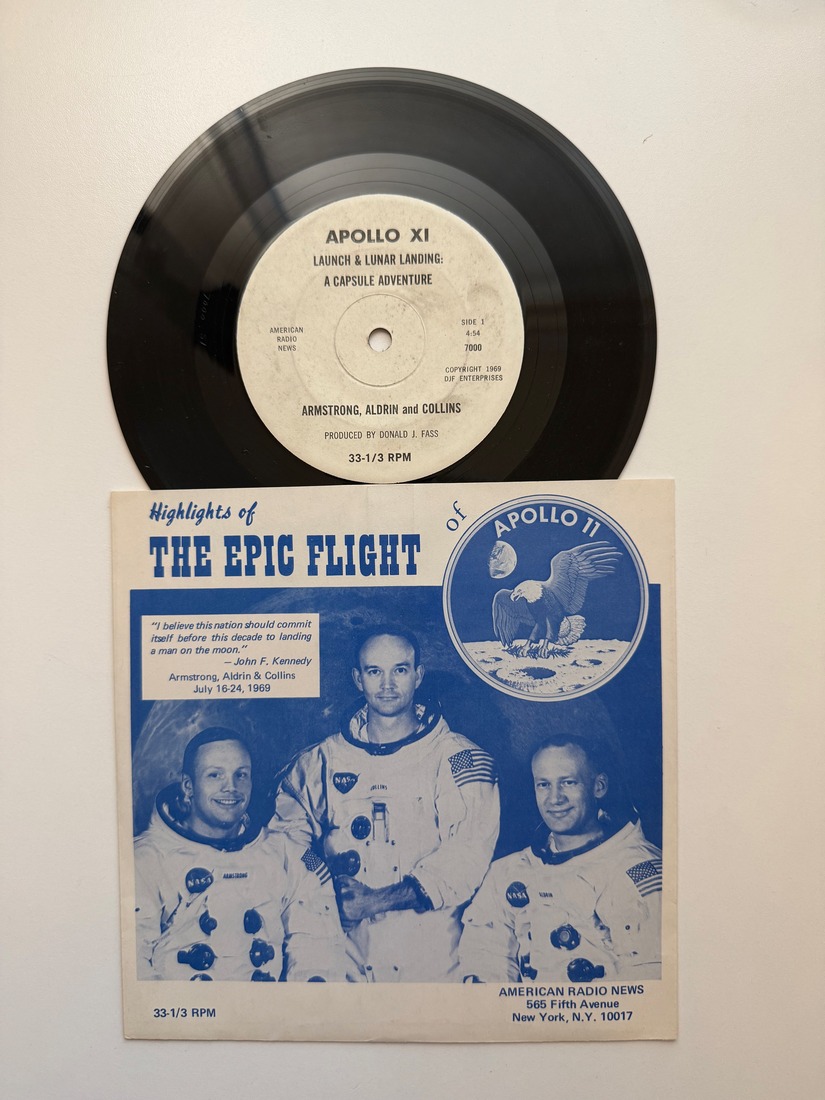
"10:56:20 07/20/69" — The Historic Conquest of the Moon
7-inch, 33⅓ RPM single (American Radio News 7000/7001, © DJF Enterprises, published by Donald J. Fass) issued in the days after splashdown. Side 1, "Apollo 11 Launch & Lunar Landing: A Capsule Adventure" (4:54), and Side 2, "Apollo 11 The First Moon Walk: A Capsule Adventure" (5:04), splice network-style narration with actual mission audio, timestamped to Armstrong's first step at 10:56:20 EDT. The picture sleeve reproduces the Apollo 11 crew portrait beneath the mission's eagle-and-Moon insignia, with Kennedy's 1961 "before this decade is out" pledge.
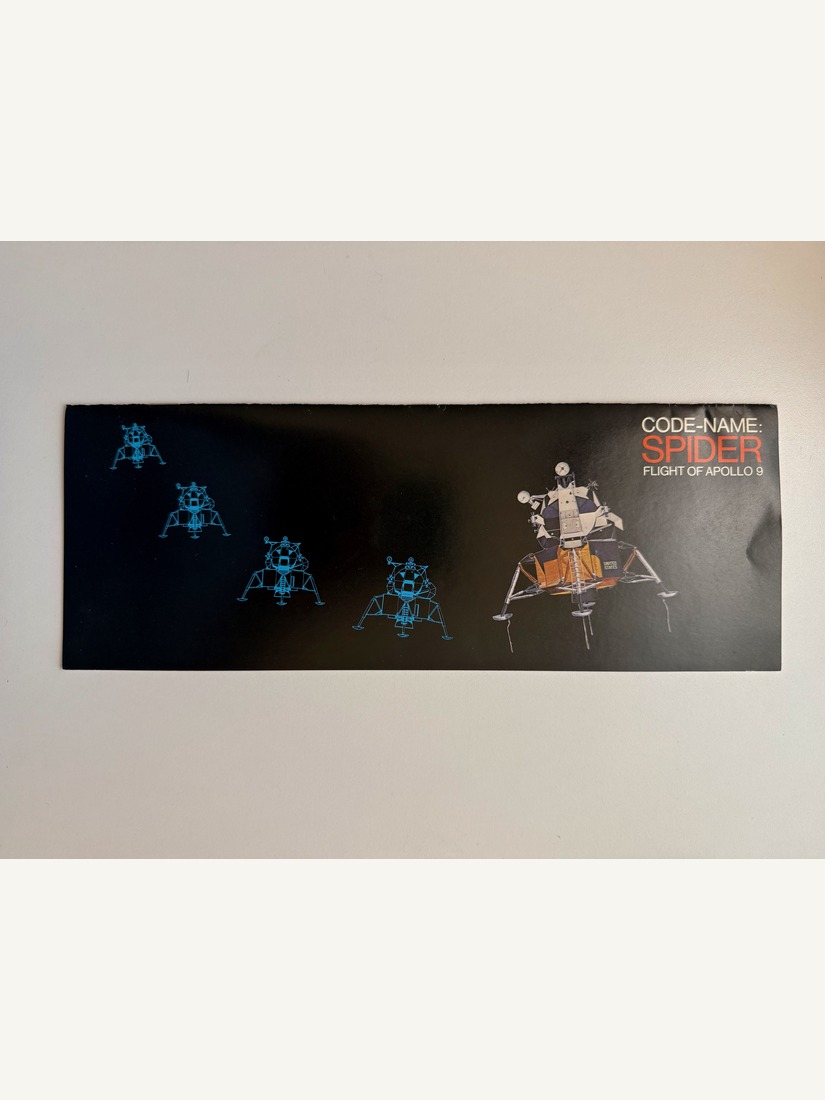
Code-Name: Spider — Flight of Apollo 9
Illustrated fold-out booklet on Apollo 9 (March 3–13, 1969), the first crewed flight of the Lunar Module, code-named Spider, flown by Commander James McDivitt, Command Module Pilot David Scott, and Lunar Module Pilot Russell Schweickart. Covers the mission from prelaunch processing and the Saturn V rollout through Gumdrop and Spider's docking and hard-fire tests, Schweickart's “Red Rover” spacewalk in the golden-slippered foot restraints, and cutaway diagrams of the LM's ascent and descent stages. Illustrated throughout with mission photography, an artist's rendering of the Command Module simulator, and quotes from the crew's in-flight radio traffic.
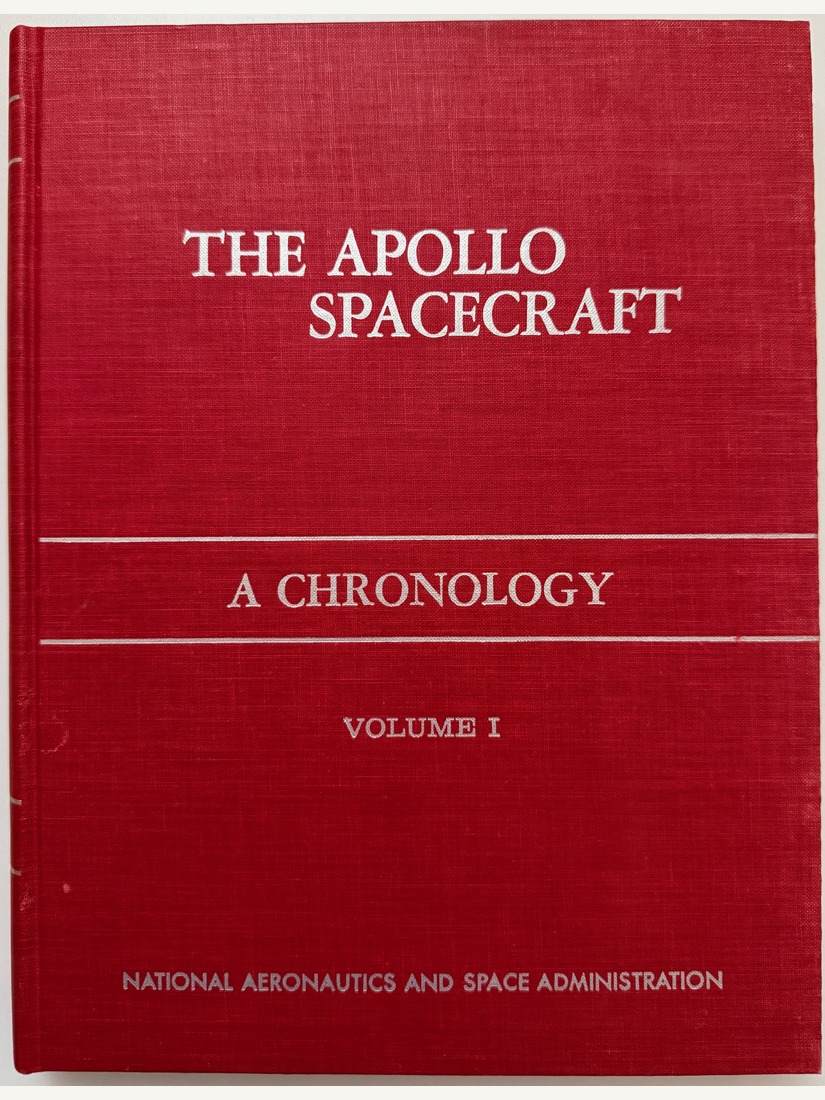
The Apollo Spacecraft: A Chronology, Volume I
NASA SP-4009, the first of a sequential four-volume history of Apollo spacecraft development compiled by NASA's history office as the program unfolded; this volume covers events through November 7, 1962. Published by NASA's Scientific and Technical Information Division. Bound in red cloth boards with silver spine stamping, no dust jacket — the format shared by all four SP-4009 volumes and the companion Skylab volume. Two copies of this printing are held in the collection; text, title page, and binding are identical between them, with the second copy showing water damage/staining to the front and rear endpapers and a small tear at the front hinge.
 Featured
The Apollo Spacecraft: A Chronology
›
Featured
The Apollo Spacecraft: A Chronology
›
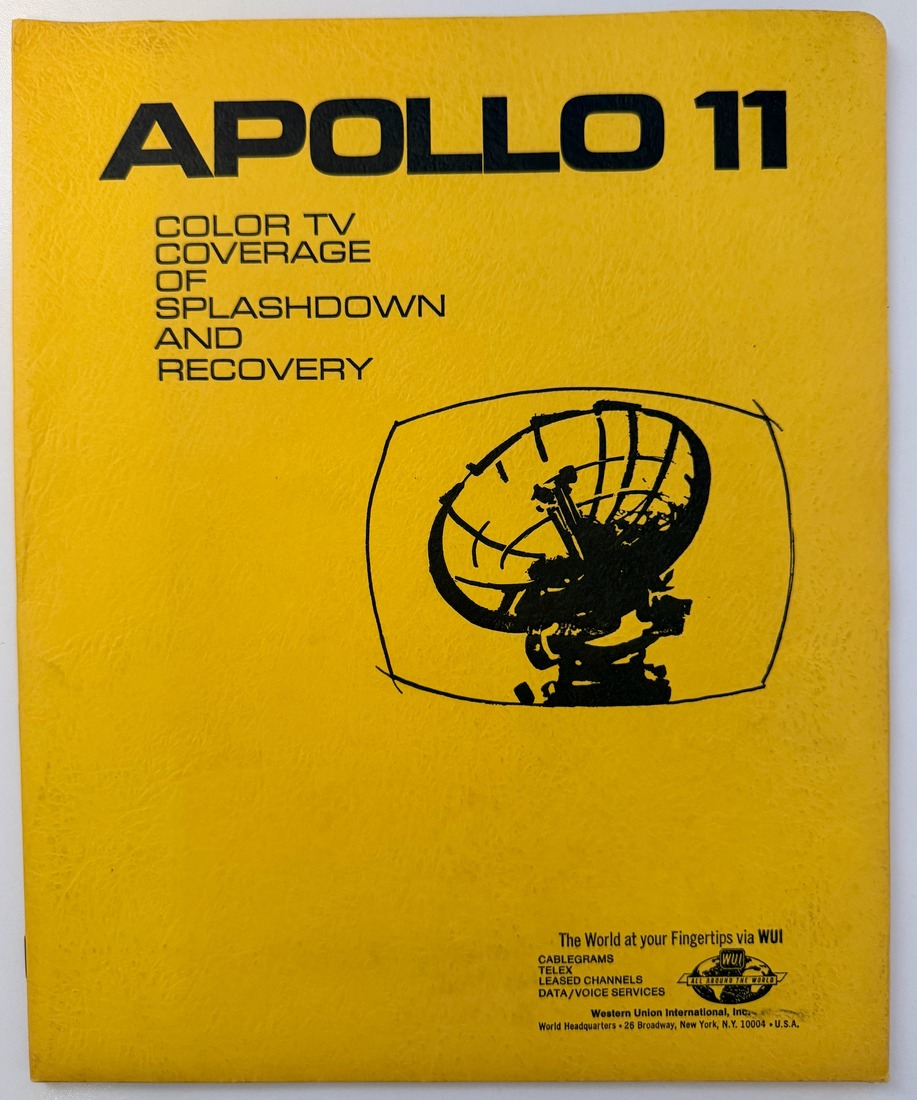
Apollo 11 — Color TV Coverage of Splashdown and Recovery
Press kit issued by Western Union International promoting its role in relaying the live color broadcast of the Apollo 11 splashdown, via a new compact mobile transmitter aboard the recovery ship USS Hornet. An accompanying news release, headlined “TV Coverage of Apollo 11 Splashdown to Travel Over 300,000 Miles in Seconds,” explains the signal's relay path from the recovery point (1,038 nautical miles southwest of Hawaii) out to more than 1,000 television stations worldwide, and why a signal that travels in a straight line needs so many relay hops to reach viewers beyond line of sight.
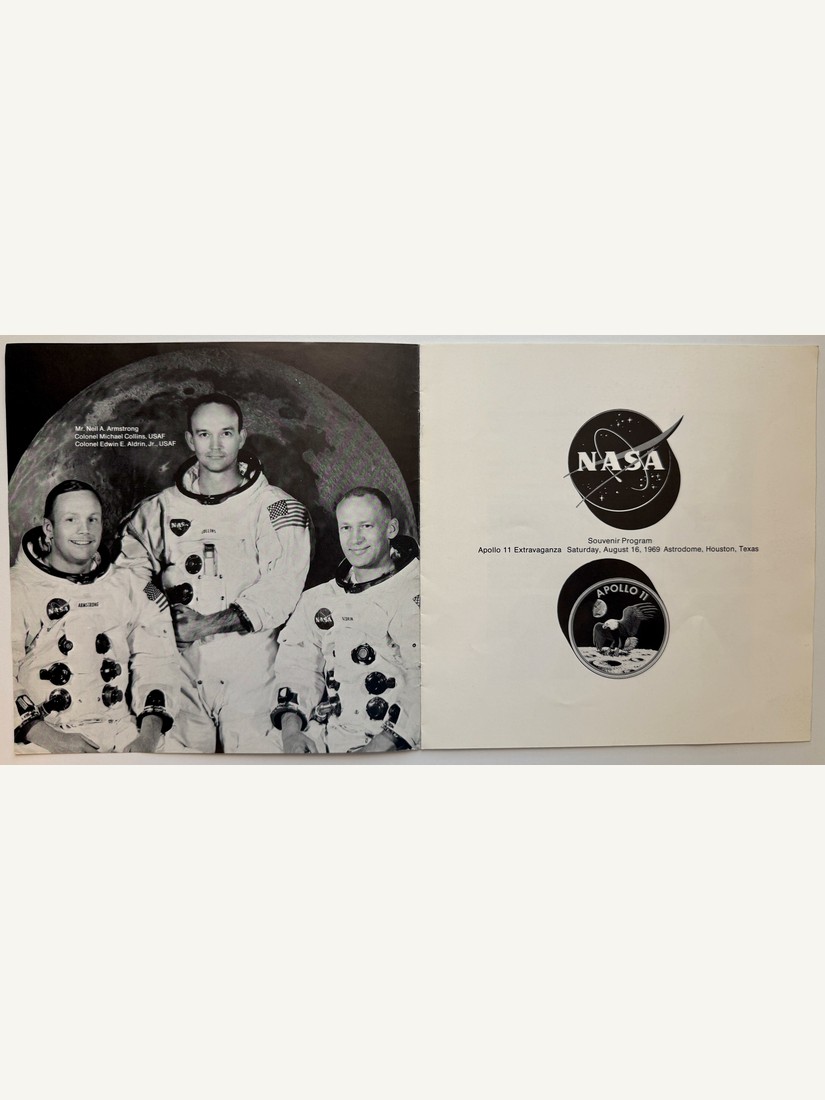
Souvenir Program: Apollo 11 Extravaganza
Program for the star-studded welcome-home celebration Houston threw for the Apollo 11 crew at the Astrodome on Saturday, August 16, 1969, five days before the astronauts left on their round-the-world "Giant Step" goodwill tour. Frank Sinatra served as master of ceremonies, backed by Buddy Brock and his Orchestra, with performances by Nancy Ames, Bill Dana, Marguerite Piazza (who also sang the National Anthem), Dionne Warwick, and Flip Wilson, all donating their talents; the show was produced by David Merrick with Giles Tippette as associate producer, under honorary chairman Jack Valenti. Speeches came from Houston Chamber of Commerce president E. Clyde McGraw, NASA Manned Spacecraft Center director Dr. Robert R. Gilruth, and Houston mayor Louie Welch, who closed the evening by presenting the assembled astronauts, introduced by Neil Armstrong. The program includes short biographies of NASA Administrator Dr. Thomas O. Paine and Dr. Gilruth, along with signed welcome messages from Mayor Welch and McGraw recalling the city's earlier welcome of the Manned Spacecraft Center's staff to the Sam Houston Coliseum on July 4, 1962. The inside cover carries the familiar Armstrong/Collins/Aldrin crew portrait against a lunar backdrop — captioned "Mr. Neil A. Armstrong" alongside "Colonel Michael Collins, USAF" and "Colonel Edwin E. Aldrin, Jr., USAF," reflecting Armstrong's earlier resignation from the Air Force and transition to NASA civilian status. Closing credits list the Houston Municipal Band under conductor Ralph Liese, the Houston Sports Association (Astrodome), stage and decorations by National Decorators, Inc., and a music grant from the Music Performance Trust Funds via AFM Local 65.
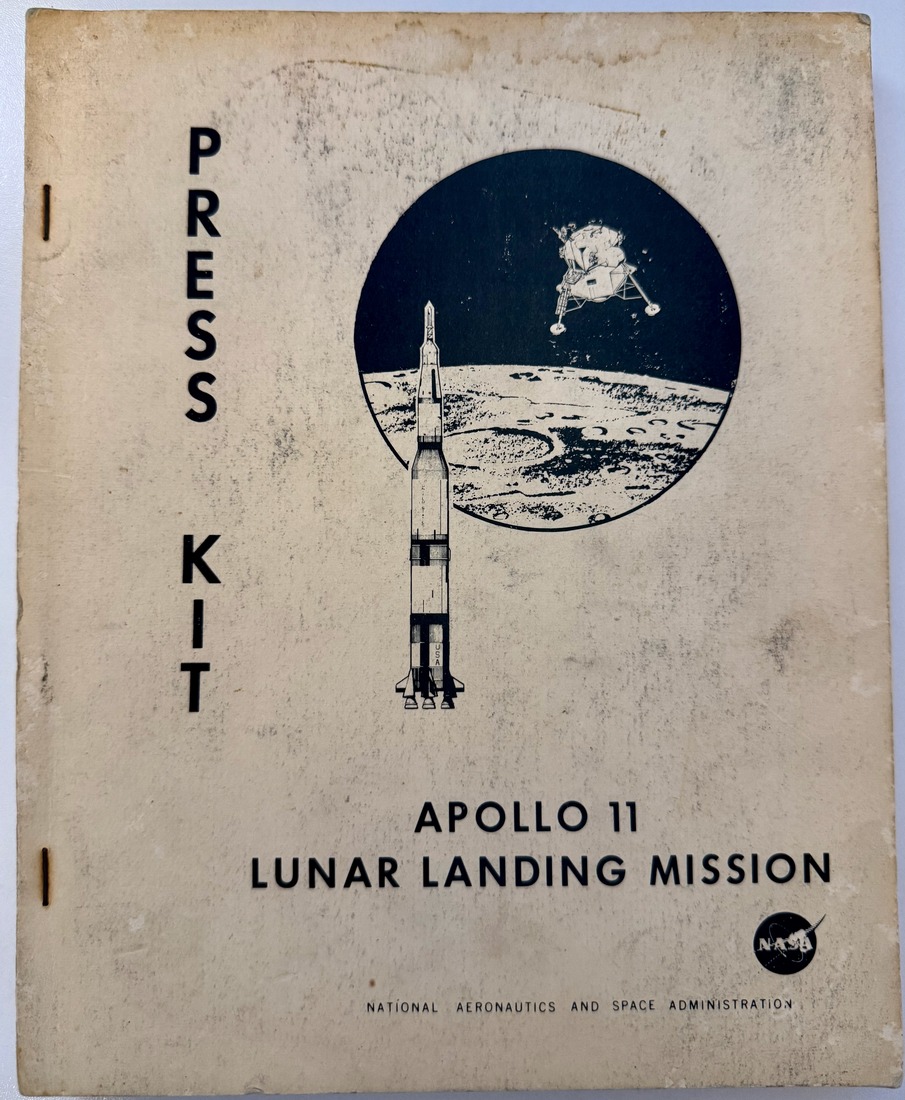
Original NASA Apollo 11 Press Kit
NASA's official 250-page press kit issued ahead of Apollo 11, the first crewed lunar landing, covering the prime and backup crews, the launch from Complex 39-A and translunar injection, and labeled cutaway diagrams of the Command, Service, and Lunar Modules. A substantial section details the mission's contamination-control program built around the returning crew and lunar samples: the Biological Isolation Garment worn on splashdown, the Mobile Quarantine Facility, the Lunar Receiving Laboratory, and spacecraft sterilization procedures. Closes with lists of Apollo/Saturn program officials and major contractors, the principal investigators assigned to study the lunar surface samples, and an Apollo glossary, acronym list, and conversion-factor tables.
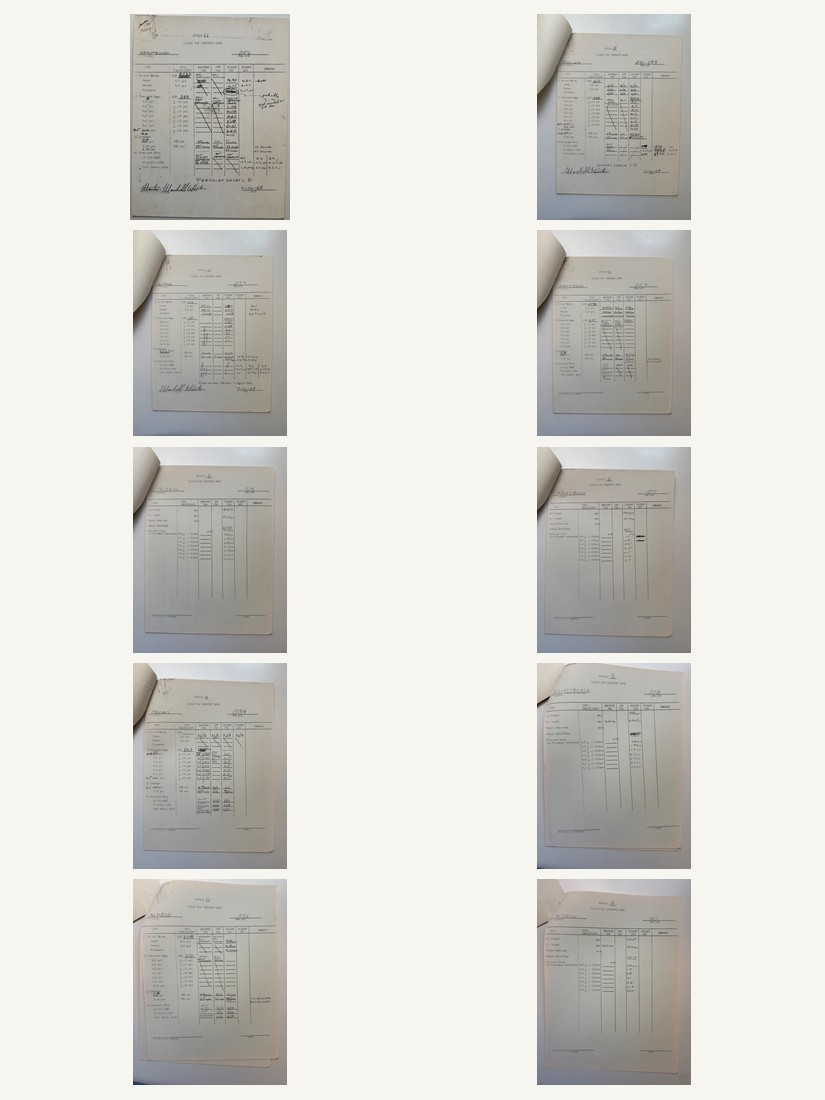
Apollo 11 Flight PGA and LCG Checkout Data: Armstrong, Collins, and Aldrin Spacesuits
Ten internal NASA Crew Systems Division (CSD) quality-control sheets tracking the pressure garment assemblies (PGA, the A7L spacesuits) and liquid cooling garments (LCG) issued to Neil Armstrong, Michael Collins, and Buzz Aldrin for Apollo 11, each logging relief-valve crack/reseat pressures, pressure-gauge calibration at 3.0–6.0 psi increments, and leakage-rate tests against factory, Cape acceptance, and flight readings. The serial numbers recorded match the published Apollo suit-serial registry exactly: PGA 056 was Armstrong's flight suit, the one he wore on the lunar surface and today conserved at the Smithsonian; PGA 077 was Aldrin's flight suit, also at the Smithsonian; and PGA A7L-033 was Collins's flight suit. Each is paired with its backup unit (Armstrong 057, Aldrin 076, Collins 034), checked out but left unsigned, apparently because it was not the suit ultimately flown. The three flight-suit sheets are all signed by the on-site CSD Mission Manager, Marshall W. Horton, and dated July 16, 1969 — Apollo 11's launch day. Four accompanying LCG sheets track the water-cooled undergarments through the final week before launch: Aldrin's first unit charged five and a half days out (July 10, 17:30), a second three and a half days out (July 12, 22:20), Armstrong's first unit two days out (July 14, 23:07), and a replacement unit charged at 00:50 on launch morning itself, written over a crossed-out earlier time. The leakage tests distinguish intravehicular from extravehicular glove readings only for Armstrong and Aldrin, the two moonwalkers, consistent with Collins remaining in the Command Module throughout the mission. The Crew Systems Division compiled a parallel official postflight report on Apollo 11 suit and PLSS performance, held today by NASA's history office; these working sheets appear to be exactly the kind of underlying test data that fed it. No provenance accompanies the sheets beyond the documents themselves; pen relief visible on the reverse of the pages is consistent with original ink rather than a reproduction.
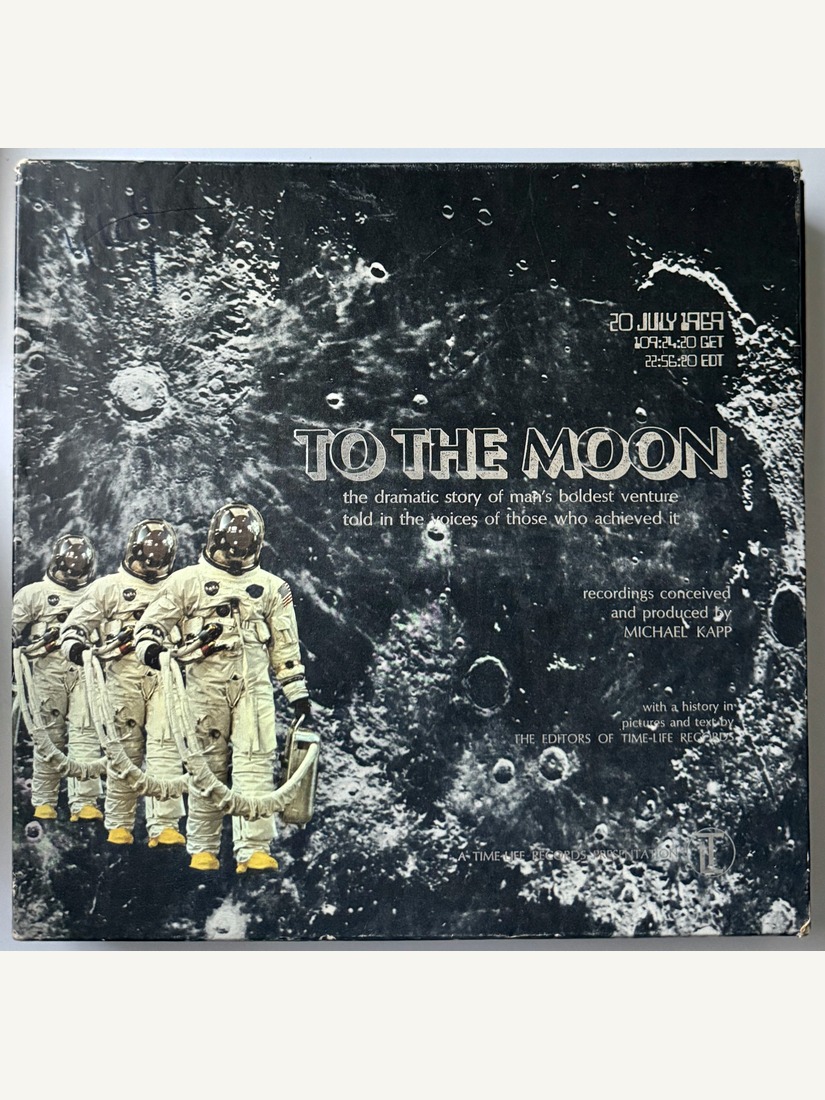
To the Moon
Boxed two-section set: Section I, “The Story in Sound,” is six LPs (twelve sides) of recordings conceived and produced by Michael Kapp, with a narrative script by David Davidson narrated by Sorrell Booke, tracing the space race from a Prologue on Tsiolkovsky, Oberth, Goddard, and the German rocket team through Mercury, Gemini, and Apollo, ending with Armstrong's first steps and Aldrin joining him on the surface; the recordings are copyrighted 1967–1969 to Redstone Productions and were “not licensed for broadcast.” Section II is a silver-bound hardcover history in pictures and text by the editors of Time-Life Records, shelved alongside the records in the same black slipcase box. The set is a period audio-visual complement to the paper record of the missions elsewhere in this collection—an LP-by-LP oral history assembled while the Apollo program was still in progress.
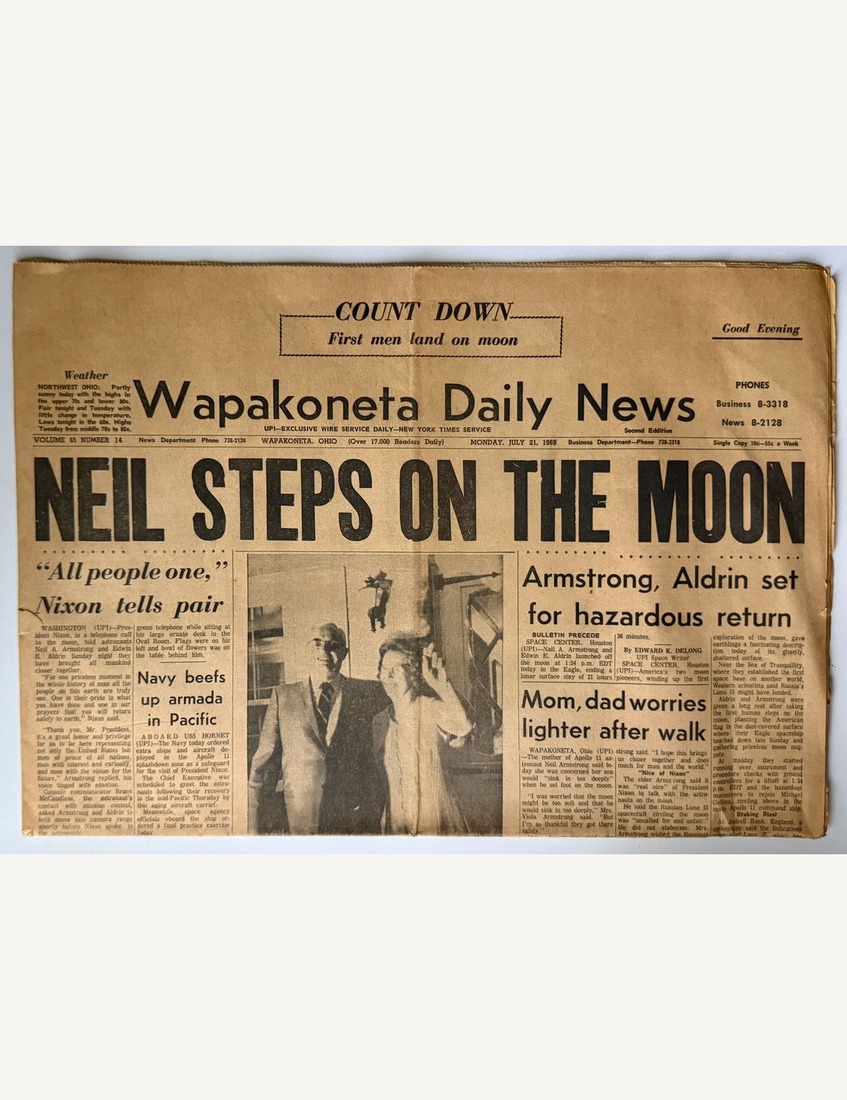
"Neil Steps on the Moon," Wapakoneta Daily News
Second Edition of Neil Armstrong's hometown paper (Wapakoneta, Ohio), July 21 1969, headlined “Neil Steps on the Moon” over “Count Down: First men land on moon.” Alongside wire coverage of the landing and Nixon's “all people one” call to the crew, the front page carries a local human-interest story, “Mom, dad worries lighter after walk,” quoting Armstrong's mother Viola by name on her fear the lunar surface “might be too soft” and that he “would sink in too deeply,” and his father's remark that Nixon's call was “real nice.” Also reports preparations for the Eagle's liftoff from the Moon later that day.
Guide to Lunar Orbiter Photographs
NASA SP-242, a 125-page reference guide prepared at Langley Research Center to the photographic survey conducted by the five Lunar Orbiter missions of 1966–1967, the program that mapped candidate Apollo landing sites and much of the rest of the Moon before any astronaut left Earth orbit. Illustrated throughout, it indexes and locates the individual frames returned by each of the five spacecraft, giving readers a way to find and interpret specific Lunar Orbiter photographs by site and coverage area.
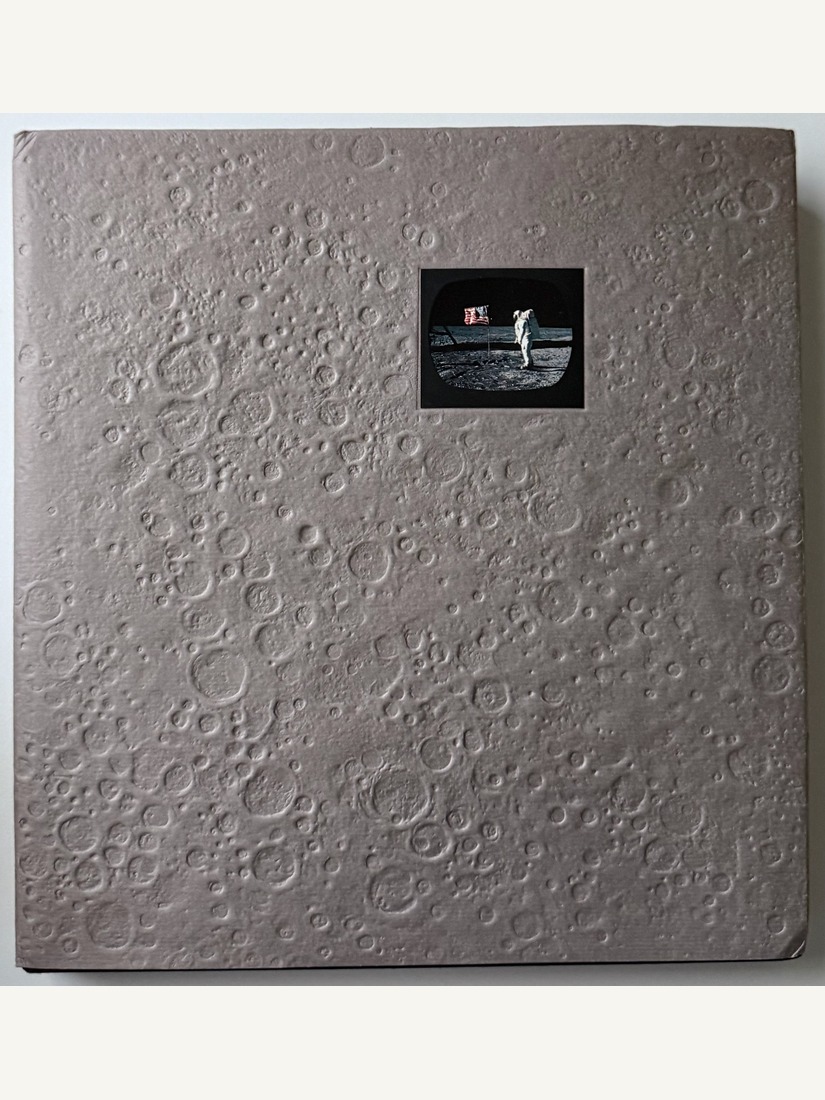
10:56:20 PM, EDT 7/20/69
Full title 10:56:20 PM, EDT 7/20/69: The Historic Conquest of the Moon as Reported to the American People by CBS News over the CBS Television Network, published by CBS in New York in 1970. This was a limited edition, not sold to the public but presented individually to network VIPs—affiliate executives and advertisers—with a personalized business card laid in as a gift card; this copy carries the card of Robert D. Wood, who had become President of the CBS Television Network in February 1969, five months before the landing. The dust jacket is embossed with the cratered lunar surface in relief, set with a small color photograph, cropped to the shape of a television screen, of Buzz Aldrin beside the flag on the Sea of Tranquility. The book opens with an epigraph from Archibald MacLeish's poem “Voyage to the Moon,” commissioned by the New York Times and run on its front page the day after the landing, followed by a preface signed simply “CBS” describing the volume as the record of how CBS News met “the most demanding challenge yet put to electronic journalism.” The roughly 170 pages that follow reproduce the coverage itself: television-screen stills paired with transcribed on-air commentary from Walter Cronkite, Roger Mudd, Mike Wallace, and Dan Rather, with analysis throughout from astronaut-turned-commentator Wally Schirra.
Apollo 12 Mission Report (MSC-01855)
NASA's official report on Apollo 12 (November 1969), the second lunar landing, crewed by Charles Conrad Jr., Richard F. Gordon, and Alan L. Bean. Covers the mission's precision landing near the Surveyor III spacecraft in the Ocean of Storms, the two lunar-surface EVAs, deployment of the first Apollo Lunar Surface Experiments Package, and the return of Surveyor III components and about 75 pounds of lunar material. The approval page carries a printed (not hand-signed) signature block for James A. McDivitt, Manager, Apollo Spacecraft Program.
From the personal collection of astronaut Jim McDivitt, with a Novaspace “Jim McDivitt Garage Sale” Certificate of Authenticity.
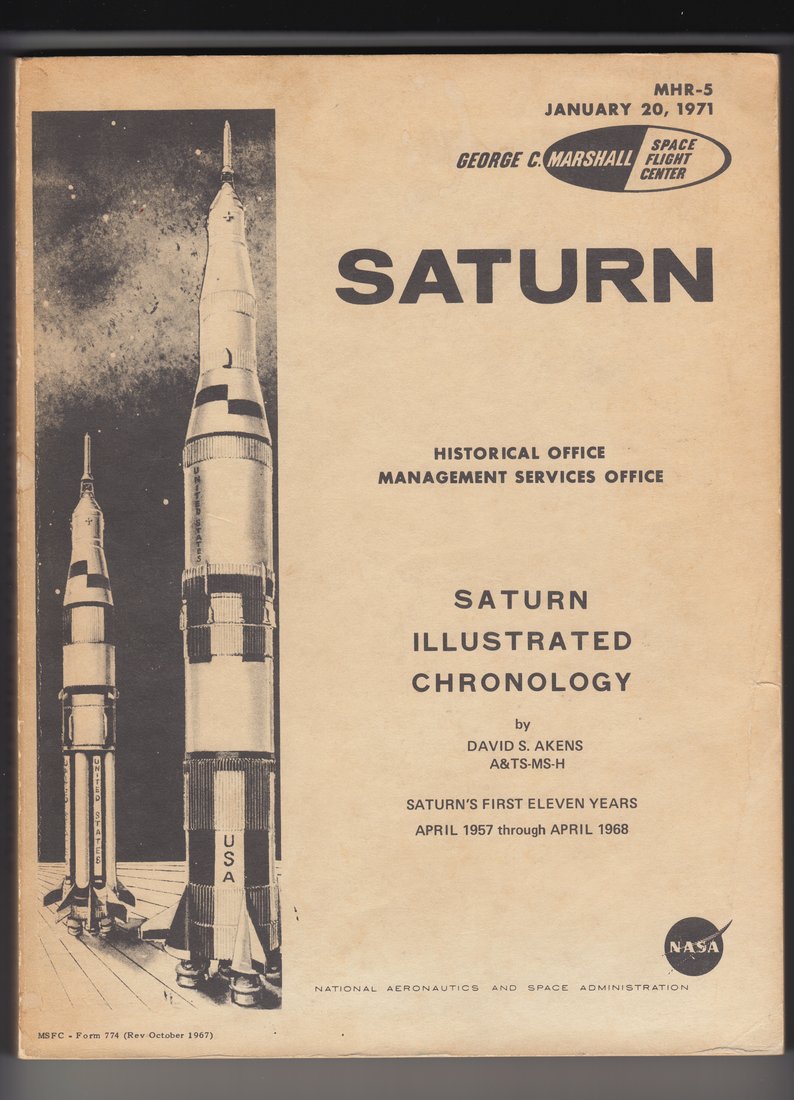
Saturn Illustrated Chronology, MHR-5
David S. Akens' illustrated chronology of the Saturn rocket program's first eleven years, April 1957 through April 1968, published by the Historical Office at Marshall Space Flight Center. This copy is the fifth and final edition (1971), superseding four earlier editions (1963, 1965, 1967, 1969) as the chronology's coverage grew year by year; NASA's own history office describes it as the most complete version, adding a glossary, a 528-item bibliography, and an index not found in the earlier printings.
NASA SP-246, Lunar Photographs From Apollo 8, 10, and 11
NASA's official photographic record from the Apollo 8, 10, and 11 missions, bound in a stamped cloth cover. Compiled by Robert G. Musgrove of the Mapping Sciences Laboratory, NASA Manned Spacecraft Center, with contributions from the Lockheed Electronics Corporation Mapping Sciences Department; includes a double-page lunar reference map locating Tranquility Base.
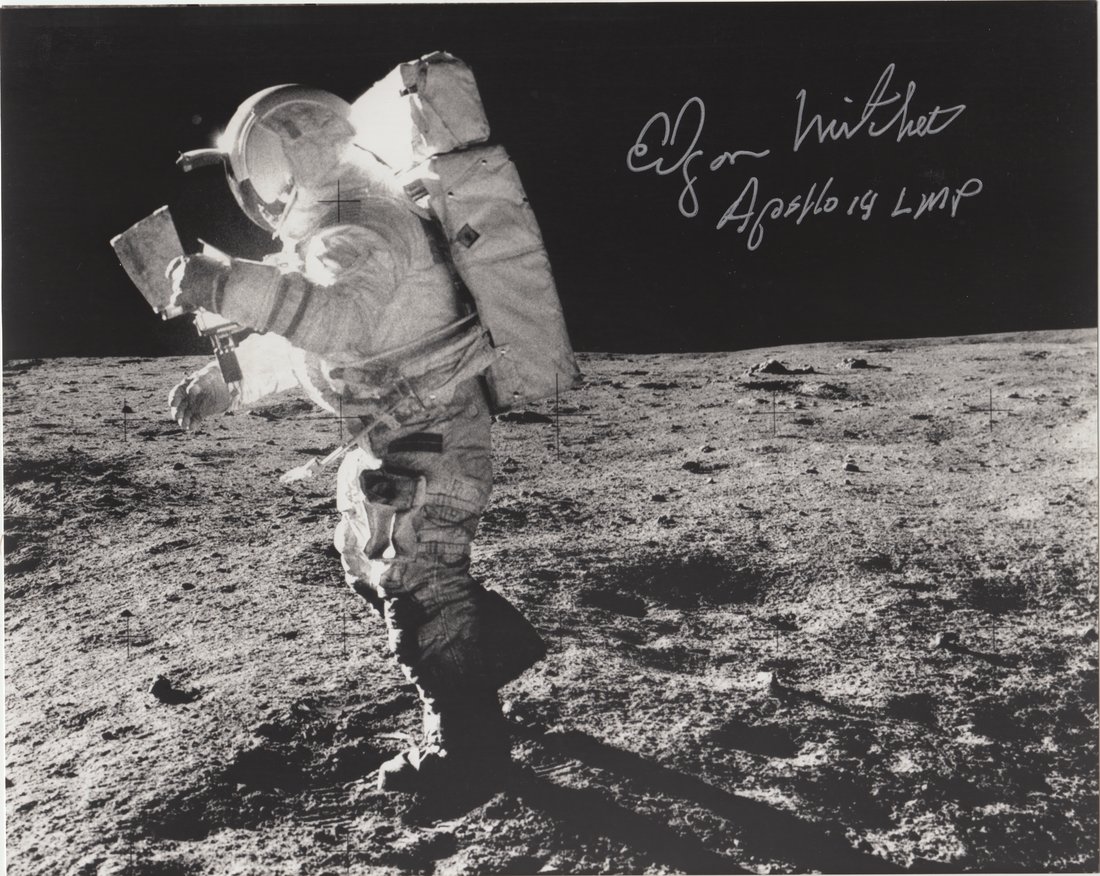
Apollo 14 EVA — Signed Edgar Mitchell
Apollo 14 lunar-surface EVA photograph, signed "Edgar Mitchell / Apollo 14 LMP."
Signed by Edgar Mitchell, Apollo 14 Lunar Module Pilot.
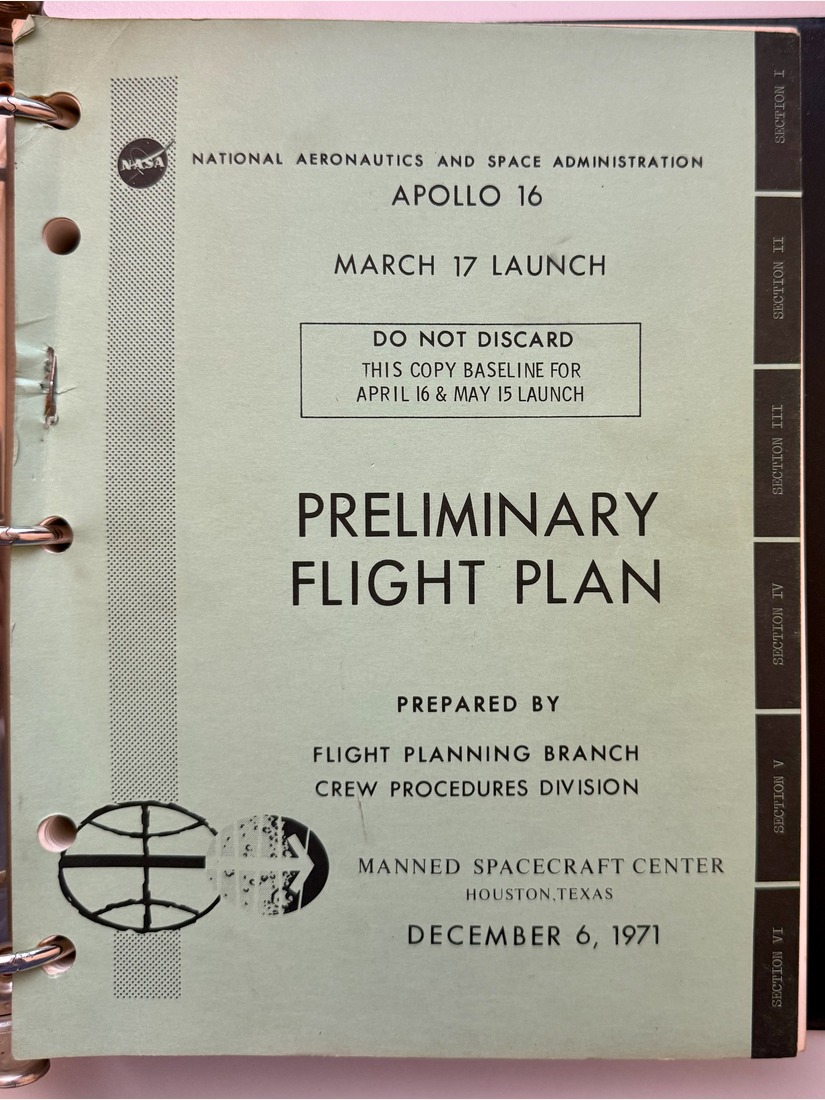
Apollo 16 Preliminary Flight Plan
Three-ring, six-section “Preliminary Flight Plan” for Apollo 16, prepared by the Flight Planning Branch of the Crew Procedures Division and dated December 6, 1971. The cover heads the document “March 17 Launch” but is stamped “DO NOT DISCARD — THIS COPY BASELINE FOR APRIL 16 & MAY 15 LAUNCH,” a schedule slip the mission itself bore out: Apollo 16 (Young, Mattingly, Duke) ultimately launched on the later of those two contingency dates, April 16, 1972, still the same December baseline. Approved by the Flight Planning Branch and Crew Procedures Division chiefs and by Donald K. Slayton as Director of Flight Crew Operations, it runs the full length of the mission—minute-by-minute CSM and LM timeline strips organized phase by phase, from Earth orbit and translunar injection through lunar orbit insertion, LM descent, the three lunar-surface EVAs (with the Lunar Roving Vehicle, flag deployment, and ALSEP offload), rendezvous and LM jettison, the post-rendezvous science phase and subsatellite launch, transearth injection, a CSM EVA, and entry, closing with consumables analysis and abbreviated and alternate mission timelines. A separate stowage table (Table 2-B) gives an axonometric map of the entire Command Module cabin at launch, keying dozens of labeled lockers and bags to itemized lists of their contents down to individual cables, film magazines, and food packages.
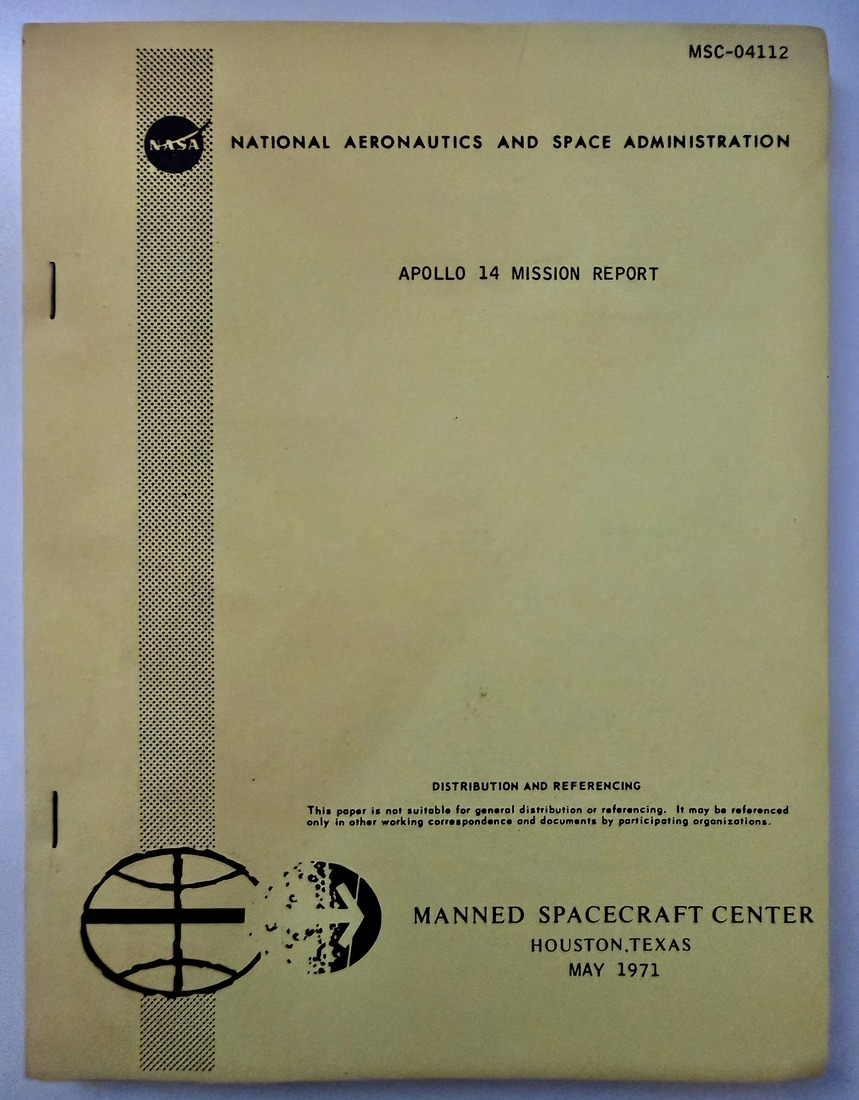
Apollo 14 Mission Report (MSC-04112)
NASA's official report on Apollo 14 (January 31 – February 9, 1971), the third lunar landing, crewed by Alan B. Shepard Jr., Stuart A. Roosa, and Edgar D. Mitchell. Covers the mission's weather-delayed launch, the six docking attempts needed after transposition, the landing in the Fra Mauro highlands, deployment of the Apollo Lunar Surface Experiments Package and a laser ranging retro-reflector, lunar geology and soil mechanics work with the Modular Equipment Transporter, and a set of in-flight technology demonstrations (electrophoretic separation, liquid transfer, heat flow and convection, and composite casting).
From the personal collection of astronaut Jim McDivitt, with a Novaspace “Jim McDivitt Garage Sale” Certificate of Authenticity.
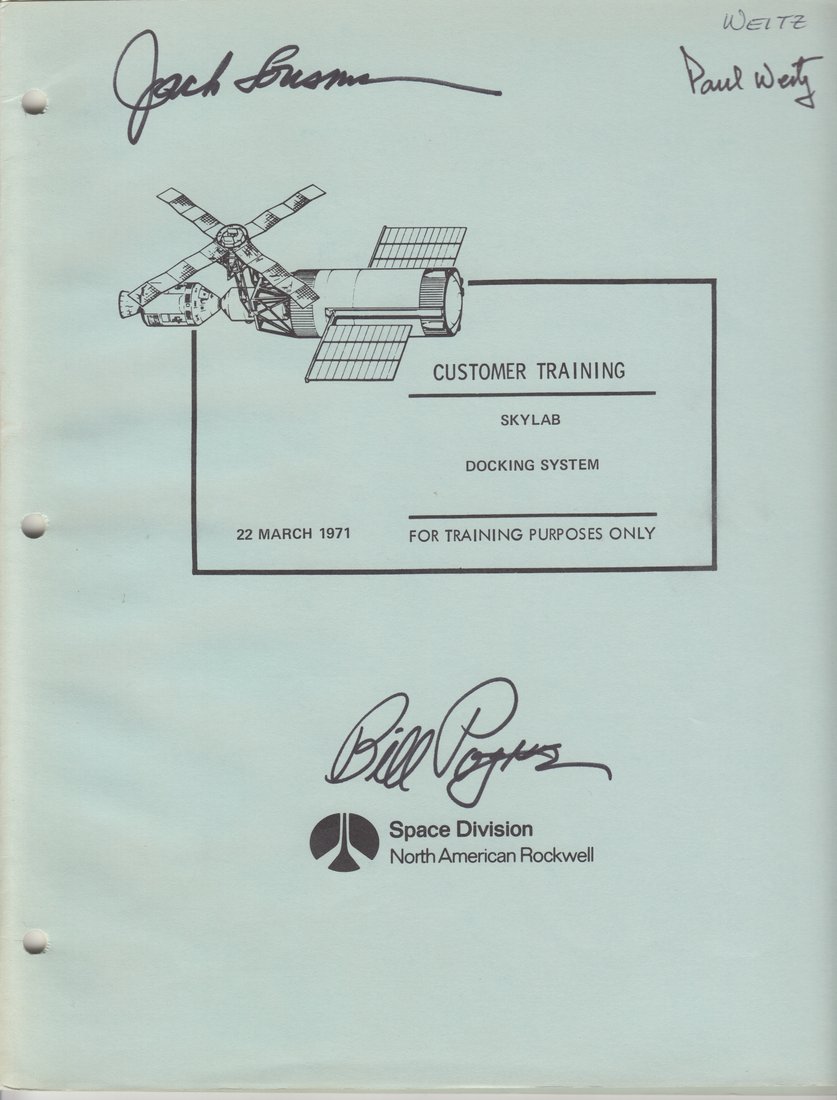
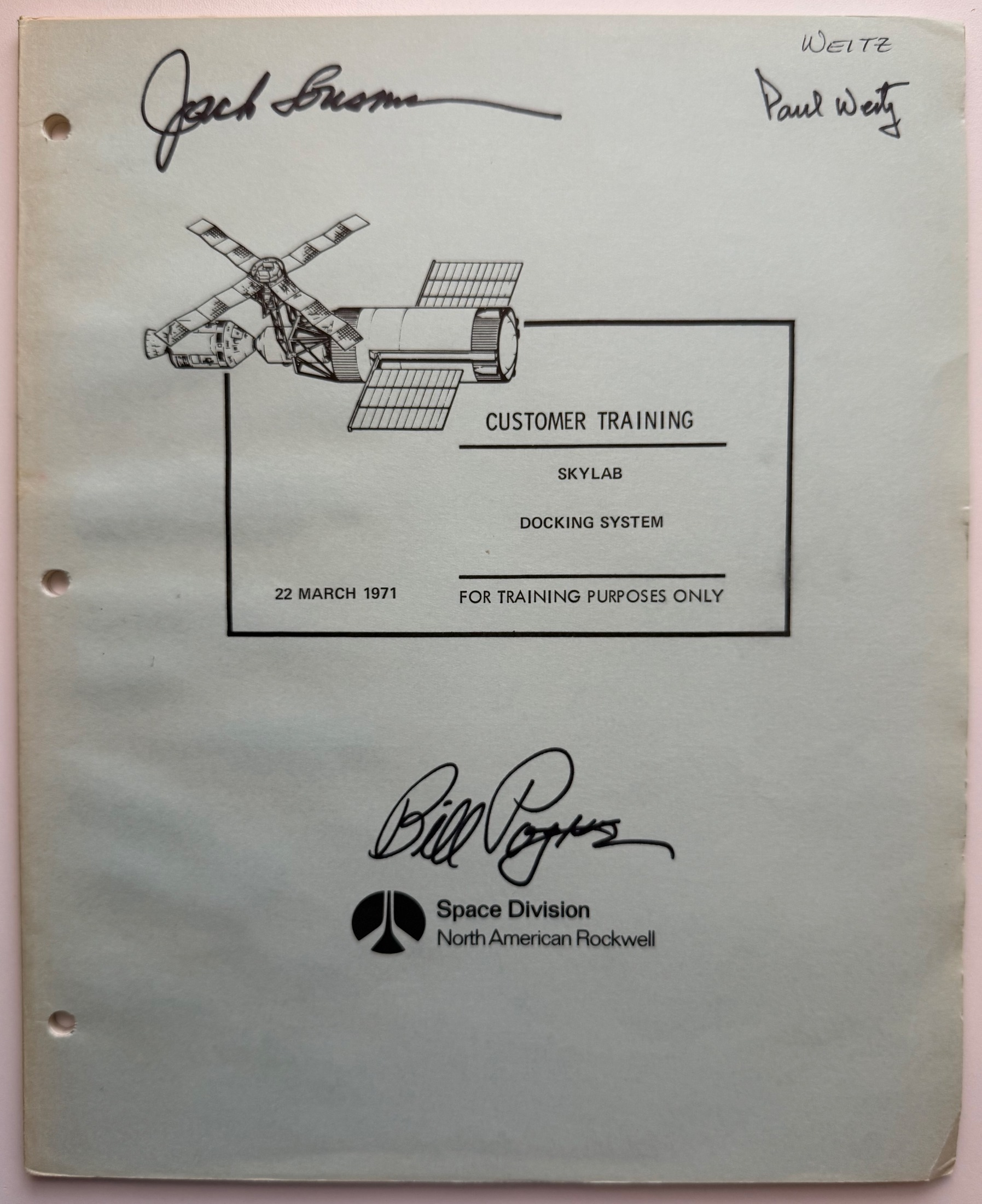
Skylab Docking System Manual, Signed by the Pilots of Skylab I, II, and III
"Customer Training — Skylab Docking System," dated March 22 1971, used for training purposes only, from Paul Weitz's personal collection. Signed on the cover by Jack Lousma, Paul Weitz, and Bill Pogue, the pilots of the three Skylab crews. Three sections: Docking System, Tunnel and MDA Pressurization System, and Docking System Specification, illustrated throughout with CSM Logistics Training diagrams. Covers the CSM/Orbital Assembly docking operational phases (earth-orbit-insertion configuration, CSM separation with probe extended, CSM docked with the orbital assembly, and probe-and-ring jettison prior to CM–SM separation), the MDA tunnel vent and pressure-equalization valve, and tabulated docking velocity and alignment tolerances (e.g., axial closing velocity of 0.1–1.0 ft/sec, beyond which structural damage to both LM and CSM may result).
Signed by Jack Lousma, Paul Weitz, and Bill Pogue. Accompanied by a Certificate of Authenticity from the Astronaut Scholarship Foundation, hand-signed by Paul Weitz (Skylab 2, STS-6), attesting that the manual is from his personal collection and that all three signatures are authentic.
 Featured
For Latches to Engage and Lock
›
Featured
For Latches to Engage and Lock
›
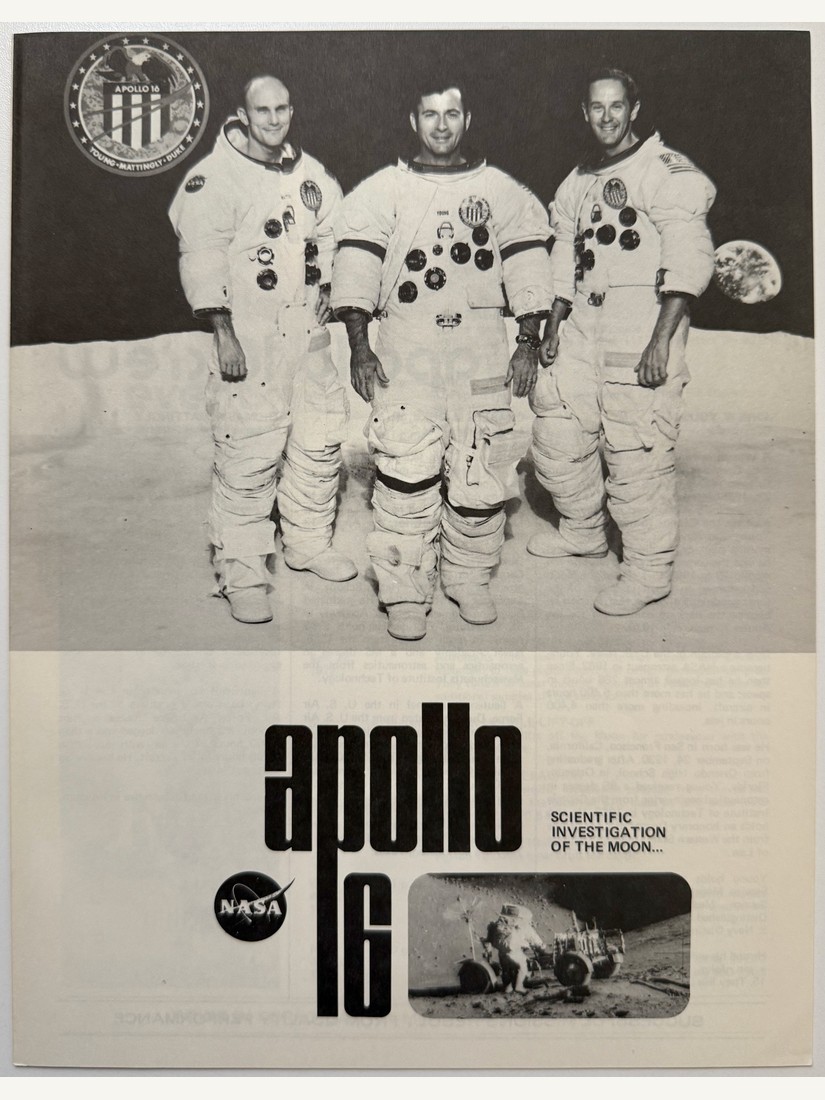
Apollo 16: Scientific Investigation of the Moon
Manned Flight Awareness program brochure distributed to contractor personnel for the April 1972 Apollo 16 mission, part of NASA's ongoing workforce quality-and-safety campaign ("Successful Missions Result from Quality Performance"). Cover photograph of the crew (John W. Young, commander; Thomas K. Mattingly, command module pilot; Charles M. Duke, Jr., lunar module pilot) in spacesuits, with the Apollo 16 mission patch and an inset of the lunar rover. Interior spread gives brief biographies of all three astronauts and a detailed day-by-day schedule of events from the April 16 launch through the April 27 splashdown, covering translunar insertion, lunar orbit insertion, the three lunar-surface EVAs (Flag Crater, Stone Mountain, North Ray Crater), lunar module liftoff, and trans-Earth injection. Back cover, captioned "Apollo Saturn," shows an astronaut and rover beside the lunar module with the surface communications relay unit, credited to Manned Flight Awareness, Marshall Space Flight Center, Huntsville, Alabama.
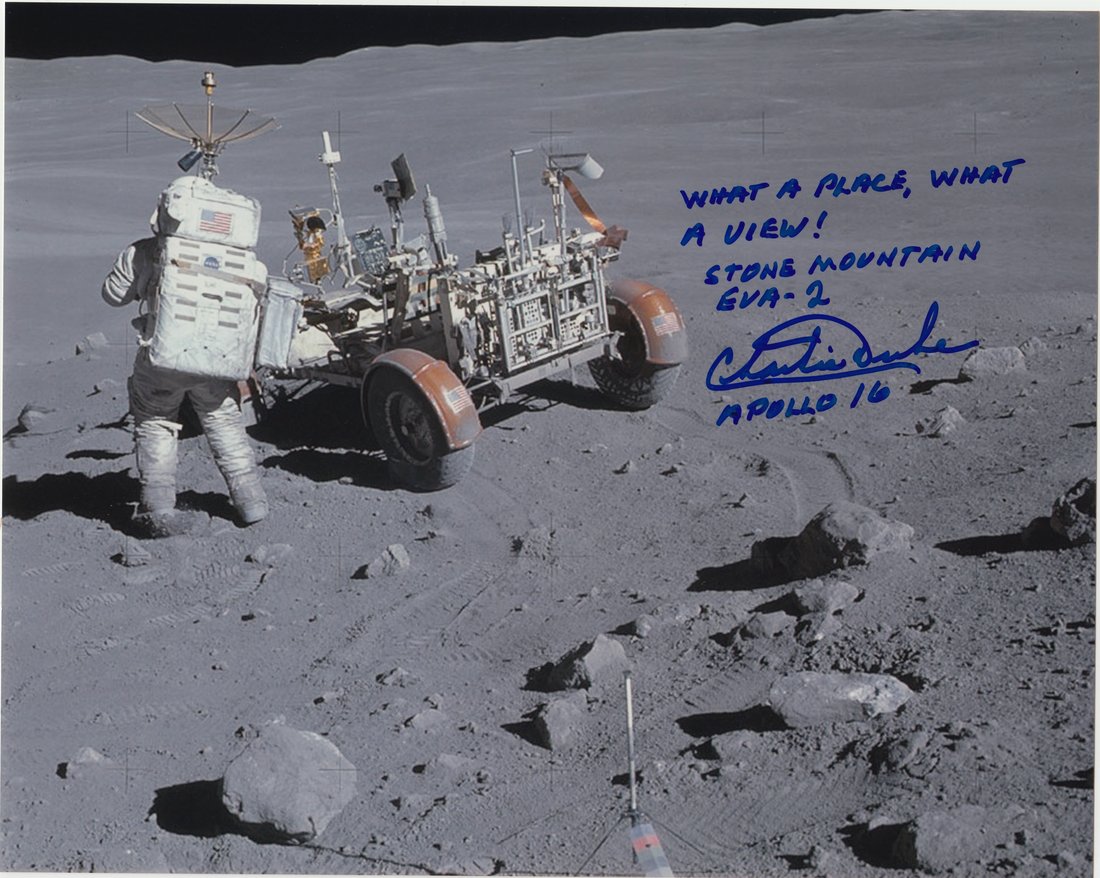
Apollo 16 EVA 2 — Signed Charlie Duke
Photograph of the lunar rover at Stone Mountain during Apollo 16's second EVA, signed "Stone Mountain EVA-2, Charlie Duke, Apollo 16."
Signed by Charlie Duke, Apollo 16 Lunar Module Pilot.
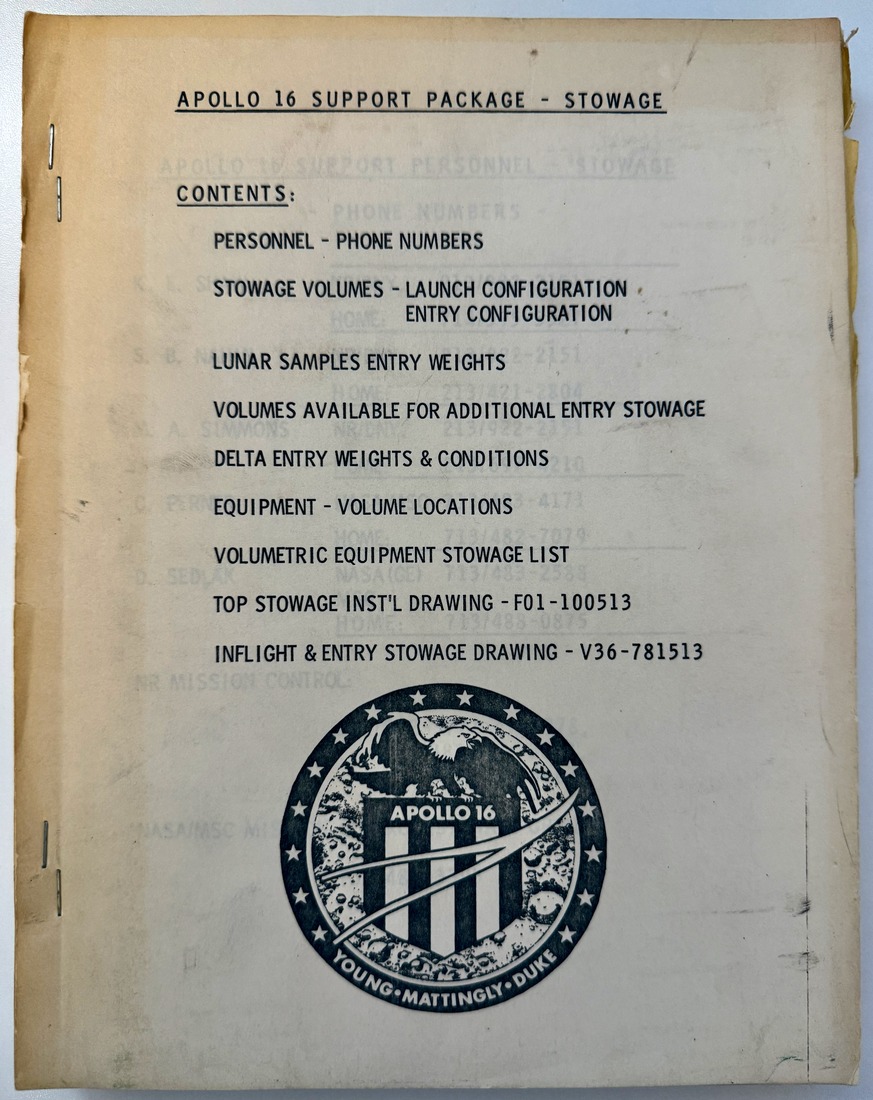
Apollo 16 Support Package — Stowage
Working support package for Apollo 16 (Young, Mattingly, Duke), covering stowage volumes for both launch and entry configurations, lunar-sample entry weights, spare volumes available for additional entry stowage, and a volumetric equipment stowage list, keyed to two engineering drawings: the Top Stowage Installation drawing (F01-100513) and the Inflight and Entry Stowage drawing (V36-781513). Included blueprint sheets detail the top-stowage bags for items such as the EMU maintenance kit, waste-management gear, and camera equipment, along with a lunar-samples entry stowage diagram giving specific bag part numbers and weights, including a 75-pound sample-return container and a 23.7-pound bag carried inside the astronauts' pressure garment assembly.
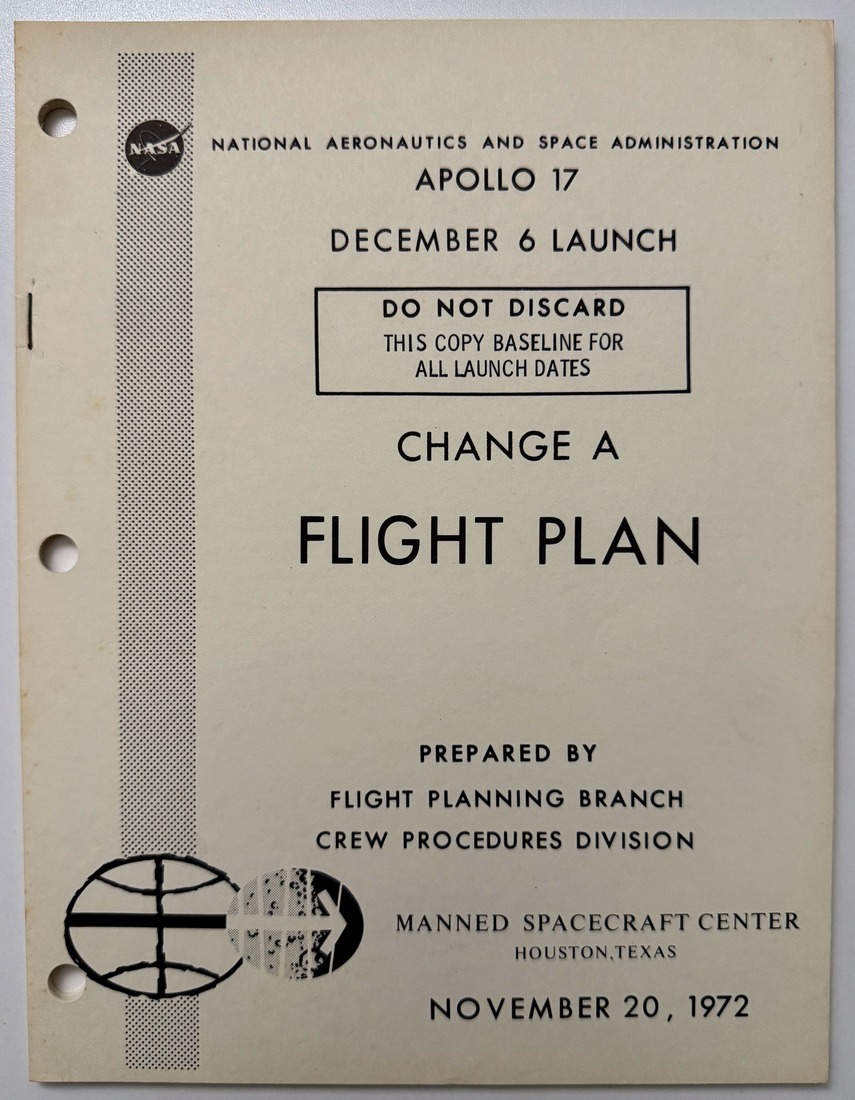
Apollo 17 Flight Plan, Change A
Dated November 20, 1972 and marked “Do Not Discard—This Copy Baseline for All Launch Dates,” this is Change A to the CSM Flight Plan for Apollo 17, baselined for the December 6 launch that would send the last Apollo crew to the Moon. The acknowledgments page credits the Flight Planning Branch team by name for the plan's principal contributions and graphics and copy preparation. The body is the minute-by-minute mission timeline in the flight plan's standard column format—ground-elapsed-time scales, systems-management call-outs, maneuver PADs, and burn-status report grids—running from translunar coast through lunar orbit and back. Sampled pages cover the SIM-bay door jettison ahead of lunar orbit insertion (with a lunar-chart illustration of Copernicus crater for visual landmark tracking), lunar sounder and pan-camera operations timed against orbital ground tracks, the transearth injection maneuver pad, jettison of the lunar module after the crew's final use of it (including a printed reminder to transfer no urine or feces and to store all open food in a Beta-cloth bag before closeout), and preparations for the deep-space EVA on the return trip to retrieve film cassettes from the service module's scientific instrument bay.
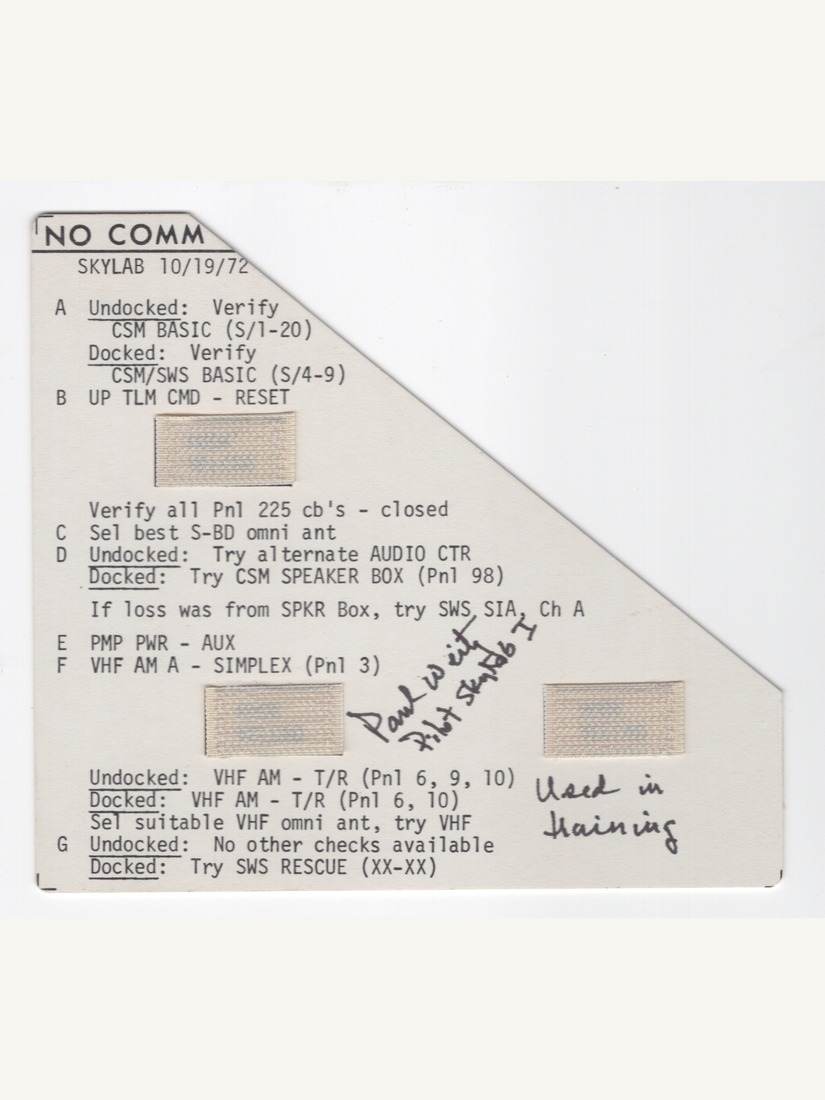
Skylab I Checklist Card, Signed by Paul Weitz
"NO COMM" contingency checklist card, Skylab, dated 10/19/72, covering undocked and docked no-communication procedures in steps A through G, signed "Paul Weitz, Pilot Skylab I," with a note that the card was "used in training." The reverse carries a second, denser reference list headed "PWR USERS," covering electrical and systems callouts across the buses, EPS, ECS, RCS, SPS, G&N, and SCS. The card is die-cut to an unusual shape, an isosceles triangle with two of its points removed, so that it would affix flat to a surface inside the Skylab workshop; three Velcro fasteners survive intact on the reverse. Weitz signed the card "Pilot Skylab I," the crew's own informal name for their flight; NASA's official designation for that first crewed Skylab mission was Skylab 2, the wording used on the accompanying Certificate of Authenticity.
Signed by Paul Weitz, pilot of the first crewed Skylab mission. Accompanied by a Certificate of Authenticity from the Astronaut Scholarship Foundation; from Weitz's personal collection for more than 30 years before its donation to the Foundation.
Featured
For Latches to Engage and Lock
›
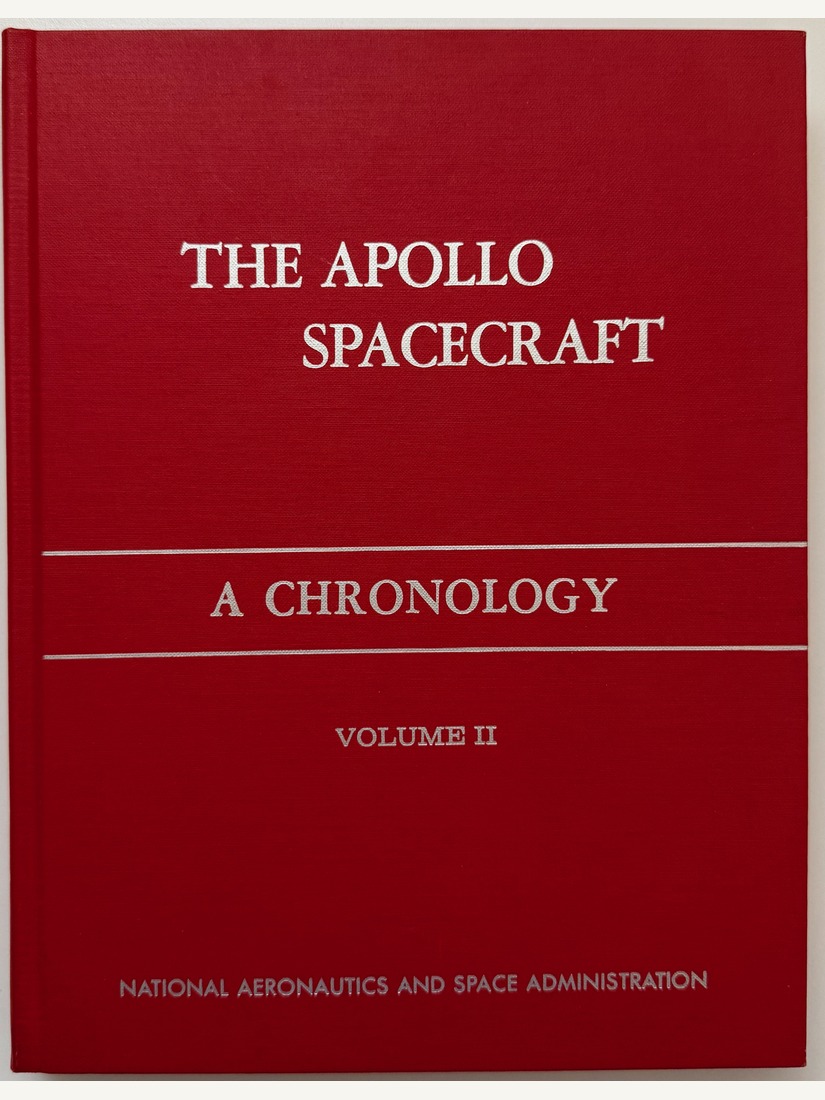
The Apollo Spacecraft: A Chronology, Volume II
NASA SP-4009, Volume II, covering November 8, 1962 through September 30, 1964. The imprint line changes here from Volume I's “Scientific and Technical Information Division” to “Scientific and Technical Information Office” — a NASA department rename between 1969 and 1973, not a change of publisher. Matching red cloth binding, silver spine stamping, no dust jacket.
Featured
The Apollo Spacecraft: A Chronology
›
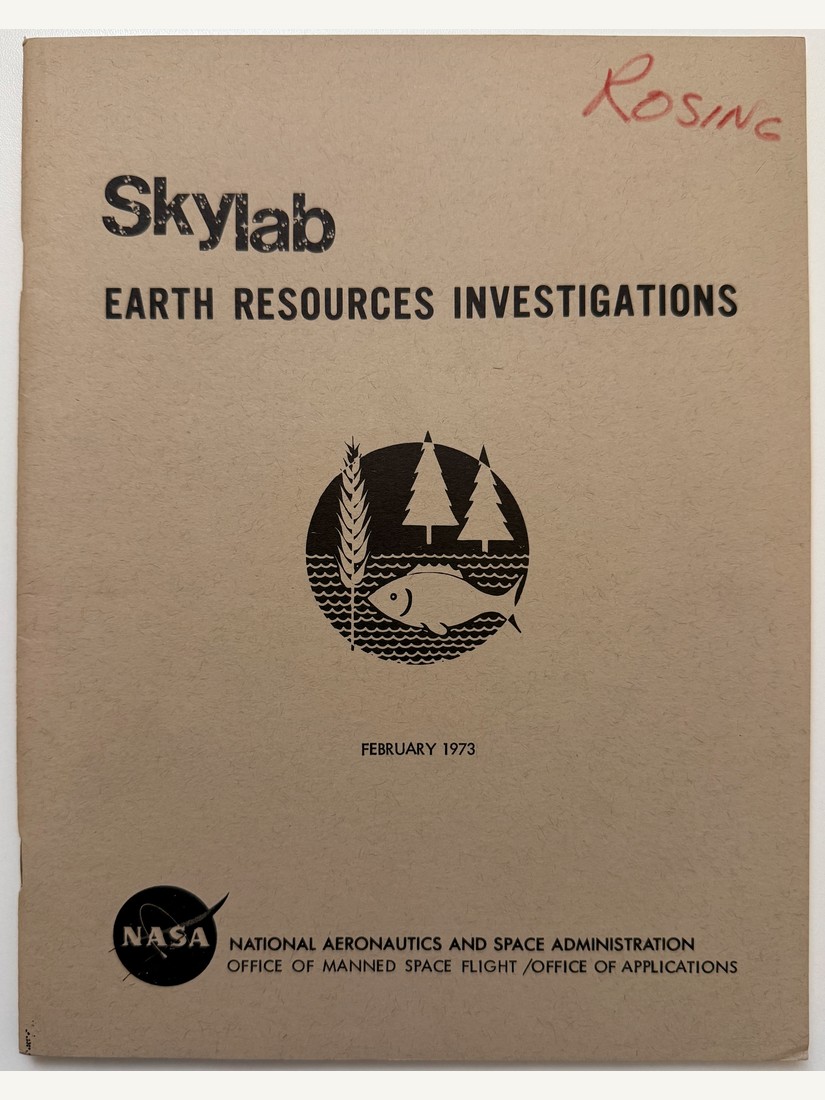
Skylab Earth Resources Investigations
NASA overview booklet on the Earth Resources Experiment Package (EREP), the Skylab payload built to test and validate remote sensing of the Earth's natural resources from orbit. The foreword explains that EREP's five instruments permitted simultaneous sensing of ground test sites in the visible, infrared, and microwave spectral regions, with particular emphasis on validating spectral-signature identification from orbital altitude; results were to be correlated against data gathered by aircraft and on-site measurement, and considered alongside the automated Earth Resources Technology Satellite (ERTS). Following a December 1970 NASA announcement inviting qualified investigators to propose uses for the data, roughly 300 proposals arrived from domestic and foreign universities, industry, and local governments; by publication the resulting data-user program comprised about 164 individual tasks assigned to Principal Investigators in 32 states and 19 foreign countries, listed by number, investigator, and location in the pages that follow. The cover device of a wheat stalk, conifers, and a fish over stylized water represents the agriculture, forestry, and fisheries applications under study.
Inscribed “ROSING” in red ink on the front cover, evidently a former owner's or recipient's name.
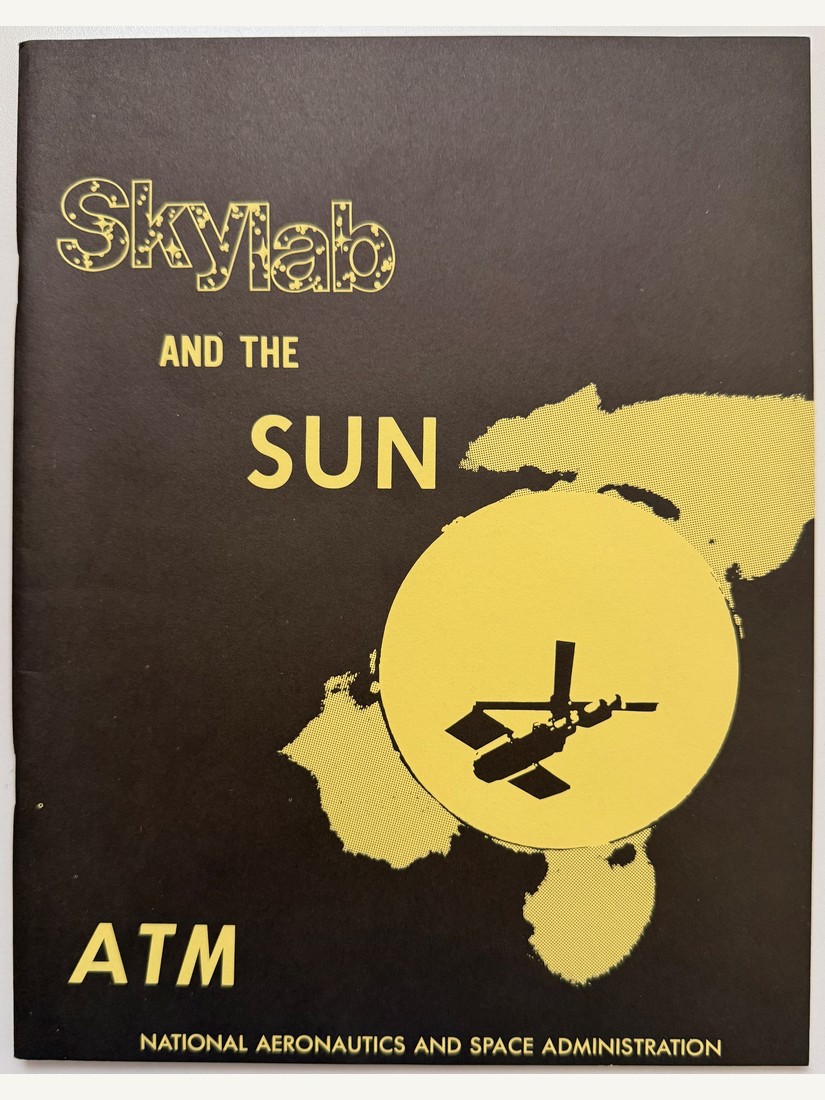
Skylab and the Sun: ATM
Public-outreach brochure on the Apollo Telescope Mount (ATM), Skylab's solar observatory, issued July 1973. In his preface, L. N. Werner of the Skylab Program Office describes the booklet's purpose as familiarizing readers with the Sun and what NASA expected to learn by observing it, with articles contributed by scientists, astronauts, and engineers associated with the ATM Program. ATM Program Manager Dixon L. Forsythe's foreword frames the mission historically, from Galileo's earliest telescopic observations of the Sun through the development of the ATM's five large experiment telescope packages, capable of simultaneous solar viewing across different wavelengths from above the disrupting effects of the Earth's atmosphere, and predicts the first ATM mission “may well be the beginning of the modern era of astronomy.” The table of contents lays out the full structure — The Skylab Program, The Sun, Solar Studies in Perspective, Skylab Solar Studies (the ATM Solar Observatory, its scientific instruments, crew operations and training, and the Joint Observing Program), and Skylab Associated Solar Programs (Coordinated Observing, Guest Observer, Ground Astronomy, Solar X-ray Spectroscopy, the ATM Calibration Rocket Program, and NOAA Solar Forecast Services) — followed by an appendix on accessing scientific data and participating as a coordinated or guest observer. The opening chapter recaps the Skylab station itself: a 100-ton orbital complex supporting more than 50 research programs, and the two-vehicle launch profile pairing a Saturn V-launched workshop with Saturn IB-launched crews.
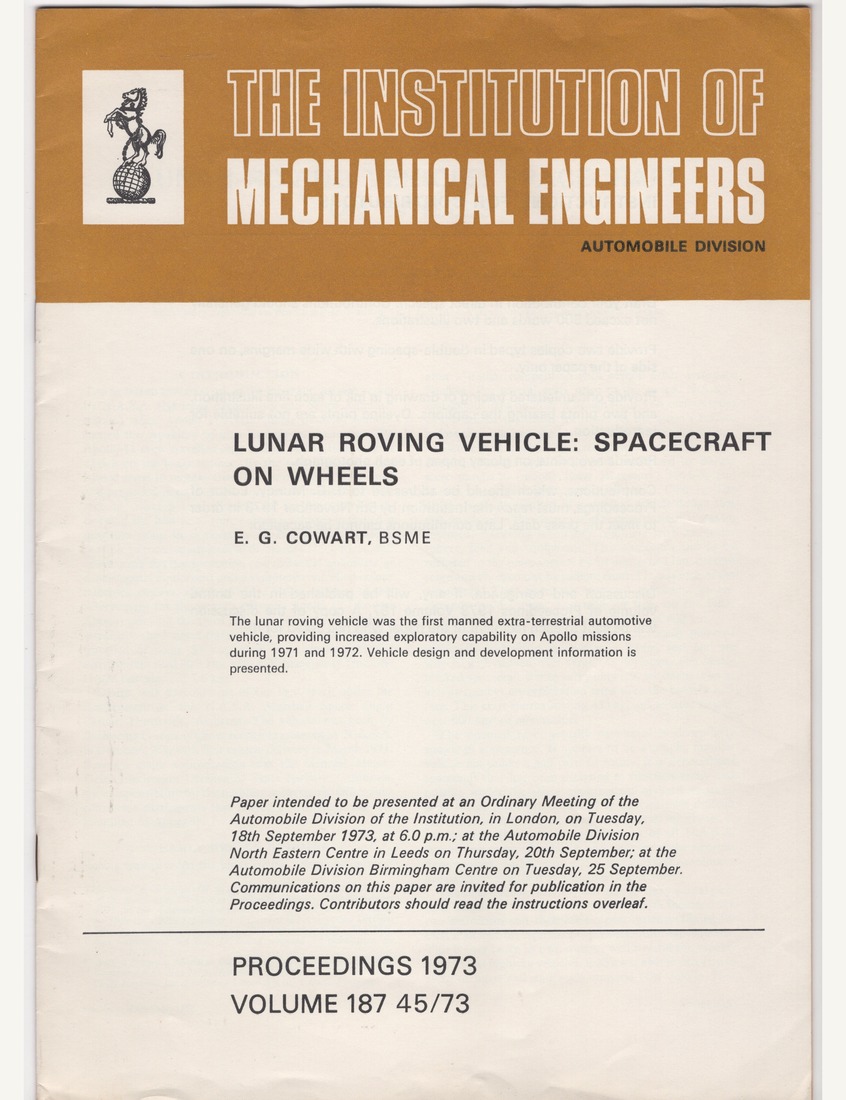
Lunar Roving Vehicle: Spacecraft on Wheels
Paper presented to the Automobile Division of the Institution of Mechanical Engineers at meetings in London, Leeds, and Birmingham, September 1973, by Boeing engineering manager E. G. Cowart. Traces the vehicle's design lineage from two earlier Marshall Space Flight Center studies, the enclosed MOLAB (1964–65) and the open-frame LSSM (1966–67), through Boeing's 1969 contract award (with General Motors' Delco Electronics Division supplying the mobility subsystems) to the vehicle that flew on Apollo 15–17. Gives major dimensions and payload figures for l.r.v.-3 (521 kg carried, more than twice the vehicle's own weight), and closes with excerpts from the Apollo 17 crew's post-flight debriefing on driving technique and the rover's performance at Taurus-Littrow.
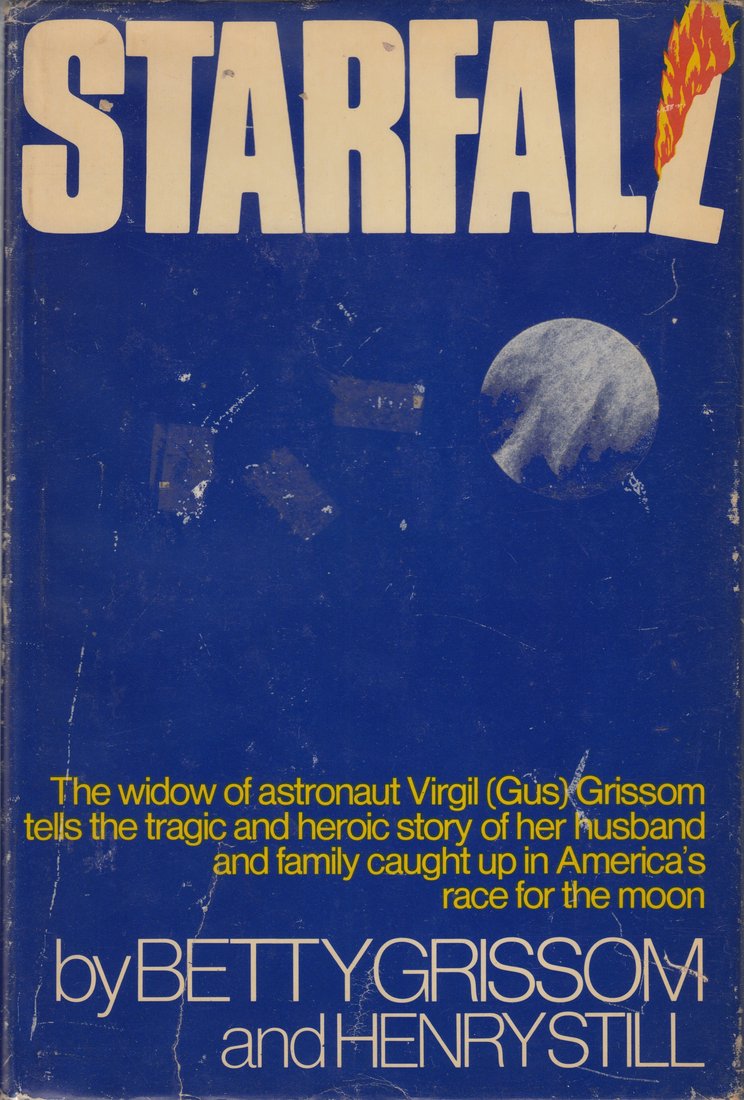
Starfall
First edition, published by Thomas Y. Crowell Company, New York, with a dust jacket designed by Walter Harper. Betty Grissom's account, written with journalist and former aerospace executive Henry Still, of her marriage to Virgil "Gus" Grissom from their Mitchell, Indiana courtship through his Mercury and Gemini flights to the January 27 1967 Apollo 1 fire and its aftermath, including her lawsuit against North American Rockwell, builders of the Apollo spacecraft. The prologue frames the fire against the failed Vanguard TV3 satellite launch of December 6 1957, reconstructing the Apollo 1 accident second by second from the two wires that touched beneath Grissom's couch to the astronauts' deaths, before returning to Gus's Indiana boyhood. The book's 20 chapters carry the story past the fire into its investigation and legal aftermath, closing with "Storefront Lawyer," "Fifteen Seconds," and "A Half Ton of Rocks." Photographs, gathered after page 128, include a Wide World Photos print of Gus and Betty with sons Scott and Mark. The acknowledgments thank Johnson Space Center director Christopher Kraft, astronauts Deke Slayton, Eugene Cernan, Ron Evans, and Jack Schmitt, NASA public affairs officer John McLeaish, historians James Grimwood and Sally Gates, sons Scott and Mark Grissom, and attorney Ronald Krist.
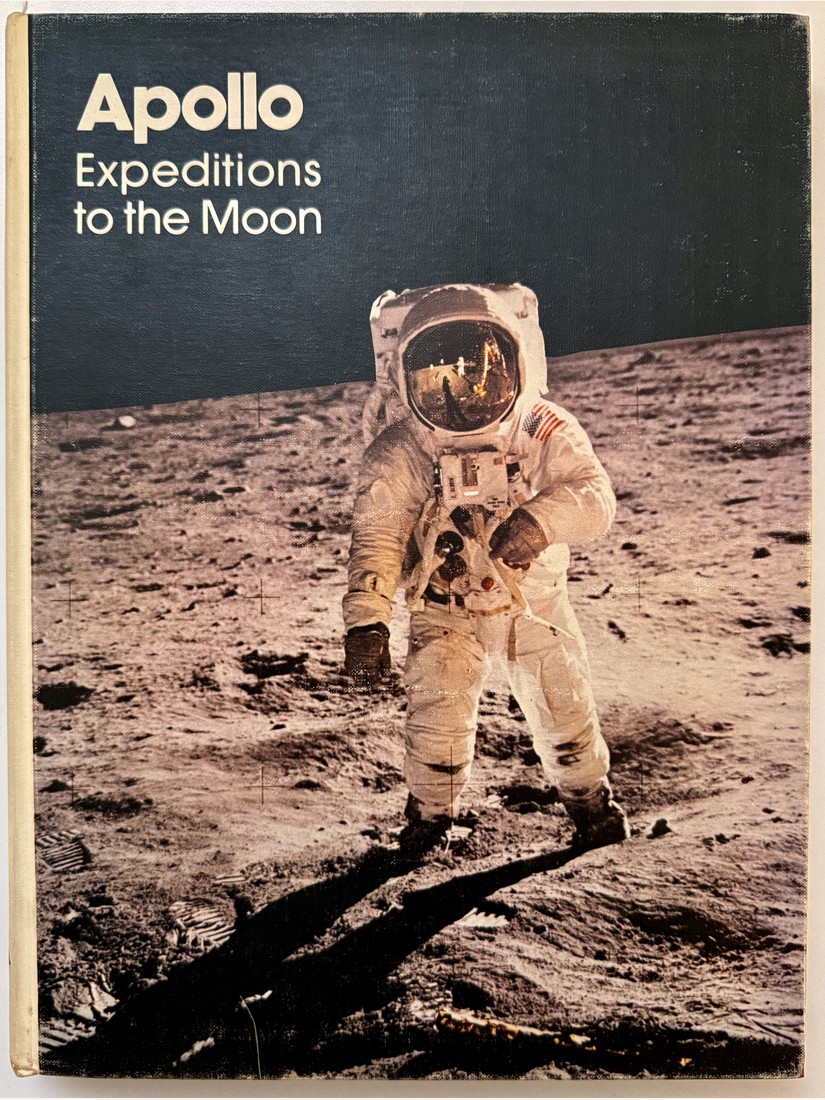
Apollo Expeditions to the Moon
NASA SP-350, published by the Scientific and Technical Information Office in 1975 to mark Apollo's conclusion, with a Buzz Aldrin lunar-surface photograph (from Apollo 11) on the cover and the full 27-step Apollo mission profile printed across the endpapers. Opens with an introduction by Robert C. Seamans, Jr. (NASA's Associate Administrator, 1965–1968) tracing the program from Sputnik through the mode-selection debates and the Apollo 8, 9, and 10 rehearsals to the first landing. The 15 chapters that follow were each written by a key participant rather than a NASA staff historian: James E. Webb and Robert R. Gilruth on why and how the goal was set, Wernher von Braun on the Saturn boosters, George M. Low on spacecraft development, Michael Collins and Edwin E. Aldrin, Jr. on the Apollo 11 landing itself, Charles Conrad, Jr. and Alan B. Shepard, Jr. on Apollo 12, James A. Lovell on Apollo 13's crippled return, Harrison H. Schmitt on the program's scientific exploration, Christopher C. Kraft, Jr. on Mission Control, Rocco A. Petrone on the Cape's launch facilities, and Homer E. Newell and Robert Sherrod closing out the volume with Apollo's legacy and the selection and training of its astronauts.
Apollo Program Summary Report
JSC-09423, the program's own closing account, issued from Houston in April 1975 after the last Apollo hardware had flown on the Apollo-Soyuz Test Project. Eleven sections and six appendices move from the unmanned Saturn/Apollo development flights and abort tests through all twelve manned missions (Apollo 1 and 7 through 17), then across the program's full breadth: lunar surface and orbital science (geology at each of the six landing sites, the ALSEP instrument packages, the Lunar Sounder and other orbital sensors), vehicle development and performance for the Saturn launch vehicles, command and service module, and lunar module, spacecraft development testing, a flight crew summary covering training and mission experience mission by mission, mission operations and the Manned Space Flight Network, a biomedical summary including the lunar quarantine program, spacecraft manufacturing and testing, launch site facilities, and the Lunar Receiving Laboratory, closing with appendices of flight data, mission designations, spacecraft weights, records set, checkout history, and flight anomalies. Illustrations sampled here include an exploded diagram of the Apollo 15 ALSEP instrument package, a cutaway of the lunar module configured for the first landing, the Block II command module side hatch mechanism, a fold-out photomap of the Apollo 16 landing area with its EVA traverse routes plotted against named craters, and the lunar module ascent-stage assembly sequence at the Grumman plant.
The Apollo Spacecraft: A Chronology, Volume III
NASA SP-4009, Volume III, covering October 1, 1964 through January 20, 1966. Matching red cloth binding and silver spine stamping continue from Volumes I and II.
Featured
The Apollo Spacecraft: A Chronology
›
Skylab: A Chronology
NASA SP-4011, a fifth, closing volume to the Apollo spacecraft chronology series, covering the Skylab program and issued separately from the four SP-4009 volumes under its own document number and registration. Same red cloth binding, silver spine stamping, and lack of dust jacket as the earlier volumes.
Carries the Ex Libris bookplate of Robert C. Seamans Jr. — NASA Deputy Administrator from 1965 to 1968, later Secretary of the Air Force, and the same Seamans whose autobiography, Aiming at Targets, appears elsewhere in this catalog. The heraldic bookplate combines Harvard and MIT arms with an orbit emblem and pictorial vignettes.
Featured
The Apollo Spacecraft: A Chronology
›
Moonport: A History of Apollo Launch Facilities and Operations
NASA SP-4204, a 24-chapter institutional history running from the Cape's pre-space missile-range days through Launch Complex 34, the mobile-launch concept behind LC-39, Saturn I and IB flight operations, the Apollo 1 fire, and the Saturn V missions through Apollo 17, closing with a chapter on the five years after. This copy is signed on the front endpaper by Ernest M. Briel, Jr., who received it directly from the authors as thanks for his contribution to the book, and comes with its original transmittal letter, dated January 22 1979 on John F. Kennedy Space Center letterhead, in which KSC Historian Frank E. Jarrett tells Briel that “the authors wish to express their thanks for your contribution to the book” and that “the enclosed volume is your personal copy.”
Signed by Ernest M. Briel, Jr. Accompanying transmittal letter on NASA/KSC letterhead, dated January 22 1979 and signed by Frank E. Jarrett, KSC Historian.
The Apollo Spacecraft: A Chronology, Volume IV
NASA SP-4009, Volume IV, covering January 21, 1966 through July 13, 1974 and closing out the four-volume Apollo chronology series. The copyright page carries the set's first full Library of Congress Cataloging-in-Publication block, cross-referencing all four volumes together for the first time. Matching red cloth binding continues from Volumes I–III.
Bears the ownership marks of space historian Gregory P. Kennedy, formerly Associate Curator for Manned Space Flight at the Smithsonian's National Air and Space Museum: a blind-embossed circular stamp over the printed imprint block on the title/verso spread, and his hand-written signature, “G. Kennedy,” in red ink, on the front free endpaper.
Featured
The Apollo Spacecraft: A Chronology
›
Chariots for Apollo: A History of Manned Lunar Spacecraft
NASA SP-4205 in the NASA History Series, published in 1979 by the Scientific and Technical Information Branch, with a foreword by General Samuel C. Phillips, USAF (Ret.), the Apollo Program Director, dated December 1978. Fourteen chapters, prepared under contract with the University of Houston, trace the design, development, and operational history of the Apollo command, service, and lunar modules — from "Concept to Challenge" and the contending mission-mode debate, through the qualification of both spacecraft, the January 1967 Apollo 1 fire recounted in "Tragedy and Recovery," and the race to land, ending with "Trip to Tranquility" and Apollo 11. Eight appendices cover the Manned Spacecraft Center site selection, astronaut assignments, the Apollo flight program, Apollo 11 experiments and lunar samples, major spacecraft component manufacturers, and program funding as of June 30, 1969. Two hardcover copies of this 1979 printing are held in the collection.

Countdown: An Autobiography
Memoir by Apollo 8 commander Frank Borman, spanning his Gemini 7 flight, command of the first crewed mission to leave Earth orbit and circle the Moon, and his later career as CEO of Eastern Air Lines. New York: William Morrow / Silver Arrow Books, 1988. First edition. Hardcover with dust jacket.
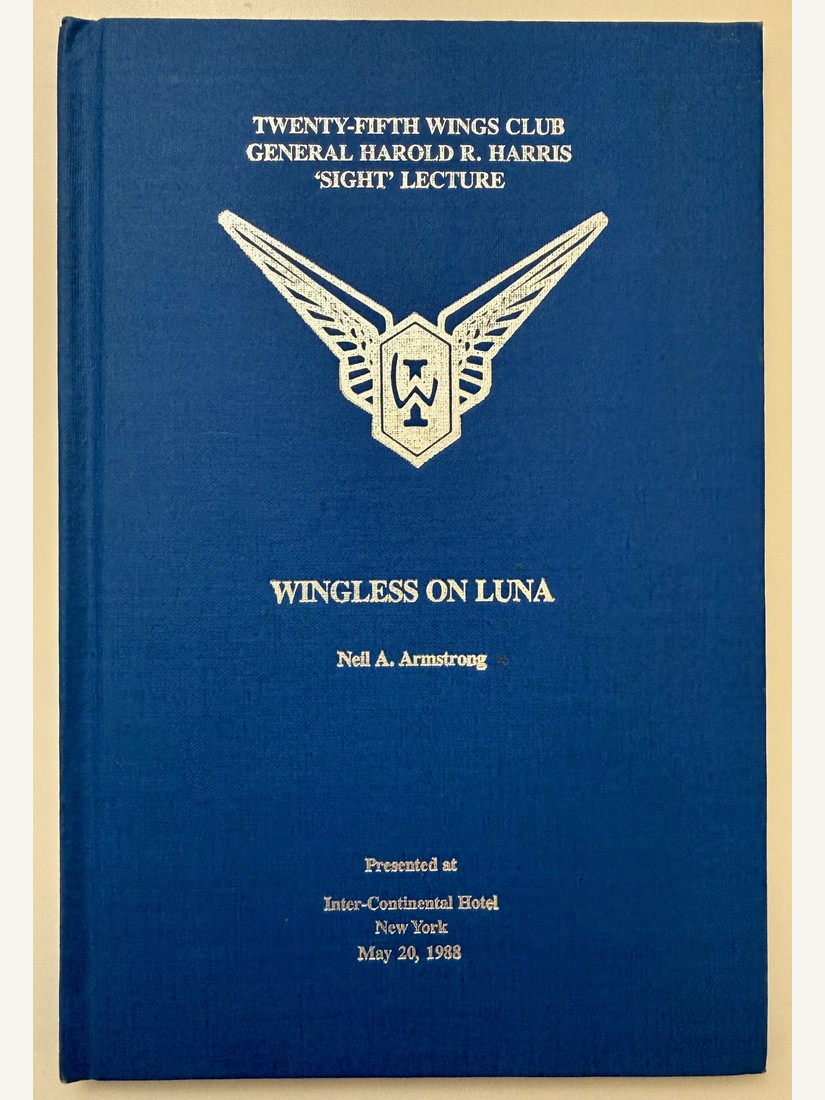
Wingless on Luna
The 25th Wings Club General Harold R. Harris “Sight” Lecture, delivered by Armstrong in New York in May 1988 and printed the same year with an underwriting acknowledgment from Rockwell International; it stands as the only separately published book Armstrong ever wrote. Rather than retell the Apollo 11 landing itself, Armstrong uses the lecture to trace the decade-long technical problem of teaching pilots and machines to fly a vehicle with no wings and no atmosphere: early full-scale test rigs and tethered gantries, the Astronaut Office's survey of VTOL aircraft including the Bell X-14A, and the development of the notoriously difficult Lunar Landing Research and Training Vehicles, illustrated throughout with period photographs and control-response plots. A closing section recounts how lunar dust behaved differently at each landing site, from the opaque sheet Armstrong himself flew through on Apollo 11 to the thin, unobscuring dust of Apollo 14, 16, and 17, and appendices tabulate the physical characteristics of the LLRV, LLTV, and the Lunar Module. The Wings Club's “Sight” Lecture series had previously hosted Wernher von Braun (1968) and Senator Barry Goldwater (1981) among other aerospace figures; this copy's cover states the lecture was presented at the Inter-Continental Hotel on May 20, 1988, while the title page inside gives the Grand Hyatt Hotel and May 18, 1988, a discrepancy between the two preliminary leaves as printed. Not signed.

Aiming at Targets: The Autobiography of Robert C. Seamans, Jr.
NASA SP-4106 in the NASA History Series, published by the NASA History Office, Washington, D.C., with a cover photo by George Tames dated 1967. Foreword by Willis H. Shapley, a colleague from Seamans' Bureau of the Budget days who joined NASA in 1965 and later reviewed the manuscript. Four chapters (Liftoff, The NASA Years, The Air Force Years, and Reentry) trace Seamans from his 1918 birth in rural Massachusetts and MIT training under Charles S. "Doc" Draper, through more than seven years at NASA as Associate Administrator under T. Keith Glennan and then Deputy Administrator under James E. Webb — part of the Webb–Dryden–Seamans "management triad" described in his introduction to Apollo Expeditions to the Moon — to his later posts as Secretary of the Air Force during Vietnam, president of the National Academy of Engineering, first Administrator of the Energy Research and Development Administration, and dean of MIT's engineering school. Three appendixes gather selected documents, a biographical appendix, and a full career chronology. The preface credits Seamans' wife Gene as a constant collaborator, noting her family newsletter, affectionately called the "Seamans Messenger," and their five children and twelve grandchildren.

The Last Man on the Moon: Astronaut Eugene Cernan and America's Race in Space
Tenth Anniversary softcover edition (St. Martin's Griffin, New York, June 2009) of Cernan's memoir, first published in hardcover in 1999; the original acknowledgments are dated Houston, September 1998. Cernan flew in space three times — pilot of Gemini 9, lunar module pilot on Apollo 10, and commander of Apollo 17, on which he became the last person to walk on the Moon. The book's 31 chapters open with the January 1967 Apollo 1 fire in "Fire on the Pad" and "Taps," before tracing Cernan's own path into the astronaut corps and his difficult June 1966 Gemini 9 rendezvous and EVA in "The Angry Alligator" and "The Spacewalk from Hell," through "Falling to the Moon" and "Down in the Valley" on the Apollo 10 and Apollo 17 missions, and closing with "The Search" on his life after Apollo. Cernan dedicates the book to his grandchildren and to those who worked to reach the Moon.
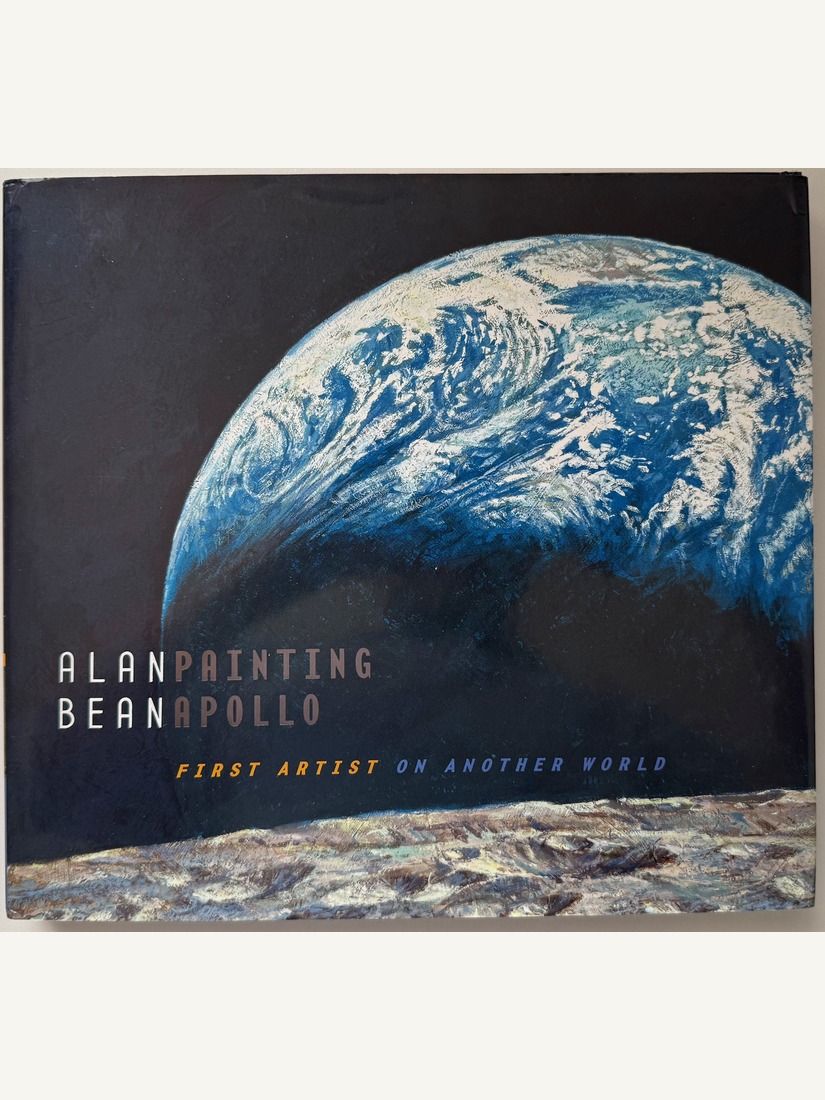
Painting Apollo: First Artist on Another World
Published by Smithsonian Books to coincide with the 40th anniversary of the Apollo 11 landing and the exhibition of the same name at the Smithsonian's National Air and Space Museum (July 2009–January 2010). Bean, the Apollo 12 Lunar Module Pilot and fourth man to walk on the Moon, resigned from NASA in 1981 to devote himself to painting his memories of the lunar surface; this coffee-table volume gathers 107 of his paintings, each paired with a quotation from a notable historical figure. Essays by art critic Donald Kuspit, cultural geographer William L. Fox, and museum director Louis Zona place Bean's work in art-historical context, and Apollo flight director Gene Kranz contributes a recollection from Mission Control.
Title-page facing plate hand-signed “Alan Bean” by the artist.
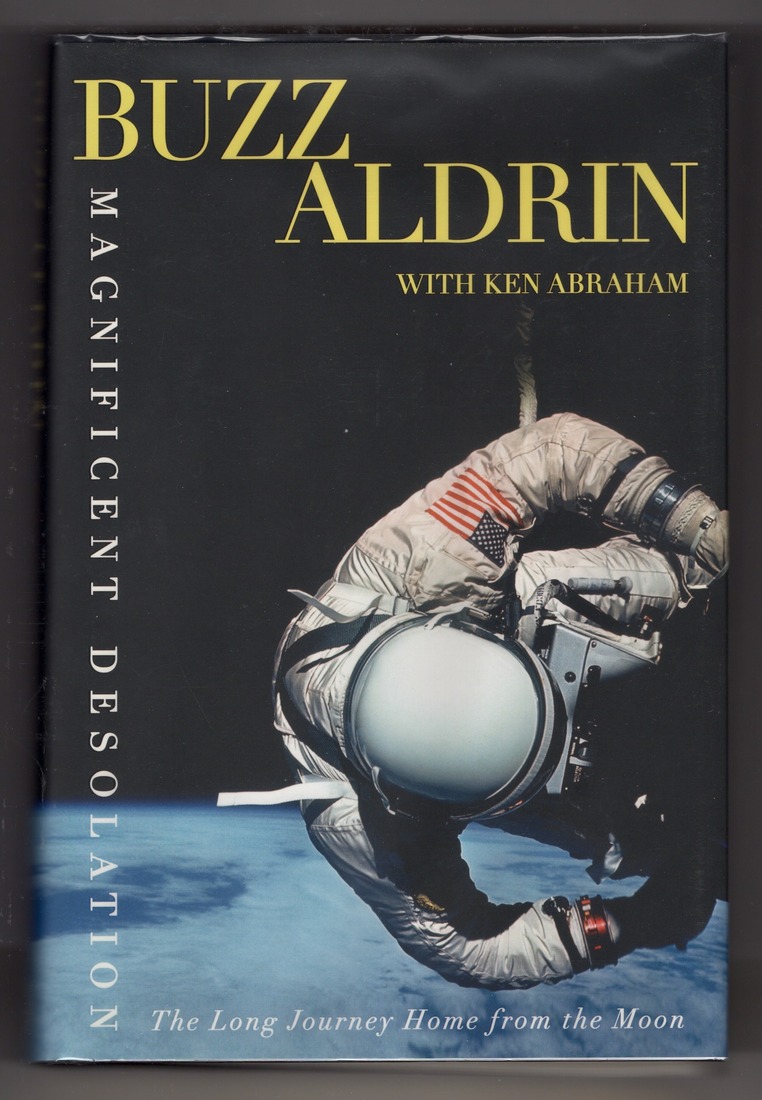
Magnificent Desolation: The Long Journey Home from the Moon
Apollo 11 lunar module pilot Buzz Aldrin's candid memoir of his life after the Moon landing, including his struggles with depression and alcoholism and his later advocacy for continued space exploration. New York: Harmony Books (Crown Publishing Group / Random House), 2009. First edition. Hardcover with dust jacket.
This copy is signed “Buzz Aldrin” in ink on the half-title page.

Never Panic Early: An Apollo 13 Astronaut's Journey
Published by Smithsonian Books, Washington, D.C., 2022, with a foreword by Gene Kranz, the Apollo 13 flight director. Haise's memoir traces his path from a Biloxi, Mississippi paperboy and Marine fighter pilot through NASA test-pilot and astronaut careers — backup lunar module pilot for Apollo 8 and Apollo 11, lunar module pilot on Apollo 13, and commander-designate of the cancelled Apollo 19 — and on to the space shuttle approach-and-landing test program and a later executive career at Grumman Aerospace. Chapters include "My Ticket to the Moon," "Odyssey — A Perfect Name," and "A Sudden Detour" on the Apollo 13 crisis, and "Life on the Edge of Space," recounting Grumman engineer Tom Kelly's work qualifying the lunar module; the book closes with "In the Rocking Chair," Haise's reflections on STEM education and his board service with the Infinity Science Center.
Title page hand-signed by both Fred Haise (inscribed “Apollo 13 LMP”) and co-author Bill Moore, dated July 16, 2022, at a public signing event at the Frontiers of Flight Museum near Love Field, Texas.
Lunar Module & Command Module manuals, drawings, schematics
Apollo Reliability and Quality Assurance Program Plan
NHB 5300.1A, Apollo Documentation No. RA 001-000-1, July 1966, superseding the October 1965 edition. Sets forth the overall Apollo R&QA policies, requirements, and procedures across nine sections: R&QA requirements by hardware development phase, program implementation by level (Apollo Program Office down to subcontractors and suppliers), R&QA plans, mission reliability analysis, status reporting, auditing, parts/materials/components program, identification for traceability, and nonconforming material control, with appendices of reference documents, abbreviations, and a glossary. Covers spacecraft, Saturn IB, Saturn V, launch vehicle engines, ground support equipment, crew systems, and mission experiment equipment. Preface bears the printed signature of Samuel C. Phillips, Major General, USAF, Director, Apollo Program, over a "DISTRIBUTION: Special" notice.
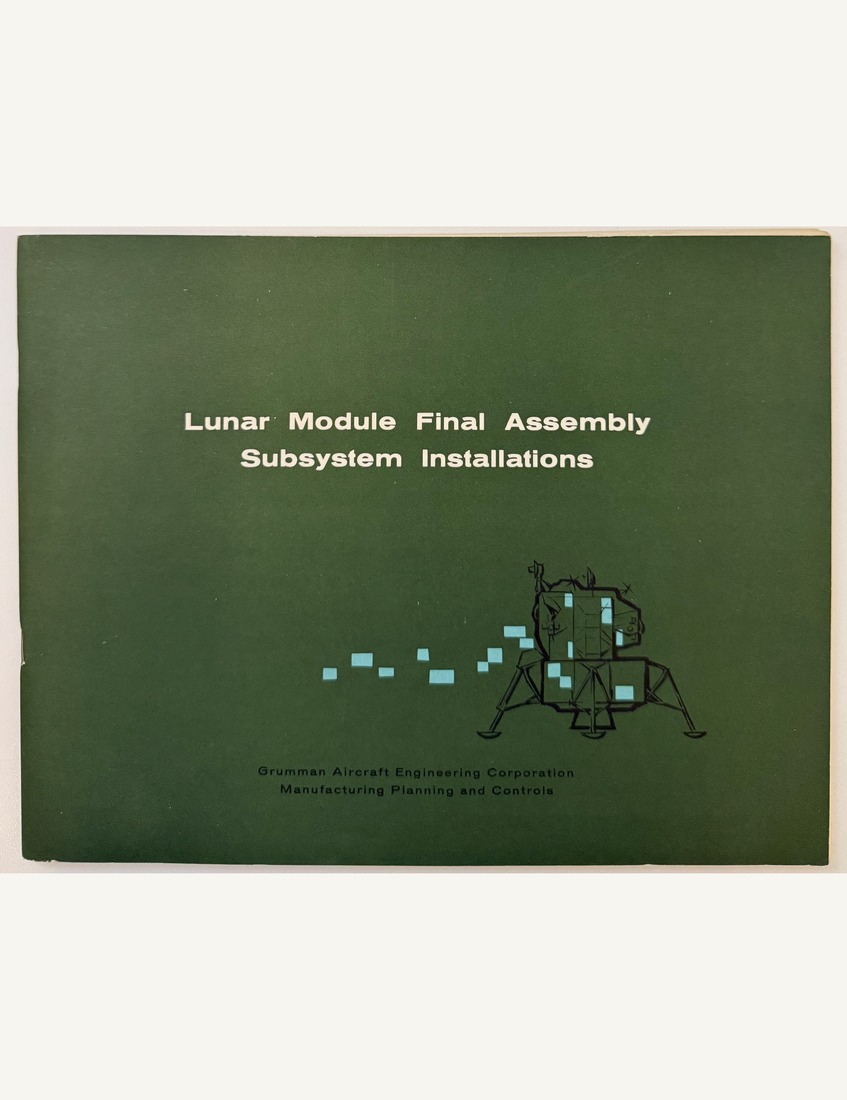
Lunar Module Final Assembly Subsystem Installations
Dated November 1966, this booklet introduces the manufacturing tasks and requirements for Lunar Module subsystem installations, describing and illustrating the major components of the Ascent and Descent stage subsystems: guidance, navigation, stabilization and control; crew provisions and displays; environmental control; electro-explosive devices (pyrotechnics, landing-gear deployment, the lunar surface sensing probe); instrumentation; electrical power; propulsion; reaction control; and communications. Flow charts and isometric exhibits then walk through the phases of final assembly, installation, and acceptance testing, including cold-flow checks, landing-gear installation, weight and center-of-gravity determination, rotate-and-clean procedures for the ascent and descent stages, and packing for shipment.
Grumman Apollo Lunar Module Manual — Propulsion System
LEM Support Manual (LMA790-8-62180) for the Propulsion Systems Checkout Cart, part no. LDW430-62180-3, published 30 August 1966 under NASA contract NAS 9-1100, superseding an earlier edition dated 30 December 1965. The cart was a mobile, five-panel test unit that selected, regulated, filtered, and monitored pressurized gaseous helium and nitrogen for prefire checkout and leak detection of the Lunar Module's Reaction Control and Propulsion Subsystems, at pressures up to 3,500 psig and flow rates up to 10 lb/min. It was used at Grumman's Cold Flow Facility in Bethpage, at the Manned Spacecraft Center's White Sands Test Facility in New Mexico, and during acceptance and prelaunch testing at MSC Houston and the Kennedy Space Center. Covers description and leading particulars, preparation for use and reshipment, operating instructions, test equipment, maintenance, wiring diagrams, and an illustrated parts breakdown across 133 pages.
Grumman Lunar Module Supercritical Helium Checkout Test Set
LEM Support Manual (LMA790-8-62190) for the Supercritical Helium Checkout Test Set, part nos. LDW430-62190-3 and -5, published 15 December 1966 under NASA contract NAS 9-1100. Consisting of a test unit, a flowmeter box, and a test gage stand, the set was used in the Lunar Module development program to check out the LEM's supercritical helium (SHe) pressurization system, at the Manned Spacecraft Center's White Sands Test Facility in New Mexico and at the Kennedy Space Center in Florida. It ran four qualification checks (a heat-leak test, a squib-valve bypass test, a proof-pressure test, and a LEM relief valve assembly leakage test) and monitored pressures up to 1,500 psig through gages and a pressure transducer accurate to a fraction of a percent of full scale. Covers description and leading particulars, installation and operation, test equipment, maintenance, an illustrated parts list, and wiring/tubing diagrams.
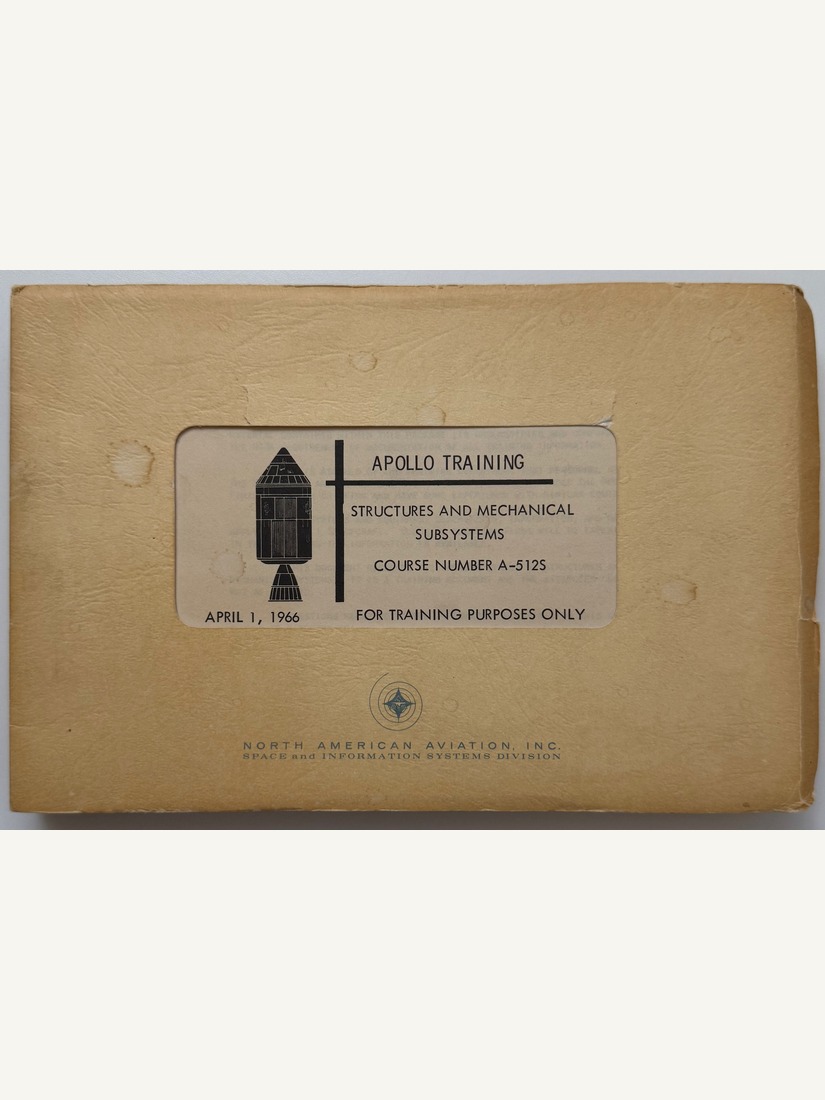
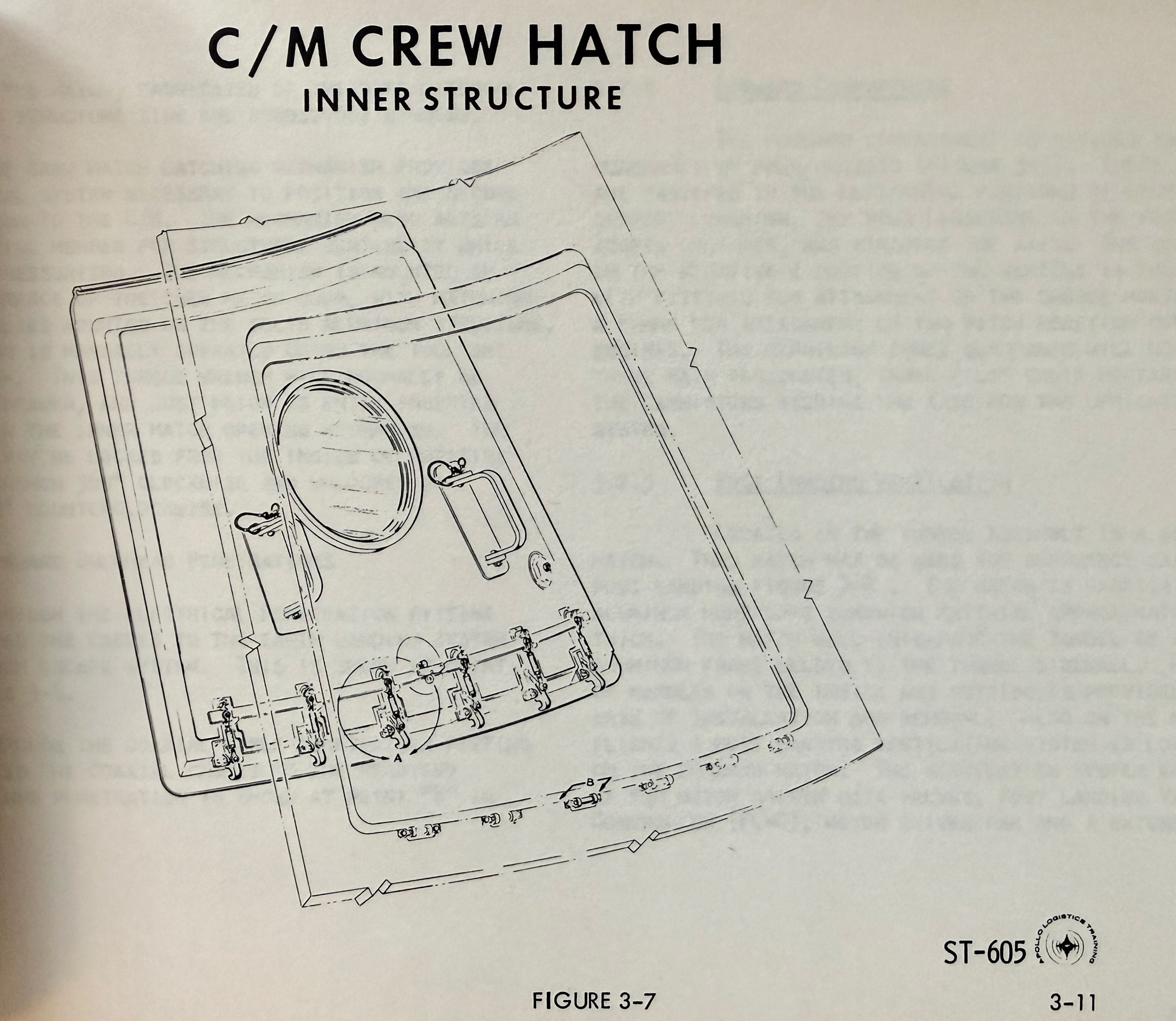
Apollo Training 1966 — Structures and Mechanical Subsystems
Course A-512S, dated April 1 1966: an internal NAA training package for the company's Apollo Logistics Training program at Downey, California, covering launch escape system structures, the command module's inner and outer structure, mechanical systems, the service module, and the spacecraft-LEM adapter. Its crew-hatch chapter documents, in isometric line drawings and mechanical detail, the Block I spacecraft's three nested crew hatches — the Boost Protective Cover hatch, the command module's outer ablative hatch, and the pressure-sealing inner hatch, the last of which locked and unlocked with a dedicated torque wrench turned a full 360 degrees clockwise to lock and 360 degrees counterclockwise to unlock. This is the same three-hatch configuration that, ten months after this manual's issue date, prevented the crew of Apollo 1 from escaping the January 27 1967 pad fire; Block II replaced it with a single outward-opening hatch. The manual does not mention the fire or crew safety, predating both by ten months, and it is not cited in either the Apollo 204 Review Board or Senate Committee reports on the accident.
 Featured
Before the Fire
›
Featured
Before the Fire
›
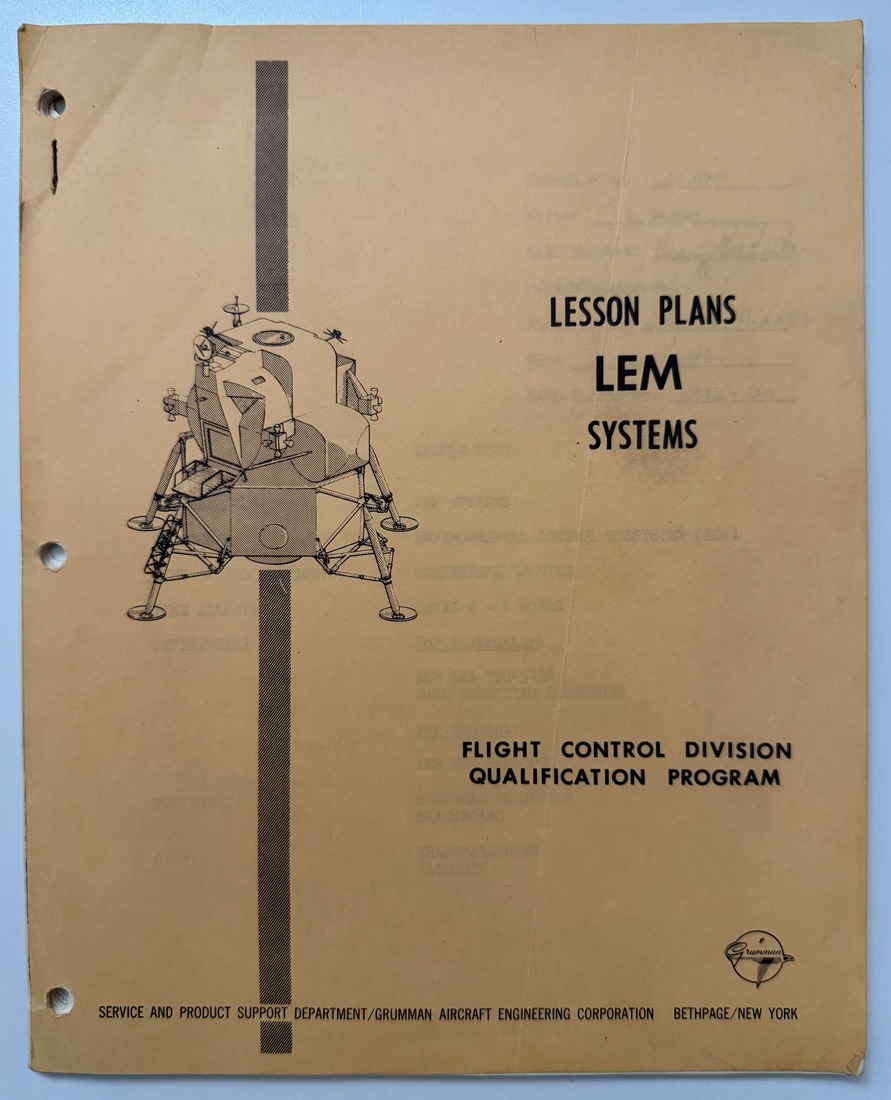
Lesson Plans, LEM Systems, Flight Control Division Qualification Program
Instructor's lesson-plan booklet for Grumman's Flight Control Division Qualification Program, Bethpage, New York. The bound lesson plan covers the LEM Systems course's Environmental Control Subsystem (ECS) subcourse—Schedule No. 25.07, GAEC Course No. 30515-006—a Level 2 conference/lecture allotted six hours, written by E. Ferner and dated 13 April 1966, with approval signatures for GAEC and the FLDQP office. Its outline works through the ECS's four sections: Atmosphere Revitalization (ARS), Oxygen Supply and Cabin Pressure Control (OSCPCS), Water Management (WMS), and Heat Transport (HTS). Bound in with it are eight of the course's training illustrations, among them the LEM ECS block diagram, a cutaway of the LEM ascent stage, the LEM displays-and-controls panel, space-suit internal flow, the ECS–space suit interface, and schematics for the Atmosphere Revitalization, Oxygen Supply and Cabin Pressure Control, and Heat Transport sections (the last a large fold-out), dated between May 1965 and May 1966. Nearly every page carries the original trainee's own pencil annotations—operating pressures, flow rates, valve settings, and memory aids penciled directly onto the diagrams—a firsthand record of the ECS qualification course as it was actually studied.
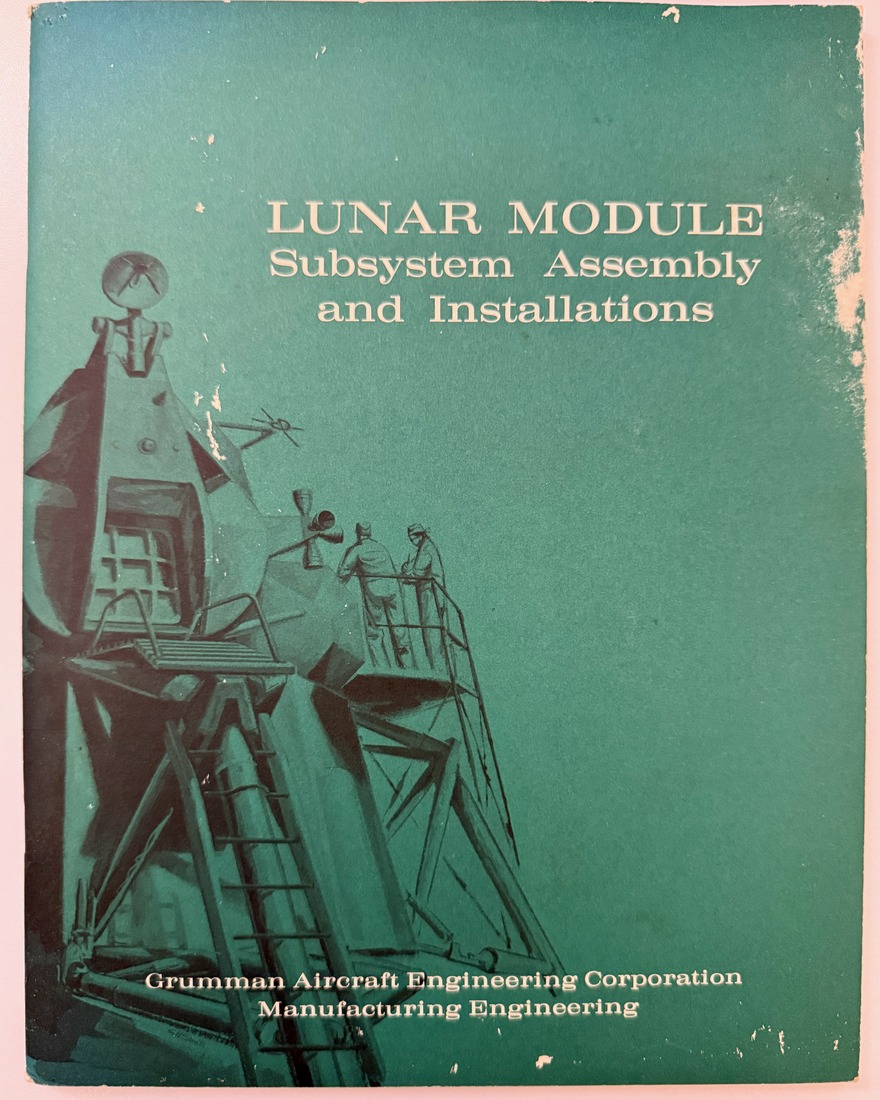
Lunar Module Subsystem Assembly and Installations
Dated December 1967, this Grumman document opens with the LM mission and a general description of the vehicle, then works through twelve subsystems in turn: ascent and descent stage structure, landing gear, electrical power, environmental control, propulsion, reaction control, crew provisions and displays, guidance/navigation/control, instrumentation, communications, and electro-explosive devices. It closes with detailed subsystem assembly, installation, and test-flow diagrams tracing the Lunar Module through Grumman's Bethpage plants, from raw subassemblies (aft bulkhead, docking tunnel, cabin skins) through structural buildup, equipment installation by group, proof-pressure and leak checks, cold-flow testing, and final rotate-and-clean and insulation work on both stages.
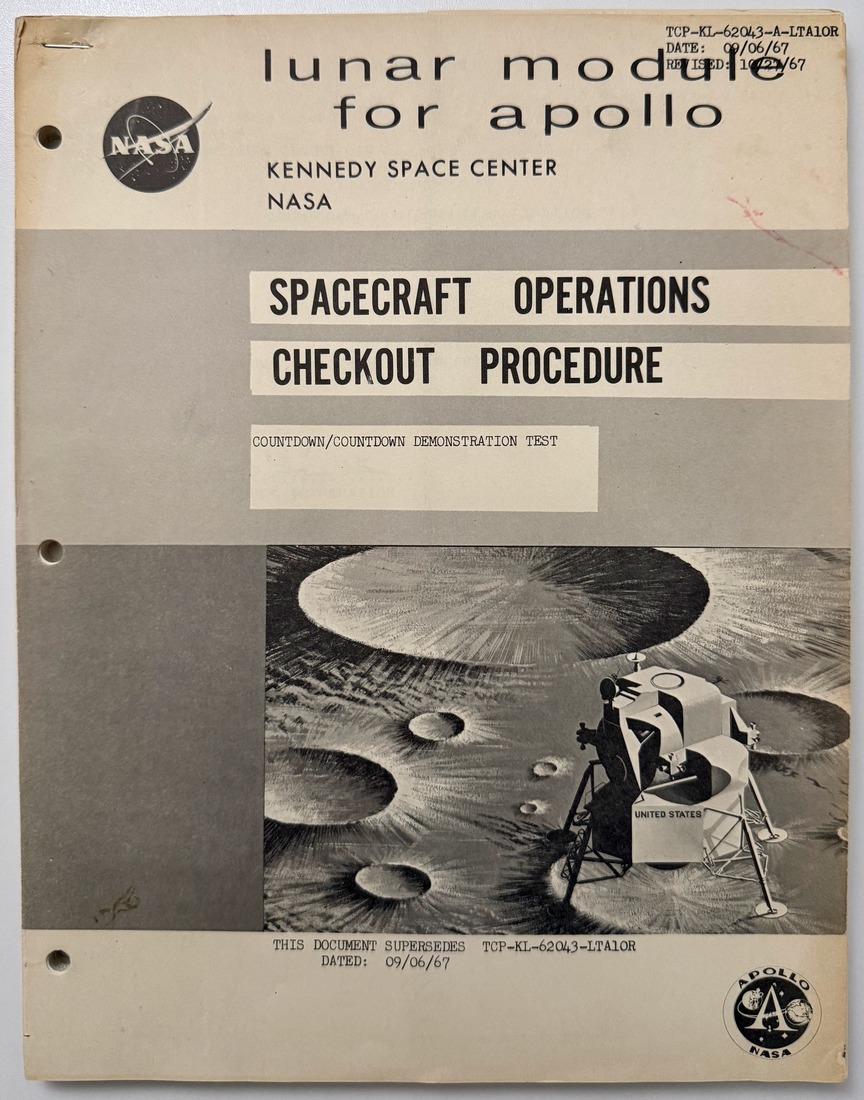
Spacecraft Operations Checkout Procedure — Countdown/Countdown Demonstration Test, LTA-10R
Test Checkout Procedure TCP-KL-62043-A-LTA10R, dated 6 September 1967 and revised 27 October 1967, prepared by Grumman for NASA's Kennedy Space Center under Project Apollo. LTA-10R was a non-functional dynamic test model of the Lunar Module—structure and mass simulating the real vehicle, its systems replaced with instrumentation—flown atop the Saturn V's S-IVB third stage on Apollo 4, the first all-up test flight of the Saturn V, launched 9 November 1967 from Launch Complex 39A. This procedure sets out the full countdown and launch sequence for LTA-10R and doubled as the script for its Countdown Demonstration Test: DFI telemetry and RF checks a day before launch, flight-battery connection and DFI checks at T–20 to 45 hours, final DFI checks in the last half hour, and mechanical steps such as SLA platform removal and SLA antenna hat coupler removal worked into the master count. The bulk of the booklet is a numbered operational procedure (call to stations and master count, EPS activation, modulation verification, commutator and PCM link checks, DFI functional testing, post-test and post-flight secure) followed by checkout data sheets of 90-by-10 communication-level readings and calibration tables, a post-test verification section, and an emergency shutdown procedure. Diagrams cover the LTA-10R vehicle/GSE interface, command-video-power flow for LC-39, and the LCC-39/LTA-10R interface, with an approval page dated 26 and 27 October 1967, within two weeks of the launch that proved the Saturn V flightworthy.
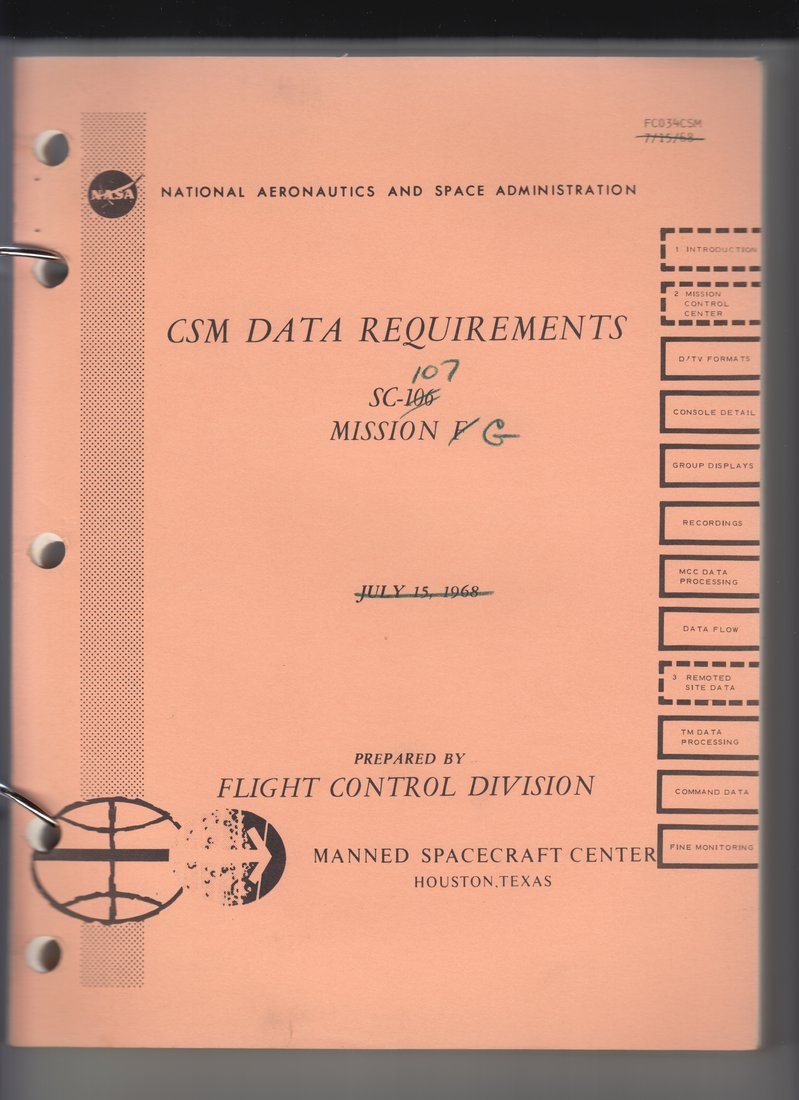
NASA CSM Data Requirements, SC-107, Mission G, August 1968
Flight Control Division data-requirements manual for Command/Service Module SC-107, Mission G — the designation later reassigned to Apollo 11. Includes the August 23 1968 transmittal memorandum for the CSM AS-506(G) Data Pack and the formal distribution/approval page, with printed (not hand-signed) approval blocks reading Arnold D. Aldrich, Chief, CSM Systems Branch, and Eugene F. Kranz, Acting Chief, Flight Control Division.
NASA/Grumman Apollo Lunar Module Color Schematic Transparencies
A plain grey cover, stamped only with a small LM silhouette and NASA and Grumman roundels, opens onto a stack of clear acetate overlay sheets that build up, layer by layer, into a fully labeled cutaway of the complete two-stage Lunar Module. Each successive leaf adds a deeper structural pass — the outer thermal and micrometeoroid shielding, the descent stage's fuel, oxidizer, and supercritical-helium tanks, the ascent stage's reaction-control and electrical systems, and finally the crew cabin with its flight panels and stowed portable life-support packs — so that flipping through the booklet in order re-enacts the vehicle's own construction from skin to systems. The last spread pairs the fully assembled cutaway with a 118-item numbered legend keyed to every visible component, from the rendezvous radar and docking target at the nose to ALSEP-related items such as the Modularized Equipment Stowage Assembly, Scientific Equipment Boxes, and Specimen Return Container at the descent stage skirt — hardware that places this printing in the Apollo lunar-surface era. The back cover credits Grumman Aerospace Corporation of Bethpage, Long Island (the company's name after its 1969 rebrand from Grumman Aircraft Engineering Corporation), with printing by Transgraphic of Germany, a firm specializing in registered multi-layer transparency displays.
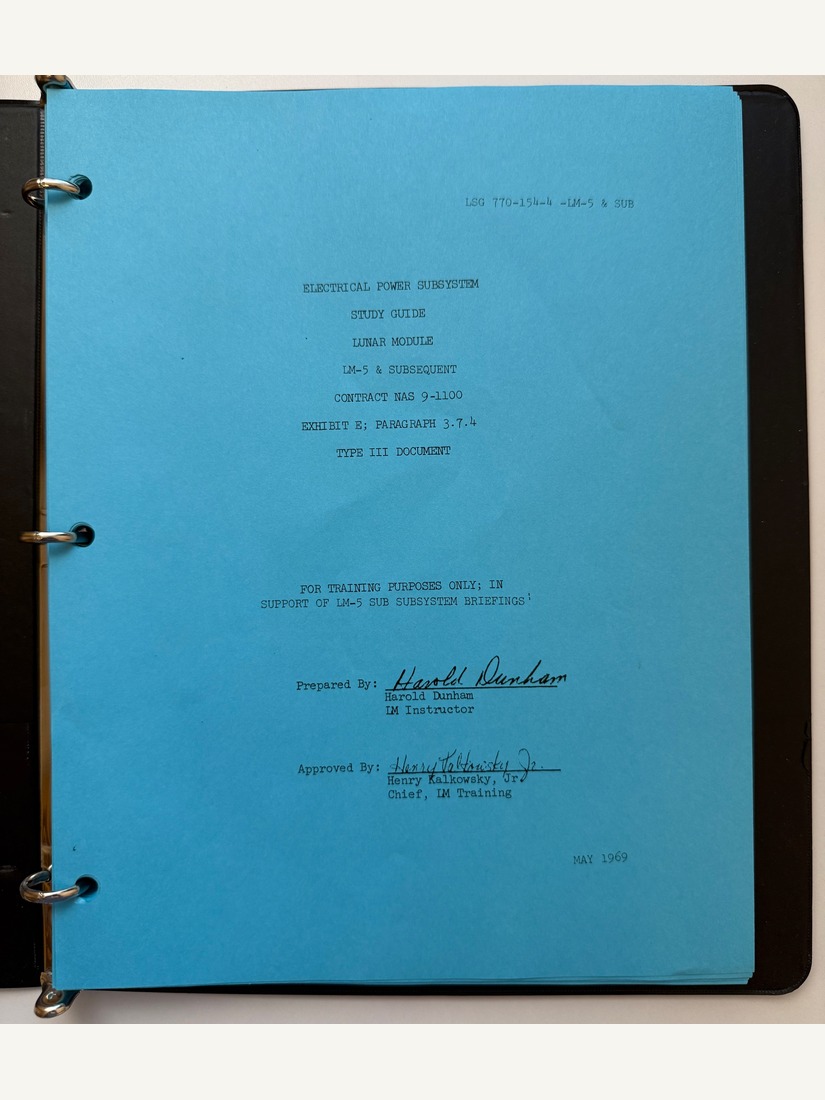
Electrical Power Subsystem Study Guide, Lunar Module LM-5 & Subsequent
A three-ring Grumman training binder, document no. LSG 770-154-4-LM-5 & SUB, prepared under LM Contract NAS 9-1100 (Exhibit E, Paragraph 3.7.4, a Type III document) and dated May 1969. It is keyed specifically to LM-5 — the lunar module that flew as Apollo 11's Eagle, with Armstrong and Aldrin, two months after this guide was issued, and stamped “for training purposes only, in support of LM-5 SUB subsystem briefings.” Three chapters cover the Electrical Power Subsystem in full — LM-5's own Panels 11, 14, and 16 reproduced with their actual switch and gauge labeling, descent and ascent batteries and electrical control assemblies, DC/AC bus distribution, Launch Umbilical Tower control logic, and a table of the seven EPS power modes from ground support equipment through an aborted ascent; the Explosive Devices Subsystem (staging, abort, and pyrotechnic hardware, keyed to LM-5's Panel 8); and Lighting (interior and exterior lighting functional trees, with tracking- and docking-light specifications). See the special feature for the fuller story of what “LM-5 & Subsequent” means and why it points to Apollo 11 specifically.
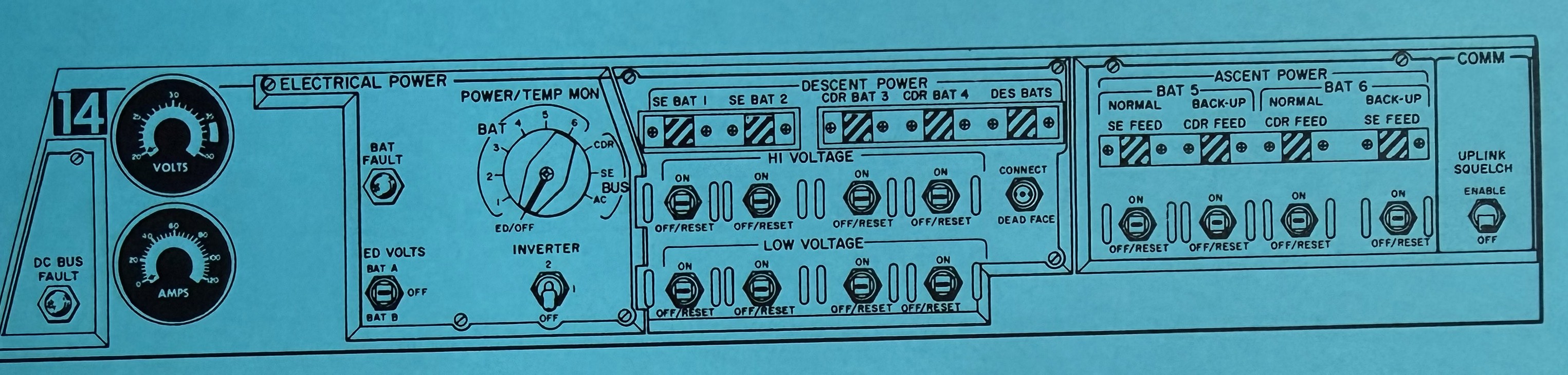 Featured
Training for Eagle
›
Featured
Training for Eagle
›
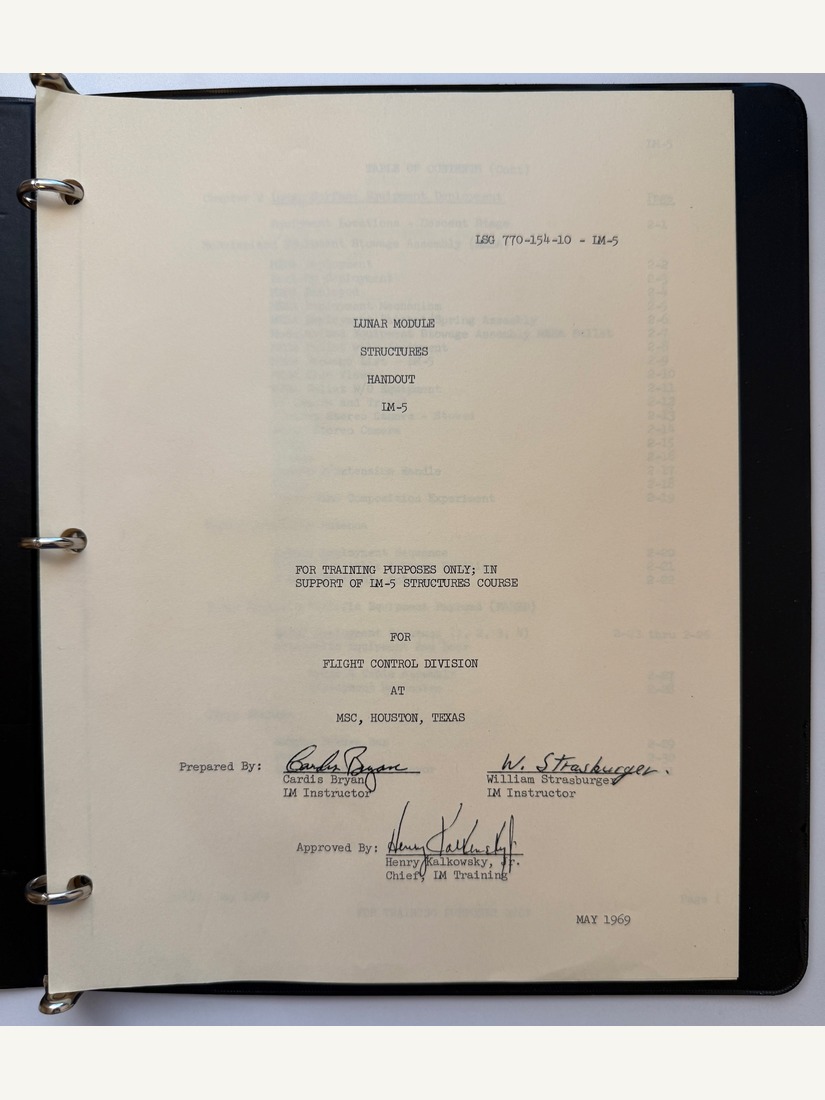
Structures Handout, Lunar Module LM-5
A companion Grumman training handout to the Electrical Power Subsystem guide above — document no. LSG 770-154-10 – LM-5, also dated May 1969 and approved by the same LM Training office, but prepared by different instructors, and addressed explicitly “for Flight Control Division at MSC, Houston, Texas” — a more specific audience than the EPS guide names, and titled “LM-5” alone rather than “LM-5 & Subsequent.” Two chapters cover the Lunar Module's structure and its lunar-surface equipment: Chapter 1 works through the ascent and descent stage structural assemblies, the landing gear's primary and secondary struts and deployment/downlock mechanism, translunar-flight separation and docking events, thermal control (shielding, blankets, coatings, and panel shingling), micrometeoroid protection, the RCS plume deflector, and the antenna erection mechanisms used during EVA; Chapter 2 covers the descent stage's Modularized Equipment Stowage Assembly (MESA) and its primary and back-up deployment sequences, the Early Apollo Scientific Experiments Package (EASEP), the S-band erectable antenna, lunar sample-return equipment, the TV camera and tripod, and the Scientific Equipment Bay door and its cable-driven deployment mechanism, illustrated with two large fold-out diagrams. Like the EPS guide, every diagram in it is drawn from LM-5's own configuration — the lunar module that flew as Apollo 11's Eagle two months after this handout was issued. See the special feature for more on this pair of Grumman training documents.
Featured
Training for Eagle
›
Medallions
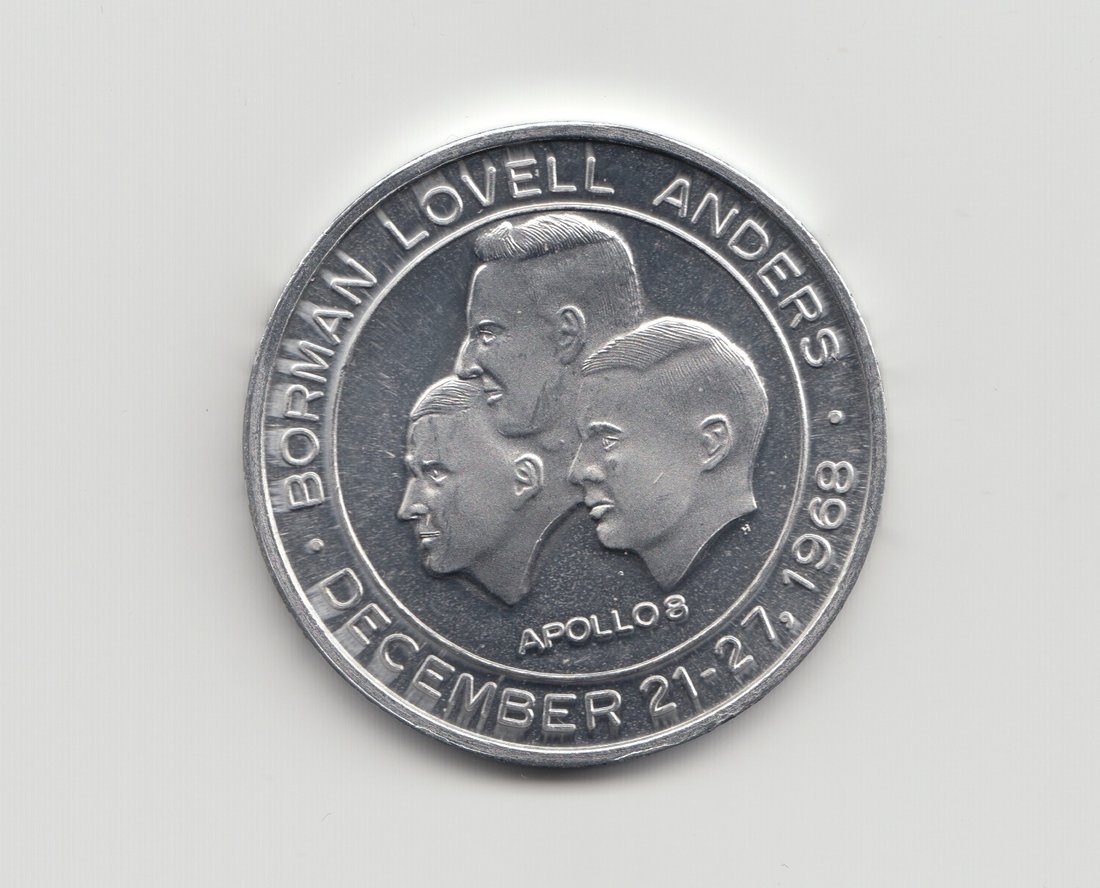
Apollo 8 MFA Medallion Containing Flown Metal
Medallion containing metal flown aboard Apollo 8 (Borman, Lovell, Anders), December 21–27 1968. Head side depicts the crew in profile beneath "Apollo 8"; the tails side, framed by "First Lunar Apollo Flight," reads "In appreciation for your contribution to the Apollo Saturn Project. The Apollo 8 crew carried metal in this medallion on man's first flight to the Moon," with a small relief of the spacecraft above the rim. Two medallions of this issue are held in the collection.
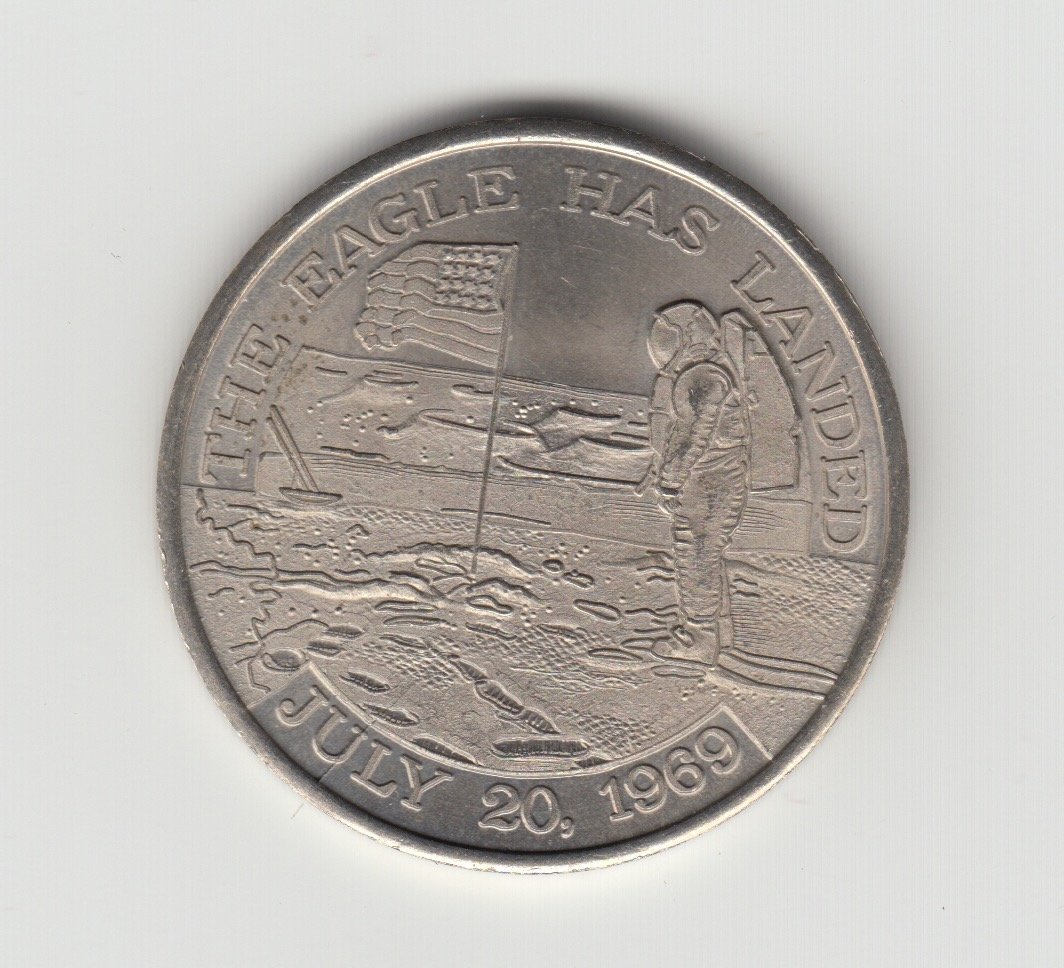
Apollo 11 MFA Medallion with Flown Metal
Original Apollo 11 medallion, "The Eagle Has Landed / July 20, 1969," with a tails-side inscription noting flown metal from the Columbia and Eagle spacecraft.
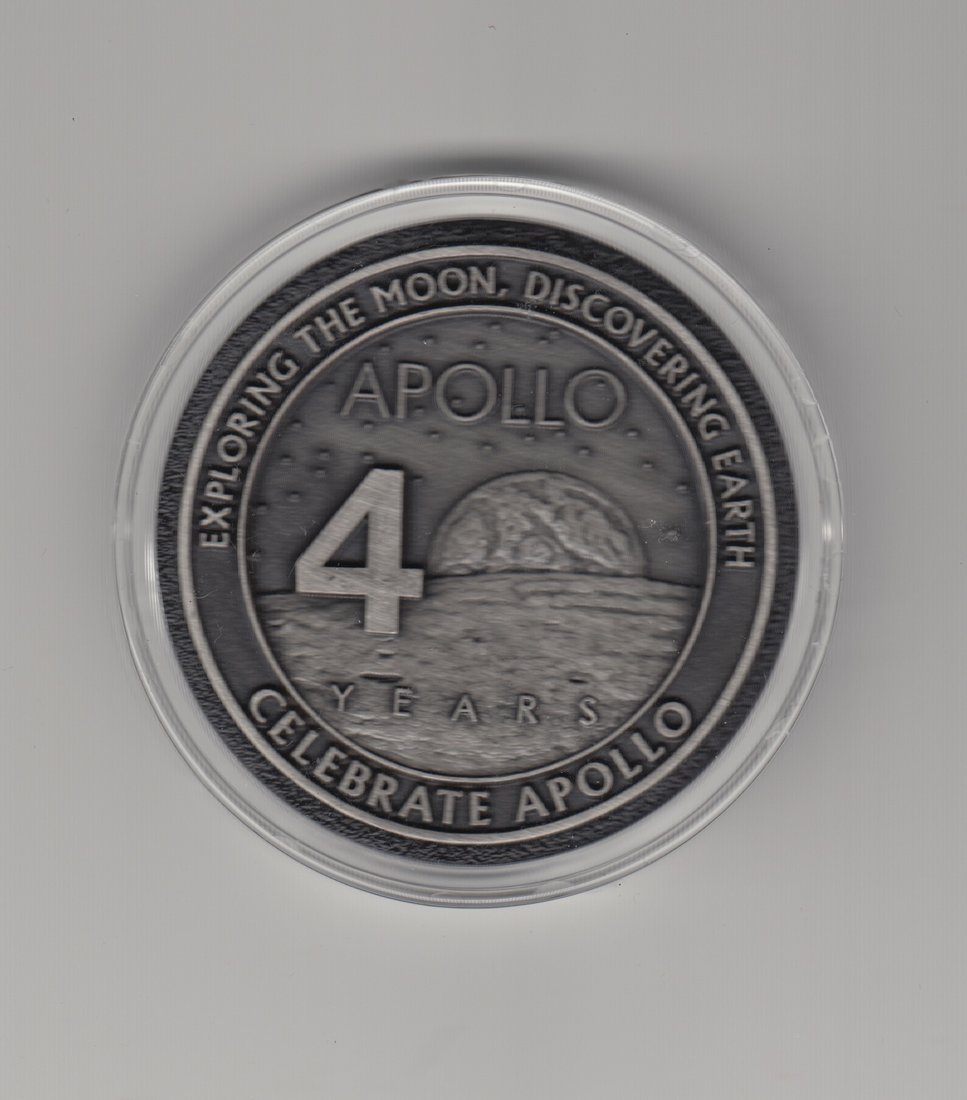
Apollo 40 Years Medallion Containing Flown Metal
Official Apollo 40th-anniversary commemorative medallion, head side bearing the NASA insignia; the tails side, ringed with "Apollo 40th Anniversary Official Commemorative," states "This medallion contains metal flown to the Moon on Apollo missions" — metal from the program generally, not tied to a single flight.
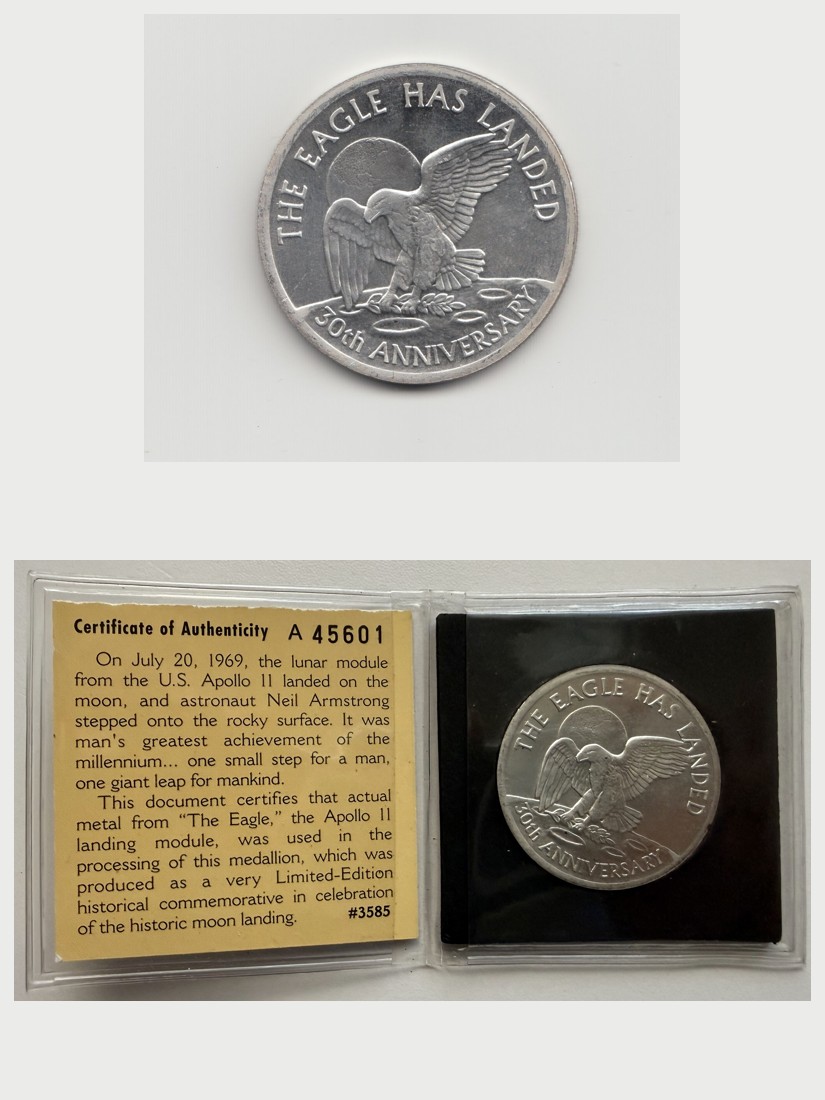
Apollo 11 30th Anniversary Medallion with Flown Metal
30th-anniversary commemorative medallion for Apollo 11, struck “The Eagle Has Landed” above an eagle landing on the Moon and “30th Anniversary” below — a different design from the original 1969 medallion elsewhere in this collection. Accompanied by its Certificate of Authenticity, No. A45601, certifying that metal from Eagle, the Apollo 11 lunar module, was used in processing the medallion, a limited-edition piece numbered 3585.
Models and Artifacts
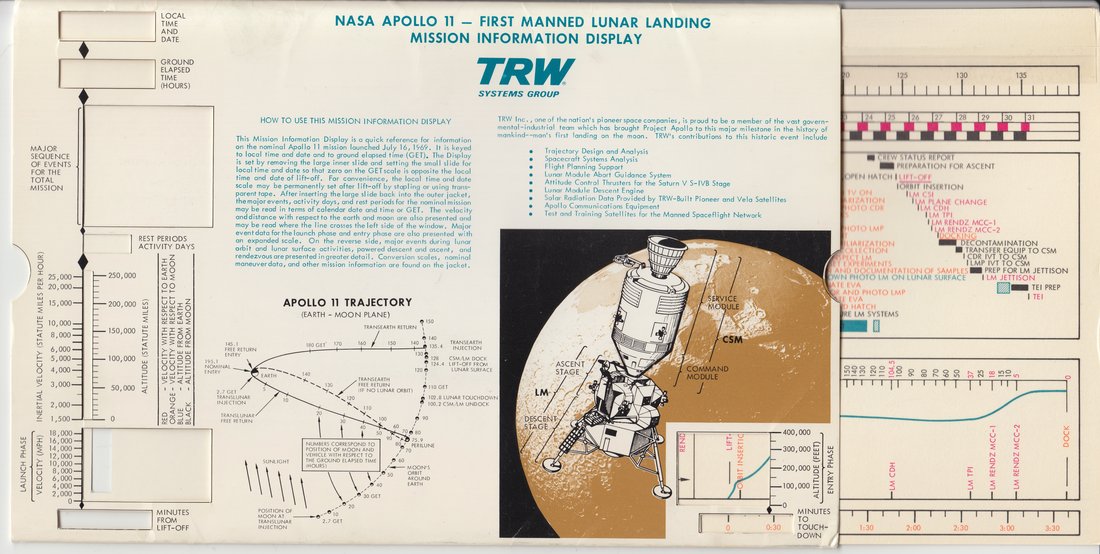
Apollo 11 Mission Display Sequencer, TRW
TRW's "NASA Apollo 11 — First Manned Lunar Landing Mission Information Display," a slide-rule-style mission tracking tool listing TRW's technical contributions (trajectory design, Lunar Module guidance and descent engine work, Pioneer/Vela satellite data, and more), with a reverse side of nominal maneuver data and a lunar surface landing-site map.
Two-sided cardstock mission display, both sides retained.
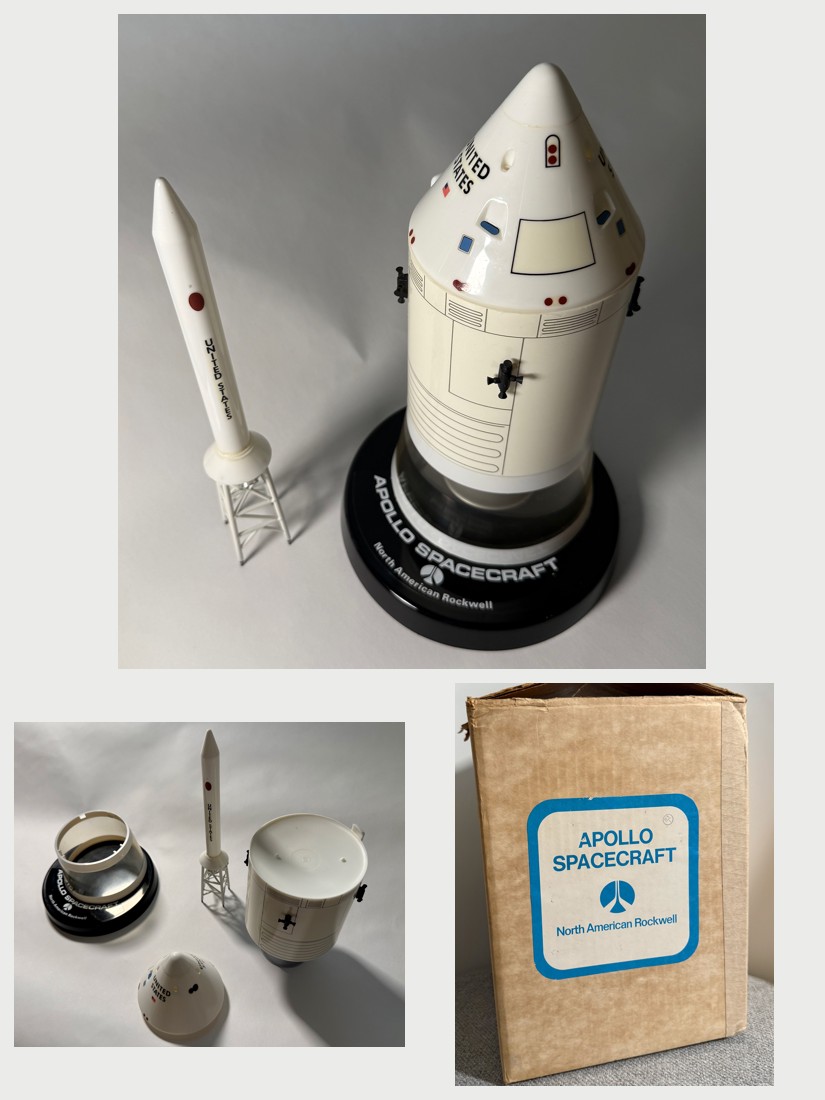
Apollo Spacecraft Contractor's Model
A contractor's desk model of the Apollo Command and Service Module, on a round black base whose rim reads “Apollo Spacecraft” and “North American Rockwell” beneath the company's circular winged emblem. The wording dates it to 1967–73, the years North American Aviation traded as North American Rockwell following its March 1967 merger with Rockwell-Standard; comparable examples from before the merger instead read “North American Aviation, Inc.” on the same base. Models of this type were contractor giveaways, presented to dignitaries, subcontractors, astronauts, and flight directors, and appear in several astronauts' official portrait photographs; they were produced for North American Rockwell by the Walter J. Hyatt Co., whose small circular “H·Y·T” maker's stamp appears in the corner of this piece's own box label, alongside the same “Apollo Spacecraft / North American Rockwell” design printed on the base. The model separates into the base, topped with a small clear plastic cylinder displaying the Service Module engine nozzle, a paneled Service Module cylinder, and a Command Module cone bearing “United States” lettering and a US flag decal, standing twelve inches tall assembled; a separate Launch Escape System tower on its own small gantry-style stand, packed in the same box, brings the ensemble to twenty-one inches overall. The base measures seven inches across.
Undated, with no serial or edition number; light yellowing to the white plastic in places, and one small plastic tab on the base's upper rim broken off but retained inside the base, not affecting the model or its display. Retains its original box and packing foam.
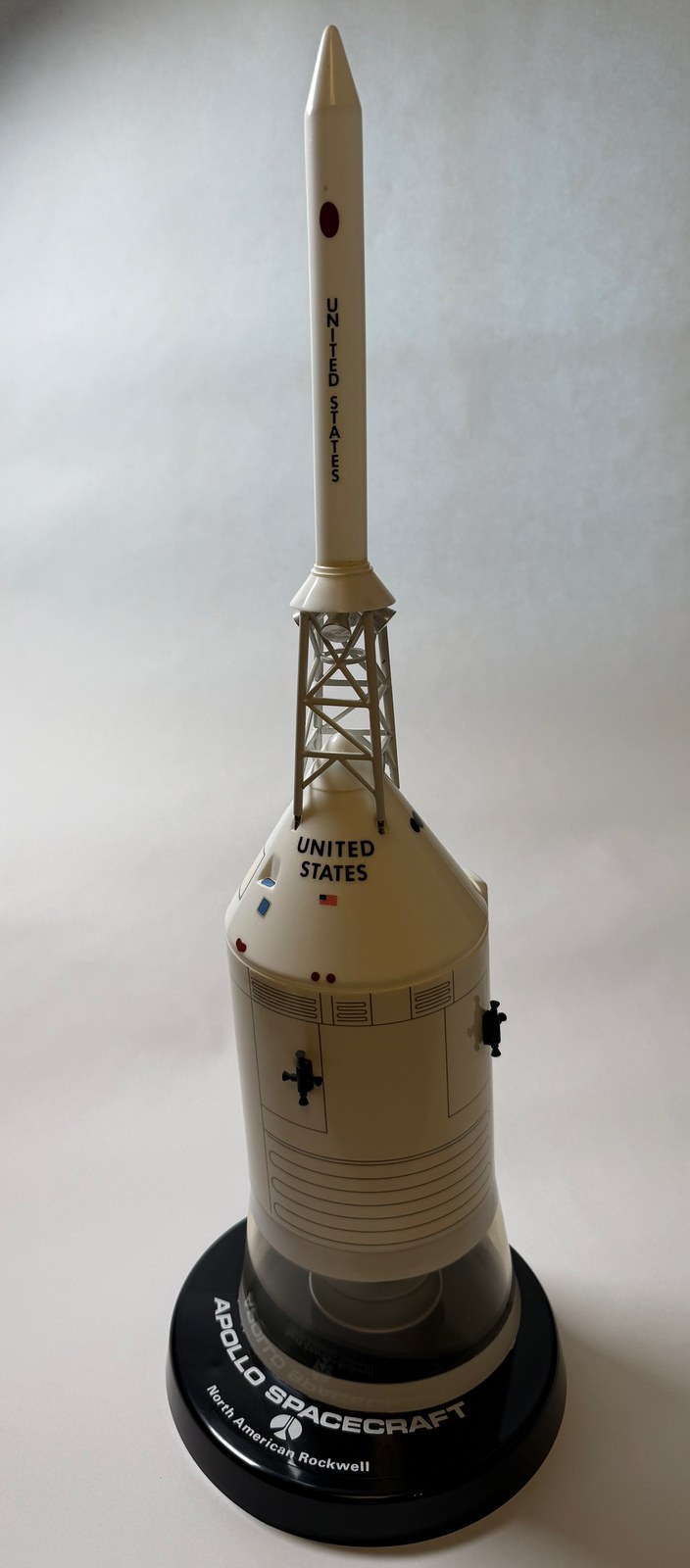 Featured
Apollo Spacecraft Model
›
Featured
Apollo Spacecraft Model
›
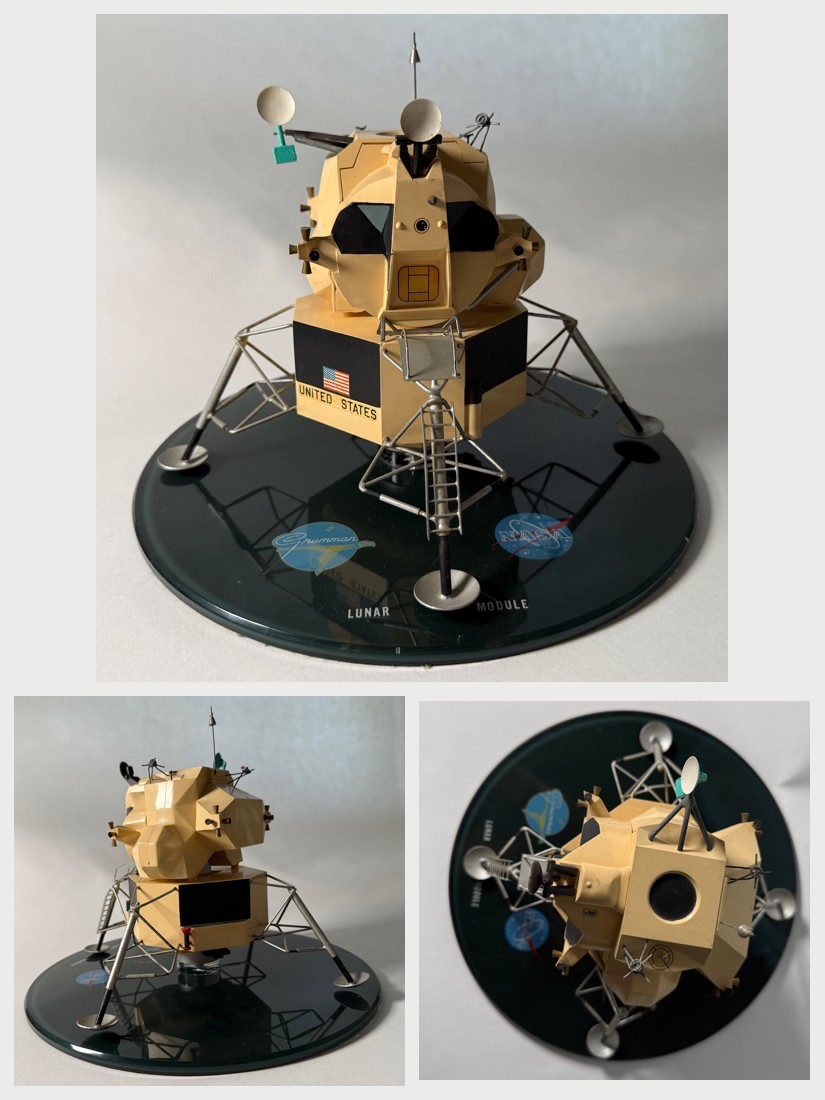
Lunar Module Contractor's Model
A contractor's desk model of the Apollo Lunar Module, made by Precise Models, Inc. for Grumman — the LM's prime contractor, based at Bethpage, New York — and distributed as a company memento. It stands on a round black glass base bearing the Grumman script logo, the NASA insignia, and the words “LUNAR MODULE.” Later editions of the model added Neil Armstrong's “one small step” line to the base; its absence here dates this example to before the Apollo 11 landing in July 1969. The two-piece model separates into ascent and descent stages, as the real Lunar Module did: the ascent stage carries a steerable S-band dish antenna, several rod-type VHF antennas, a forward docking hatch, and two triangular windows; the descent stage stands on four spidery landing legs ending in round footpads, with the forward leg carrying the astronauts' egress ladder and porch below a panel lettered “UNITED STATES” beside a US flag decal. The model measures six inches tall and ten inches across the base.
Unboxed. Overall yellowing to the white plastic, consistent with age.
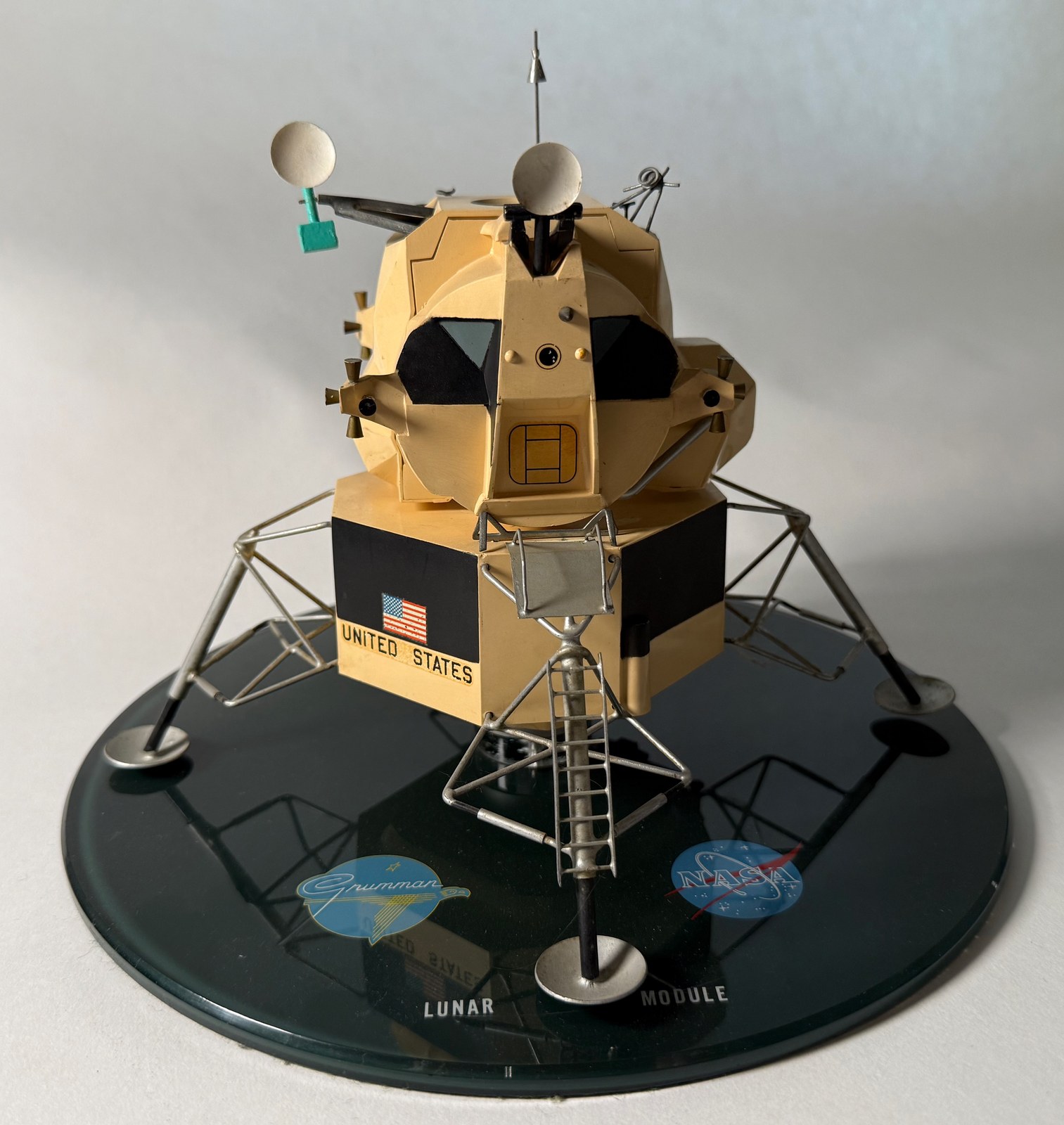 Featured
Lunar Module Model
›
Featured
Lunar Module Model
›

Emergency Escape Gas Mask (M26A1), with Guenter Wendt's Letter Explaining Its Use
An M26A1 “Mask, Gas, Rocket Propellant,” manufactured by the Mine Safety Appliances Co. of Pittsburgh, Pennsylvania. The green rubber facepiece has a single oval eyepiece secured by a hinged chrome retaining ring stamped “MSA,” and a round side-mounted filter port (the canister itself is not present). The rubber head harness is molded “MINE SAFETY APPLIANCES CO. PITTSBURGH PA. / PULL FRONT STRAP LAST,” alongside a small date-wheel disc marked “2.” The canvas carrier bag is stenciled in yellow “MASK, GAS, ROCKET PROPELLANT / M26A1 / FOR NASA,” followed by a caution notice to “REMOVE TAPE FROM BOTTOM OPENING OF CANISTER BEFORE USING MASK,” and carries a canvas inventory tag hand-inked “2781.”
Accompanied by a letter from Guenter F. Wendt, the legendary Pad Leader for NASA's Mercury, Gemini, and Apollo launches, dated 28 November 1995 and hand-signed, replying to a query (and a drawing, which Wendt compliments) from an earlier owner of the mask. Wendt writes: “With regard to your gas mask it is a piece of protective equipment that is stored in boxes of ten or twenty units in hundreds of places at the space center, They are used where hypergolic fuels are stored (orbiter & SRB's) or processed. They are primarily ment [sic] to provide an emergency exit protection. The removal of the tape will open the filtration pass to activate the unit.” The reference to the orbiter and Solid Rocket Boosters places the mask's described service context in the Space Shuttle program, rather than the Apollo era with which Wendt is most closely associated. The filter canister is not included.
Print ephemera
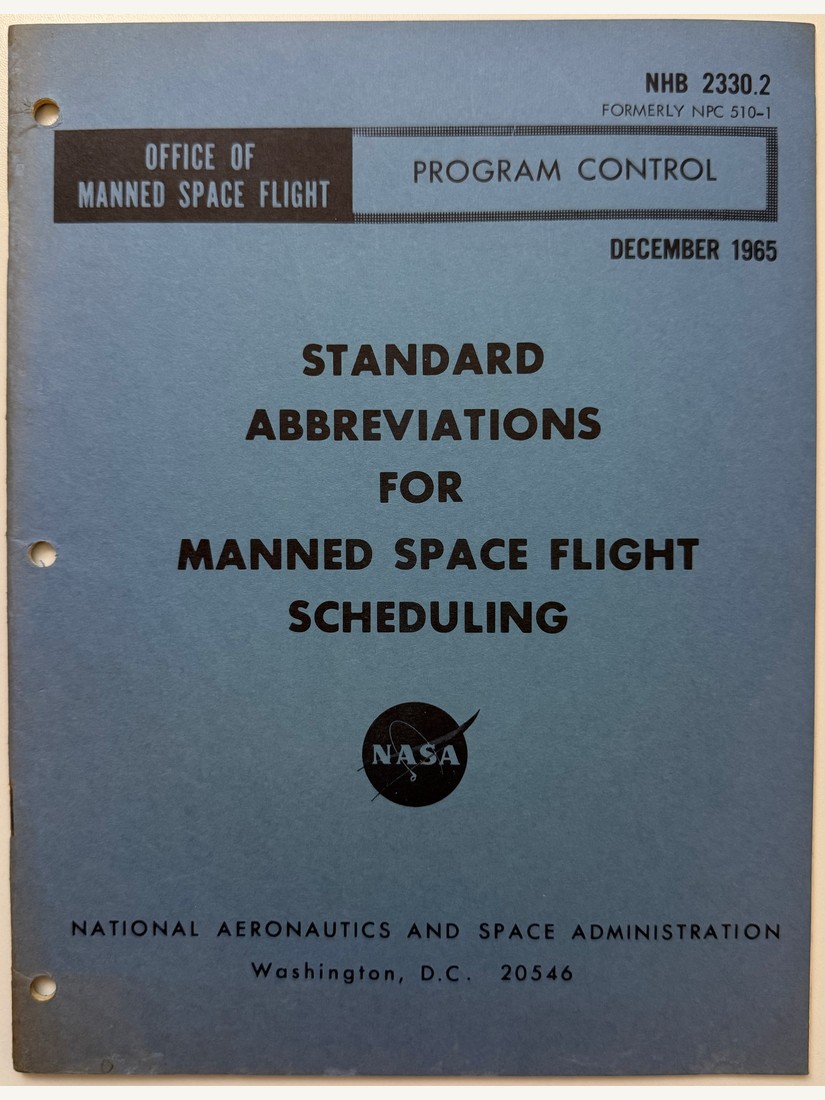
Standard Abbreviations for Manned Space Flight Scheduling
NHB 2330.2 (formerly NPC 510-1), issued December 1965 by the Office of Manned Space Flight's Program Control division, superseding the fourth edition of NPC 510-1. A companion volume to the Manned Space Flight Program Scheduling and Review Handbook (NHB 2330.1), standardizing the abbreviations and acronyms used in program schedules, arranged in two sections (Alphabetical List by Abbreviation, Alphabetical List by Description). Preface credited to Wm. E. Lilly, Director of Manned Space Flight Program Control, dated November 10, 1965. The introduction sets out the handbook's ground rules, distinguishing an "abbreviation" (a shortened word or phrase, e.g. ASSY for assembly) from an "acronym" (a coined word from initial letters, e.g. RADAR or NERVA), and giving rules for punctuation, capitalization, hyphenation, pluralization, word form, and the use of slashes (reserved for cases like C/O for checkout, to avoid confusion with "company").
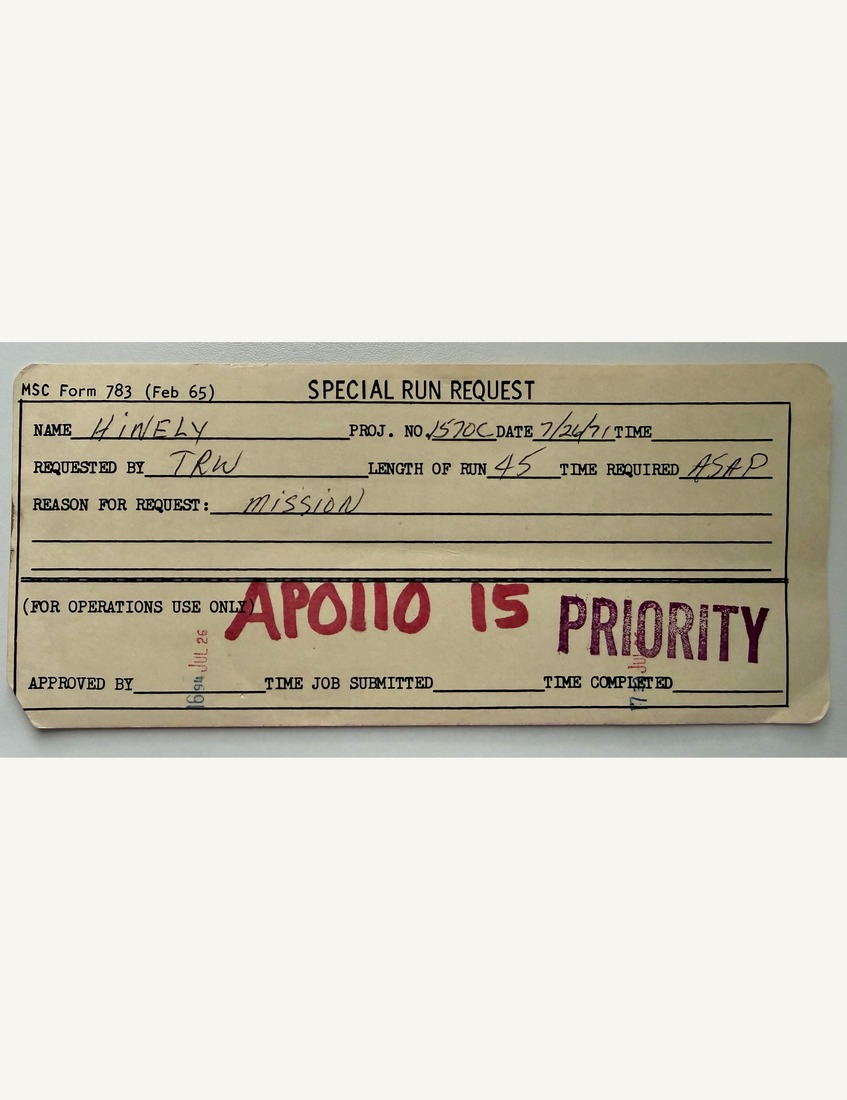
Computer Run Request Card, TRW, Apollo 15, 1971
MSC Form 783 (Feb 65) “Special Run Request,” filled out by hand by TRW's Hinely on July 24 1971, two days before Apollo 15's July 26 launch: Project No. 1570C, a 45-line special computer run needed “ASAP” for “mission” support, stamped “APOLLO 15” and “PRIORITY” in red and purple ink to flag it for expedited processing (faint corner stamps appear to read received/completed dates of July 26 and 27). TRW's Mission Planning and Analysis Division held Manned Spacecraft Center support contracts for Apollo trajectory reconstruction and guidance and control analysis, the kind of rush job this slip was requesting. The request form is printed on the front of a standard 80-column Column Binary IBM card; the reverse retains the card's unused, unpunched pre-printed layout, whose header fields (TAG, SUM, CHECK, INITIAL LOCATION, WORD COUNT, RELOC) match a CDC binary card format used to load object code into the Control Data Corporation mainframes contractors like TRW used for trajectory work.
Single card, printed on both sides; front and reverse both retained.
Apollo–Soyuz Test Project
1975
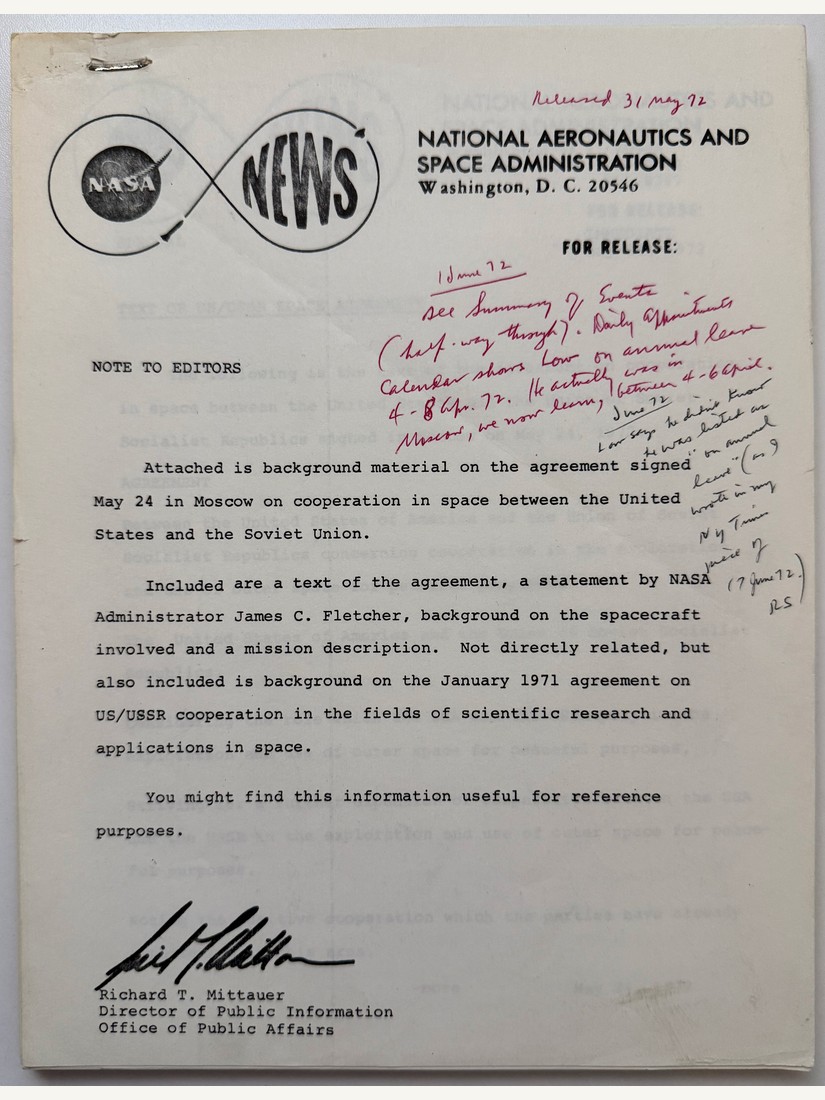
US/USSR Space Cooperation Agreement: NASA Press Kit
NASA News packet issued around the May 24, 1972 signing, in Moscow, of the US/USSR agreement on cooperation in the exploration and use of outer space — the accord, concluded by President Nixon and Soviet Premier Alexei Kosygin, that set the stage for the 1975 Apollo-Soyuz Test Project. Includes a cover "Note to Editors" (released May 31, 1972), the full text of the agreement (six articles, effective on signature and remaining in force for five years), and companion Release 72-109, "US/USSR Rendezvous and Docking Agreement," summarizing the parallel April 4-6, 1972 technical meeting in Moscow between NASA Deputy Administrator George M. Low and Academy of Sciences Vice President V. A. Kotelnikov, background on the modified Apollo command/service module and new docking module and on the Soviet Soyuz spacecraft, a mission description for the planned 1975 test docking flight, and a chronology of the four working-level agreements reached since October 1970. Also includes two NASA technical diagram sheets (M72-6051 and M72-6052, both dated May 23, 1972) illustrating the docking module's dimensions and its position atop the Saturn IB launch vehicle.
Credited to Richard T. Mittauer, Director of Public Information, Office of Public Affairs (printed byline, not a hand signature); heavily annotated in red and black ink by a contemporary reader fact-checking the whereabouts of NASA Deputy Administrator George M. Low around the April 1972 Moscow meeting, apparently for a New York Times piece dated June 7, 1972.
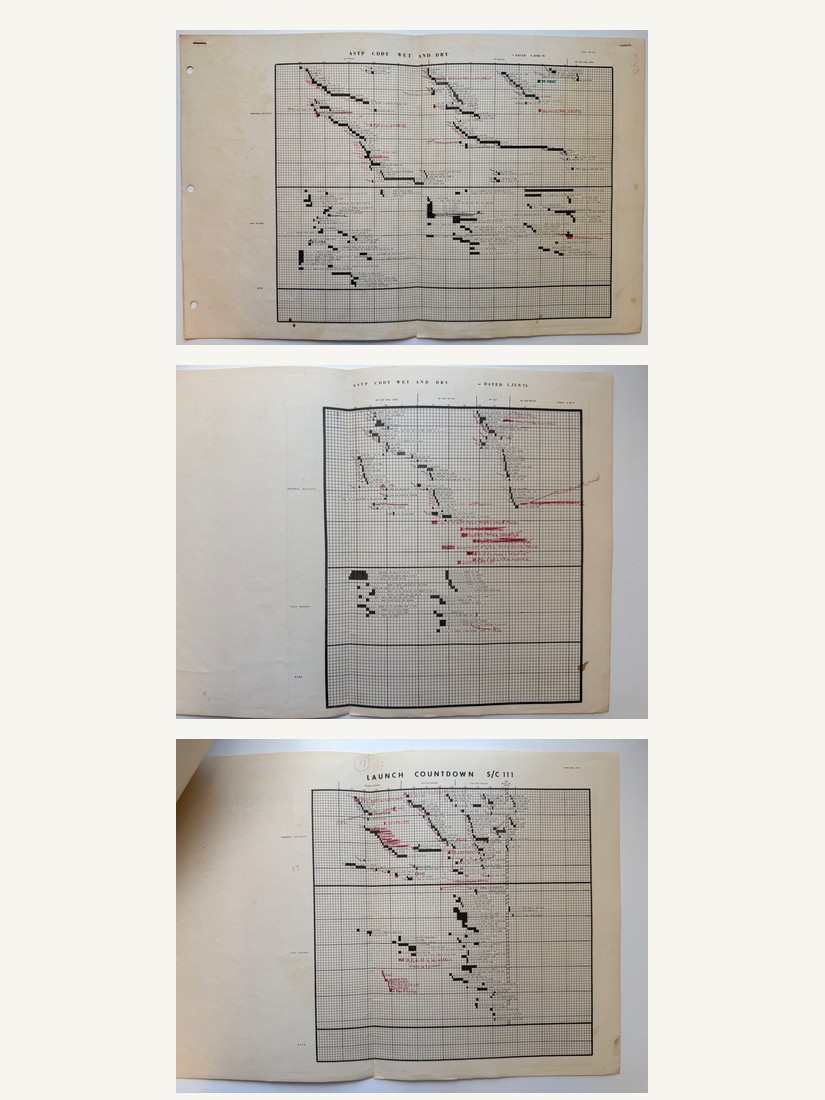
ASTP Countdown Planning Charts: CDDT Wet and Dry, and Launch Countdown for Spacecraft 111
Three oversized double-page bar-chart timeline sheets from an internal launch-operations planning binder. Two, headed “ASTP CDDT Wet and Dry” and dated 5 June 1974 (page 00-101, and a continuation marked “Sheet 2 of 3”), lay out the Countdown Demonstration Test hour by hour — the full dress-rehearsal countdown run in both a fueled (“wet”) and unfueled (“dry”) configuration ahead of flight, tracking tasks such as helium servicing, cryogenic tanking and detanking, hatch closeout, and crew ingress against a countdown clock spanning roughly T-133 hours to T-0 and into hold/recycle branches, with rows grouped into General Activity, Test Setups, and BCRD tiers. The third sheet, headed “Launch Countdown S/C 111” (page 00-103), is the actual flight countdown plan for Command/Service Module 111 — the CSM that flew the Apollo-Soyuz Test Project, docking with Soyuz 19 in July 1975 in the final flight of an Apollo spacecraft. All three sheets are heavily worked in red ink with crossed-out and rewritten line items, added steps, and margin notes, consistent with an engineer's working copy rather than an archival reference set; a faint pencil page sequence in the corner of the third sheet suggests the pages were pulled from a larger personal binder. No accompanying folder or provenance came with them.
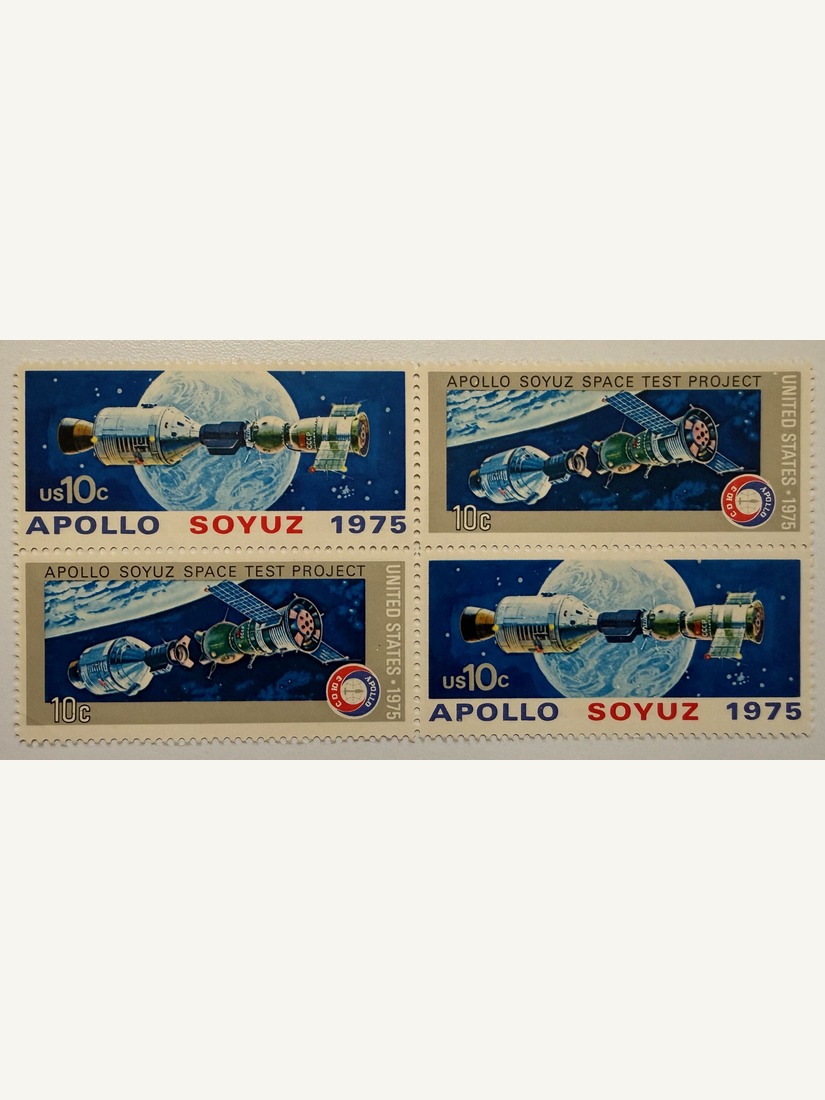
Apollo-Soyuz Test Project: US Postage Stamps from 1975
A mint block of four 10¢ commemoratives (Scott 1569–1570), issued July 15, 1975 — the same day Apollo and Soyuz docked in orbit — as a se-tenant pair repeated twice, designed so the two stamps read as a single continuous scene when placed side by side. Robert T. McCall designed the “after linkup” half (Scott 1569), showing the joined spacecraft against the Earth under the “APOLLO SOYUZ 1975” lettering; Soviet artist Anatoly Aksamit designed the “before linkup” half (Scott 1570), showing the two craft approaching each other beside the joint Soyuz-Apollo docking emblem. The United States and Soviet Union each issued their own stamps for the mission that day; these were printed by the Bureau of Engraving and Printing in photogravure.
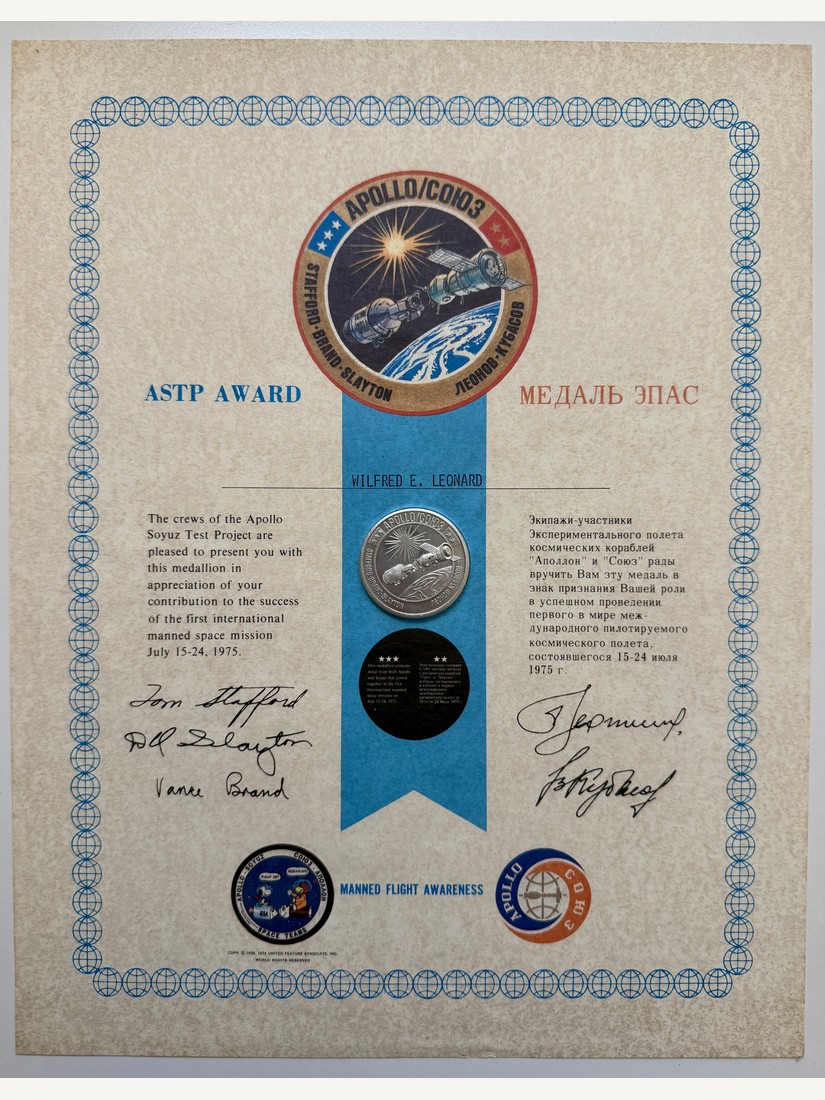
Apollo-Soyuz MFA Medallion with Flown Metal, with Certificate
Bilingual English/Russian award certificate issued by NASA's Manned Flight Awareness (MFA) program — later renamed Spaceflight Awareness — to a contractor or agency employee in recognition of a contribution to the Apollo-Soyuz Test Project, July 15–24 1975, the first joint US–Soviet piloted spaceflight. A 1½-inch aluminum medallion is mounted on the certificate's ribbon; its reverse states that it contains metal flown aboard both the Apollo and Soyuz spacecraft that docked during the mission. The practice of issuing MFA medallions began with Apollo 8 in 1969 and continued through the Space Shuttle era, ending with STS-114 in 2005 — fifteen in all, many, including this one, manufactured by the Barco Mint of New Orleans. The certificate names the joint crew — Thomas Stafford, Donald “Deke” Slayton, and Vance Brand for the United States, and Alexei Leonov and Valeri Kubasov for the Soviet Union — and carries the two official ASTP mission patches alongside an unofficial “Space Teams” cartoon insignia showing Snoopy riding the Apollo craft (“Right On!”) and a bear riding Soyuz (“Poyekhali!” — Yuri Gagarin's 1961 launch cry, “Let's go!”).
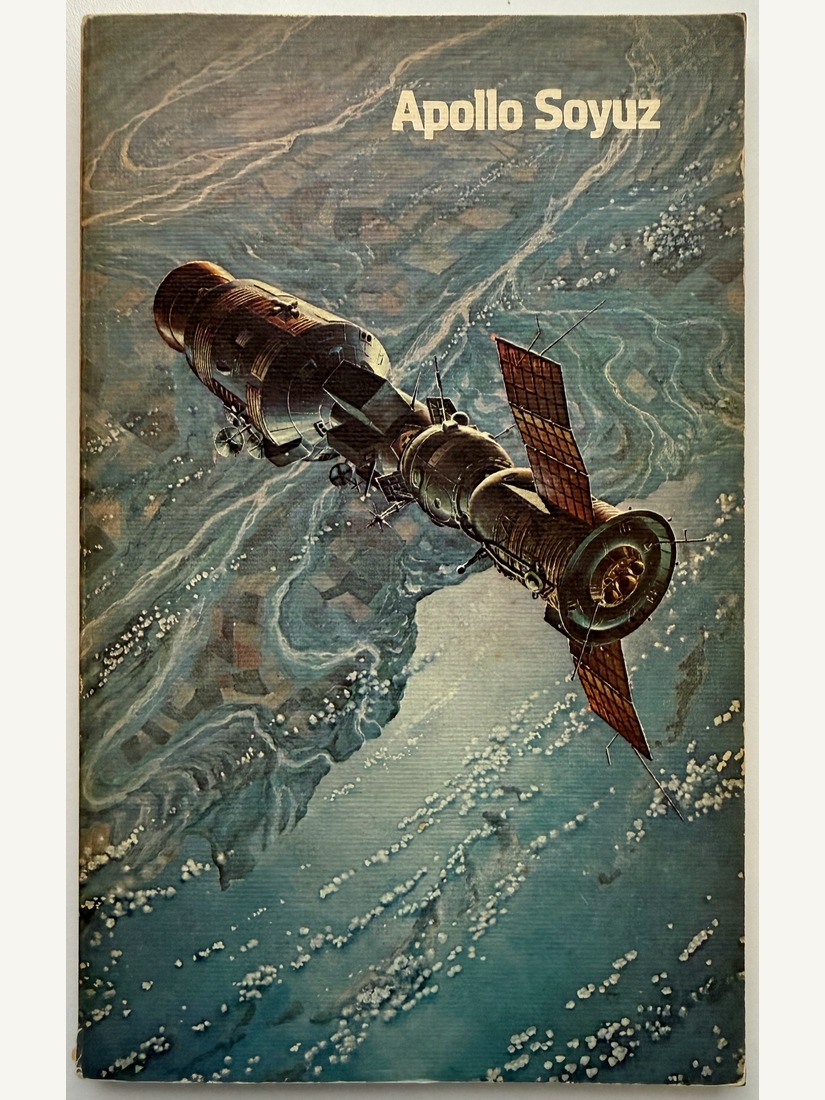
Apollo Soyuz
NASA educational booklet (EP-109) on the July 1975 Apollo-Soyuz Test Project, illustrated with a painting of the docked Apollo and Soyuz spacecraft over Earth on its cover. Ten chapters carry the mission from planning to legacy — The Meeting, The Mission, The Background, The Spacecraft, The Meanings, The Scientific Experiments, The Men, The Mementos, The Reentry, and The Look Ahead — followed by appendix tables of the Brezhnev-Ford crew statements, mission timeline, list of "firsts," program officials, scientific experiments, and major Apollo contractors. As the preface frames it, the two-day docking of a three-man Apollo and two-man Soyuz in a 225-kilometer orbit was history's first international crewed spaceflight, watched live by television audiences as the crews shared meals, exchanged gifts, and ran joint experiments.
Apollo-Soyuz Test Project: Summary Science Report. 2 volumes.
NASA SP-412, prepared by the Johnson Space Center. Foreword by ASTP Program Director Chester M. Lee and Technical Director Glynn S. Lunney, describing the July 15–24, 1975 mission—the first docking of manned spacecraft from two nations—and noting that beyond the five joint U.S.-U.S.S.R. experiments, the Apollo crew ran 23 unilateral experiments, two of them supplied by the Federal Republic of Germany. Volume I (1977) covers astronomy, Earth atmosphere and gravity field, life sciences, and materials processing across 23 chapters, opening with R. T. Giuli’s summary of scientific results and including the joint Artificial Solar Eclipse experiment (MA-148) co-authored by Soviet scientists G. M. Nikolskiy, A. I. Simonov, and I. S. Kim alongside their American counterparts. Volume II (1979), edited by Farouk El-Baz and Delia M. Warner of the Smithsonian Institution under NASA contract NAS9-13831, is devoted entirely to the Earth Observations and Photography Experiment: eleven vertical stereostrip mapping passes and sixty visual observation targets shot with Hasselblad and Nikon cameras, yielding geological and tectonic studies of Southern California’s San Andreas Fault system, the Red Sea/Levantine Rift zone, the Western Desert of Egypt, southeastern Spain, and South Australia.
The Partnership: A History of the Apollo-Soyuz Test Project
NASA SP-4209 in the NASA History Series, Washington, D.C., 1978, by the husband-and-wife historian team of Edward Clinton Ezell and Linda Neuman Ezell — the latter also a co-author, with Jane Van Nimmen, of Volumes II and III of the NASA Historical Data Book elsewhere in this collection. Foreword by Christopher C. Kraft, Jr., Director of the Johnson Space Center, dated November 1977, who describes the nearly 20-year evolutionary process behind the joint US-Soviet flight and notes that no more than two hundred managers, engineers, and technicians from each nation ever came into direct contact. The authors' preface describes their work as "combat history" — interviewing and observing joint working-group sessions in Houston with tape recorders in hand, and, since none of them traveled to the Soviet Union, relying on participants' own recollections of the Moscow negotiations. The book traces the roughly two-decade path to the July 1975 docking and introduces the five participating astronauts and cosmonauts as they worked together in orbit.
Apollo Soyuz Test Project Press Kit: 20th Anniversary Commemorative Edition
Softcover commemorative rebinding, issued for the 1995 anniversary, of the original joint US–USSR press kit distributed for the July 1975 mission. Reproduces the full 1975 kit in facsimile: the General Release (No. 75-118, dated June 10, 1975), historical background, mission objectives, countdown and launch phase, Saturn IB/Apollo vehicle description, mission profile and events, crew transfers, the 28 joint ASTP experiments (Soft X-Ray, Artificial Solar Eclipse, Doppler Tracking, Electrophoresis, Multipurpose Electric Furnace, and others), crew equipment and menus, biographies of Thomas P. Stafford, Vance D. Brand, and Donald K. Slayton, Apollo Command/Service and Docking Module descriptions, Saturn IB launch vehicle history, tracking and communications, Launch Complex 39, program management by NASA center, and a list of major contractors. Foreword notes the kit was prepared jointly, with separate US and Soviet sections.
Space Shuttle & Beyond
1970s – 1980s
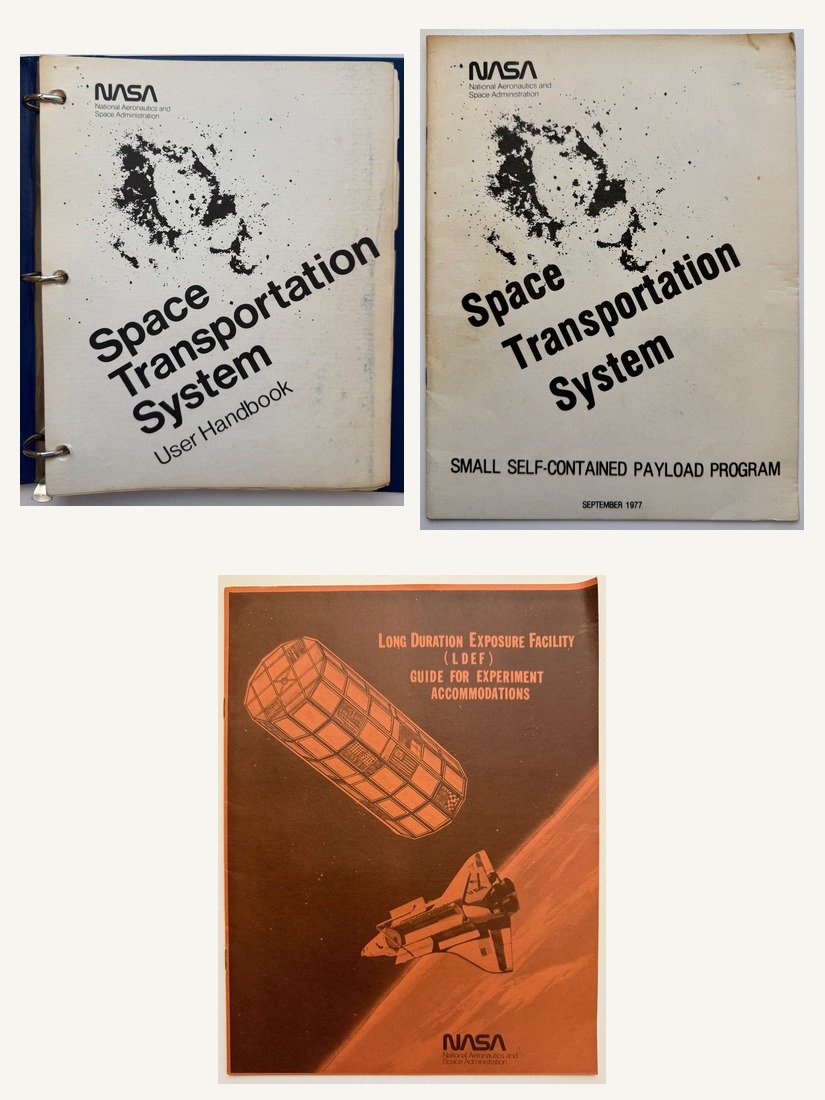
Space Shuttle Payload Planning File: STS User Handbook Excerpt with ‘Getaway Special’ and LDEF Program Brochures
A working file assembled around one goal: getting a small self-contained experiment flown on the Space Shuttle. The core is a three-ring “Space Transportation System User Handbook” binder, dated June 1977, retaining curated excerpts on Spacelab payloads, cargo integration, and, at length, the Long Duration Exposure Facility (LDEF). Tucked in a folder pocket are two further NASA publications on the same theme: “Space Transportation System — Small Self-Contained Payload Program” (September 1977), which coins the “Getaway Special” name for a program NASA itself calls “still being formulated” — a 200-lb/5-cubic-foot size limit, a $500 deposit, $3,000–$10,000 pricing, and named Headquarters contacts — loose with a photocopied page from the underlying reimbursement directive, NMI 8610.8; and “Long Duration Exposure Facility: Guide for Experiment Accommodations” (Revision A, May 1976, Langley Research Center), describing LDEF's twelve-sided frame and targeting a 1979 first flight it would not actually make until 1984, bound with a blank experiment-proposal form.
Every document dates from 1976–1977, before a single Shuttle had flown, and all address the same narrow question: how a small outside experiment could ride along in the cargo bay, as a Getaway Special or an LDEF tray payload — read together, one person's working file for pursuing exactly that opportunity.
NASA 40th Anniversary
Limited-edition commemorative for NASA's 40th anniversary in 1998, copy 865 of 1500, produced by the Houston Image Group (a Houston civic/corporate sponsor consortium) rather than by NASA itself. Spiral-bound with embossed silver metallic covers; opens with a letter from Administrator Daniel S. Goldin to Johnson Space Center, followed by a year-by-year photo chronology from NASA's 1958 founding.
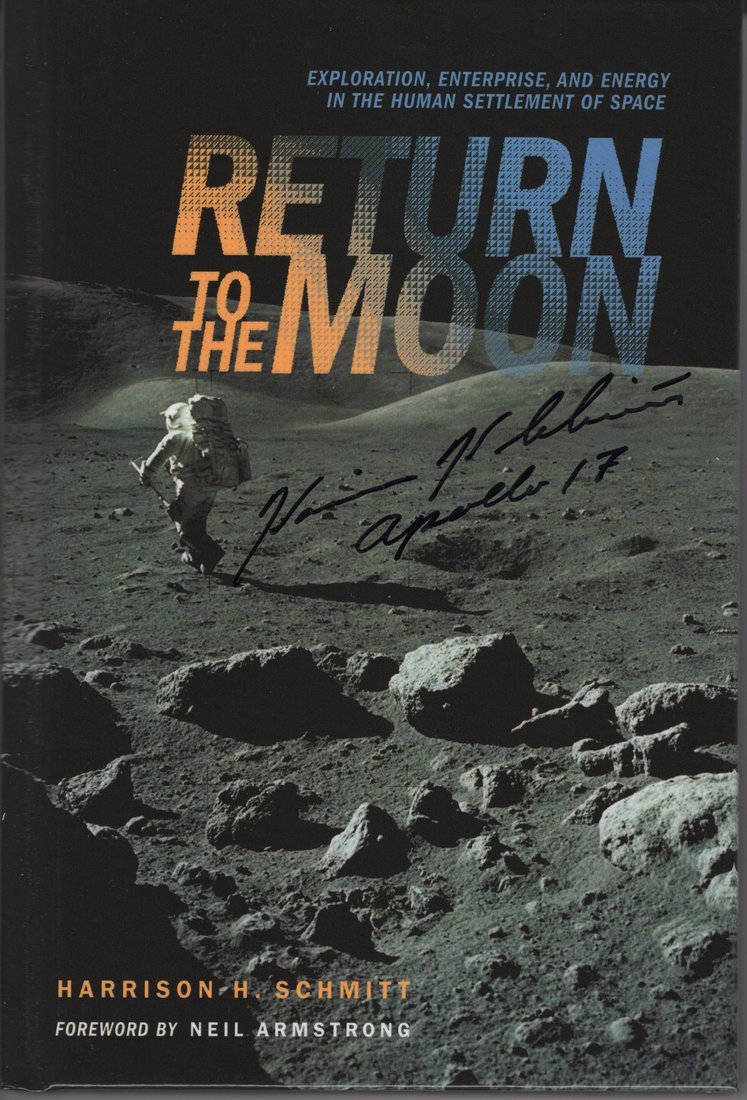
Return to the Moon: Exploration, Enterprise, and Energy in the Human Settlement of Space
Published by Copernicus Books, an imprint of Springer Science+Business Media. Apollo 17 lunar module pilot and geologist Harrison “Jack” Schmitt — the only professional scientist to walk on the Moon, and later a U.S. Senator from New Mexico — lays out a chapter-by-chapter case for a commercially financed return to the Moon built around mining lunar helium-3 as fuel for terrestrial fusion power, working through booster and fusion-power economics, lunar mining and settlement costs, NASA restructuring, space law, and the human factors of long-duration lunar work; one chapter revisits the Apollo 1 fire as a management case study. In his foreword, Neil Armstrong traces the history of humanity's understanding of the Sun's energy, from nineteenth-century miscalculations through the discovery of nuclear fission and fusion, as scientific backdrop for Schmitt's helium-3 argument.
Cover hand-signed by the author, “Harrison H. Schmitt, Apollo 17.”
Robotic & Experimental Programs
Mariner · Voyager · X-15
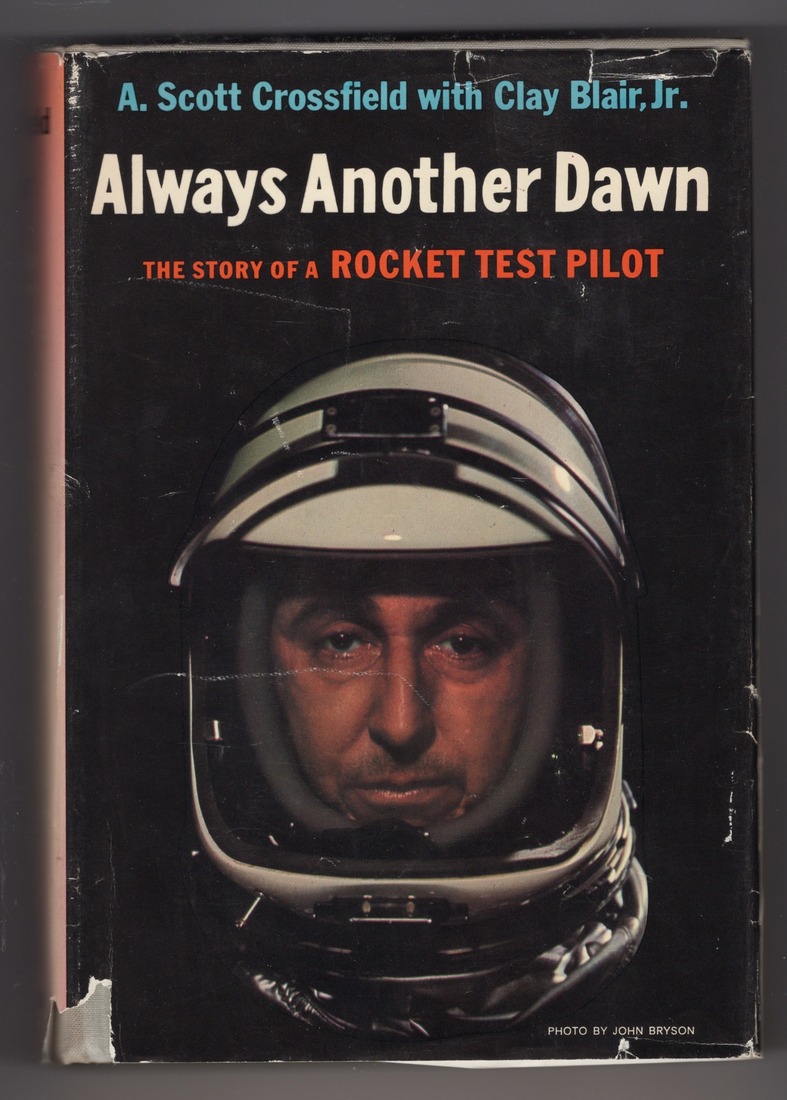
Always Another Dawn: The Story of a Rocket Test Pilot
Memoir of NACA/NASA and North American Aviation test pilot Scott Crossfield, covering his rocket-plane career from the X-1 and D-558-II Skyrocket (first flight past Mach 2, November 1953) through the early X-15 program. Cleveland and New York: The World Publishing Company, 1960. First edition. Hardcover with dust jacket; jacket has some wear, with chipping and short tears at the corners.
Two period newspaper clippings on X-15 flight tests (Edwards Air Force Base AP wire stories, undated) are laid in.
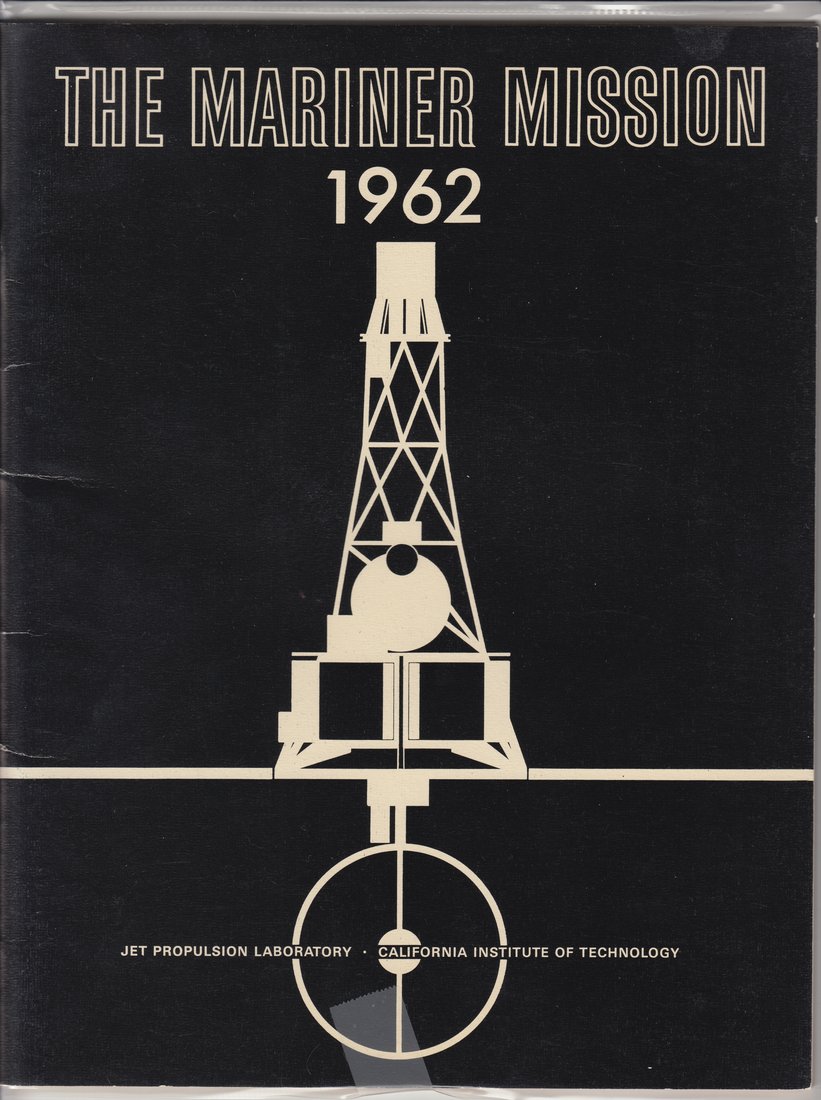
The Mariner Mission, 1962
A 34-page JPL booklet on the Mariner 2 mission to Venus, written entirely in the future tense of an in-flight cruise report rather than after the fact — Mariner 2 launched August 27, 1962 and would not reach Venus until mid-December, so this appears to have been issued during that roughly four-month cruise phase to explain the spacecraft and its objectives while the mission was still underway. It opens with "The Planet Venus," summarizing pre-flyby knowledge and the competing theories then current for the planet's puzzling heat (a dense ionosphere, a greenhouse effect, or surface-level wind friction), then covers the July 1962 loss of Mariner 1 (destroyed by the Range Safety Officer 290 seconds after launch owing to a guidance deviation) and the fixes made before Mariner 2 flew an identical design. A "Mariner 2 Spacecraft" section details its Atlas D–Agena B launch and parking-orbit injection, attitude control by cold-gas jets and Sun/Earth sensors, the September 4, 1962 midcourse correction burn, and the hydrazine motor's ability to add as little as 7/10 foot per second of velocity. "Mariner 2 Scientific Instruments" lists the six onboard experiments — microwave and infrared radiometers, a magnetometer, charged-particle and cosmic-dust detectors, and a solar plasma spectrometer — run by investigators from nine institutions including Caltech, JPL, MIT, and UC Berkeley. A closing "Subcontractors" section names the 34 firms that built Mariner 1 and 2 hardware under $6.5 million in JPL contracts, plus over 1,000 further industrial contributors totaling more than $3.5 million. Numerous JPL clean-room and test-stand photographs of the actual Mariner 2 spacecraft illustrate the text throughout.
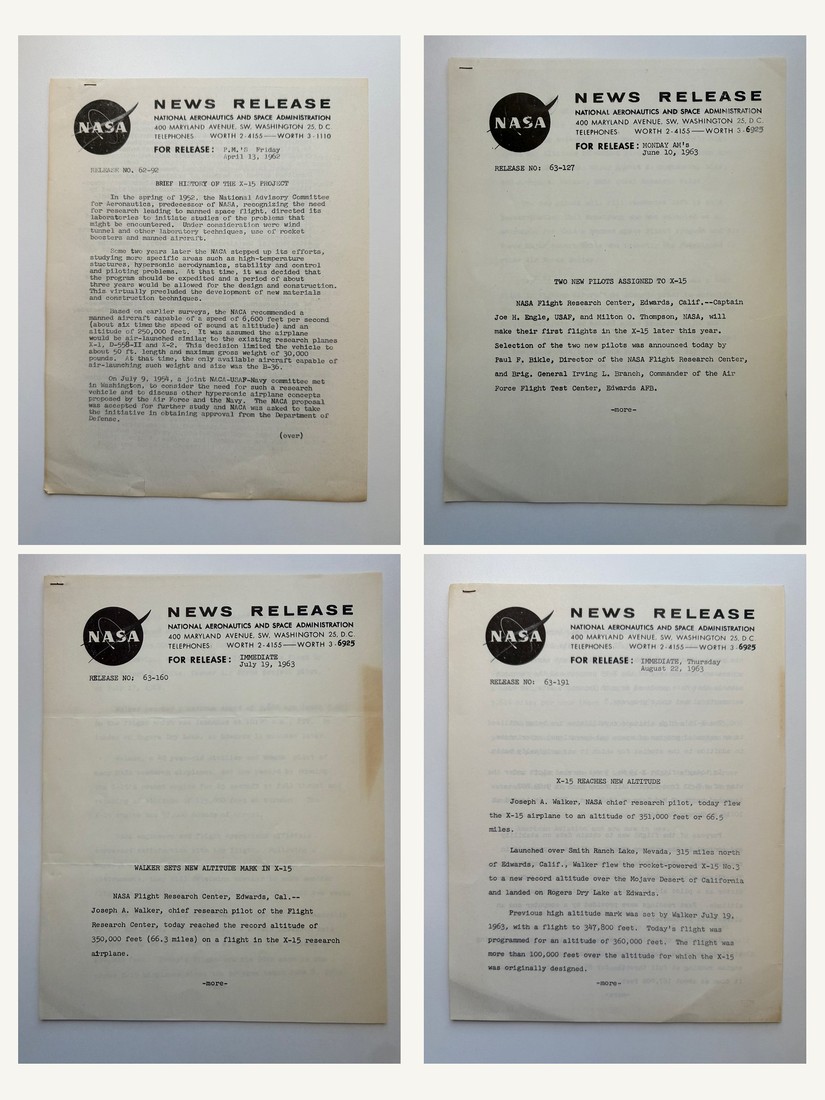
Four NASA News Releases on the X-15 Program
Four original press releases charting the X-15 rocket-plane program over its most active year. Release 62-92 (April 13, 1962), "Brief History of the X-15 Project," traces the program's origin to a spring-1952 NACA directive on manned-spaceflight problems, the resulting design requirement for an air-launched aircraft capable of Mach 6 and 250,000 feet within a roughly 50-foot, 30,000-pound airframe, and the July 9, 1954 joint NACA-Air Force-Navy committee that approved the concept for development. Release 63-127 (June 10, 1963) announces two new project pilots, Capt. Joe H. Engle (USAF) and Milton O. Thompson (NASA), per Flight Research Center director Paul F. Bikle and Air Force Flight Test Center commander Brig. Gen. Irving L. Branch. The final two releases record chief research pilot Joseph A. Walker's back-to-back altitude records: 63-160 (July 19, 1963) reports his flight to 350,000 feet (66.3 miles), and 63-191 (August 22, 1963) reports his follow-up flight in X-15 No. 3, launched over Smith Ranch Lake, Nevada and landed on Rogers Dry Lake, reaching 351,000 feet (66.5 miles) — more than 100,000 feet above the altitude for which the aircraft was originally designed, and explicitly framed in the release as surpassing his own July mark. Engle would go on to fly the X-15 above 50 miles, earning astronaut wings, before commanding two Space Shuttle missions.
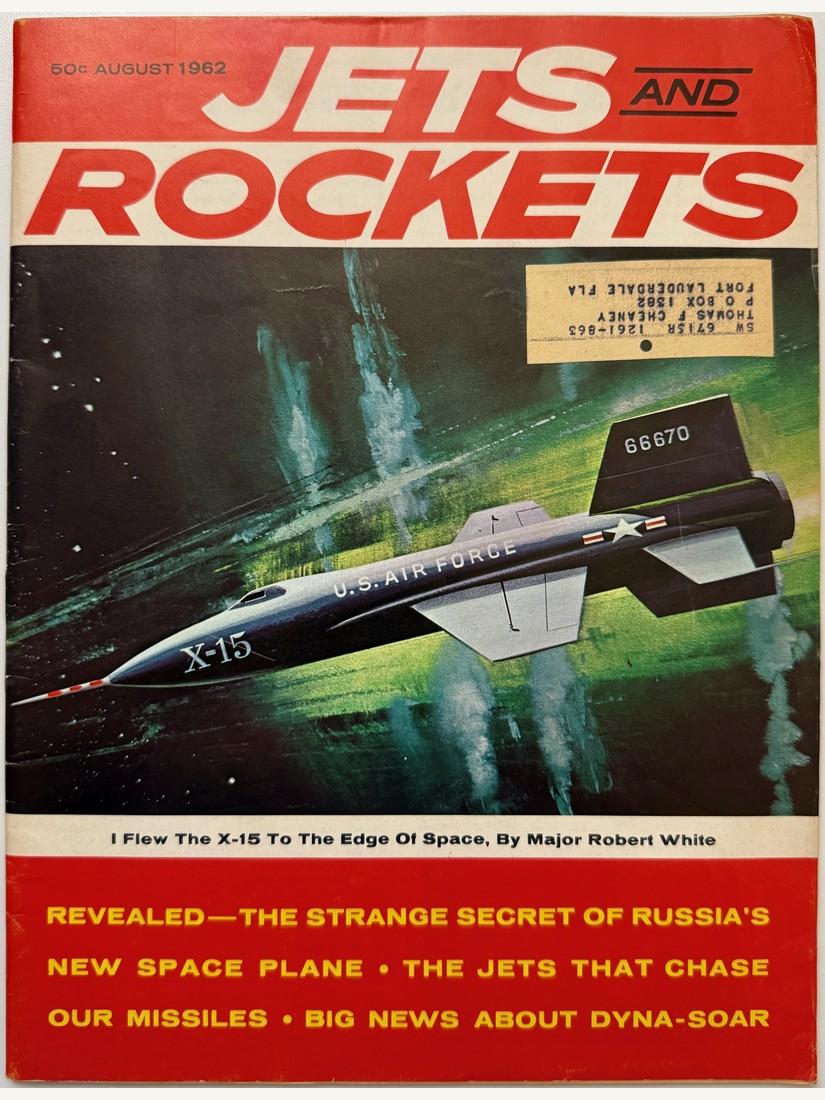
Jets and Rockets, First Edition, August 1962
Vol. 1, No. 1 of "Jets and Rockets: The Magazine of Aerospace News," a bi-monthly digest edited by Otto O. Binder, Ralph Hill, and Thomas Whyle. Cover story "I Flew the X-15 to the Edge of Space" by Major Robert A. White; also covers the Dyna-Soar program, the Vostok capsule, in-flight jet refueling, and forest-fire aircraft. An inserted notice tells subscribers there is no August 1962 issue of Space World magazine (also edited by Binder) and that this premier issue of Jets and Rockets is being sent in its place, "edited and written by many of the same people" as Space World. No further issues of Jets and Rockets have been traced, and Space World is independently documented as having continued publishing under its own name into the late 1980s — so this appears to have been a short-lived rebrand rather than a lasting replacement.
Orbiting Solar Observatory Satellite, OSO I: The Project Summary
NASA SP-57, prepared by Goddard Space Flight Center, Greenbelt, Maryland, and issued by NASA's Scientific and Technical Information Division, Washington, D.C., 1965. The foreword recounts that Ball Brothers Research Corporation led development of the observatory, designed for roughly six months of operation, with subcontractors Electronic Specialties Company (antennas), AVCO (receiver and decoders), and Vector Manufacturing (transmitter and diplexer); NASA Project Manager was Dr. J. Lindsay, with BBRC project directors F. P. Dolder (spacecraft systems) and R. H. Gablehouse (communications systems). OSO I launched March 7, 1962, from Cape Canaveral's Air Force Missile Test Center. Five chapters cover the program introduction and observatory design, spacecraft dynamics (including nutation-damper development), structural design and fabrication of the wheel and sail sections, electrical and gas control systems, and the data acquisition and command system, closing with an assessment of the mission's overall performance.
Mariner-Venus 1962: Final Project Report
NASA SP-59, prepared under contract for NASA by the Jet Propulsion Laboratory, California Institute of Technology, and issued by NASA's Scientific and Technical Information Division, Washington, D.C., 1965. Foreword by W. H. Pickering, Director of JPL, calling Mariner "the first interplanetary spacecraft" and looking ahead to planetary orbiters and landers. Covers the Mariner R (1962) project's history of knowledge about Venus, project organization and management, the space vehicle system's design and testing (including the Mariner R-3 backup), and the trajectory and orbit design that carried Mariner 2 past Venus in December 1962, humanity's first successful planetary flyby.
X-15 Research Results with a Selected Bibliography
NASA SP-60, a semi-technical summary of the X-15 program marking the tenth anniversary of its 1954 inception and the fifth year since its first flight, with a foreword by Flight Research Center director Paul F. Bikle dated November 1, 1964. Covers the aircraft's origin and design compromises, then its flight-research results across nine chapters: aerodynamic characteristics from supersonic to hypersonic speed, the heat-sink structure that withstood skin temperatures up to a cherry-red 1300°F, the dynamics of high-altitude reentry (including a roll-yaw coupling problem serious enough to make the airplane briefly uncontrollable above 250,000 feet, solved with a roll-damper and revised tail), man-machine integration (the X-15 met its research objectives on 110 of 120 flights, a 92-percent success rate), and the program's later role as a flying laboratory for other research. By late 1964 the three X-15s had made 120 flights, reaching Mach 6.06 and 354,200 feet — more than twice the speed and three times the altitude of any other aircraft then flying. Includes a chronology of the program from 1952 and a selected bibliography of X-15 technical literature. Government Printing Office issue, wrappers; the front cover carries the contemporary NASA library accession stamp (April 19, 1965) and a Scientific and Technical Aerospace Reports (STAR) cataloging notation in a period hand.
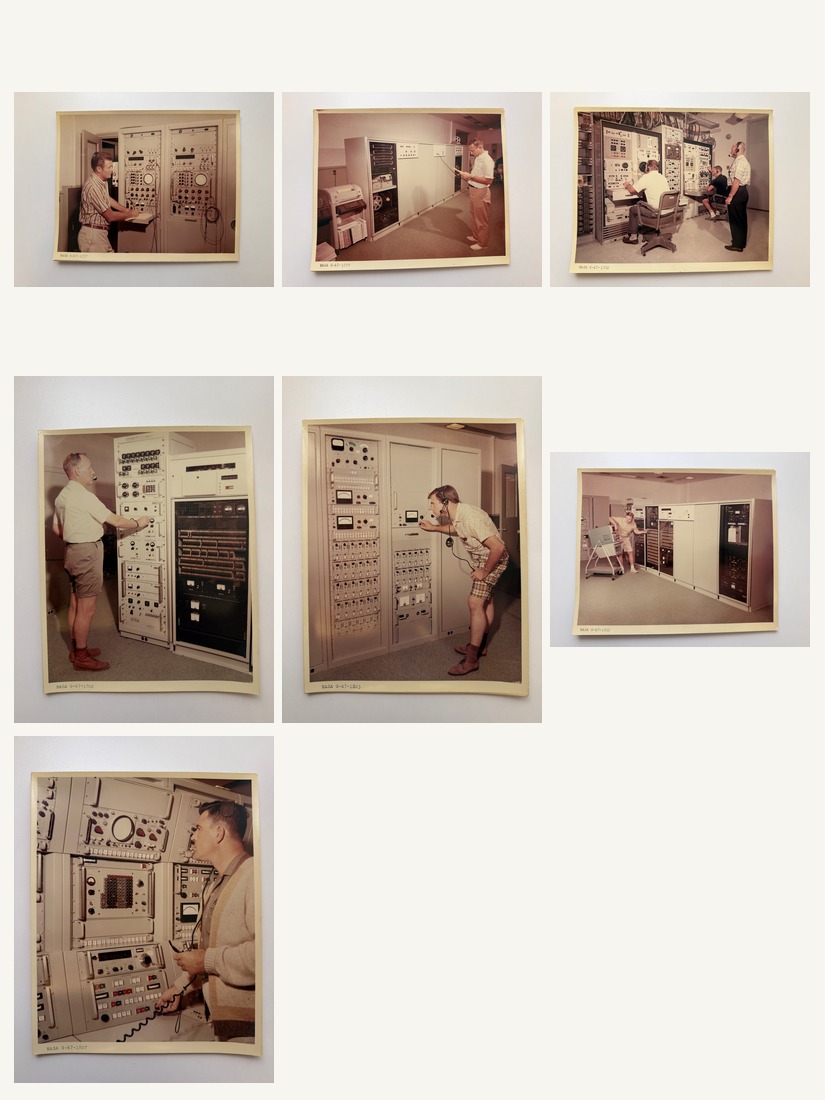
Manned Space Flight Network: Unified S-Band Ground Station Equipment Photograph Lot
Seven official NASA photographs, sequentially numbered G-67-1757 through G-67-1807, documenting the equipment and technical-support areas of a Unified S-Band (USB) ground tracking station of the Manned Space Flight Network (MSFN) — the worldwide chain of stations, managed by Goddard, that tracked and communicated with the Gemini and Apollo spacecraft. The photographs show technicians at the Klystron Power Monitor and Exciter Control panels, the Primary Power Control and Emergency Power Supply racks, oscilloscopes and frequency counters, reel-to-reel recorders, and a comms desk, with several men wearing headsets and one photographed mid-call on a corded handset. A shelf of reference binders visible in one frame is labeled "TDP" (Tracking Data Processor) and "APP" (Antenna Position Programmer), the two computer subsystems that positioned the station's antenna and processed spacecraft tracking data. No station name or signage appears in any of the seven photographs, so the specific MSFN site is not identified; the short sleeves, shorts, and open collars worn by the men photographed are consistent with (though not proof of) one of the network's warmer-climate overseas stations.
The Mariner 6 and 7 Pictures of Mars, NASA SP-263
The official photographic volume presenting the final, computer-processed results of the Mariner Mars 1969 television experiment, prepared at JPL under Stewart A. Collins with a foreword by Henry J. Smith, NASA's Deputy Associate Administrator for Science. Mariner 6 and 7 flew past Mars in successive weeks of July–August 1969, following up Mariner 4's cratered 1964 flyby with over 200 far- and near-encounter television frames, all reproduced here without the detailed scientific interpretation reserved for the companion Television Experiment Team supplement in the January 1971 Journal of Geophysical Research. The far-encounter sequence (Chapter 3) captures Mars as a shrinking disk over several days, with global sketches keying features such as Syrtis Major, Hellas, Sabaeus Sinus, and the North Polar Hood to frame numbers like 7F0, 7F25, and 7F33; the near-encounter sequence (Chapter 4) closes to high-resolution strips revealing the actual Martian South Pole in frame 7N17, unusual raised knobs south of the pole in 7N16, the floor of the Hellas basin in 7N28–30, and a crater-density comparison between dark Sabaeus Sinus and light Deucalionis Regio in 6N21–22 that found no significant difference between the two albedo regions. Appendices give far- and near-encounter photoreference tables and a NASA Mars map.
NASA — General & Institutional
Agency history, publications, and institutional ephemera
Space Handbook: Astronautics and Its Applications
An 85th Congress, 2nd Session Committee Print, transmitted December 29 1958 by committee director George J. Feldman and assistant director Charles S. Sheldon II and published the following year. The committee, chaired by Majority Leader John W. McCormack, commissioned the RAND Corporation (led by Robert W. Buchheim) to produce this lay-language survey of the state of the art of spaceflight, based on RAND's own Report No. RM-2289-RC. Part I introduces the subject; Part II surveys the technology (the space environment, trajectories and orbits, rocket vehicles, propulsion and propellants, guidance and communication, atmospheric flight, landing and recovery, the environment of manned systems, space stations, and even nuclear weapon effects in space); Part III covers applications such as observation, meteorological, navigation, and communication-relay satellites; and Part IV surveys astronautics programs in the U.S.S.R. and other countries.
NASA Authorization for Fiscal Year 1961: Hearings, Part 2 — Scientific and Technical Aspects of NASA Program
Senate hearings before the NASA Authorization Subcommittee on H.R. 10809, appropriating NASA's fiscal year 1961 budget, held June 30, 1960, with a letter of submittal from NASA Administrator T. Keith Glennan to Senator Stennis dated June 27, 1960, covering material updated from the subcommittee's 1959 hearings. Running to more than 1,000 pages, Part 2 compiles technical status reports from NASA program chiefs across seven areas: Space Sciences (atmospheres, ionospheres, energetic particles, lunar exploration), Applications Programs (meteorological and communications satellites, geodesy), Manned Space Flight by George M. Low, Tracking and Data Acquisition, Propulsion (launch vehicles, nuclear and electric rockets), Research Programs (hypersonic and VTOL aircraft, structures, human factors), and the Life Sciences Program, closing with an appendix tabulating U.S. and Soviet satellites, lunar probes, and space probes launched from 1957 through June 1960.
Aeronautics and Astronautics: An American Chronology of Science and Technology in the Exploration of Space, 1915–1960
Published by NASA in 1961, with a foreword by Deputy Administrator Hugh L. Dryden dated December 16, 1960, and a preface by NASA Historian Eugene M. Emme dated January 13, 1961. Compiled barely two years into the agency's existence as a ready reference on the history of American aeronautics and rocketry, the chronology is arranged in two parts — "From the Founding of NACA to the Dawn of the Space Age, January 1915–October 1957" and "The First Three Years of the Space Age, October 1957–December 1960" — followed by five appendices: a chronicle of earth satellites and space probes, a chronicle of world airplane records, a chronicle of select balloon flights (1927–60), a list of select awards and honors in aeronautics and astronautics, and the membership roster of the NACA, 1915–58, along with a select bibliography and a detailed subject and name index. Bound in plain blue cloth boards stamped with the NASA insignia, without a dust jacket; the title page is reproduced here in place of a cover.
Astronaut Policy and Selection: NASA News Release Lot
Seven NASA Headquarters news releases (April 1962 – June 1963) tracing the astronaut corps' buildup and the rules governing its members. Release 62-99 (April 18, 1962) announces the search for five to ten additional pilots to support Mercury and fly the new Gemini and Apollo spacecraft. A paired set from September 16, 1962 (62-199 and 62-198) lays out NASA's new astronaut media policy: personal narratives could now be sold, but any story containing undisclosed official information was barred, and a second post-flight press conference open to all outlets was made mandatory. The next day, NASA named the second astronaut group, the "New Nine" (Armstrong, Borman, Conrad, Lovell, McDivitt, See, Stafford, White, and Young), in release 62-200-A — immediately followed by 62-200-B, a curiously clinical release comparing the new pilots' average age, weight, height, and flying hours to the original Mercury Seven. An undated Hangar "S" fact sheet on the astronauts' Cape Canaveral crew quarters names Air Force Lt. Dolores "Dee" O'Hara, the astronauts' nurse — one of the few women named in NASA's early press material. The lot closes with release 63-122 (June 5, 1963), announcing the recruiting round that would become the third astronaut group, "The Fourteen."
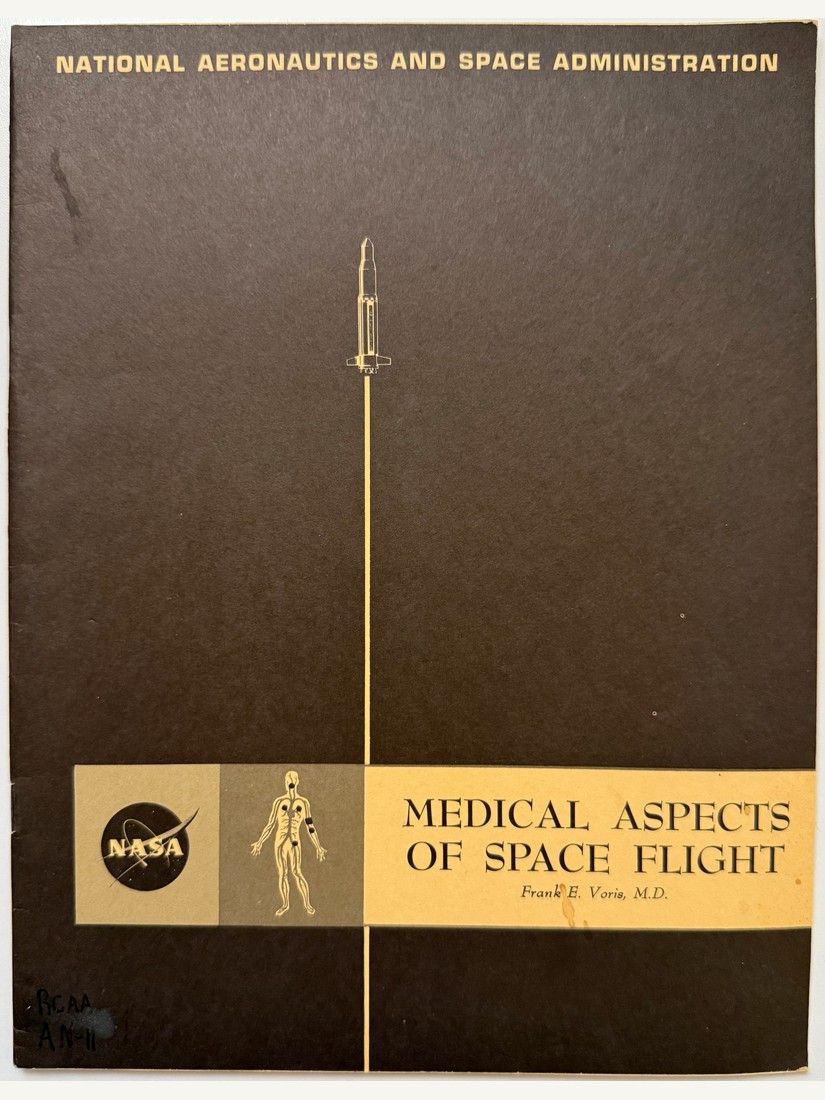
Medical Aspects of Space Flight
NASA Educational Publication EP-17, a short illustrated leaflet rather than a technical reference volume, written by Capt. Frank B. Voris, USN, Chief of Human Research in the Biotechnology and Human Research Division of NASA's Office of Advanced Research and Technology. Surveys the medical challenges of Projects Mercury, Gemini, and Apollo in plain language: supplying respiratory requirements (comparing the U.S. 5-psi pure-oxygen system to the Soviet 14.7-psi mixed-gas approach), the full pressure suit as both safety device and firefighting tool, acceleration forces and custom-molded couches, weightlessness, radiation hazards, nutrition, waste disposal, micrometeorite strikes, and psychological problems, closing with a section on the biotechnology spinoffs of the space program (cardiac monitoring, mining and diving equipment, metallurgy). Illustrated with a photograph of "Amy," a mouse flown and recovered with a telemetering "mouse-mitter," a flight-simulator tracking test at Ames Research Center, and John Glenn training on the human centrifuge at the Naval Air Development Center, Johnsville, Pennsylvania.
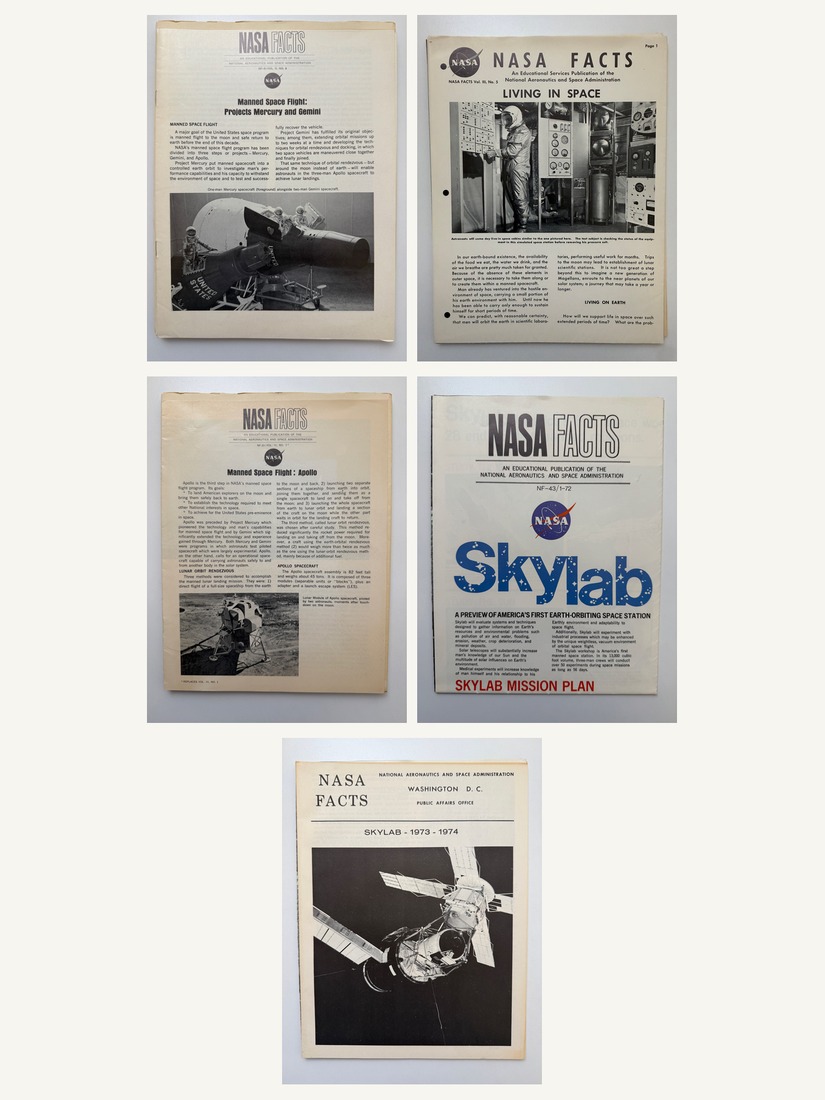
NASA Facts: Manned Spaceflight Programs, Lot of 5
Five issues of "NASA Facts" tracing the manned program from Mercury through Skylab. "Manned Space Flight: Projects Mercury and Gemini" (NF-9, Vol. II, No. 8) lays out NASA's three-step plan — Mercury, Gemini, Apollo — pairing a photo of the one-man Mercury capsule beside the two-man Gemini spacecraft. "Living in Space" (Vol. III, No. 5) looks at the life-support challenges of extended missions, illustrated with a pressure-suited test subject checking equipment in a simulated space cabin, and looks ahead to orbiting laboratories and multi-year interplanetary voyages. "Manned Space Flight: Apollo" (NF-23, Vol. IV, No. 7, replacing Vol. III, No. 1) sets out Apollo's three goals — landing and returning astronauts safely, establishing technology for other national interests in space, and U.S. preeminence in space — and explains why lunar-orbit rendezvous was chosen over the direct-flight and earth-orbit-rendezvous alternatives for the 82-foot, 45-ton spacecraft assembly. The two remaining issues bookend the Skylab program: "Skylab" (NF-43/1-72), subtitled "A Preview of America's First Earth-Orbiting Space Station" and carrying the Skylab Mission Plan, was issued in 1972 ahead of launch to describe the planned Earth-resources, solar, and medical experiments; "Skylab – 1973-1974," issued by the Public Affairs Office in Washington, recaps the program after it had actually flown.
Advances in Space Research
Proceedings of the First Inter-American Symposium on Space Research, held in Buenos Aires in November 1960 and published in 1964 by Pergamon Press with the support of Argentina's National Commission for the 150th Anniversary of the May Revolution. Edited by the technical staff of the Argentine National Commission on Space Research, presided by Teófilo M. Tabanera, who writes the foreword himself, framing the sounding rocket as a tool within reach of less economically developed countries and describing Latin American participation as a route to future international cooperation. The opening paper, Richard W. Porter's “International Cooperation in Space Research,” surveys the region's substantial contributions to the International Geophysical Year: cosmic-ray studies in Argentina, Brazil, and Bolivia; Antarctic research by Argentina and Chile; the geophysical institute at Huancayo, Peru; ionospheric forward-scatter studies across Argentina, Brazil, Chile, Ecuador, and Peru conducted with the U.S. Central Radio Propagation Laboratory; oceanographic work involving Argentina, Brazil, Chile, and Colombia; Andean and Altiplano seismology; and the “Moonwatch” optical-tracking teams that Porter calls almost indispensable to the IGY's Earth Satellite Program. The 24 papers that follow, from contributors including Hugh L. Dryden and Homer E. Newell of NASA, Donald H. Menzel of Harvard, and researchers from Bolivia's Laboratorio de Física Cósmica in La Paz and Peru's Instituto Geofísico de Huancayo, cover aerodynamics, solid-propellant rockets, upper-atmosphere sounding, stratospheric balloons, cosmic radiation, and space communications, closing with a U.S. Atomic Energy Commission paper on the Snap-3 radioisotope thermoelectric generator and a summary of the symposium's panel discussion. The appendix lists all participants by institution, spanning NASA, General Electric, Princeton, and the U.S. Naval Research Laboratory alongside Argentina's Comisión Nacional de Energía Atómica and Universidad Nacional de La Plata, Bolivia's cosmic-physics laboratory, Peru's Huancayo institute, Japan's University of Tokyo, and Britain's National Physical Laboratory.
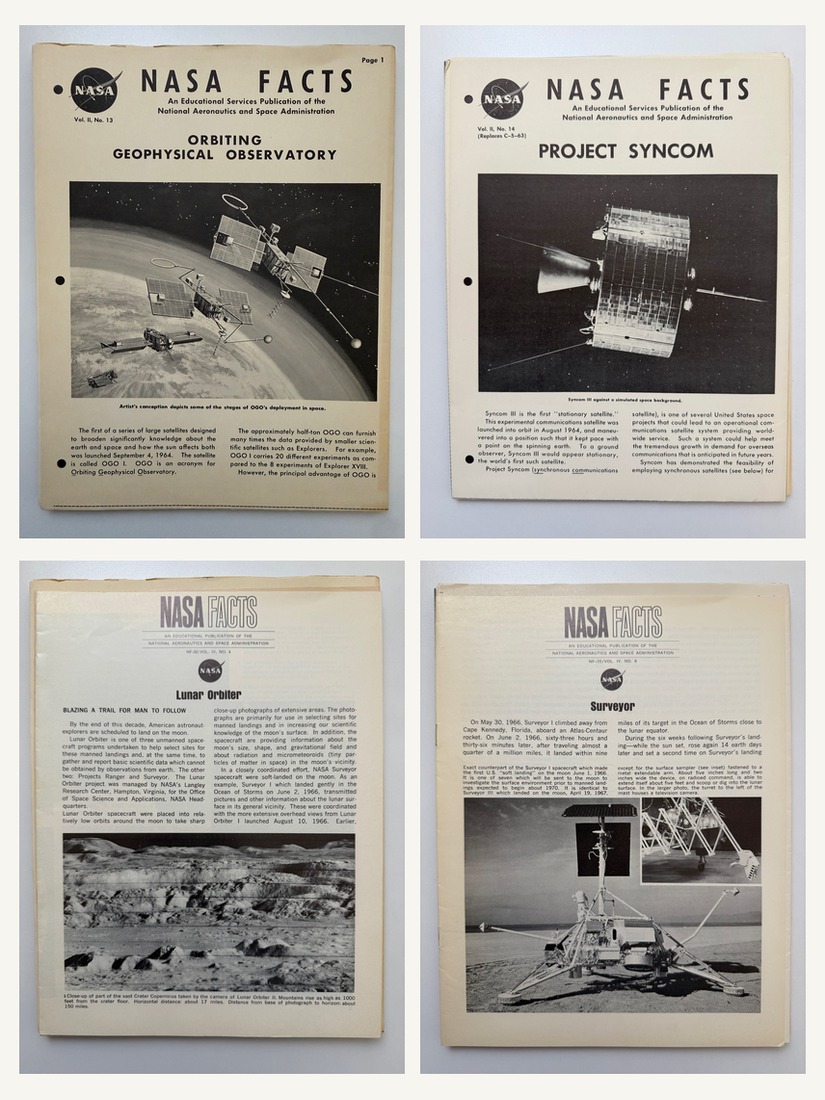
NASA Facts: Uncrewed and Communications Programs, Lot of 4
Four issues of "NASA Facts" on the agency's uncrewed science and communications satellites. "Orbiting Geophysical Observatory" (Vol. II, No. 13) covers OGO I, launched September 4, 1964 as the first of a series of large satellites carrying 20 experiments — well over the 8 aboard the smaller Explorer XVIII — to study the earth, space, and the sun's effects on both. "Project Syncom" (Vol. II, No. 14, replacing C-5-63) covers Syncom III, launched August 1964 as the world's first geostationary satellite, appearing stationary to a ground observer as it kept pace with a fixed point on the spinning earth. "Lunar Orbiter" (NF-32, Vol. IV, No. 4) places the program alongside Ranger and Surveyor as one of three uncrewed efforts to scout landing sites ahead of Apollo, illustrated with a Lunar Orbiter II close-up of the vast Crater Copernicus and referencing Lunar Orbiter I's August 10, 1966 launch. "Surveyor" (NF-35, Vol. IV, No. 6) covers Surveyor I's June 2, 1966 soft landing in the Ocean of Storms after riding an Atlas-Centaur rocket from Cape Kennedy, detailing its extendable surface-sampler arm and referencing Surveyor III's April 19, 1967 landing, which places this issue in mid-1967.
A Handbook for Employees
General-orientation handbook (NPC 103) issued to new NASA hires, opening with a welcome message from Administrator James E. Webb recounting the July 29, 1958 National Aeronautics and Space Act and the agency's October 1, 1958 founding, followed by seventeen sections on pay, working time, career development, benefits, retirement, and separation from service. Its “If You Have a Complaint” chapter states NASA policy plainly: “to promote and insure equal opportunity for all qualified persons, without regard to race, creed, color, or national origin,” backed by a Compliance Officer at headquarters and every field installation enforcing the President's Committee on Equal Employment Opportunity, and guarantees that raising a grievance will not itself be held against an employee. The cover art's spacewalk and rendezvous-and-docking vignettes, alongside earlier Mercury capsule and X-15 imagery, point to a mid-1960s printing rather than the earliest 1961–62 edition, though the body text's figure of roughly 19,000 employees suggests it carries over passages from an earlier revision predating NASA's Apollo-era workforce peak of over 30,000.
A previous reader has underlined the nondiscrimination and anti-retaliation passages in pencil.
NASA Facts: Lot of 14 Informational Sheets
Fourteen issues of "NASA Facts," the agency's ongoing series of single-topic public-information sheets, spanning center profiles, mission summaries, and classroom science handouts. "Apollo 17: The Last Apollo" and "Manned Space Flight — The First Decade" both look back on the program from its close. "Most-Asked Questions About Space" answers the mail NASA's Public Affairs Office says it received at a rate of 7,500 letters a month, addressing everything from program cost ("about 2-1/2 percent of all federal spending") to whether NASA will ever fly a woman astronaut ("probably, but not in the immediate future"). Four sheets belong to the "Science Series" issued for junior and senior high classrooms in August 1967: Telemetry, Weightlessness, Spacecraft Tracking and Communication, and Rocket Propulsion. "The Pioneer Spacecraft" (NF-31, Vol. IV, No. 3) covers NASA's sun-orbiting Pioneer probes monitoring interplanetary space and forecasting solar flares, referencing Pioneer VI (launched December 1965) and Pioneer VII (August 1966), placing this issue around 1966–67. Also included: profiles of the Lyndon B. Johnson Space Center and the Langley Research Center (the latter's own headline misprints "Research" as "Reseach"), a Gemini Program Summary, "Project Apollo: Manned Exploration of the Moon," "Space Benefits," and "Explorer XXIX (The Geodetic Explorer)" on the geodetic satellite that mapped irregularities in Earth's gravity field.
An Administrative History of NASA, 1958–1963
This softcover copy is hand-signed and inscribed on the title page by NASA Administrator James E. Webb: “To Harvey Sherman, with appreciation for his help and friendship.” The recipient is very likely Harvey Sherman, the public-administration writer and organizational consultant whose own book It All Depends: A Pragmatic Approach to Organization appeared the same year, though this volume does not itself document the nature of his connection to Webb or to NASA. A hardcover copy of the same title is also held in this collection, but this signed softcover is the more significant of the two. NASA SP-4101, the first volume in the NASA History Series, prepared by Robert L. Rosholt of the University of Minnesota’s Public Administration Center. Nine chapters trace NASA's administrative development from its NACA antecedents and 1958 founding through the November 1963 headquarters reorganization — organizational structure, procedures, personnel, finance, and procurement — illustrated throughout with fold-out organizational diagrams charting NACA's and then NASA's structure as it evolved year by year. Six appendixes reprint the Space Act, further organization charts, and NASA's personnel, finance, and procurement growth. The foreword is personally written and signed in print by Administrator Webb, dated February 3, 1966, laying out the “management triad” he formed with Dr. Hugh L. Dryden and Dr. Robert C. Seamans upon taking office in February 1961—the same partnership framing Webb gives in his introduction to Apollo Expeditions to the Moon, elsewhere in this collection. Rosholt’s preface and a March 1965 postscript acknowledge Minnesota professors Lloyd Short and George Warp, NASA Historian Eugene Emme and Deputy Historian Frank Anderson, Helen Wells and Sally Holman of the NASA Historical Staff, and early NASA contacts Don Cadle, Albert Siepert, and John Young.
Title page hand-signed and inscribed by James E. Webb, NASA Administrator 1961–1968, to “Harvey Sherman.”
Aerospace Bibliography, Fourth Edition
January 1968 edition of NASA's annotated, graded reading list for teachers and students, compiled by the National Aerospace Education Council. Organized into books (by subject, with reading levels from primary grades through college/adult), reference works, periodicals, and classroom teaching aids, plus author and title indexes and a directory of publisher addresses. The preface notes this is the first edition to arrange teaching aids by subject heading and to drop film and filmstrip listings, directing readers instead to dedicated film bibliographies.
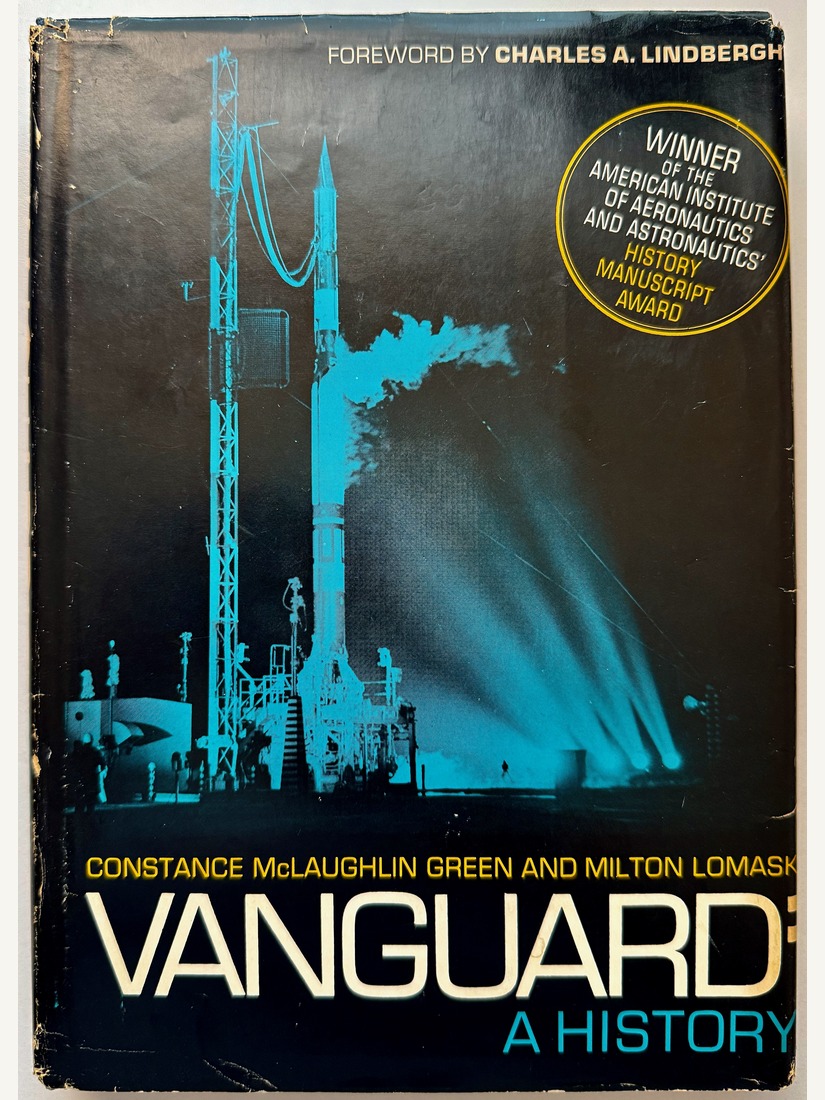
Vanguard: A History
Published by Smithsonian Institution Press, City of Washington, 1971, with a foreword by Charles A. Lindbergh dated 11 August 1969. Lindbergh's foreword recounts his own encounters with the satellite program, including a visit to the Army's Redstone Arsenal where Wernher von Braun showed him a satellite mock-up and estimated he could have orbited a satellite months before Sputnik I had funding been approved. Winner of the American Institute of Aeronautics and Astronautics' History Manuscript Award. Fourteen chapters trace Project Vanguard from the background of early space exploration and the fight for government support, through vehicle-specification battles, range and tracking-system construction, early test firings, the shock of Sputnik I, and the eventual TV-3 failure and later successes, to the National Academy of Sciences' scientific harvest and a final accounting of the program.
Mariner-Venus 1967: Final Project Report
NASA SP-190, issued by NASA's Scientific and Technical Information Office, Washington, D.C., 1971. Foreword by Glenn A. Reiff, Mariner-Venus 1967 Program Manager, notes that Mariner 5 was converted from a spare Mariner-Mars 1964 spacecraft with only limited modifications, extending and verifying the Mariner 2 results from a closest approach of just over 4,000 kilometers with seven scientific experiments, at an actual cost 10 percent below the estimate. Chapters detail the spacecraft's mechanical configuration, science subsystem (ultraviolet photometer, solar-plasma probe, helium magnetometer, trapped-radiation detector, dual-frequency receiver), telecommunications, guidance and control, and propulsion, alongside mission operations coordinated with the ongoing Mariner 4 Mars mission.
Origins of NASA Names
NASA SP-4402 in the NASA History Series, published by the Scientific and Technical Information Office, Washington, D.C., 1976. Foreword by Monte D. Wright, Director of the NASA History Office, dated June 1975. The authors' preface credits Johnson Space Center Historian James M. Grimwood with proposing the compilation, and explains that names drew on mythology, legend, straightforward mission description (often yielding acronyms, as with TIROS for "Television and Infra-Red Observation Satellite"), the formal NASA Project Designation Committee, or informal usage later adopted officially; the study covers approved projects through 1974 and excludes canceled or postponed ones. Six parts cover Launch Vehicles, Satellites, Space Probes, Manned Space Flight, Sounding Rockets, and NASA Installations, followed by four appendixes: a glossary of abbreviations and acronyms, the international spacecraft designation system, the NASA Major Launch Record 1958–1974, and the NASA Naming Committees. A prefatory Note explains NASA's inconsistent numbering conventions, including how secondary flight designations such as Freedom 7 (Mercury-Redstone 3) and Friendship 7 (Mercury-Atlas 6) related to official flight numbers. The preface also credits Arthur G. Renstrom of the Library of Congress and NASA Archivist Lee D. Saegesser for locating illustrative photographs.
Atlas of Mars, the 1:5,000,000 Map Series, NASA SP-438
The complete large-format planetary atlas covering the entire Martian surface at 1:5,000,000 scale, in 30 numbered quadrangles (MC-1 through MC-30) plus a Mare Australe polar supplement, each presented as a controlled photomosaic, an airbrushed shaded-relief rendering, and a contoured topographic version. With a foreword by Stephen E. Dwornik, Chief of NASA's Planetary Geology Program, describing the atlas as the culmination of mapping work begun in 1964 with Mariner 4's first close-up images (1% of the surface) through Mariner 6/7 (10%), Mariner 9 (100% at low resolution), and finally the two Viking Orbiters, which between 1976 and 1979 supplied the medium- and high-resolution photographic base needed for detailed mapping of the whole planet. Elevation contours were derived from S-band radio occultation, ultraviolet and infrared spectrometer data, and Earth-based radar. Appendices cover nomenclature, mapping procedures, contour methods, the USGS Mars mapping team, and a bibliography of Mars cartography.
Beyond the Atmosphere: Early Years of Space Science
NASA SP-4211 in the NASA History Series, by Newell, NASA's first head of space science and later Associate Administrator. Preface signed from Alexandria, Virginia, January 1979, thanking NASA History Office archivist Lee Saegesser and Goddard's Dr. Norman Ness and Dr. John O'Keefe for their manuscript reviews. Twenty-two chapters in six parts trace the field from its rocket-borne upper-atmosphere origins in 1946 through the Rocket and Satellite Research Panel and the IGY satellite program, the creation of NASA, its often fractious relations with the Department of Defense, the Academy of Sciences, universities, and JPL, and on to the broadening scope of solar-system and life-sciences research and the outlook for the Space Shuttle era. Appendixes reprint panel memberships, RSRP proposals for a national space program, and President Nixon's 7 March 1970 statement on the space program.
Stages to Saturn: A Technological History of the Apollo/Saturn Launch Vehicles
NASA SP-4206 in the NASA History Series, published by the Scientific and Technical Information Branch, Washington, D.C., 1980. This is the hardcover first edition; the collection also holds a softcover copy, shelved alongside it. Dedicated "To Wernher von Braun, 1912–1977, and the men and women who built the Saturn." Foreword by William R. Lucas, Director of the George C. Marshall Space Flight Center, dated June 1979, comparing the Saturn program's scope and vision to the Panama Canal and the Manhattan Project, and noting its flawless flight record of 32 launches (10 Saturn I, Saturn IB, and Saturn V vehicles combined) without a single failure, carrying 27 men around the Moon and 12 onto its surface, and going on to lift Skylab and the Apollo-Soyuz Test Project crew. In his preface, dated June 1979, Bilstein explains the book as a technological rather than narrative history, organized topically into seven parts—Prologue; The Saturn Building Blocks; Fire, Smoke, and Thunder: The Engines; Building the Saturn V; Coordination: Men and Machines; Step by Step; and Epilogue—with eight appendixes covering a Saturn V schematic, the prelaunch-launch sequence, flight history, R&D funding history, contractors, the location of surviving Saturn hardware, and NASA/MSFC personnel rosters. The acknowledgments credit Dr. Rudolph Hermann and the University of Alabama in Huntsville's Research Institute for the origins of the project, Frederick I. Ordway III and David L. Christensen for documentation, John Stuart Beltz and Mitchell R. Sharpe of Marshall Space Flight Center for working papers and research, Johnson Space Center Historian James M. Grimwood for hosting the project in its final phase, and Dr. Eugene M. Emme, archivist Lee Saegesser, Dr. Monte D. Wright, and Dr. Frank W. Anderson, Jr., of the NASA History Office for guidance and editing.
NASA Historical Data Book, Volumes I–III
NASA SP-4012 in the NASA Historical Series, a three-volume reference set sponsored by the NASA History Office. Volume I, NASA Resources 1958–1968, is by Jane Van Nimmen and Leonard C. Bruno with Robert L. Rosholt — also the author of An Administrative History of NASA, 1958–1963 (SP-4101), a copy of which, hand-signed by NASA Administrator James E. Webb, is elsewhere in this collection — and carries a foreword by Deputy Administrator George M. Low dated April 20, 1974; its six chapters cover NASA facilities, personnel, finances, procurement, and installations, with an appendix of major NASA organization charts. Volumes II and III, both by Linda Neuman Ezell (prefaces dated Spring 1982 and Fall 1985), cover Programs and Projects for 1958–1968 and 1969–1978 respectively — launch vehicles, manned spaceflight, space science, space applications, aeronautics and space research, and tracking and data acquisition — with a data sheet for each flight project describing the spacecraft, experiments, participants, and contractors. This matching set was issued by NASA's Scientific and Technical Information Division in 1988.