- Year
- 1962
- By
- NASA (Office of Legislative Affairs)
- Section
- Mercury
- Shelf
- R7
- Catalog
- Catalog F · NASA Missions
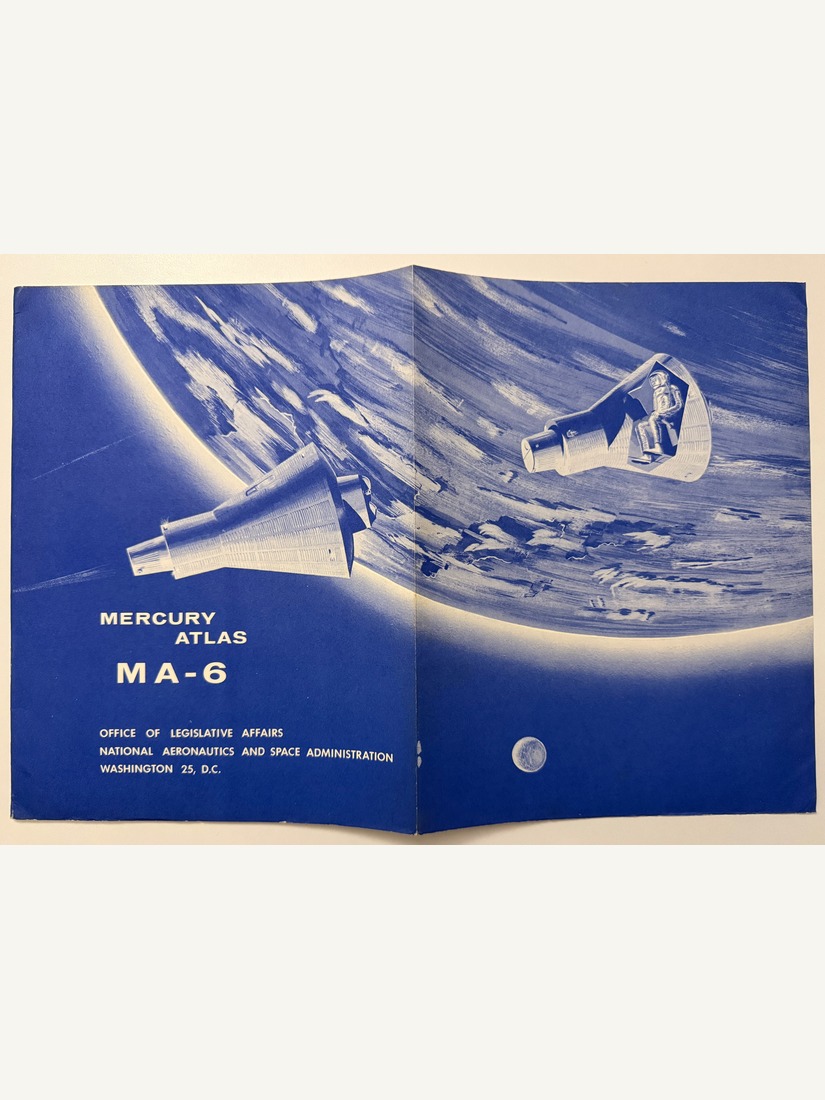
Dated January 1962 and credited to Paul G. Dembling, Director of the Office of Legislative Affairs, this booklet was prepared for Congress to explain the significance of the coming first American orbital flight.
It lays out the mission (evaluate a man-spacecraft system, investigate man’s capabilities in space, and get the pilot’s opinion on the spacecraft and its supporting systems), a launch date “currently scheduled no earlier than January 24, 1962” (the flight actually went up February 20), and the option of a one-, two-, or three-orbit mission decided only minutes before launch. Pilot John H. Glenn, Jr., a 40-year-old Marine lieutenant colonel, is profiled alongside backup pilot M. Scott Carpenter; the Bell-shaped spacecraft, listed as No. 13 in engineering documents and named Friendship 7 by Glenn, is detailed down to its dimensions and weight, its McDonnell Aircraft Corp. construction, and its Atlas D booster from General Dynamics.
Further sections cover the 18-station Mercury Tracking Network, recovery ship deployment under Rear Admiral John L. Chew, and the pilot’s onboard tasks, from managing spacecraft systems to keeping a manual navigation log in case ground communications failed.
This booklet dates from a full year after Alan Shepard’s and Gus Grissom’s suborbital flights (May and July 1961) and documents Glenn’s own already-assigned orbital mission, not the earlier three-way competition among the two of them and Glenn for the first Mercury flight.