Characteristics Of The Rocket Motor Unit Based On The Theory Of Perfect Gases.
Pages 433-454. Theoretical work on rocket motors by a founding member of the JPL. These theoretical studies were undertaken before practical tests were attempted.
Tsiolkovsky.
Biography of Konstantin Tsiolkovsky by the engineer B. N. Vorobev (Vorob’ev), issue 5 of the Zhizn’ zamechatel’nykh lyudei (Lives of Remarkable People) series published by the Komsomol’s Molodaya Gvardiya, in a printing of 50,000 copies. It carries a preface by Academician A. E. Fersman and a frontispiece portrait and a facsimile of Tsiolkovsky’s handwriting. Vorobev says in his own foreword that the book is a shortened version of research he carried out in 1937–1939, based on Tsiolkovsky’s manuscripts in the Civil Air Fleet archive, his correspondence, and help from his widow and daughters. Thirteen chapters follow Tsiolkovsky from his childhood in Izhevskoe, his deafness and self-education, through his years as a teacher in Borovsk and Kaluga, to his dirigible, his early wind tunnel, the cosmic rocket and his death in 1935, set against the history of ballooning and aviation in Russia and abroad, with chapters on David Schwarz and on the years after the Revolution. The appendices list Tsiolkovsky’s published works, the sources used and earlier writings about him. It references and reproduces Kibalchich’s diagram for a rocket (1918) also available in this collection. Tsiolkovsky’s rocket design is also surveyed in the year-end 1925 double number of Vestnik Znaniya, also in this collection. Tikhonravov’s introduction to the 1947 Works On Rocket Technology (Catalog C) credits Vorobev with discovering, among Tsiolkovsky’s papers, the 1883 manuscript “Free Space.”
Propulsori A Reazione Per L'Astronautica, Seconda Comunicazione.
Gussalli's second communication on his "double reaction" propulsion system for astronautics, expanding a paper he first read in 1930. Part One revisits, updated, the same double-reaction propulsor he built and tested in 1912 and had already reported on in his 1923 Si Può Già Tentare Un Viaggio Dalla Terra Alla Luna? (Catalog A) — a Serpollet steam generator driving a De Laval-type turbine wheel — illustrated with period photographs of the actual apparatus, and closes with an appendix table of astronautics milestones adapted from Robert Esnault-Pelterie's L'Astronautique (1930), into which Gussalli inserts his own 1909–1912 experiments to assert priority. Part Two lays out his 1939-patented (Belgian patent 436,202) "Veicolo per l'Astronautica": an intersiderial vehicle that collects solar radiation on a 130-meter mirrored and blackened tail to raise steam and drive six independent turbo-propulsors, sidestepping the need to carry propellant mass — his proposed answer to the mass-ratio problem central to contemporary rocket theory. The table of contents lists dedicated technical-critique chapters addressed to Robert Esnault-Pelterie and Hermann Oberth (Part Three, Caps. 47 and 49), followed by a lengthy point-by-point rebuttal of an examiner's objections to his work.
Moon.
A popular account of the Moon in the Academy of Sciences series Academy of Sciences to the Stakhanovites, edited by P. P. Parenago. About 100 pages cover phases, surface features, maps, the origin of lunar relief, tides and the question of life. A late chapter, “Future Flight to the Moon,” presents the reactive engine, with a portrait of Tsiolkovsky and illustrations of a rocket-plane and a lunar station. Inscribed and signed by the authors.
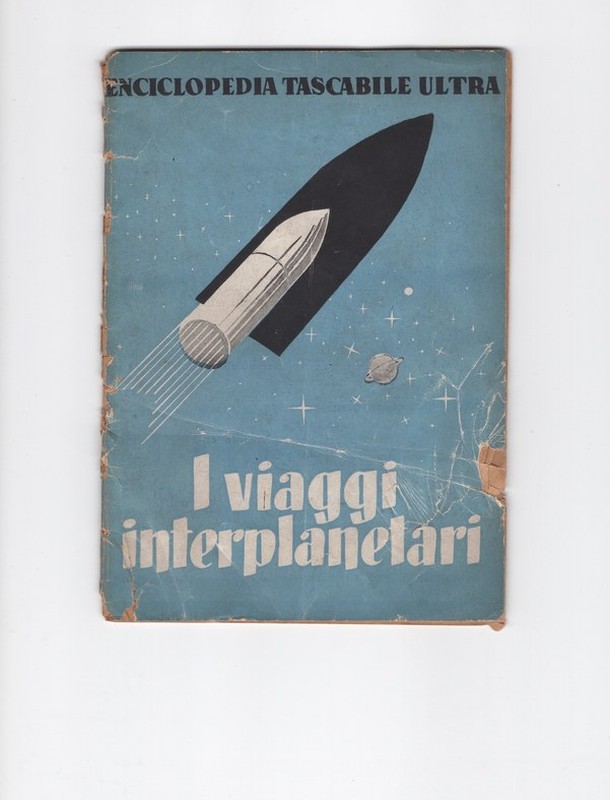
I Viaggi Interplanetari.
Volume 2 of the Enciclopedia Tascabile “Ultra,” a series of small popular booklets sold at two lire, by Franco Nava. Printed by Tip. Luigi Sala & figli, Milan, in November 1942 (dated “11-42-XXI” in the Fascist calendar), with distribution throughout Italy by S. A. Agire of Rome. The back cover advertises the series as keeping busy readers up to date with the latest word in each branch of knowledge. The short Preface announces that interplanetary travel, once left to novelists, has become a problem for astronomy, ballistics, celestial mechanics, aerodynamics, physiology and radio, and that a new branch of science, astronautica, has been born. The Sommario lists thirteen sections, running from “Dall’atmosfera in su” and the cannon (“dalla fantasia alla realtà”) through the rocket and its applications to the Gussalli vehicle, the double-reaction propeller, the 1939 Gussalli astronautical vehicle, departure from Earth, criticisms of the Gussalli system with replies, and “L’uomo negli spazi siderali.” The rocket sections discuss Von Opel’s rocket car and the first rocket aeroplane, Goddard, Oberth, Valier, Tiling and Stemmer, and the book gives particular space to Luigi Gussalli’s proposals. A small wartime Italian booklet in fragile paper wraps, with the cover chipped and torn along the edges.
Rockets, Dynamators, Jet Motors.
A 1944 question-and-answer handbook, “answers to 280 questions” with a 400-item index, by A. L. Murphy, a member of the American Rocket Society and a self-described consulting specialist on rocket and jet propulsion. The preface says it is a semi-technical “open report” for the uninitiated, and that “dynamator,” a term Murphy coined, means a converter that gives any jet thrust in a direction other than its own. Nine sections run from atmospheric jets and rockets through dynamators, jet vehicles, landings, fuels, and models, with photographs and diagrams of rocket-assisted aircraft and a sectioned rocket.

Rockets. The Future Of Travel Beyond The Atmosphere.
Willy Ley’s first book in English about rockets, and, as the jacket puts it, the first popular but thoroughly scientific account of the interplanetary dream published in the United States. Copyright 1944; published by the Viking Press in May 1944, with a Canadian edition from Macmillan of Canada on the same day. The copyright page notes that it was produced in full compliance with War Production Board conservation orders, and the book is dedicated “To Olga.” The jacket, designed by Immerman Studio, carries a list of questions the book answers, from why a rocket can surpass the velocity of its own exhaust to whether space travel would ever pay for itself. Ten chapters run from “The Beginnings of an Idea” and “The Decades of the Great Dreams” through “The Rocket’s Red Glare,” “Prophets with Some Honor,” “The Battle of the Formulae,” “Success, Failure, and Politics” and the meteorological rocket to “The Rocket into Cosmic Space,” “The Spaceship” and “Terminal in Space.” Notes and Addenda cover rocket artillery, Winkler’s HW-2, Goddard’s and Tiling’s experiments, Valier’s last rocket car, Sänger’s experiments, rocket airplanes and the “Fischer Hoax,” followed by a bibliography. There are 46 line drawings and 14 plates, among them Ganswindt’s spaceship, the spaceship model built for the film Frau im Mond, Tiling with his winged rocket, Valier with his rocket sled, Schmiedl’s and Zucker’s mail rockets, the German Rocket Society’s alcohol-oxygen motor, Goddard in his laboratory, and Soviet rocket throwers from the film of the battle of Stalingrad. Also in the collection, two of his magazine pieces: “Eight Days in the History of Rocketry” (Thrilling Wonder Stories, 1937) and the two-part “The End of the Rocket Society” (Astounding Science Fiction, 1943).
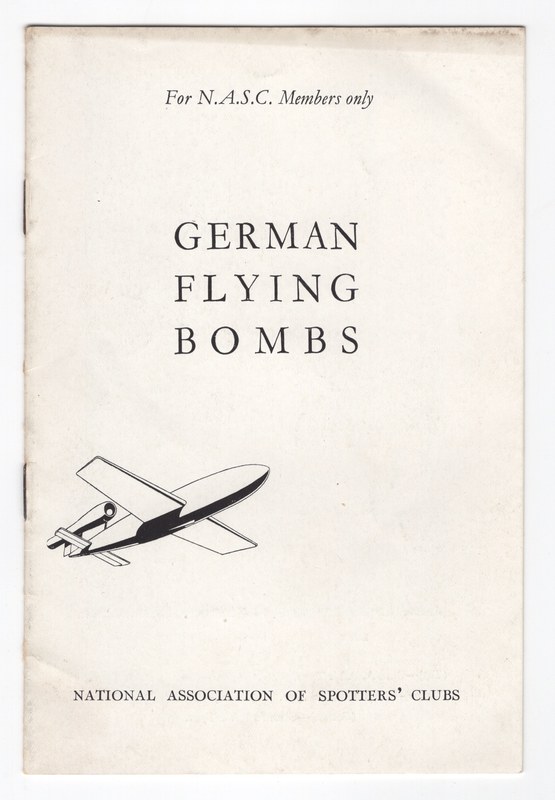
German Flying Bombs - Spotters Guide.
Wartime publication with photos and drawings of German V1 weapons. For N.A.S.C. members only.
 Featured
Reporting the Robot Bomb
›
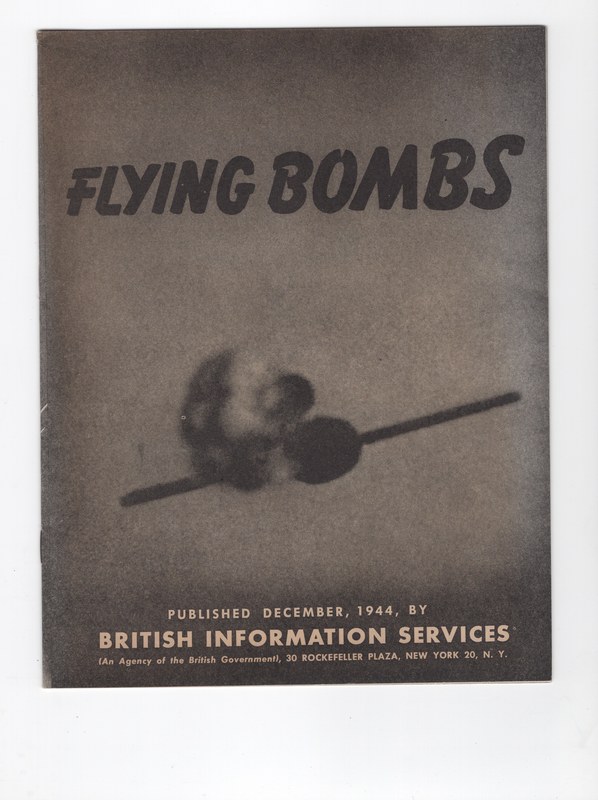
Flying Bombs.
An agency of the British Government. Information Division. Wartime publication. Profusely illustrated with photos of the V1 weapon attacks on England. Published in New York City at 30 Rockefeller Plaza.
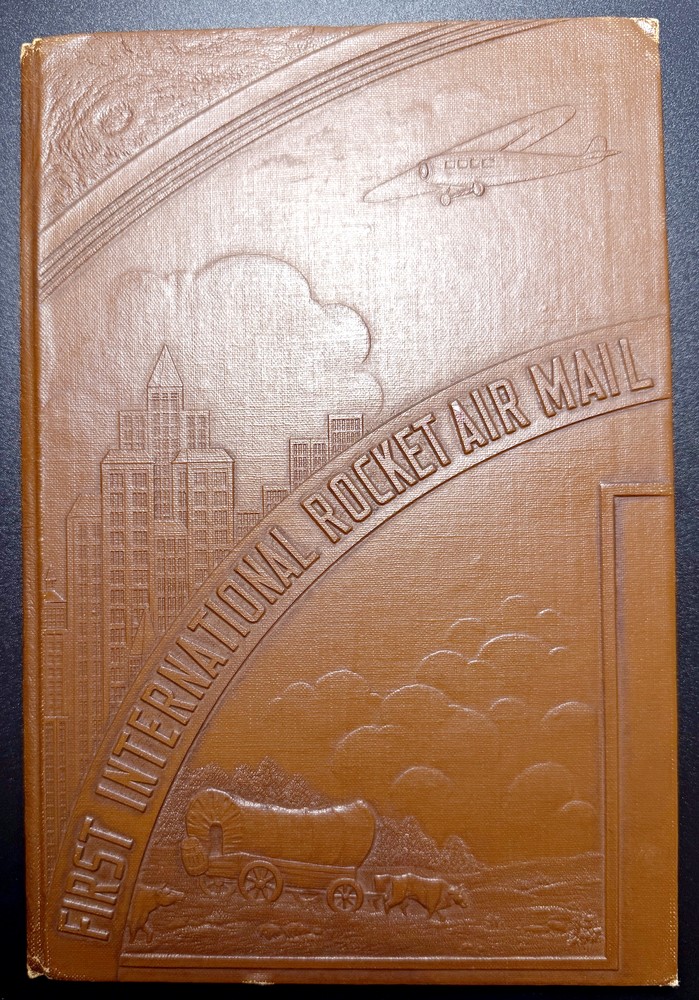
First International Rocket Air Mail Flight, From the United States of America to the United States of Mexico (and return).
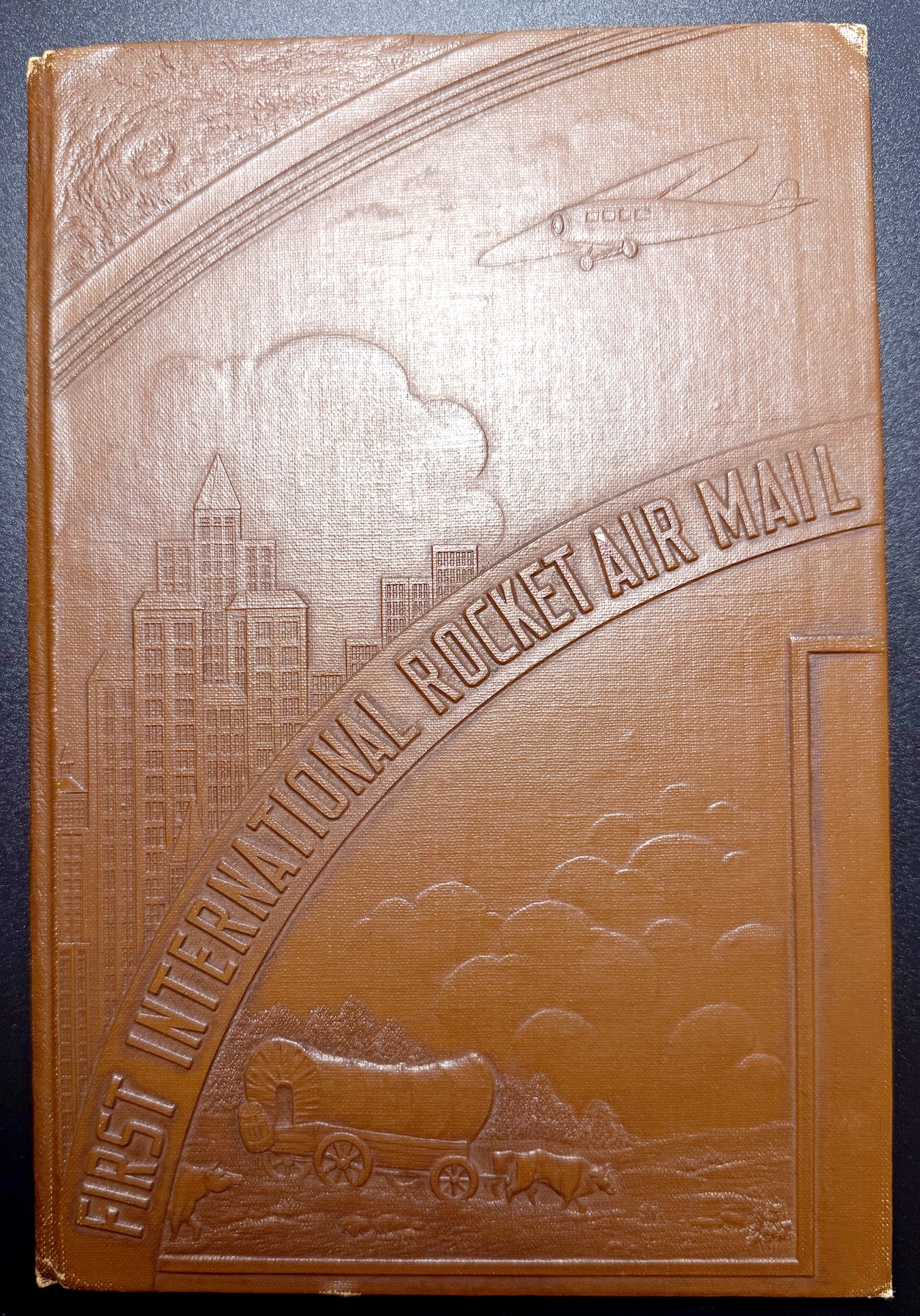
Leather-bound souvenir volume commemorating the July 2, 1936 rocket mail flight across the Rio Grande between McAllen, Texas and Reynosa, Tamaulipas. Conventionally dated 1936, but the foreword’s references to the bazooka and to Roosevelt as sitting president place its actual production closer to 1943–1945. Two copies in the collection, identical in text but not in contents: one bound with genuine flown covers bearing period postage and cancellations, the other with mounted specimens and uncut sheets only. Referenced in Billig’s Rocket Mail Catalogue (Vol 8, 1955), also available in this collection.
 Featured
First International Rocket Air Mail
›
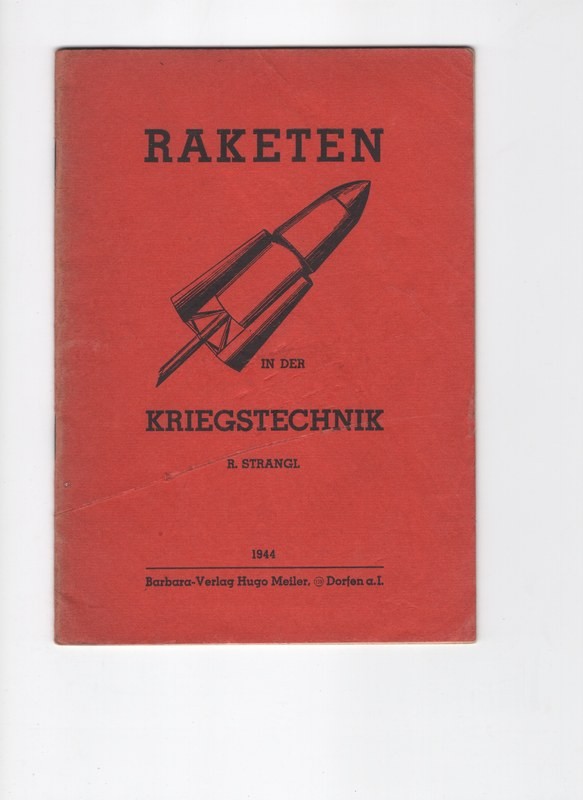
Raketen In Der Kriegstechnik.
A wartime German booklet by Raimund Strangl, dated 1944 on the title page, printed by Carl Gerber, Munich, with the cover designed by Heinrich Baumer. The paper is thin wartime stock and the red card wrappers carry the title. Its six short sections are “Wesen der Rakete” (the rocket’s nature), “Geschichte der Rakete,” “Neueste Entwicklung,” “Einsatz der Raketen in diesem Kriege,” “Was kann man von den Raketen erwarten?” and a short bibliography. The history section starts from the Chinese origin of the rocket in the thirteenth century, then follows its spread to the Arabs and Europe, down to the Austrian army’s 1914 stick signal rocket, shown in sectional line drawings alongside a French 34 mm signal rocket and a rope-carrying lifesaving rocket. The wartime section covers Soviet salvo rocket launchers (a photograph shows a wrecked one mounted on a light tank) and the British “Holman Projector” parachute-and-cable defense against aircraft, with an illustration of a Focke-Wulf Condor attacking a merchant ship.

Die Entwicklung Des Raketenantriebes In Allgemein Verständlicher Darstellung. Band I, Band II, Band III.
Complete set of three volumes, each dated by its own preface (Solothurn, October 1944 to February 1945), written by a private Swiss engineer with no wartime allegiance to either side. The collection also holds a rebound incomplete set (missing Band I).
 Featured
A Neutral Engineer’s War
›
On The Energy Equation Of Ballistics Of Missiles.
Shapiro’s article (pp. 3–26) is the first of six papers in Izvestiya of the Dzerzhinsky Artillery Academy of the Red Army, vol. XLIII, 1944. He derives an energy equation for the combustion chamber of a powder rocket, valid for non-stationary processes and changing gas temperature, extending Part I of his Ballistics of Rocket Projectiles, and shows errors in earlier attempts by Wentzel, Grave and Mamontov. The next paper, I. P. Grave’s “Some Variants of Progressive Powder Forms” (pp. 27–46), also concerns rockets: it works out the geometry of multi-channel propellant grains modeled on the German nine-channel rocket powder and on Walsh-type forms, with diagrams and tables. The other four papers (approximate integration, penetration of steel barriers, hydraulic shock, analytical chemistry) are on unrelated subjects.
German Aircraft-Missiles.
Stenogram (“Германские самолеты-снаряды”) of a public lecture on the V-1 by engineer-lieutenant colonel V. F. Bolotnikov, delivered August 25, 1944 in the October Hall of Moscow’s House of Unions, weeks after Churchill’s own account of the campaign to the House of Commons. Issued by the Lecture Bureau of the USSR Council of People’s Commissars, printed at the Pravda press in a run of 20,000 copies and marked “на правах рукописи” (circulated in lieu of formal publication) — disposable, of-the-moment wartime ephemera rarely found intact today.
 Featured
Moscow’s First Word on the V-1
›
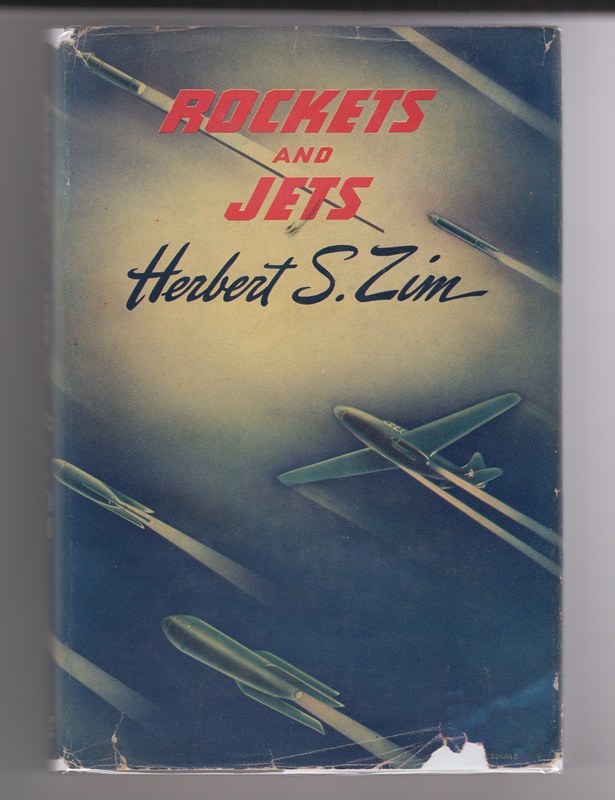
Rockets And Jets.
A non-technical account of rockets and rocketry. First edition, first printing with the “I” and the war eagle emblem on the copyright page. Later printings lack the war eagle.
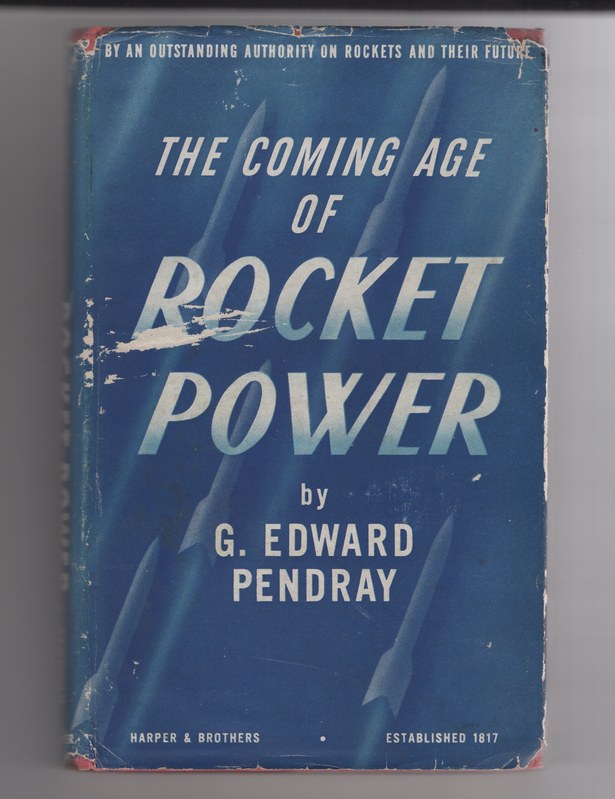
The Coming Age Of Rocket Power.
Popular account of the history of rocket development.
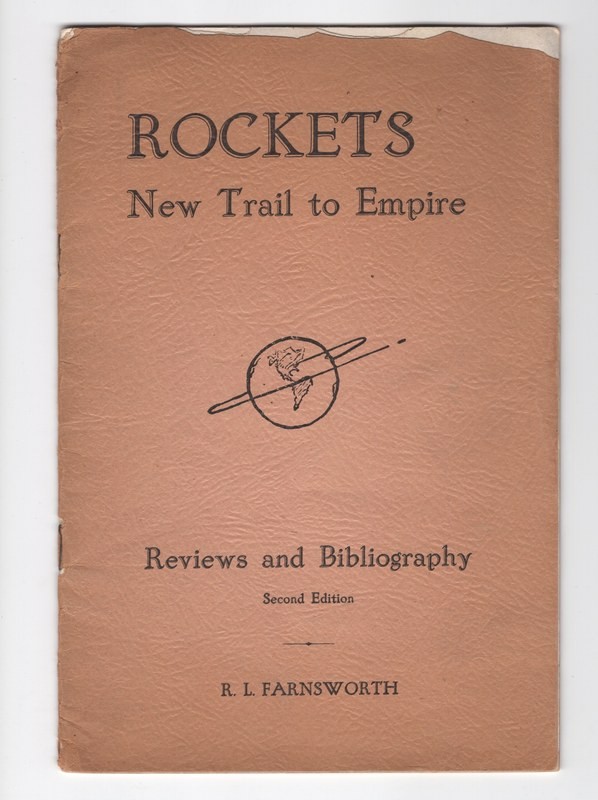
Rockets - New Trail To Empire.
R. L. Farnsworth’s booklet for the United States Rocket Society, subtitled Reviews and Bibliography and marked Second Edition on the cover because the first edition was mimeographed. A typed slip states that it was written in January 1945; copyright 1945. Dedicated to his wife Evelyn, it opens with a frontispiece portrait of Farnsworth as president of the Society. The text moves from “What Is a Rocket?” and “The Rocket Has ‘Arrived’” through mail, plane and meteorological rockets and a list of rocket problems—gravitation, finance, fuel, space, design and “Return Trip Tickets!”—to the case for the Moon (“Why the Moon?”, “Big Business,” “Lunar Empire and Competition,” “The Renaissance!”). It closes with a bibliography (pp. 22–29), an index to articles in Astronautics, the journal of the American Rocket Society, and a page on what the Society is and how to join. This copy is signed by Farnsworth: a hand-written complimentary-copy inscription on the first page is signed by him as President and Treasurer, and a typed slip is tipped in reading “With my compliments: R. L. Farnsworth—On to the Moon!” Also in the collection, a signed notice from the US Rocket Society (Jan. 1945) announcing this booklet, along with further Farnsworth correspondence (see Catalog E, Miscellanea), and the Society’s magazine Rockets (Vol. 1, Nos. 1, 3–5), also in this catalog.
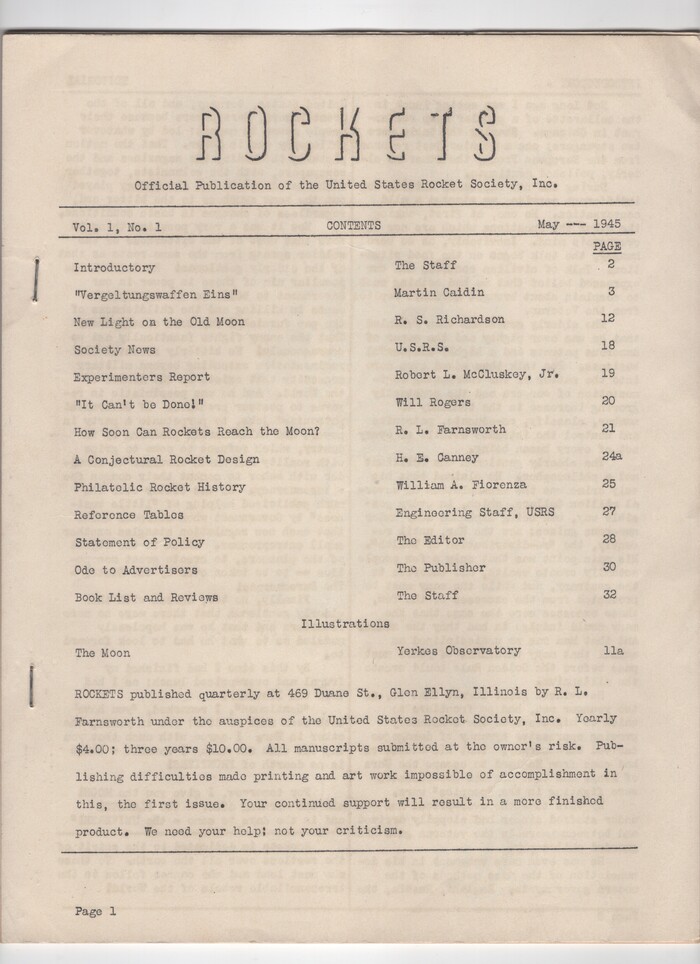
Rockets, Vol. 1, Nos. 1, 3–5
Official publication of the United States Rocket Society. Four issues from the magazine’s first year: No. 1 (May 1945), No. 3, No. 4, and No. 5. Issue 1 references the U.S.–Mexico rocket mail flight, also held in this collection, and carries a “Statement of Policy” by Farnsworth arguing for American possession of the Moon in explicitly racial and imperialist terms. Issue 3 carries a letter from Arthur C. Clarke and Farnsworth’s response to it; Clarke later refers to this exchange in his personal letter also available in the collection.
Rocket Research - History and Handbook.
The “New” edition from January 19, 1945 as stated in front page. With a new preface, additional patents (up to No. 2,344,957) and a list of rocket societies.
Theory And Testing Of Jet Propulsion Motors And Rockets.
A short technical primer by S. Fonberg of the Aircraft Jet and Rocket Corp., New York, published in London in 1945 by P. P. Agency (copyright is held jointly by Fonberg and the New York corporation; printed by Geo. Barber & Son, London). The Foreword calls it no exhaustive treatise but an attempt to present the fundamental concepts of reaction motors simply, with worked numerical examples and the use of calculus avoided. The first half covers the general theory of reaction propulsion, the thermodynamics of reaction motors, the rocket, the compression-expansion and resonance types of jet motor, the ram jet (the Athodyd), the derivation of the formulae, and thrust amplifiers or boosters. The second half treats testing: a spring-mounted stand with a drum recorder for rockets, a rotating test stand with a Prony brake, a wind tunnel, and tests of the ram jet and resonance motor, illustrated with line figures.
Rocket Assemblies.
Ordnance Pamphlet 1415 (Preliminary), Rocket Assemblies, issued by the U.S. Navy Bureau of Ordnance on 7 April 1945 and originally marked Confidential. A transmittal letter over the name of Rear Admiral G. F. Hussey, Jr., Chief of the Bureau of Ordnance, explains that the pamphlet summarizes data on the component parts and complete rounds of rocket ammunition for all personnel concerned with its assembly and operation, that it was issued in preliminary form because of urgent need and would be revised, that it supersedes Ordnance Data 5368, and that it was not to be carried in aircraft. The body is a set of landscape tables, one for each rocket caliber (headed, for example, 2.25 and 5.0 Rocket Mk’s and Mod’s), listing each Mark and Modification: complete round description, maximum overall length, weight, nominal velocity, outline drawing numbers, and the head, motor, nose-fuze and base-fuze components, with a remarks column (obsolescent, current, no production, and similar). Not illustrated. Three-hole punched in soft covers, as issued.
Expériences Et Analyse Du Moteur À Réaction (Le V-2).
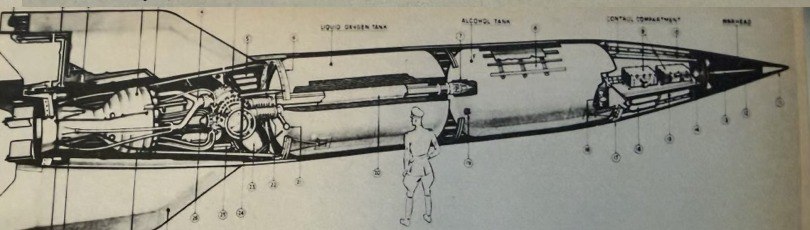
The printed text of a conference given by Ananoff at the Palais de la Découverte on May 24, 1945, published under the L’Université de Paris heading. Printed by the Imprimerie Alençonnaise, Maison Poulet-Malassis, Alençon (Orne). It runs to 31 pages with line figures and photographs. Ananoff opens by saying it would be presumptuous to describe every rocket experiment in the world; instead he explains what a direct-reaction motor burning liquid fuel and oxidizer is, which he sees as the future of reaction propulsion, and then analyzes the German V-2 as its most characteristic example. He contrasts it with the air-breathing turbojet and the V-1, discusses fuel delivery and the pump, tanks, mixing, injection and the combustion chamber (Tsiolkovsky’s pressure-feed proposal is mentioned as ingenious but impractical), and reproduces a cutaway of the V-2 with the legend in English. A short section on the pure-reaction Messerschmitt 163 follows. The Conclusion looks ahead to sounding the upper atmosphere and to ultra-fast intercontinental flights, such as Paris–New York in under an hour, with V-2 type rockets carrying mail rather than explosive; and the closing sentence adds that if humankind ever dreams of the other worlds of the sky, it will be through the reaction motor and it alone.
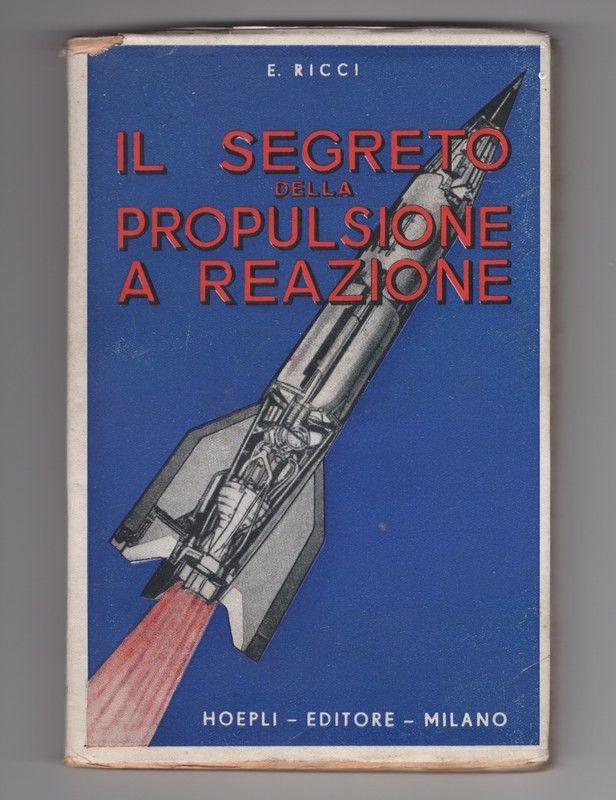
Il Segretto Della Propulsione A Reazione.
Probably one of the first accounts of Germany’s V-weapons in book form in Italian. Illustrated.