Catalog B · WWII · Special Feature · Book of Note
First International Rocket Air Mail
A souvenir that predates its own subject
On the afternoon of July 2, 1936, a crowd gathered on the north bank of the Rio Grande just south of McAllen, Texas. The river was running high and turbulent, and a triangular slipway, decorated in red, white, and blue, had been assembled on the bank. Movie cameras from Kodak and representatives of both the American Legion and the Mexican government stood ready. The occasion: the first attempt in history to send mail across an international border by rocket.
A Teenager, a Mortgage, and the Rio Grande
The scheme belonged, by most later accounts, to a teenager. Keith Rumbel, a 16-year-old with the unlikely combination of hobbies of stamp collecting and amateur rocketry, and later a Rice University chemistry scholar and MIT-trained government rocket scientist, proposed the idea to Loyal Service Post No. 37 of the American Legion in McAllen, which needed to pay off the mortgage on its new post building before Fourth of July dedication ceremonies. Rockets built from laminated cardboard and fiberboard, powered by fuel not much more sophisticated than fireworks powder, would carry mail across the river to Reynosa, Tamaulipas, and back. Collectors would buy the specially designed vignettes and first-day covers; the Legion would get its building paid off; and a small Texas border town would claim a footnote in the history of rocketry and postal history alike.
The first rocket did not survive contact with reality. It exploded roughly 100 feet into the air, scattering covers across the water and wounding a customs official with shrapnel. The second rocket flew true, true enough to sail 2,000 feet past the river and into the middle of Reynosa, where it made an unscheduled delivery to the wall of the U.S. Bar, sending patrons fleeing in the belief the roof was coming down. A third rocket found a small shack. Return flights across the border went more smoothly, though one rocket set a cornfield alight. By day’s end, something like 2,000 covers had crossed the border successfully, official flight documentation had been produced, and a small-town publicity stunt had become a permanent, minor landmark in the history of rocket mail.
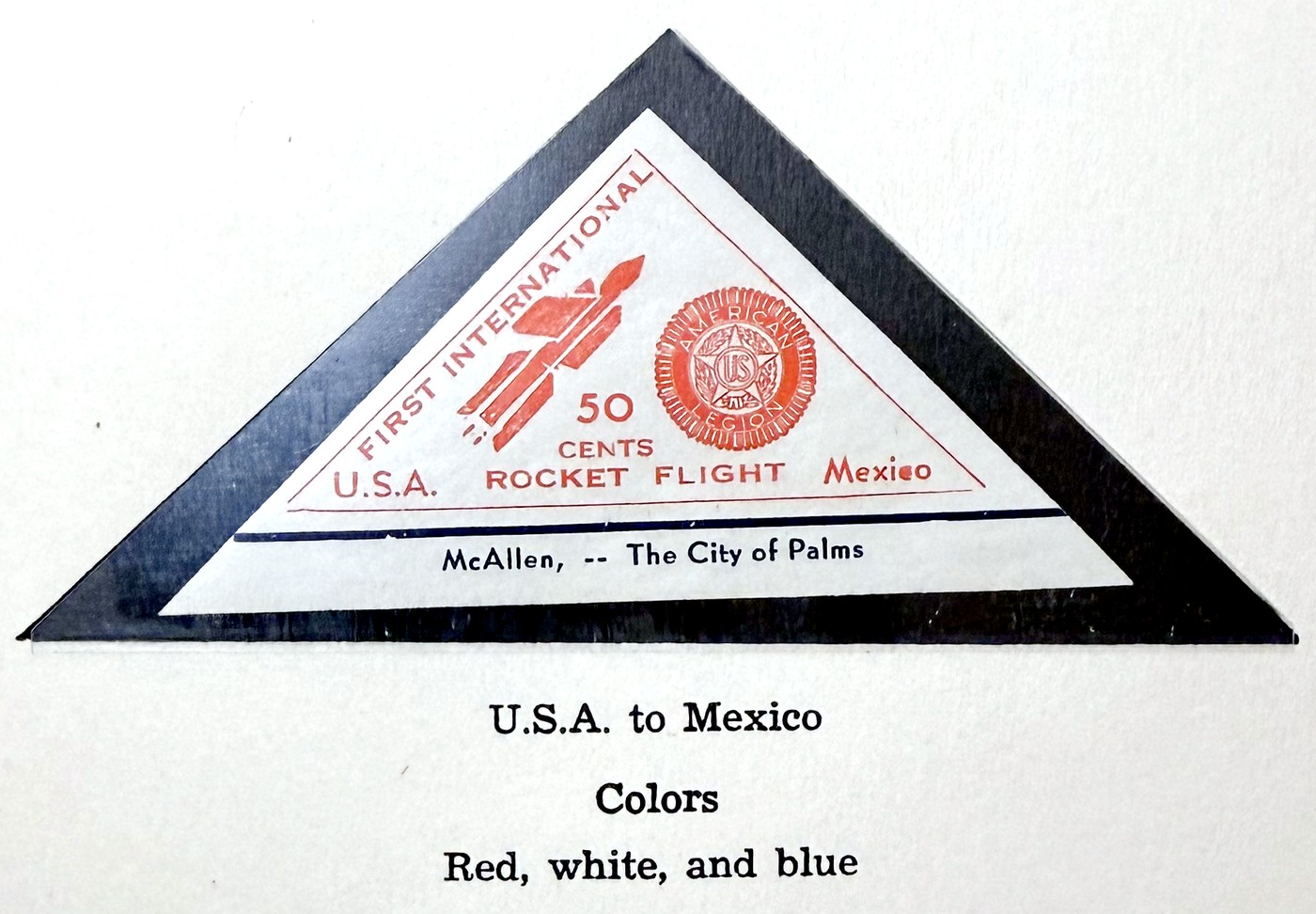
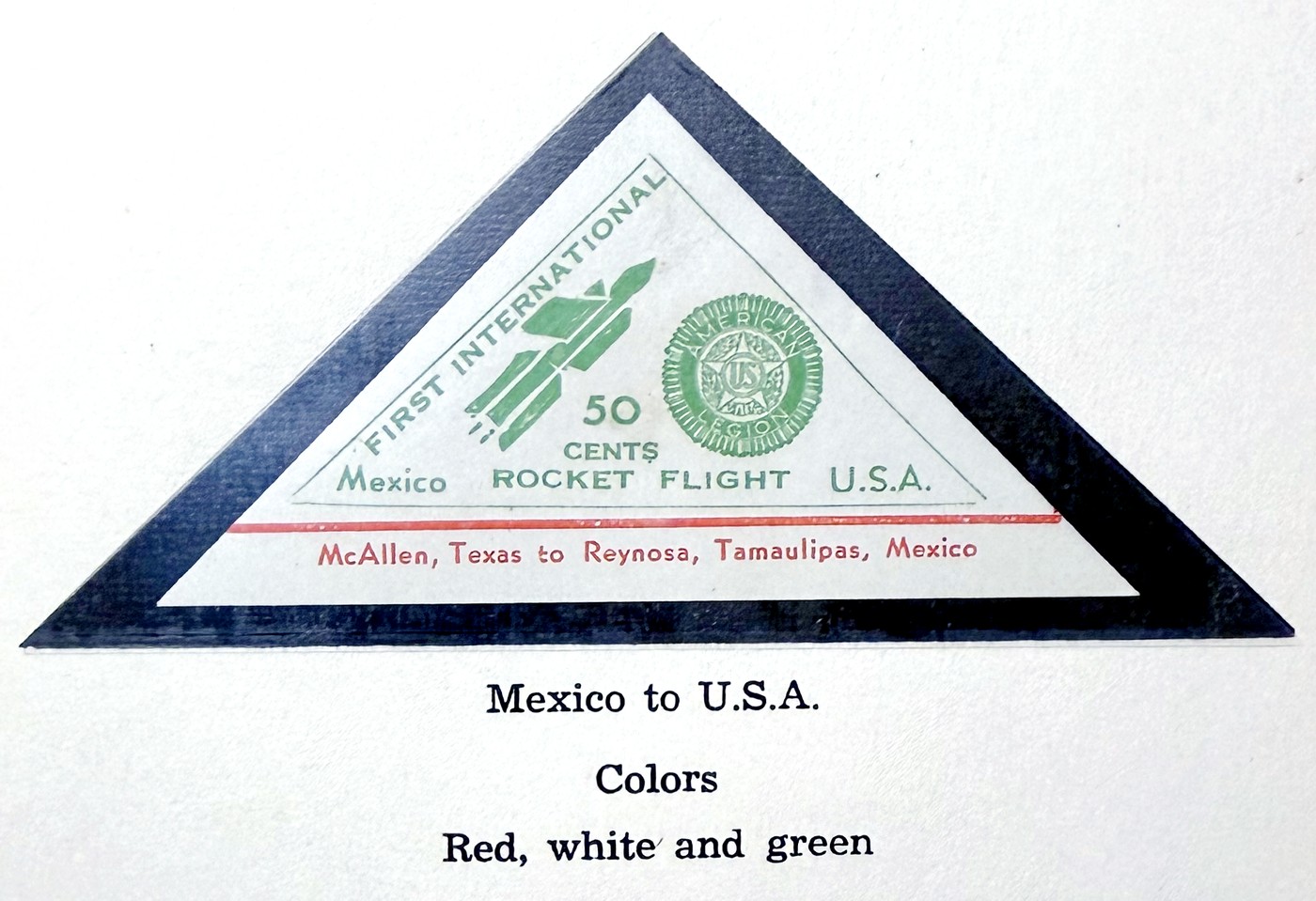
The Rockets Themselves
The book’s own narrative gives a surprisingly technical account of the hardware. The rockets were about seven feet in length and twelve inches in circumference, carrying two separate mail compartments, one built into the nose and the other set just back of center to keep the rocket balanced in flight. Each rocket carried a loading of about 300 covers. They were powered by a fuel chosen for a high coefficient of expansion combined with combustion slow enough to avoid another mid-air explosion, while still building enough pressure to send the rocket across the river.
The design itself was the product of a group of sons of Legion members, who spent the better part of a year on the construction and, after the first rocket’s mid-flight failure, on refining it. Return-flight tests pushed for both accuracy and distance: rockets that had traveled a bit over 1,000 feet on the first attempt were, by the end of the day, landing accurately from as far as 3,000 feet away.
The Booklet That Wasn’t Written in 1936
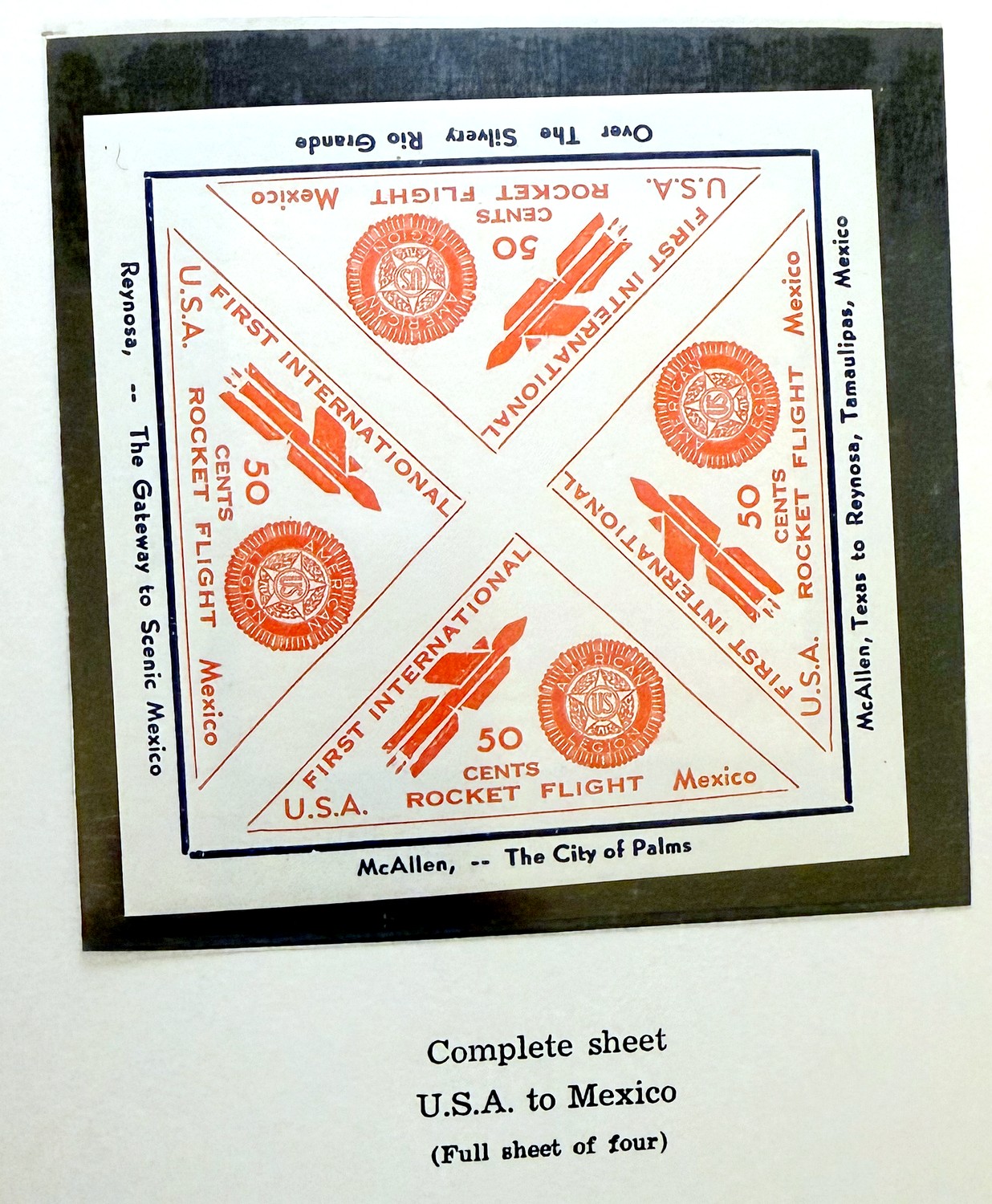
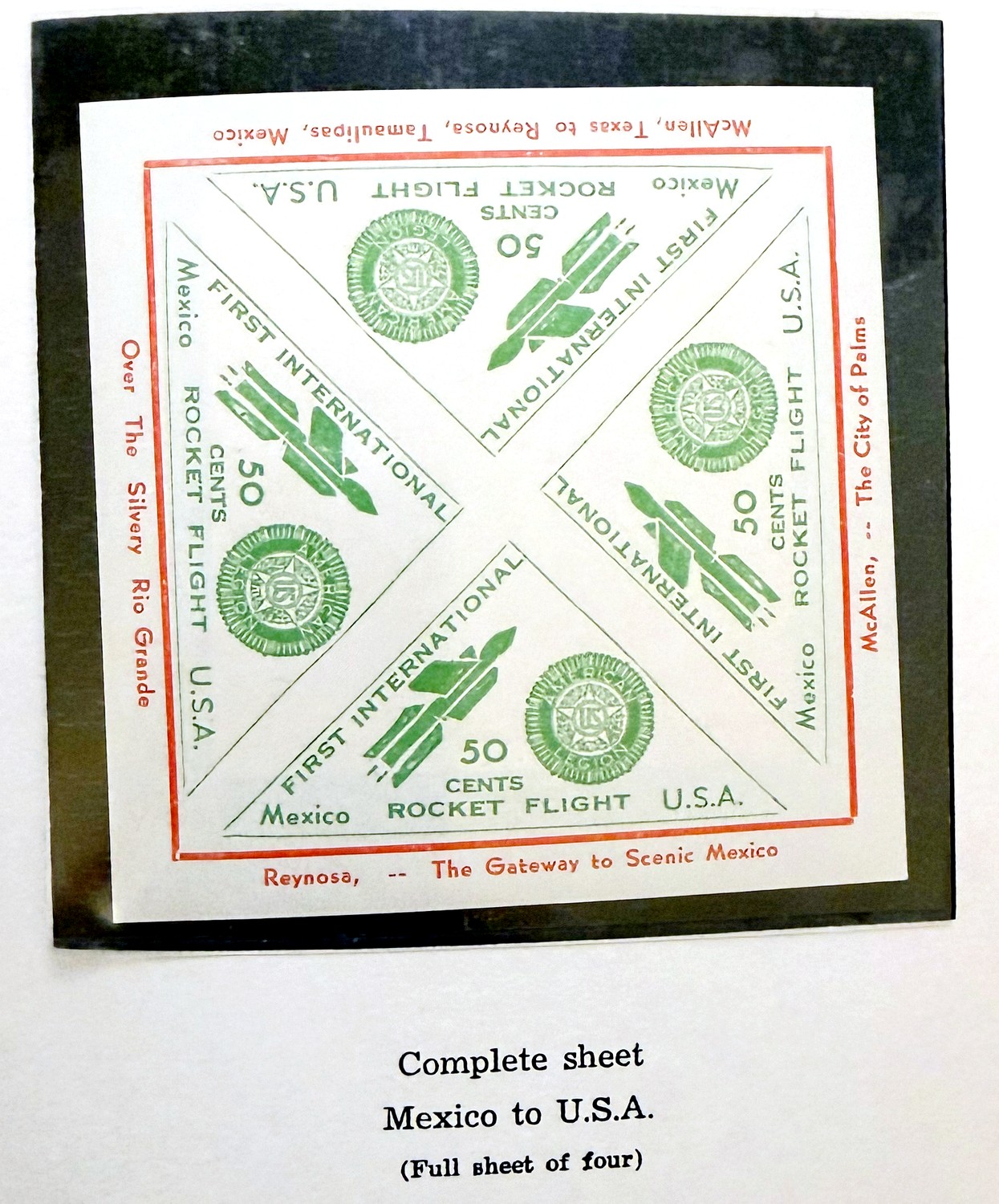
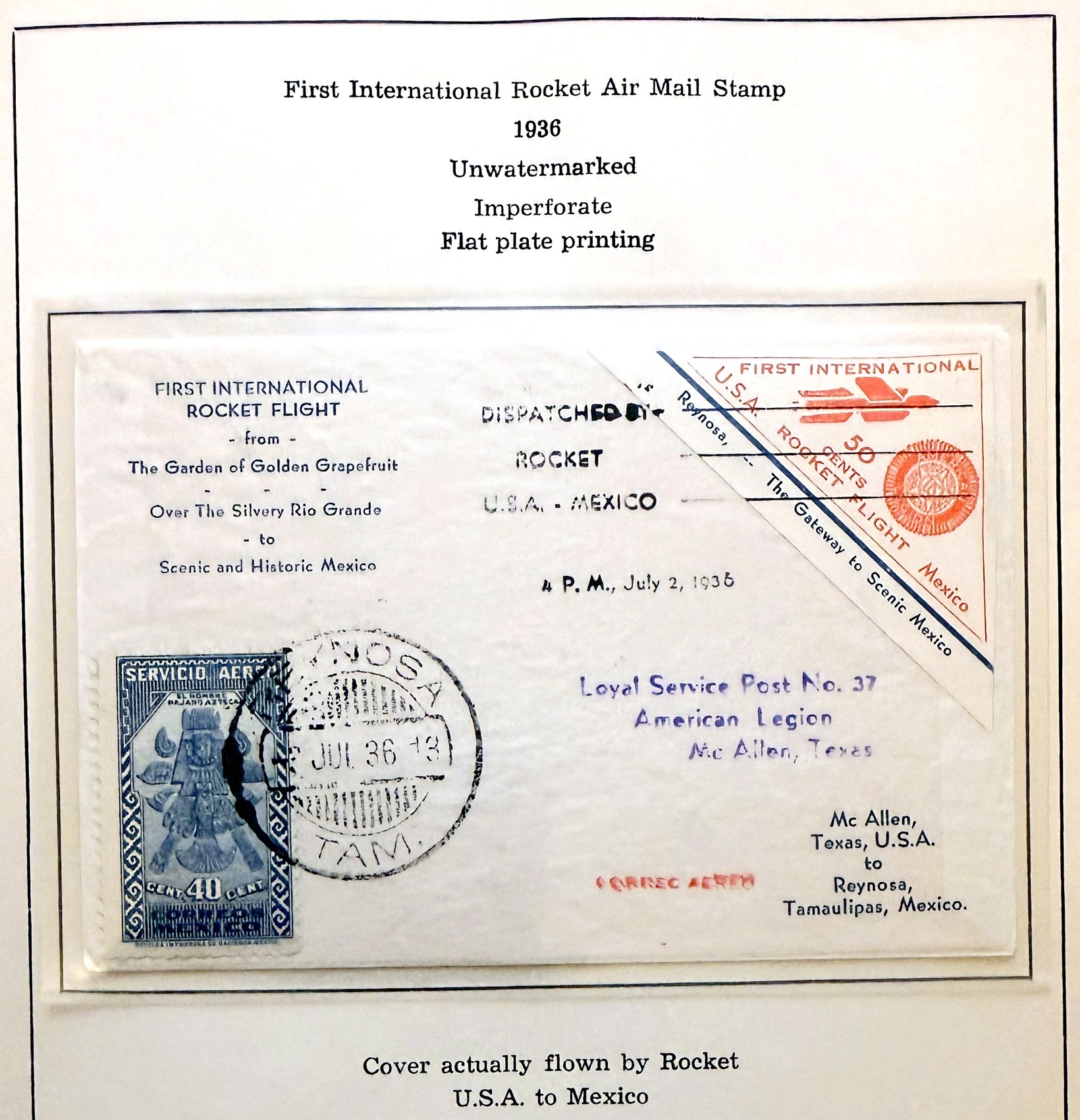
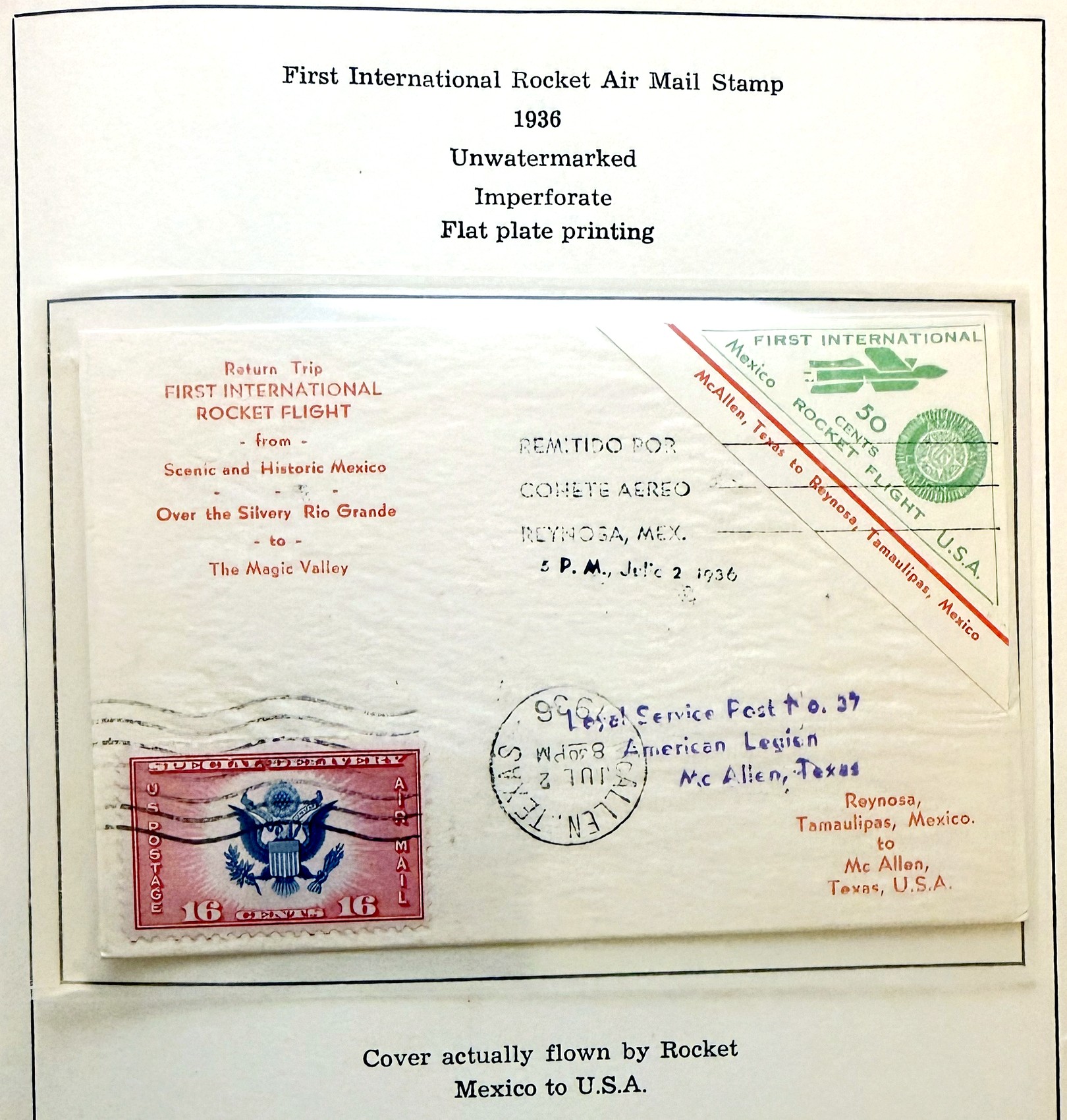
Sometime after the event, though not, it turns out, in 1936, a leather-bound souvenir volume appeared: First International Rocket Air Mail Flight, From the United States of America to the United States of Mexico (and return), with a foreword by George W. Wentz, Jr. Its embossed cover, oddly, carries no image of a rocket at all, only an airplane banking over a stylized skyline, a covered wagon, and the arched title lettering. Inside, a narrative account of the flight sits alongside mounted specimens of the two triangular vignettes issued for the occasion, along with full uncut sheets of four, and, in some copies, genuine flown covers bearing period postage and cancellations.
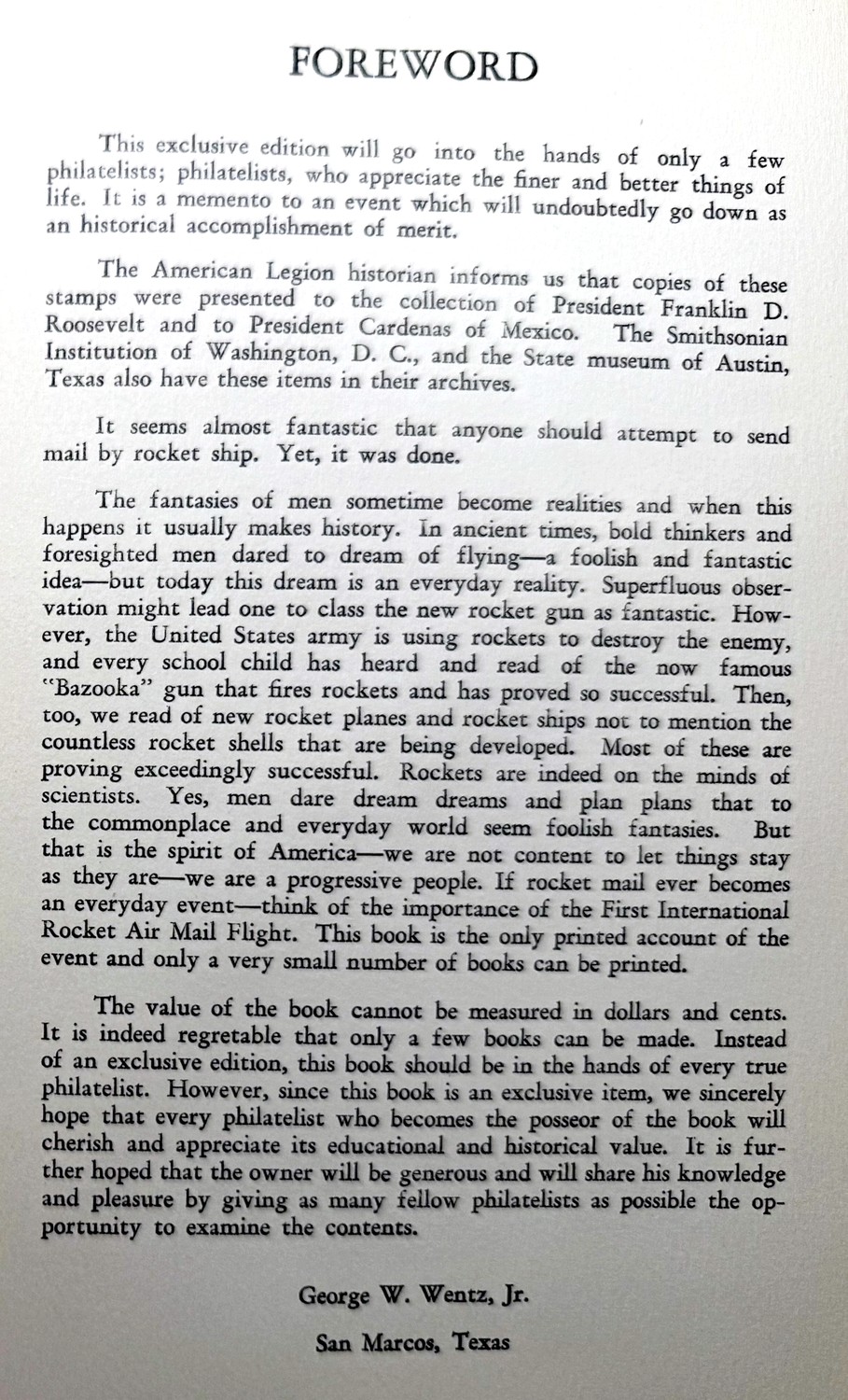
Bibliographies conventionally date this booklet to 1936 and credit its authorship to “O. K. Rumbel,” presumably Keith’s father, Oliver Keith Rumbel, a Legion member. But the foreword itself gives the book away. Wentz writes of rockets “proving exceedingly successful” and invokes, admiringly, “the now famous ‘Bazooka’ gun that fires rockets.” The bazooka was first fielded in June 1942 and did not enter the public vocabulary until the war years that followed. Wentz goes on to describe “new rocket planes and rocket ships” and “countless rocket shells that are being developed,” language that belongs to the era of the V-1, V-2, and wartime rocket ordnance, not to 1936, when rocketry was still a matter of amateur experimentation and Sunday-supplement speculation.
A second detail sharpens the dating further. The foreword states that copies of the book were presented to “President Franklin D. Roosevelt,” to “President Cardenas of Mexico,” to the Smithsonian Institution, and to the State Museum of Austin, phrasing that treats Roosevelt as the sitting president at time of writing. Roosevelt died in April 1945. Taken together with the Bazooka reference, this places the book’s actual production somewhere in the narrow window of roughly 1943 to early 1945, a full seven to nine years after the event it commemorates. Wentz himself, a stamp dealer, is the only named party in the volume, and Keith Rumbel, the flight’s actual chairman and instigator, is never mentioned in the text at all.
What the Colophon Tells Us
The book’s closing note is unusually forthcoming for a philatelic souvenir. It carries a printed, not hand, signature block for Garland Adair (American Legion State Historian and Chairman of the Centennial Committee), W. J. Burris (Post Adjutant, Loyal Service Post), and Sr. José Rodríguez (Chief of Mexican Customs Service), part of the typeset page rather than an autograph, and states plainly:
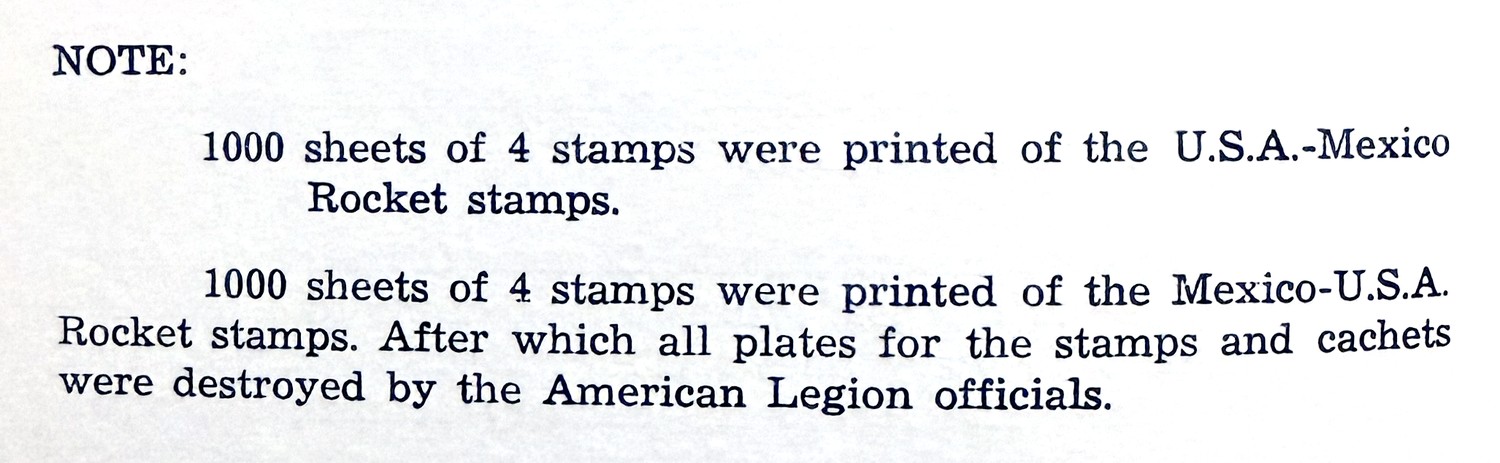
“1000 sheets of 4 stamps were printed of the U.S.A.-Mexico Rocket stamps. 1000 sheets of 4 stamps were printed of the Mexico-U.S.A. Rocket stamps. After which all plates for the stamps and cachets were destroyed by the American Legion officials.”
That gives a firm print-run ceiling: 4,000 vignettes per direction, 8,000 total, with the printing plates and cachet dies deliberately destroyed once the run was complete, a detail that itself likely fed the vignettes’ collectibility in the years that followed. The narrative text elsewhere in the book adds that only 51 covers were recovered, in damaged form, from the rocket that exploded mid-flight, each marked “Damaged by Rocket Explosion 4:10 P.M. July 2, 1936” before being posted along with the rest of the flight’s mail, a documented sub-variety for anyone chasing the full range of surviving material from the event.
Two Copies, One Text, Different Contents
Comparing two copies side by side turns up something that a single copy alone would not reveal: the printed text block is identical between copies, but the philatelic material bound into each one is not.
Copy #1 contains, in addition to the standard mounted vignette specimens and uncut sheets of four, two genuine flown covers, one each direction, bearing actual period postage (a Mexican 40-centavo airmail stamp cancelled at Reynosa, Tam.; a U.S. 16-cent airmail stamp cancelled at McAllen, Texas) with period cancellations dated July 2, 1936, and the vignettes used as cachets rather than as loose specimens. This is postal history in the fullest sense: evidence the item actually traveled by rocket, not merely a souvenir manufactured around the event years later.
Copy #2, by contrast, contains only mounted specimens and uncut sheets, no flown covers. Its printed text, foreword, production narrative, and closing colophon are word-for-word identical to Copy #1’s. The implication is that this “limited edition” was not printed as a fixed, uniform object in the way a conventional book is. Rather, the shared, mass-produced text block was assembled with whatever philatelic material remained available to whoever bound each individual copy, likely drawing on Wentz’s own dealer stock. Two copies of “the same book,” in other words, are not equally rare, equally complete, or equally valuable, and any serious cataloging of this title should treat each copy as an individual assemblage rather than assume uniformity from a shared title page and foreword.
Billig Corrects the Record
The flight also has its own entry in Billig’s Specialized Catalogues, a long-running series of philatelic reference works, and that entry took three editions to get right, a specialized catalogue’s equivalent of the same layered, self-correcting record found in the souvenir book itself. Volume 8 (1955), compiled by Stephen H. Smith, credits the flight to “Professor R. H. Goddard” as experimenter, a complete fiction: Goddard had no connection to the McAllen flight at all. Volume 8A (1958), a supplement by Dr. Max Kronstein, opens by replacing the entry wholesale, headed in its own text “Page 68: Supplemented and Corrected Text for the Whole Page 68,” and names the real experimenter: “Keith E. Rumbel, for the McAllen (Texas) Post of the American Legion,” the same teenager credited in this collection’s own account above. Goddard quietly disappears from every Billig printing after that.
Volume 8A also documents material the souvenir book never mentions: three unscheduled trial rockets, flown June 22, 1936, ten days ahead of the international flight, each testing a different airframe (winged, wingless, streamlined) and a different mail load before the design was finalized for July 2. And it records a genuine printing error: of the 1,000 sheets of four USA-Mexico stamps, 100 blocks were mistakenly run off the Mexico-USA print stock, carrying the return-flight’s text in the outbound stamp’s color. Six covers bearing this error were flown before the mistake was caught; a further 73 carry a cachet with the word “Dispached,” the T having fallen out of the type before anyone noticed.
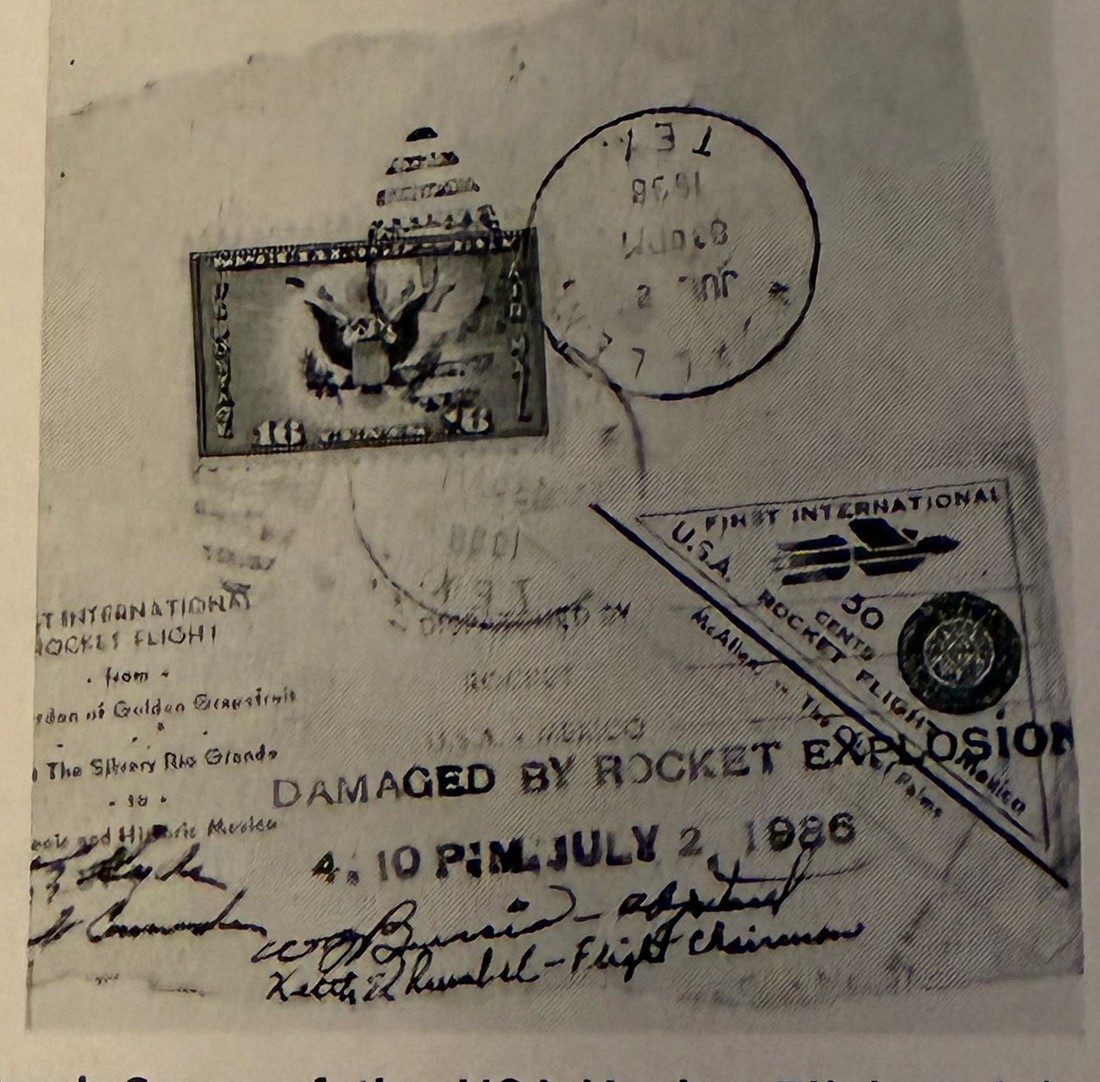
Of the 1,500 covers loaded onto the five outbound rockets, one rocket exploded mid-air and scattered its load over the river; only 51 covers were salvaged, from the U.S. bank, and re-mailed under that explosion cachet. Another rocket overshot Reynosa entirely and struck a nearby house; Mexican authorities seized the rocket and its 150 covers on the spot, not releasing them until the 20th anniversary of the flight, in 1956. Between the explosion, the seizure, and ordinary losses in the river, only 1,072 of the original 1,500 covers were ultimately redespatched with Mexican postage, a shortfall the souvenir book’s own colophon, with its flat print-run figures, gives no hint of.
A Sequel, Twenty-Five Years On
Volume 8B (1965), Kronstein’s second supplement, picks the story up again under a heading that reads simply “Continued from Vol. 8A page 21”: on July 2, 1961, exactly 25 years after the original crossing, a further group of rocket flights repeated the run between McAllen and Reynosa, in both directions. Five new rockets continued the 1936 numbering, No. 6 through No. 10, each also carrying the name of a body in the solar system: Sun, Mercury, Venus, Earth, and Mars outbound to Mexico; Jupiter, Saturn, Uranus, Neptune, and Pluto on the return. An eleventh rocket, marked “USA-Mexico-United Nations,” carried nothing but United Nations-cacheted airletters in both directions, printed “Hold for Rocket Dispatch” and cancelled at U.N. headquarters before being flown across the river and redespatched at McAllen.
Each 1961 rocket again carried its mail in ten sections of 100 covers; one outbound section and one return section were lost to explosion, each redespatched under a red “Flight stopped by rocket explosion” cachet, an echo of 1936’s own crash cover. Covers flown into Mexico received a Mexican airmail stamp locally overprinted “25o. Aniversario — Primer Cohete Internacional—Reynosa, Mexico—McAllen, U.S.A.—1936–1961,” 25,000 copies of which were authorized after consultation with the Mexican postal authorities. Kronstein notes, almost in passing, that the red plate number printed on the overprint sheets is 723661, which is also the anniversary written out plainly: July 2, (19)36 to (19)61.