Catalog B · WWII · Special Feature · Book of Note
Moscow’s First Word on the V-1
A Soviet lecture, printed within weeks
On the night of June 13, 1944, one week after the Allied landings in Normandy, Germany opened a new front against London that no soldier could stand between: the Vergeltungswaffe 1, the world’s first operational cruise missile. Western readers would come to know it as the buzz bomb, or the doodlebug. Soviet readers, a few weeks later, were introduced to it under a flatter, more technical name, самолет-снаряд, the “aircraft-projectile,” in a slim gray pamphlet handed out at a public lecture in the October Hall of Moscow’s House of Unions.
A Lecture, Transcribed and Printed Within Weeks
The title page tells most of the story on its own. This is Германские самолеты-снаряды (“German Aircraft-Missiles”), a stenographic transcript (“стенограмма”) of a lecture by engineer-lieutenant colonel V. F. Bolotnikov, Candidate of Technical Sciences, delivered on August 25, 1944. It was issued by the Lecture Bureau attached to the Committee for Higher School Affairs of the USSR Council of People’s Commissars (the forerunner of the later All-Union Znanie lecture network), printed at the Pravda press in Moscow, in a run of 20,000 copies, and marked “на правах рукописи”, “with the status of a manuscript,” the standard Soviet designation for material distributed for immediate public use rather than formal book publication.
In other words, this was disposable, of-the-moment print, meant to circulate through lecture halls and reading rooms and then be discarded, exactly the kind of ephemera that rarely survives eighty years intact. It carries a print-shop order number (“Заказ 2358”) and a paper-allocation code (“А5474”) on the final page, the small bureaucratic fingerprints of Soviet wartime publishing.
What makes the timeline worth pausing on is how current the content is. Bolotnikov’s opening section, “First Information” (Первые сведения), walks through the story almost as a news chronology: the June 13 attacks; the inaccurate early reports (some claimed the weapon was radio-guided, which turned out to be false); Britain’s official technical disclosure on June 20; the construction diagram that Krasnaya Zvezda itself printed on June 25; Churchill’s statement to the House of Commons, republished in the Soviet press on July 7; and finally Churchill’s updated casualty figures from his August 2 Commons address: 5,340 flying bombs launched against Britain, 4,735 killed, roughly 14,000 injured. Bolotnikov delivered his lecture just three weeks after that speech. This pamphlet isn’t retrospective history, it’s a Soviet engineer synthesizing Western press reporting into a technical briefing almost as fast as the news came in.
What the Lecture Actually Explains
Bolotnikov’s plan of the lecture, reproduced in full on an early page, moves through the hard engineering: the pulsejet engine, the autopilot, the warhead, and the airframe, before turning to launch technique, combat effectiveness, countermeasures, and a closing section asking, in the middle of the campaign, whether the weapon was a surprise.
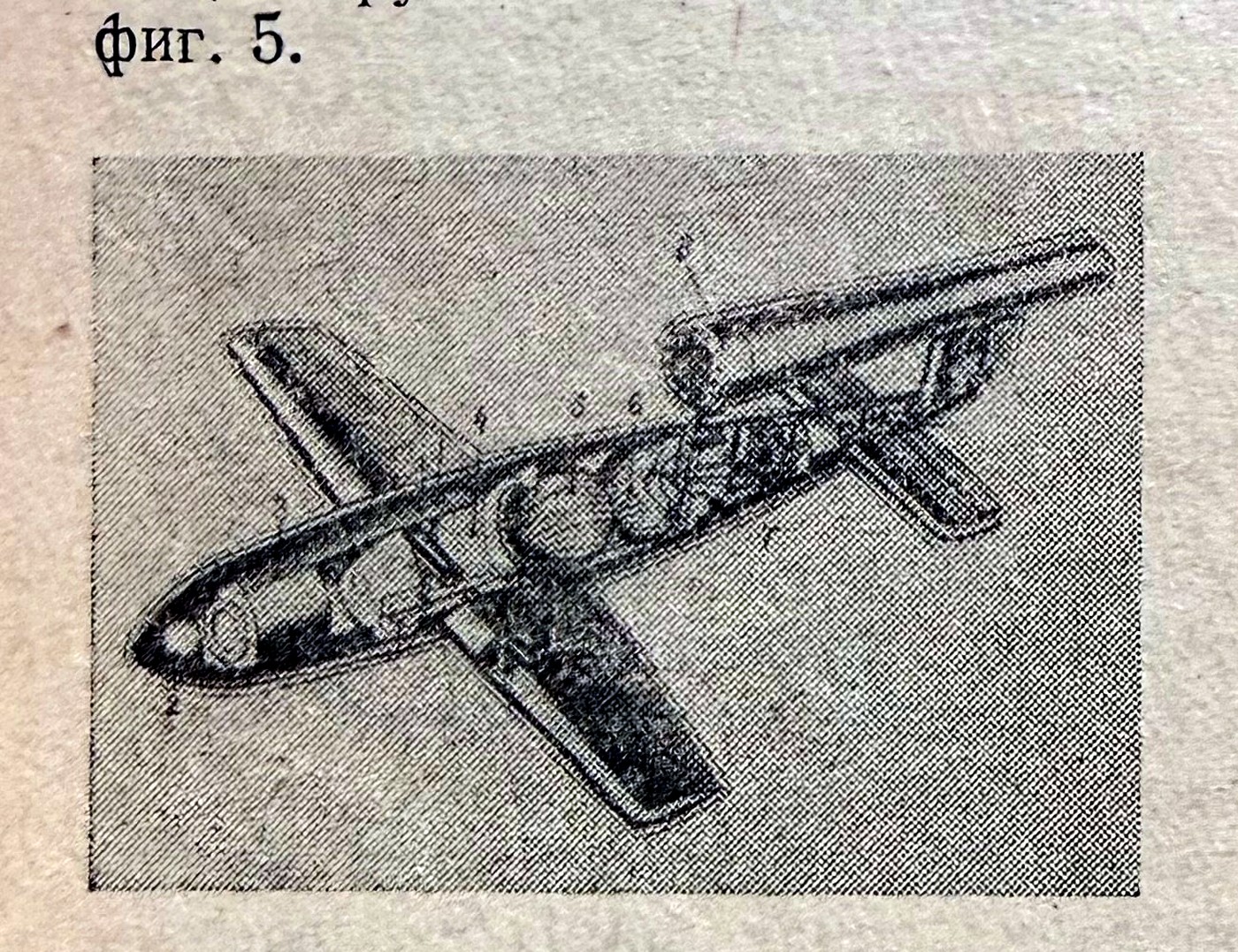
The technical content holds up well. Bolotnikov gives the warhead’s explosive charge as roughly 900 kg, a figure close to the V-1’s actual ~850 kg Amatol payload; he correctly reports that the “radio control” rumors were false and that the internal transmitters some units carried had no receivers at all, serving only to help German observers track actual flight paths by triangulating periodic signal fixes, not to steer the weapon in flight. He walks through the layered, redundant fuzing system (electrical contact fuzes on the nose and belly, electro-inertial fuzes that fire on impact shock, and a mechanical clockwork fuze set for up to two hours’ delay as a final backup), and reconstructs the flight-weight breakdown, about 2,100 kg total, split roughly between warhead, fuel, engine, and structure, well enough to derive a plausible range of 220–260 km and a flight endurance of 25–30 minutes.
Borrowed Eyes: Western Reconnaissance Photos, Cyrillic Captions Around Them
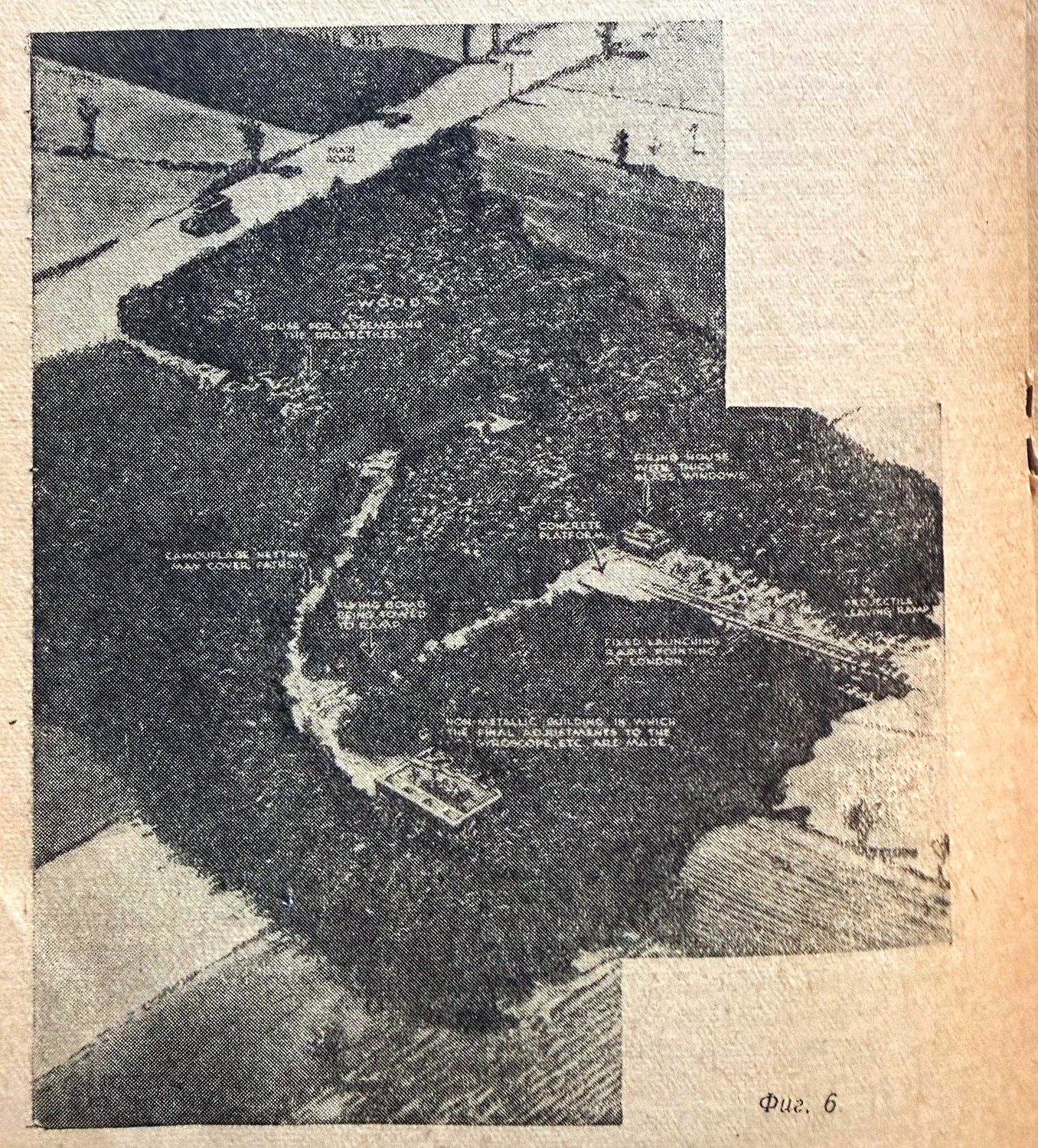
The most quietly fascinating pages in the booklet are the ones Bolotnikov didn’t draw himself. To illustrate the launch sites and their camouflage, the pamphlet reproduces annotated aerial reconnaissance photographs straight out of the British press, English captions and all (“LAUNCHING RAMP CAMOUFLAGED INTO THE LAY-OUT OF A FRENCH VILLAGE,” “FIXED LAUNCHING POINT AT LONDON,” “PROJECTILE LEAVING RAMP”). Soviet typesetters simply pasted the Western photostat in whole, English text intact, and wrapped it in Russian captions and lecture prose. It is a small but vivid artifact of how Soviet technical intelligence in 1944 leaned openly on Allied press material, nothing clandestine about it, just a lecturer clipping the London papers to explain a live threat to a Moscow audience.
Bolotnikov is also candid about the weapon’s limits. He reports the V-1’s aiming error at roughly 4 km from a 1° sighting error alone, plus another 2 km of navigational drift from routine wind-estimation error over a 20-minute flight, for a combined probable error around 5 km. His conclusion is blunt: the weapon cannot hit a specific target and is only usable for area bombardment of a large city. He closes on message, crediting the Red Army’s westward advance with pushing the launch sites out of range and “neutralizing the enemy’s poisonous technology,” the expected patriotic coda for a 1944 Lecture Bureau publication, sitting right alongside genuinely competent engineering analysis.
Condition and Provenance
The copy is complete: 25 pages plus original printed wrappers, worn at the spine and corners but intact, with the expected toning of Soviet wartime pulp paper. The front cover carries a red-pencil mark, a loose scrawled flourish rather than a legible signature. Inside the back cover, a penciled “600” is almost certainly a dealer’s price notation from a past sale rather than anything original to the pamphlet. A directly comparable pamphlet, Битва за Белоруссию, the stenogram of a lecture by General-Lieutenant A. V. Sukhomlin delivered three weeks earlier in that same October Hall, issued by the same Lecture Bureau and printed at the same Pravda press, turns up in the Russian antiquarian trade, confirming this is a known, if scarce, genre of Soviet wartime ephemera rather than a unique survival.
Transcription and translation of the Russian text above are the collection’s own, drawn directly from the photographed pages of this copy.