Catalog B · WWII · Special Feature
Reporting the Robot Bomb
The V-1 and V-2 reach a wartime public
Germany’s V-weapons were, for their first audiences, both a military threat and an information problem. Allied civilians, airmen, and lecturers on all sides scrambled to explain an unfamiliar kind of weapon — one with no pilot and no precedent.
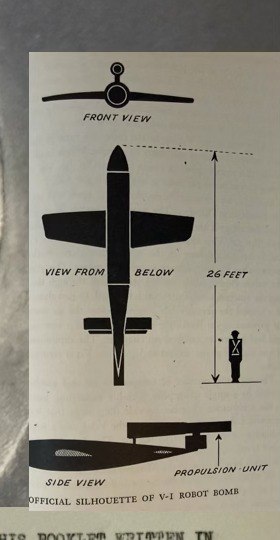
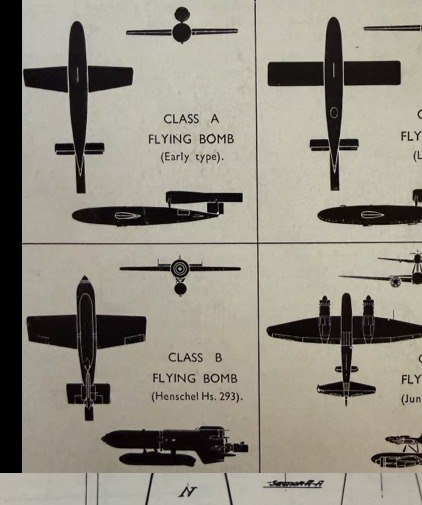
In Britain and the United States, spotters’ guides like the N.A.S.C.’s German Flying Bombs, cataloged in this collection, broke the V-1 down into recognizable silhouettes and construction classes, distinguishing the early and later Fieseler airframes from radio-controlled cousins like the Henschel Hs 293. The illustrations shown here are drawn from that guide.
The Soviet Union’s earliest public account came from the same war: V. F. Bolotnikov’s German Aircraft-Missiles, a stenogram of a public lecture delivered in Moscow just weeks after Churchill’s own account of the campaign (see Special Feature).