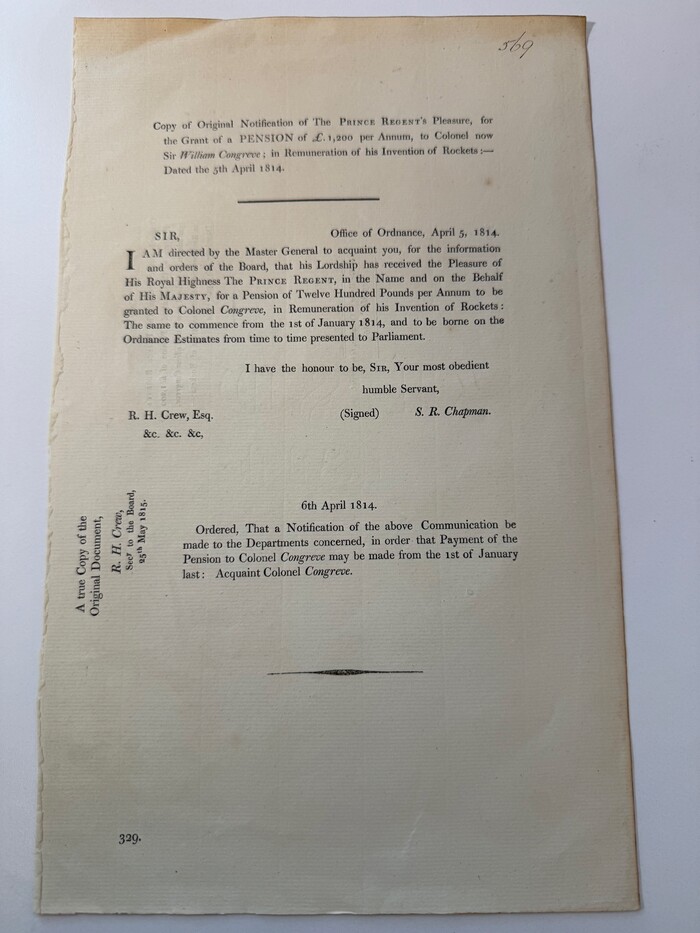
Notification of a Grant to Colonel William Congreve
Copy of the original notification of the Prince Regent’s pleasure for the grant of a pension of £1,200 per annum to Colonel, now Sir, William Congreve, in remuneration of his invention of rockets, dated 5 April 1814. Ordered printed by the House of Commons, 25 May 1815. British parliamentary papers of this period are rare; provision for sale to the public was not made until 1836.
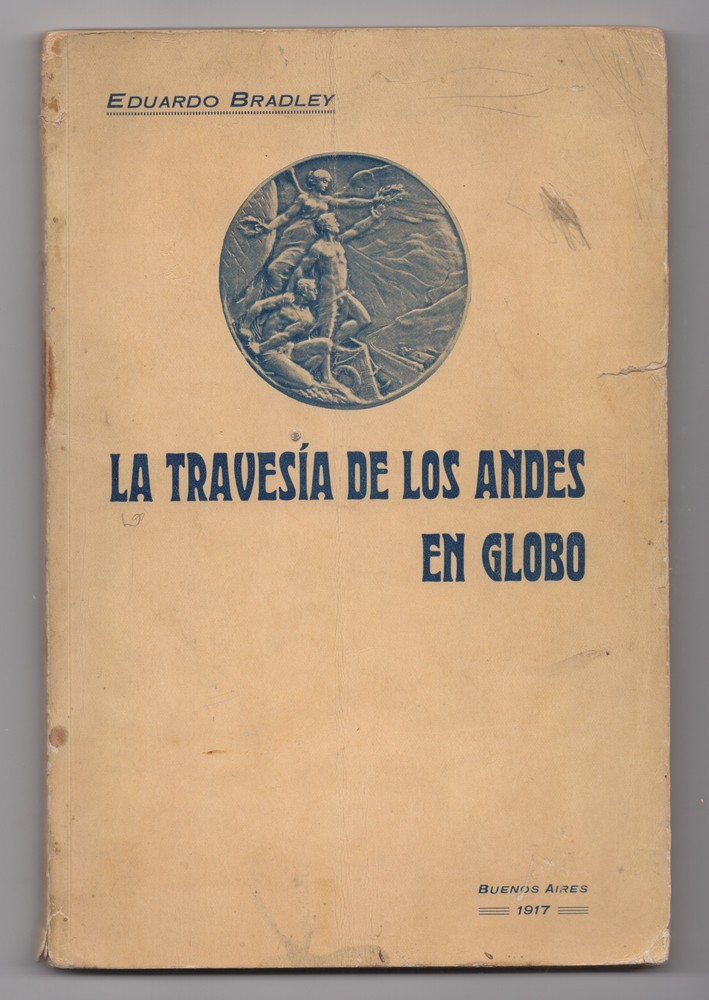
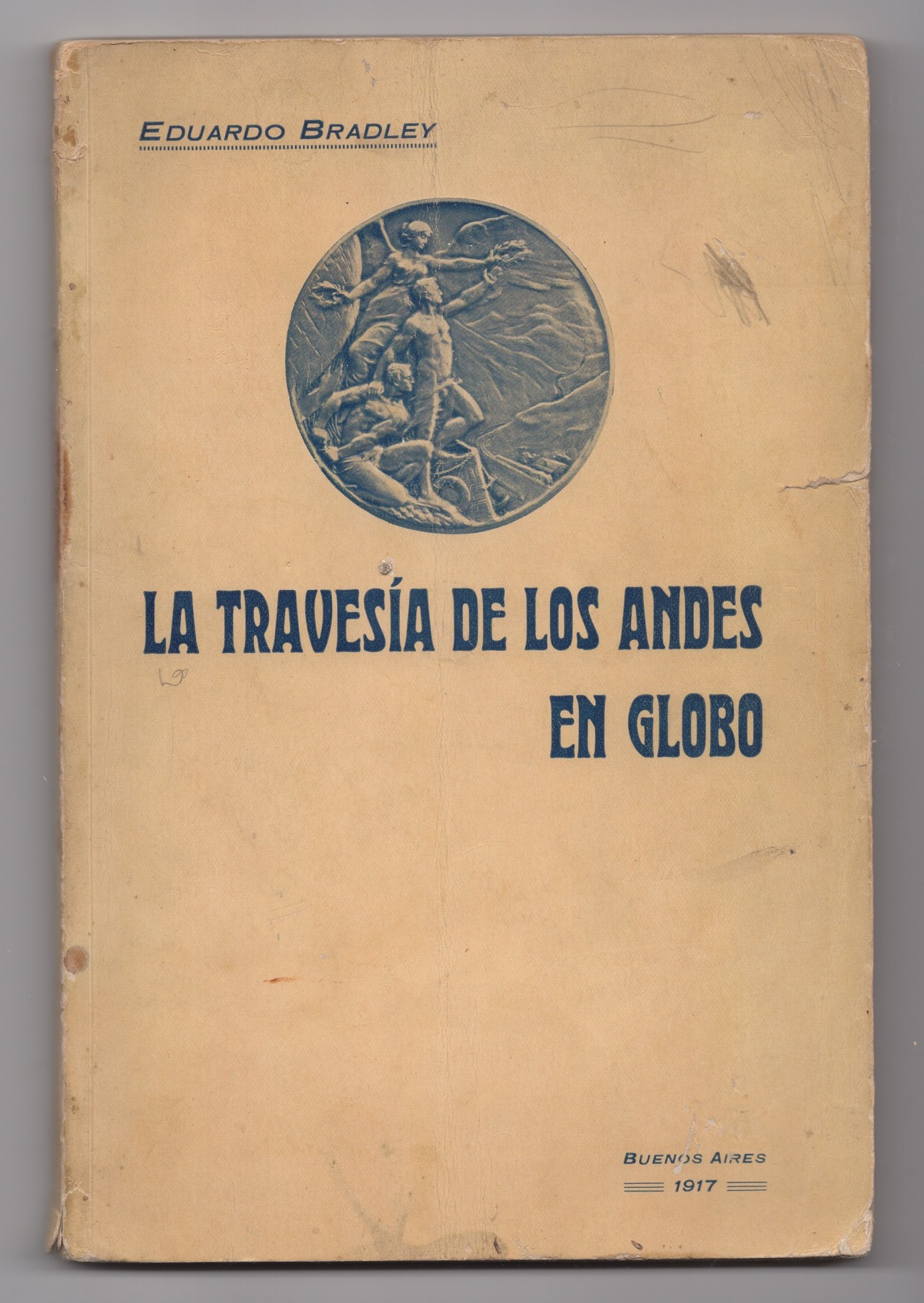
La Travesía de los Andes en Globo.
First-person account of the first balloon crossing of the Andes, Santiago to Uspallata, June 24, 1916, closer to a flight diary than a polished narrative. Illustrated throughout by Bradley with his own diagrams, including a fold-out map of the route and a profile chart of the peaks the balloon cleared. First and only edition; no later printing or reissue recorded. Three exemplars in the collection, identical apart from condition.
 Featured
Crossing the Andes by Balloon
›
Featured
Crossing the Andes by Balloon
›
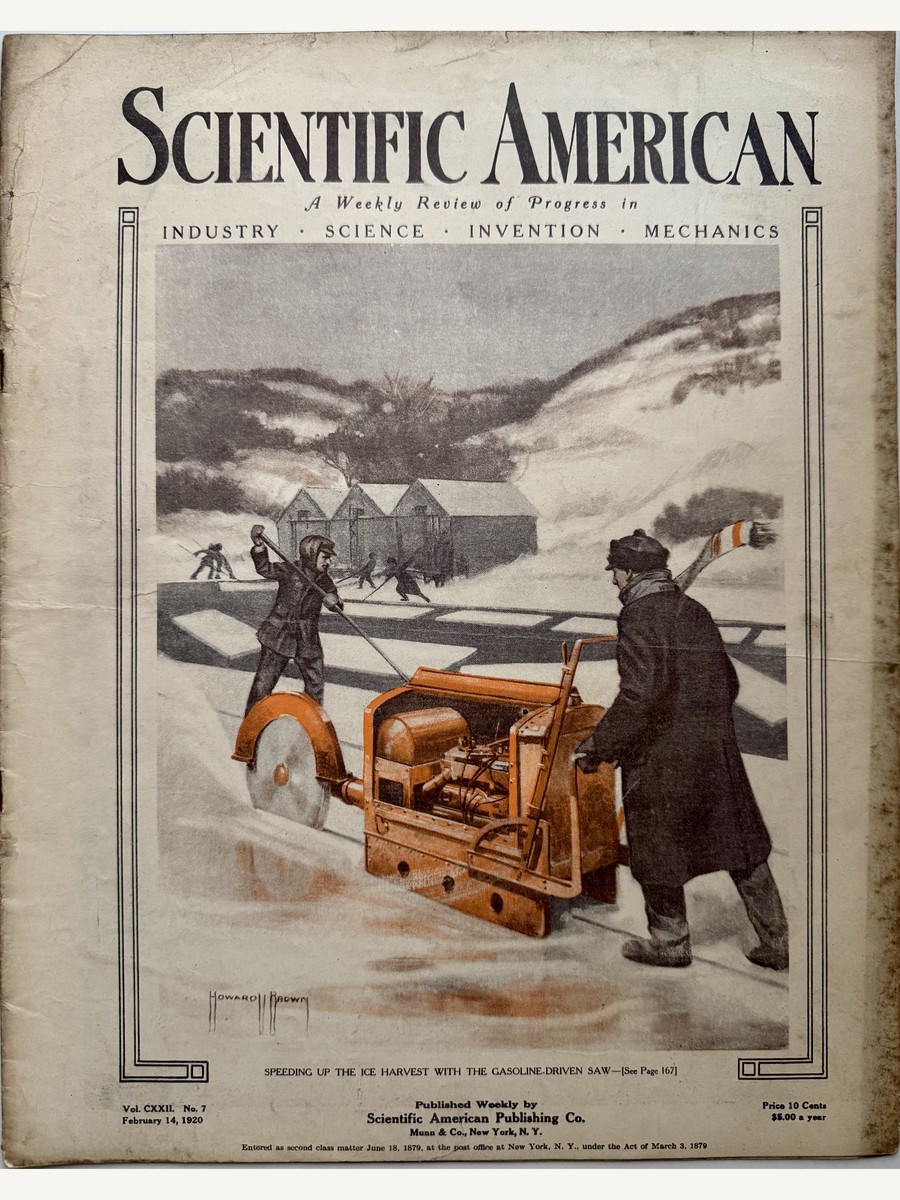
“The Exploring Rocket: The Missile That Could Be Shot to the Moon, and Its True Purpose”
Response to the sensational press coverage that greeted Robert Goddard’s “A Method of Reaching Extreme Altitudes,” published one week after the Smithsonian released the paper and a month after the New York Times’ now-notorious editorial mocking his rocket-in-vacuum physics. Rather than joining in, the magazine faults the daily press for seizing on Goddard’s incidental mention of a moon shot “as the feature of the story and the hook on which to hang the headlines,” walks through his mass-ratio and rocket-efficiency theory in serious technical detail, and explicitly vindicates the vacuum-thrust experiments the Times had ridiculed: “Dr. Goddard confirms what some of us at least have always known or suspected… the rocket continues to get impulse from its exploding charge even in complete vacuo.” Vestnik Znaniya, No. 8, 1925 (elsewhere in this catalog) likewise reports on Goddard’s “lunar rocket” project. Scientific American, Vol. CXXII, No. 7, February 14, 1920, pp. 161, 178.
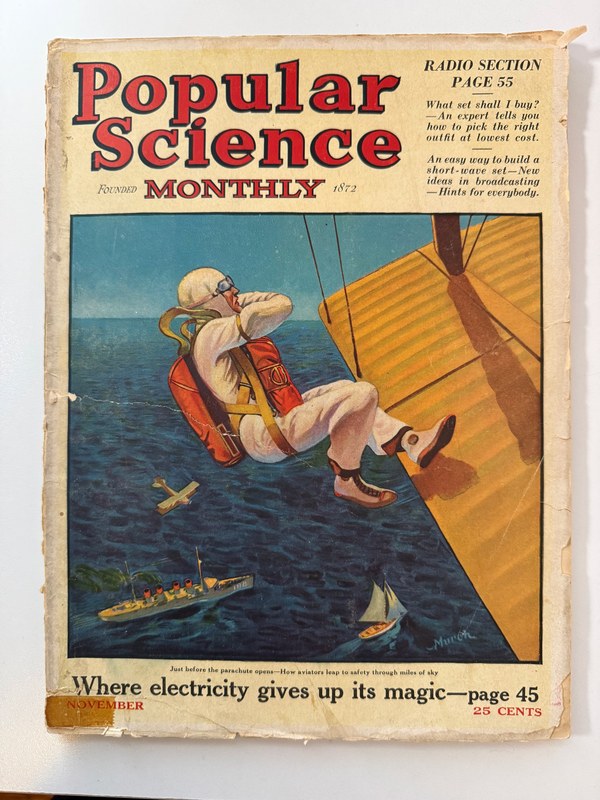
“Death Rocket Rains Fiery Metal”
Unsigned article on Ernest Welsh’s anti-aircraft “death rocket,” profiled the following year in Vestnik Znaniya, also in this collection. Welsh, an amateur inventor of North Ferriby, East Yorkshire, claimed his three-foot rocket could climb five miles and burst a charge of 700 molten-metal pellets over a 100-square-yard area, a barrage he proposed for defending cities against air raids. Popular Science Monthly, November 1924, p.40.
Vestnik Znaniya [The Herald of Knowledge], 1925: Complete Year (Nos. 1–24), Bound.
Complete bound year of Vestnik Znaniya (“The Herald of Knowledge”), a Leningrad popular-science monthly, all twenty-four 1925 numbers as one volume. No. 8 (p.581) reports on Robert Goddard’s “lunar rocket” project. No. 3 (p.231) profiles Ernest Welsh’s “death rocket,” an anti-aircraft weapon also reported in Popular Science Monthly, November 1924, also in this collection. The year-end double number (pp.1343-1350) surveys Tsiolkovsky’s rocket design and Kibalchich’s 1881 proposal, also in this collection.
Deutscher Hausschatz, 53. Jahrgang [53rd Year], 1926/27: Bound.
Deutscher Hausschatz was a general-interest, richly illustrated Catholic family magazine of fiction, poetry, and popular science, unrelated to rocketry apart from one essay: Max Valier’s “Der Vorstoß in den Weltenraum” [The Advance into Outer Space] (pp.119–121), the same title as his full-length book of 1924–25, also in this collection. Valier names Goddard and Oberth directly, walks readers through the rocket mass-ratio problem via the recoil of a gun mounted on a railway wagon, and sets Goddard’s 2,434 m/sec exhaust velocity with solid propellants against Oberth’s 2,200–4,220 m/sec with alcohol and liquid oxygen, which Oberth hoped to push to 5,000 m/sec. Five imaginative plates illustrate a spacecraft escaping Earth’s gravity, its cutaway interior, a tethered spacewalk near the Moon, the return home, and a future Earth-Moon spaceport; the essay closes by forecasting intercontinental rocket planes and a Moon landing before the year 2000. A footnote credits the piece as reprinted, with the publisher’s permission, from Paul Siebertz’s 1927 anthology Wunder im Weltall, issued by the same Munich house.
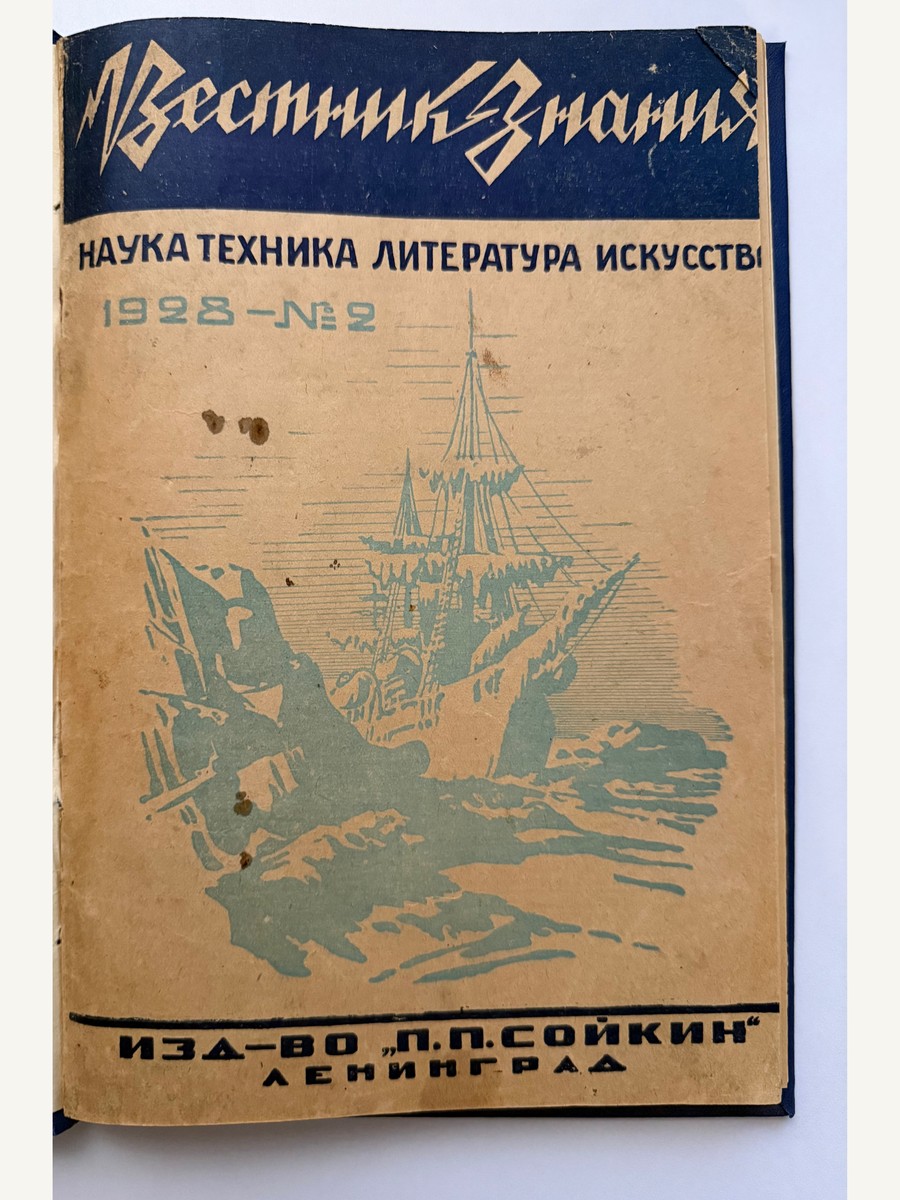
Vestnik Znaniya [The Herald of Knowledge], 1928, No. 2.
Single issue of this Leningrad popular-science biweekly, edited by an editorial board including Acad. N. A. Morozov and Acad. E. V. Tarle. Its lead article (p.75) is Prof. N. A. Rynin’s own survey of interplanetary-flight theories, illustrated with eight diagrams: cannon shot, centrifugal launch, and radio-propelled ships, then in more technical detail the rocket designs of Tsiolkovsky, Goddard, Oberth, Hohmann, and Zander, several also represented elsewhere in this collection. Rynin points readers to his own multi-volume encyclopedia of the same title for fuller detail, and closes by proposing an international “Institute of Interplanetary Communications.” The same issue carries a translated article by American astronomer Donald H. Menzel on the possibility of life on Mars, and an advertisement for the relevant volume of Rynin’s own book series, priced at 1 ruble 70 kopecks.
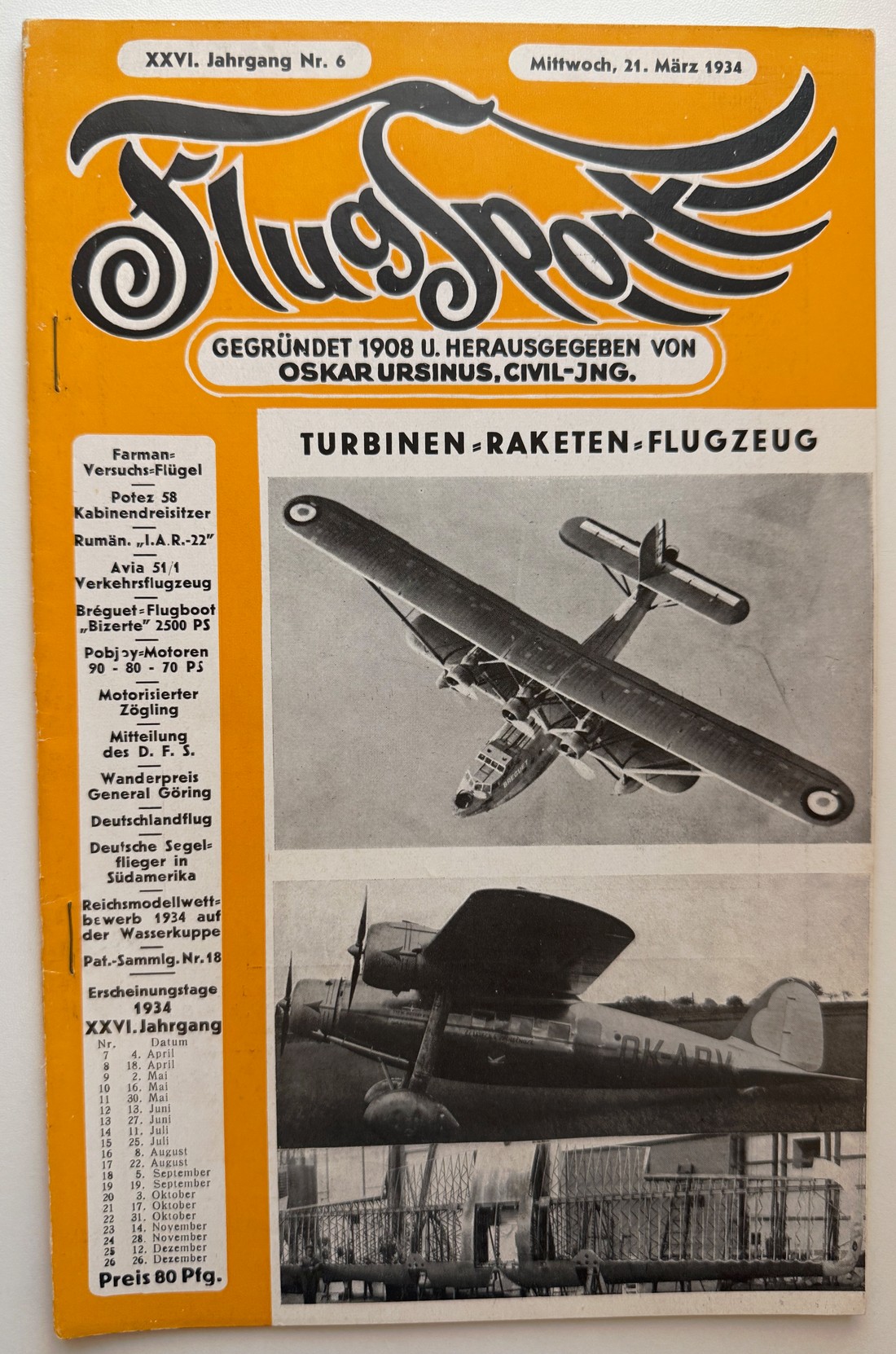
Prof. Goddards Turbinen-Raketen-Flugzeug für die Stratosphäre.
Lead article (pp.112–115) of this German illustrated aviation biweekly, No. 6 of the 26th volume, 21 March 1934. Opens by dismissing a garbled press notice claiming Goddard had abandoned direct rocket thrust for a turbine-driven design, then quotes at length from Goddard’s own account (via Scientific American, 1932) of a hybrid craft: propeller-driven in dense low-altitude air, direct rocket thrust at altitude where propellers lose efficiency. Reproduces schematic diagrams from Goddard’s U.S. Patent 1,809,271, cites 1930 turbine-rocket test firings at Camp Devens, and closes by tying the concept to his 1919 Smithsonian paper. Also in the collection: Goddard’s own Scientific American account of his 1936 liquid-fuel rocket flight.
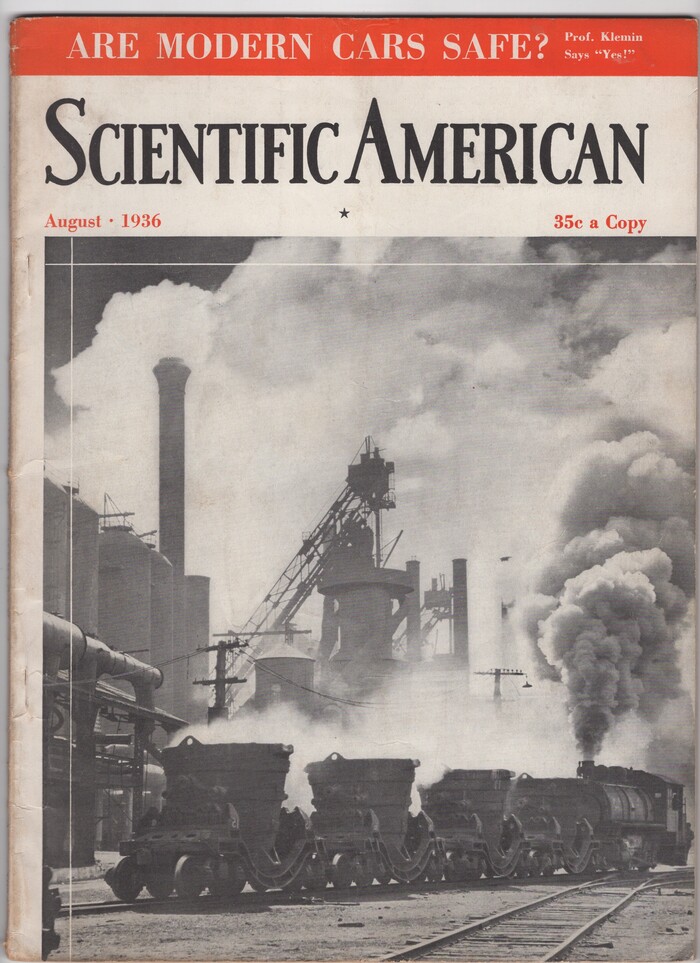
Liquid Propellant Rocket Development (Scientific American Reprint)
Goddard’s own account of his first successful flight of a liquid-fuel rocket, published across two consecutive issues of Scientific American: August 1936 (pp. 78–80) and September 1936 (pp. 148–151), in original pictorial wrappers. Considered Goddard’s second most significant publication after his 1920 Smithsonian monograph on reaching extreme altitudes. Also included: G. Edward Pendray’s profile of Goddard, “Number One Rocket Man — A Silhouette of the Shy Massachusetts Physicist Who Pioneered in Rocket Research,” Scientific American, May 1938, pp. 270–272 (front cover marred, affecting a few letters of text). Related to the Smithsonian Miscellaneous Collections pamphlet Liquid-Propellant Rocket Development, also available in this collection.
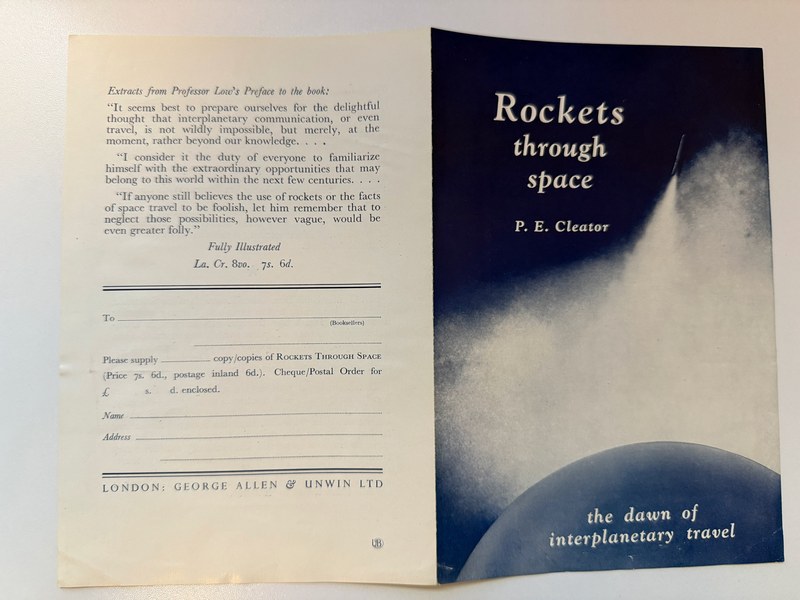
Ad for Rockets Through Space.
An advertisement for P. E. Cleator’s book: Rockets Through Space, available in this collection. Quotes the editor’s scientific advisor and the book’s preface. Includes a printed form in the last page to request copies of Cleator’s book.
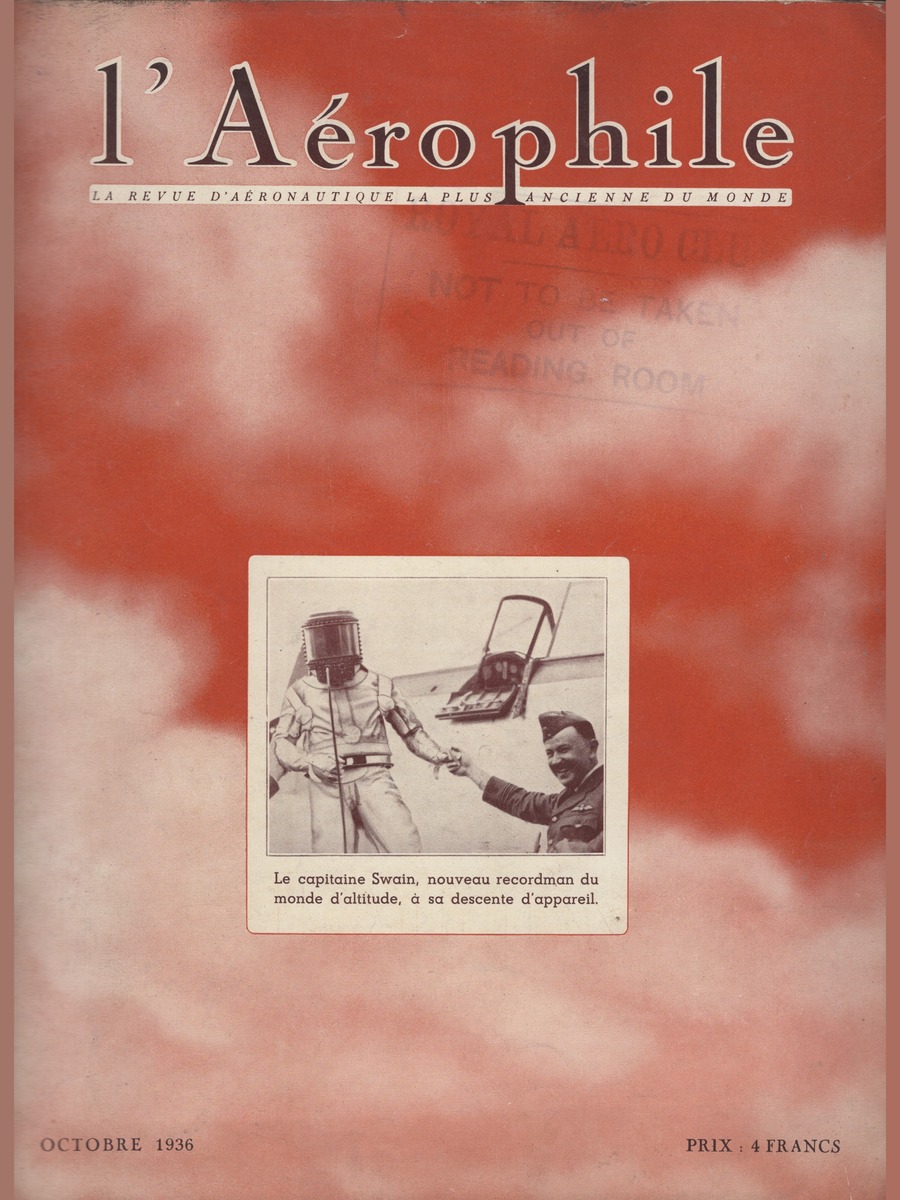
Les Fusées Volantes Météorologiques.
Article (pp.228–232) on meteorological sounding rockets, published in this issue of L’Aérophile, self-billed on its cover as “la revue d’aéronautique la plus ancienne du monde.” Credited at its close to Ley, already a year into his American exile and identified here as an honorary member of the American Rocket Society, and to Herbert Schaefer, described as a former engineer at the Raketenflugplatz Berlin, the VfR’s Reinickendorf test field that Ley himself had helped run before 1933. This ex-library copy carries a Royal Aero Club stamp restricting it to the reading room.
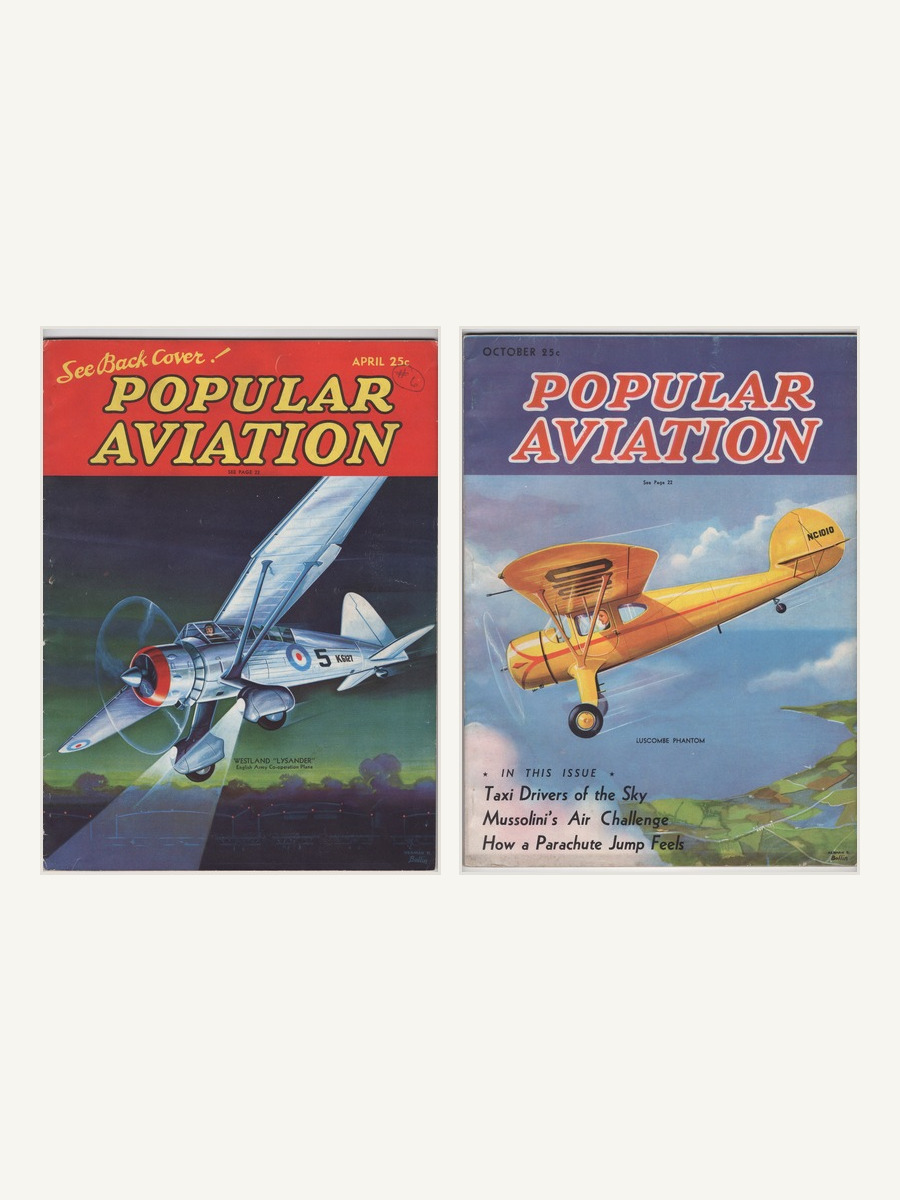
“Space Navigation by Rocket,” “Sky-Rocketing Through Space,” and “Where Is Rocketry Today?”
Three rocket articles from Popular Aviation’s 1937 volume. Alvin Edward Moore’s two-part “Space Navigation by Rocket” (Feb.) and “Sky-Rocketing Through Space” (Apr.) survey rocket history from Heron of Alexandria to Goddard’s Roswell work. Charles G. Philp’s “Where Is Rocketry Today?” (Oct.) gives the fullest account, tracing Goddard back to his 1919 pamphlet and the Guggenheim-funded Roswell flights; Philp’s own 1935 book on the subject is also in this collection. Moore: Popular Aviation, February 1937, pp.27-28, 66-67; April 1937, pp.35-36, 62. Philp: Popular Aviation, October 1937, pp.49, 70.
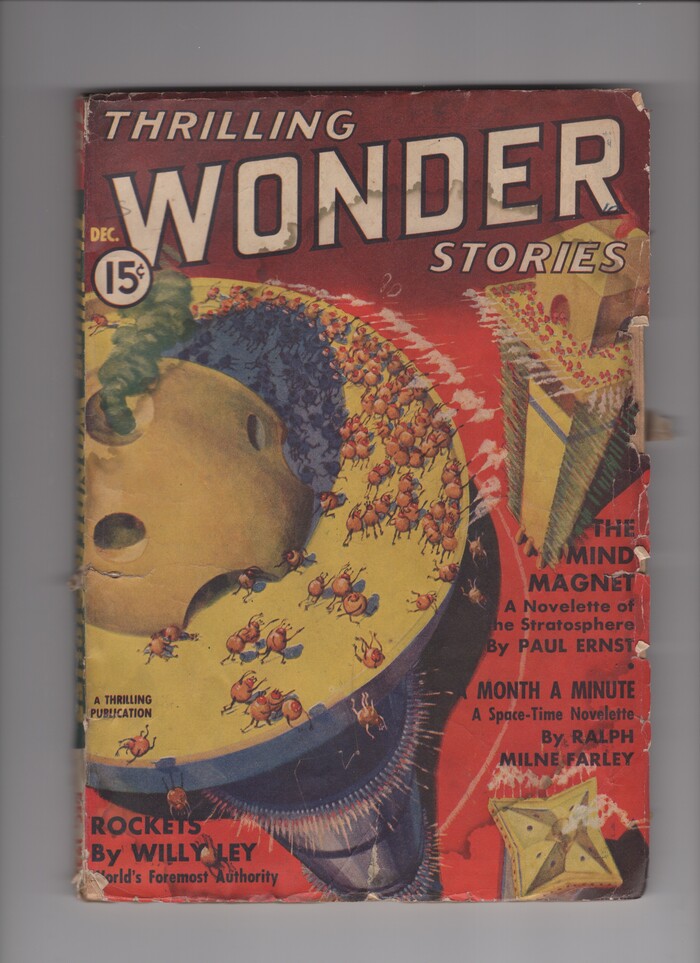
Eight Days in the History of Rocketry
Ley’s survey of key moments in the modern history of rocketry, written from his perspective as a former leader of the German rocket society (Verein für Raumschiffahrt), not long after his emigration to the United States following the Nazi seizure of German rocketry research. Appeared in Thrilling Wonder Stories, Vol. 10, No. 3 (December 1937); the cover itself bills the piece simply as “Rockets by Willy Ley, World’s Foremost Authority.” Also in the collection: Ley’s book Rockets (1944) and his two-part Astounding Science Fiction article “The End of the Rocket Society” (1943).
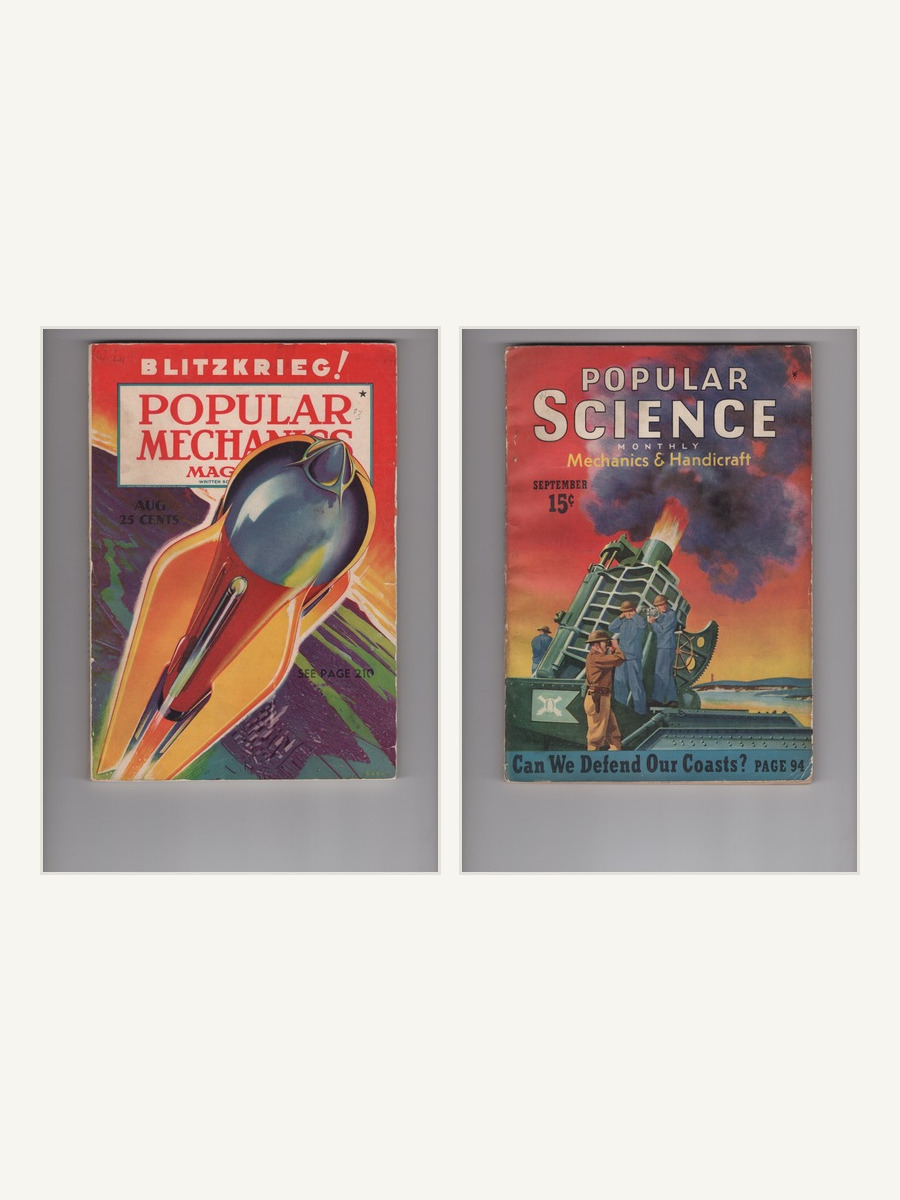
“Seeking Power for Space Rockets” and “New Experiments With Rockets”
Two 1940 articles on the Caltech GALCIT rocket group later nicknamed the “Suicide Squad.” Popular Mechanics’ unsigned “Seeking Power for Space Rockets” (Aug.) surveys Malina, Parsons, and Forman’s fuel and combustion-chamber testing at Caltech. Robert E. Martin’s “New Experiments With Rockets,” in Popular Science Monthly the next month, gives the more personal account, with candid photos of Parsons and Forman at work, testing that became JPL’s founding nucleus. Popular Mechanics: August 1940, pp.210-213, 118A-119A. Popular Science Monthly: September 1940, pp.108-110.
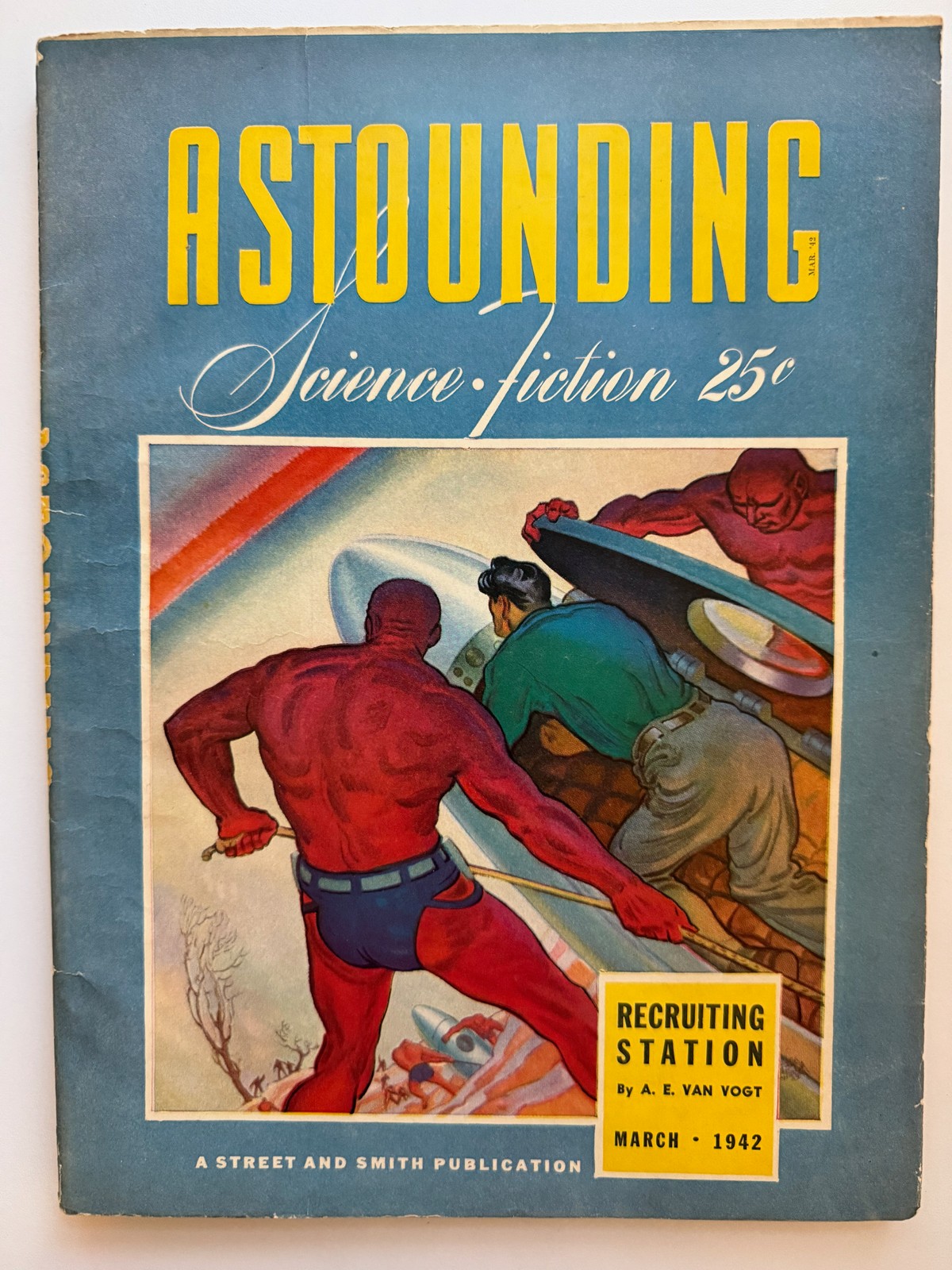
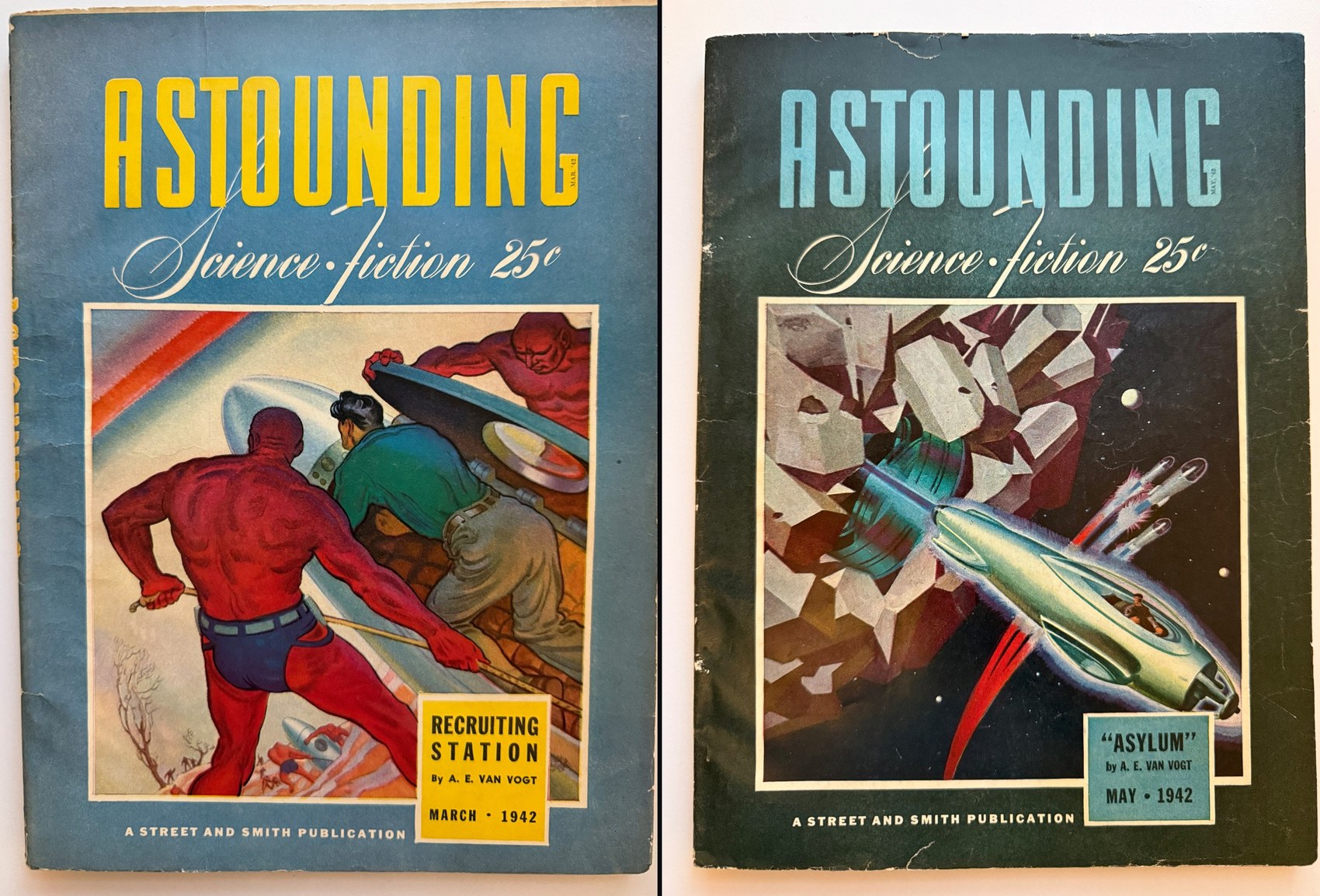
Astounding Science Fiction, March 1942.
Contains the first publication of “Runaround,” the Asimov robot story that gave the Three Laws of Robotics their first explicit statement, recited by its two engineer-narrators on p.100. Cover story “Recruiting Station” by A. E. van Vogt. Acquired, along with the May 1942 issue also in this collection, while pursuing rocketry material; outside the collection’s core subject, but kept for its own significance.
 Featured
The Birth of the Three Laws of Robotics, and the Foundation Series
›
Featured
The Birth of the Three Laws of Robotics, and the Foundation Series
›
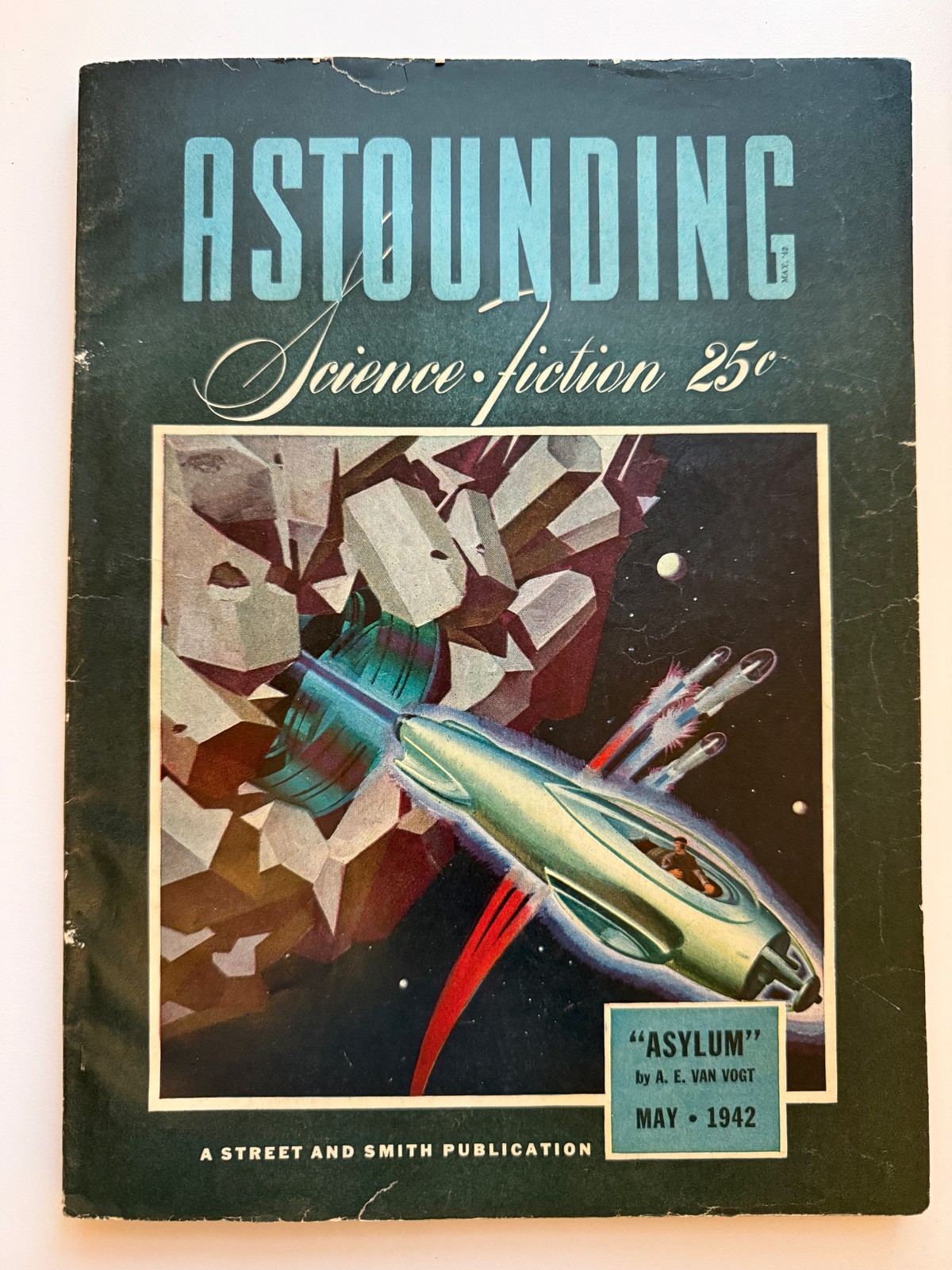
Astounding Science Fiction, May 1942.
Contains the first publication of “Foundation,” the opening story of Asimov’s Foundation series, later expanded into the Foundation Trilogy and among the most influential works in the genre’s history. Cover story “Asylum” by A. E. van Vogt. Also in the collection: the March 1942 issue, containing “Runaround,” the story that gave the Three Laws of Robotics their first explicit statement.
Featured
The Birth of the Three Laws of Robotics, and the Foundation Series
›
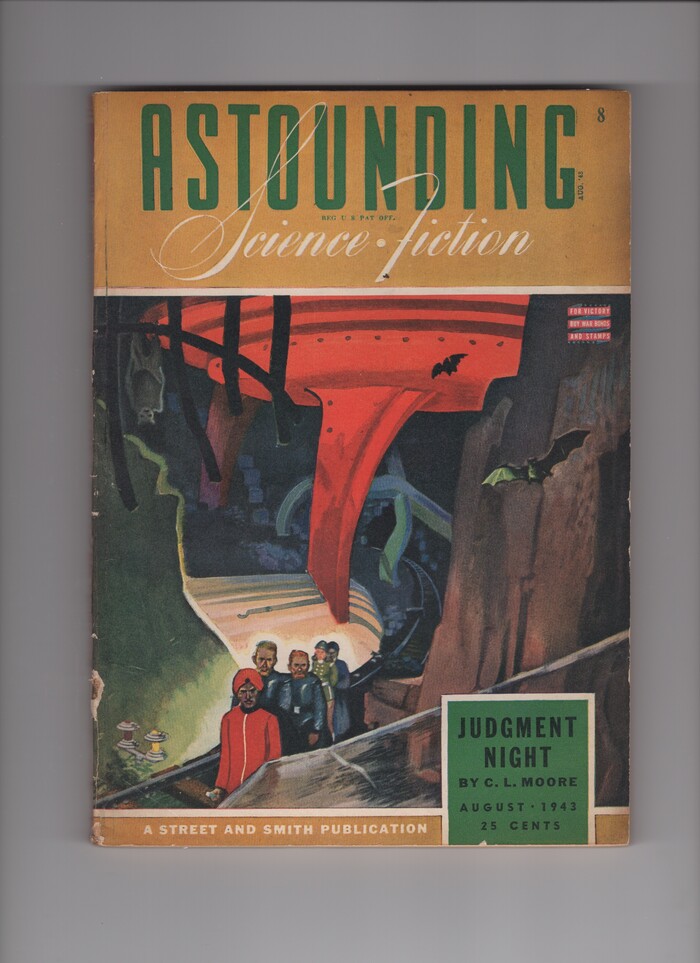
The End of the Rocket Society
Two-part article published across two consecutive issues of Astounding Science Fiction, August and September 1943. The magazine’s table of contents describes it as “Describing the work and research—and final disintegration—of the most active and effective of the rocket research societies.” Also in the collection: Ley’s book Rockets (1944) and his Thrilling Wonder Stories article “Eight Days in the History of Rocketry” (1937).
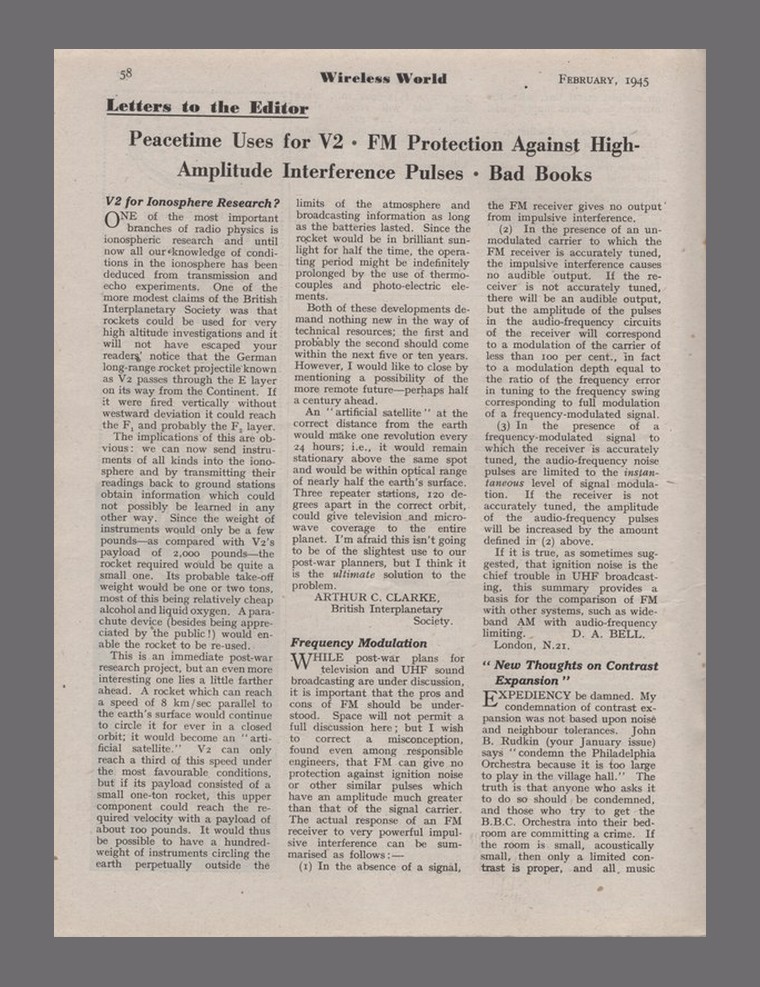
V2 for Ionosphere Research.
The letter to the Editor that inspired geostationary satellites. Available in the original February 1945 issue of Wireless World “An ‘artificial satellite’ at the correct distance from the earth would make one revolution every 24 hours…”
 Featured
Arthur C. Clarke
›
Featured
Arthur C. Clarke
›
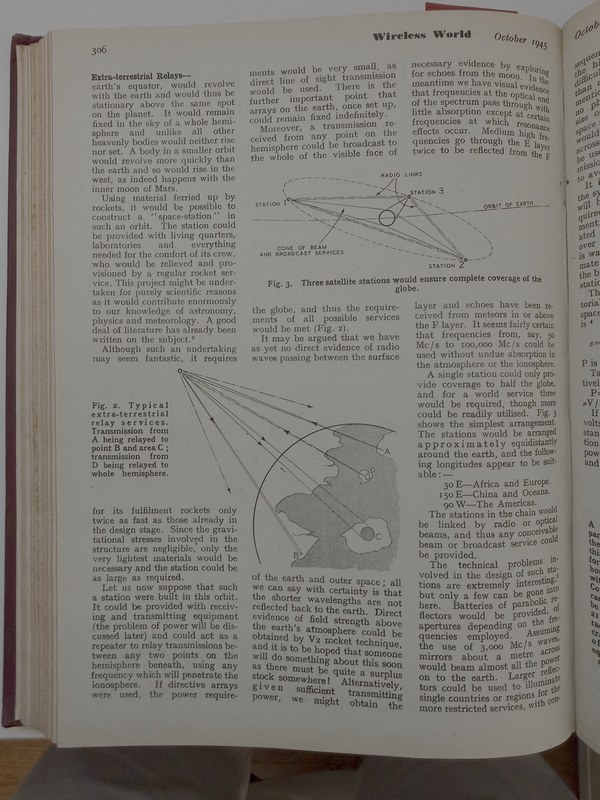
Extra-Terrestrial Relays: Can Rocket Stations Give World-wide Radio Coverage?
The article describing geostationary satellites. Available in the October 1945 issue of Wireless World “Using material ferried up by rockets it would be possible to build a ‘space-station’ in such an orbit…”
Featured
Arthur C. Clarke
›
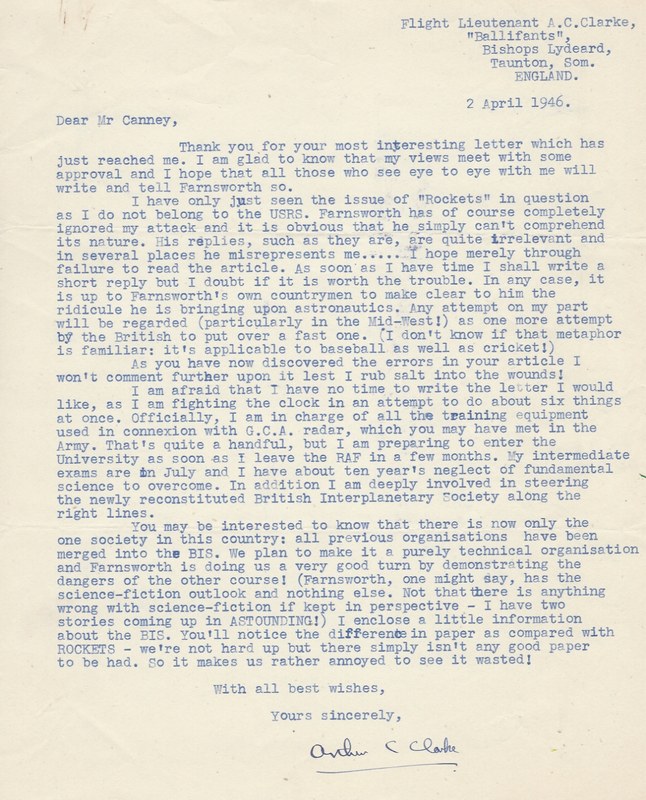
Letter and BIS papers
Personal letter discusses radar work, and mentions his first science fiction stories to be published in Astounding! magazine. One signature probably a copy, the other appears to be original. The short stories are also available in this collection as original issues of Astounding! magazine.
Featured
Arthur C. Clarke
›
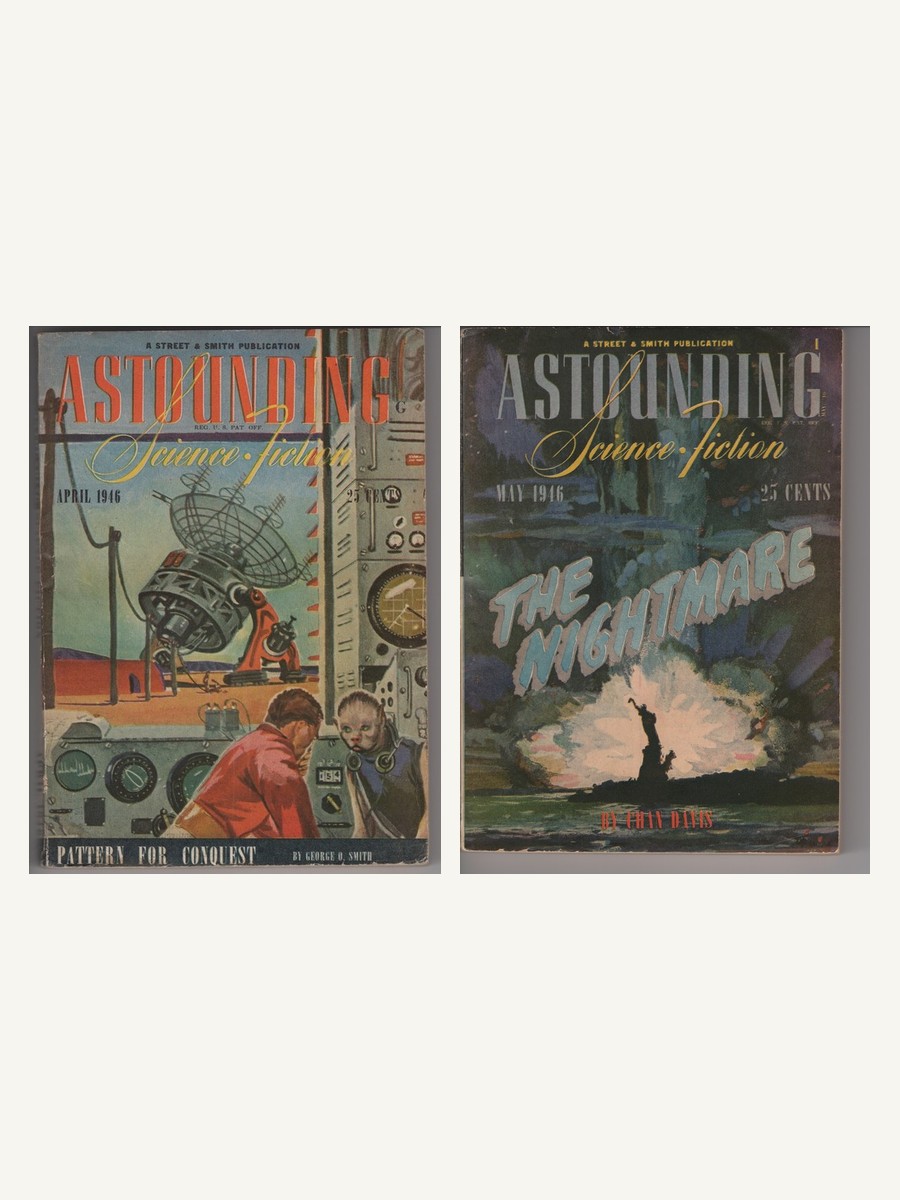
Rescue Party and Loophole
Clarke’s first science fiction stories in the original issues of Astounding! Magazine. April 1946 (Rescue Party, p.36) May 1946 (Loophole, p.57)
Featured
Arthur C. Clarke
›
Correspondence: Count von Braun.
Published letter, printed over Ley’s name (pp.154–156), in this issue of the Journal of the British Interplanetary Society, Vol. 6, No. 5, recalling Ley’s first meeting with a teenage Wernher von Braun at a Verein für Raumschiffahrt gathering in 1929, his subsequent election to the VfR board, and the founding of Peenemünde. The wry title answers a mistaken “Count” attribution that Ley traces to von Braun’s father, Magnus von Braun, a Freiherr (baron) and member of the Deutsche Adels-Gesellschaft who served as Reichsminister of Agriculture in 1932. The same issue carries A. V. Cleaver’s paper “Interplanetary Flight: Is the Rocket the Only Answer?” (p.128).
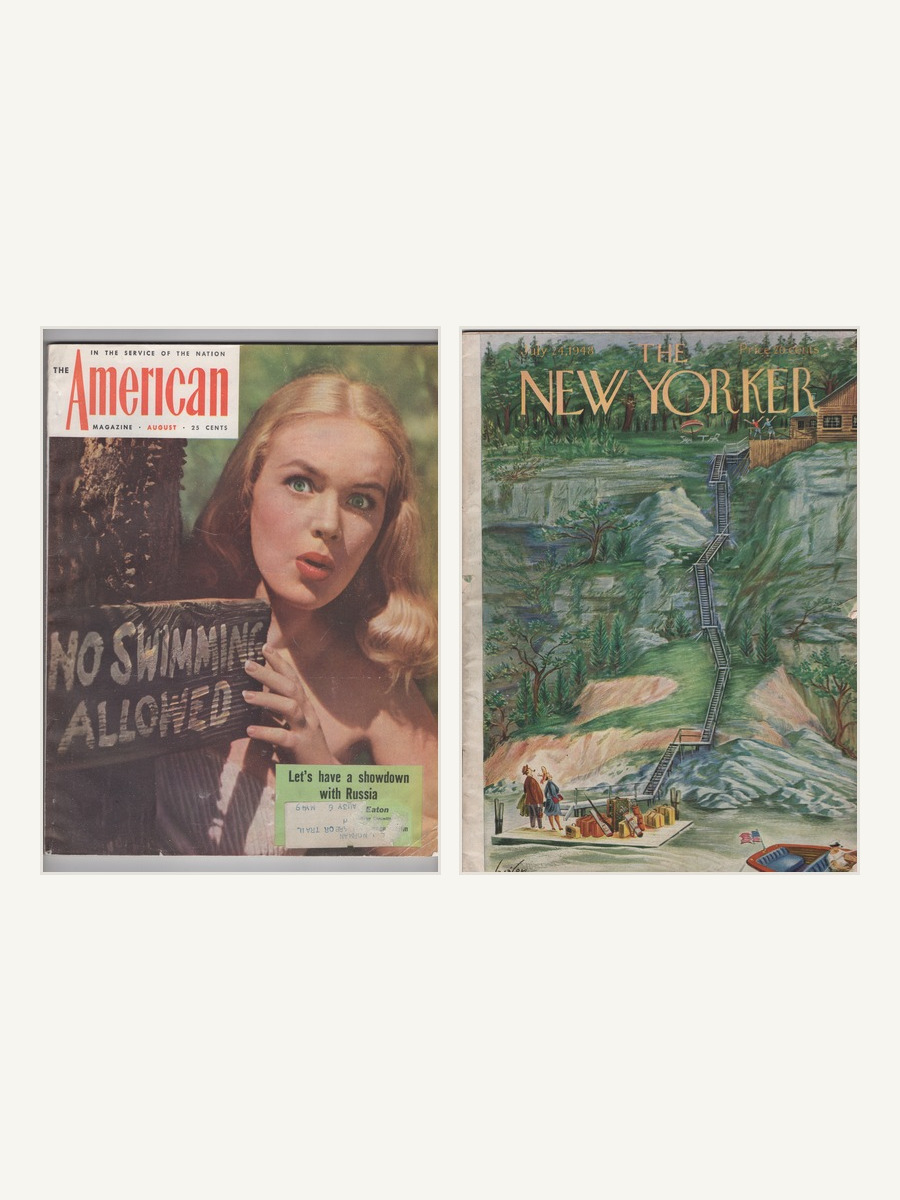
“Life Among the Rockets” and “A Reporter At Large: White Sands”
Two magazine articles on the White Sands V-2 program. Eddy’s piece doesn’t name Wernher von Braun; Lang’s report the next year is likely the first American-magazine appearance of his identity, describing him as the thirty-three-year-old former Peenemünde chief. Lang’s piece was reprinted, retitled “V2s Among the Rattlers,” in his own collection, Early Tales of the Atomic Age (1948), also in this collection. Eddy: The American Magazine, August 1947, pp.28-29, 97-102. Lang: The New Yorker, July 24, 1948, pp.40-46.
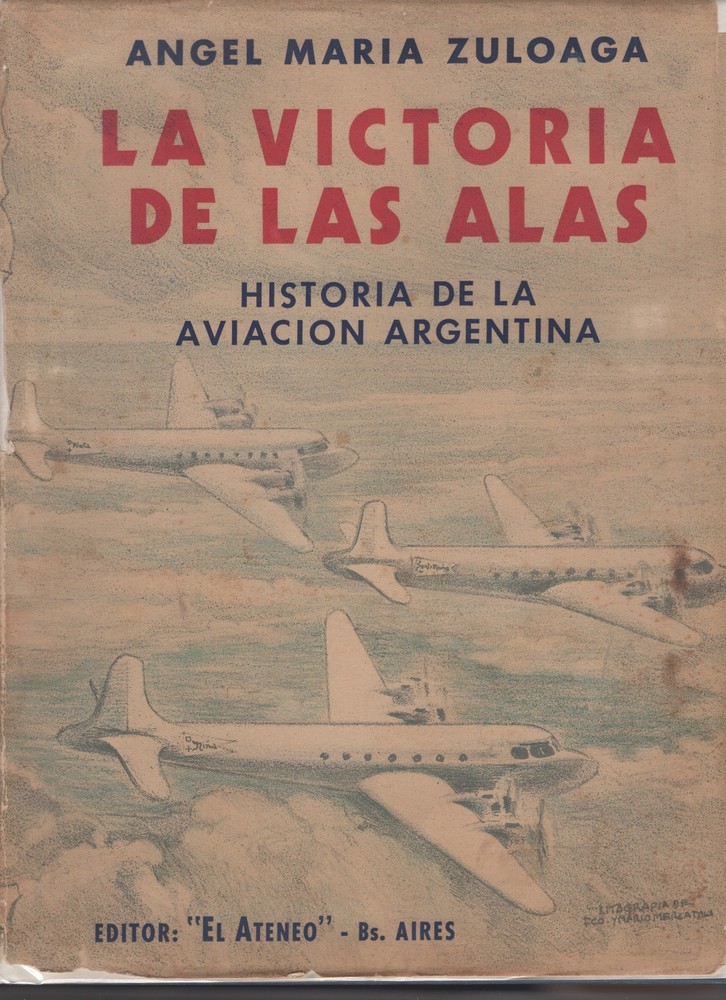
La Victoria de las Alas: Historia de la Aviación Argentina.
Documented chronicle of Argentine aviation history by Bradley’s co-pilot on the 1916 crossing, by 1948 a brigadier in the Fuerza Aérea Argentina. This copy is a presentation copy, inscribed by Zuloaga in 1953 to the Chilean hostess who received him at Machalí, and inscribed onward by her in turn. First edition; scarcer than the revised 1958 edition issued with Argentine Air Force backing.
Featured
Crossing the Andes by Balloon
›
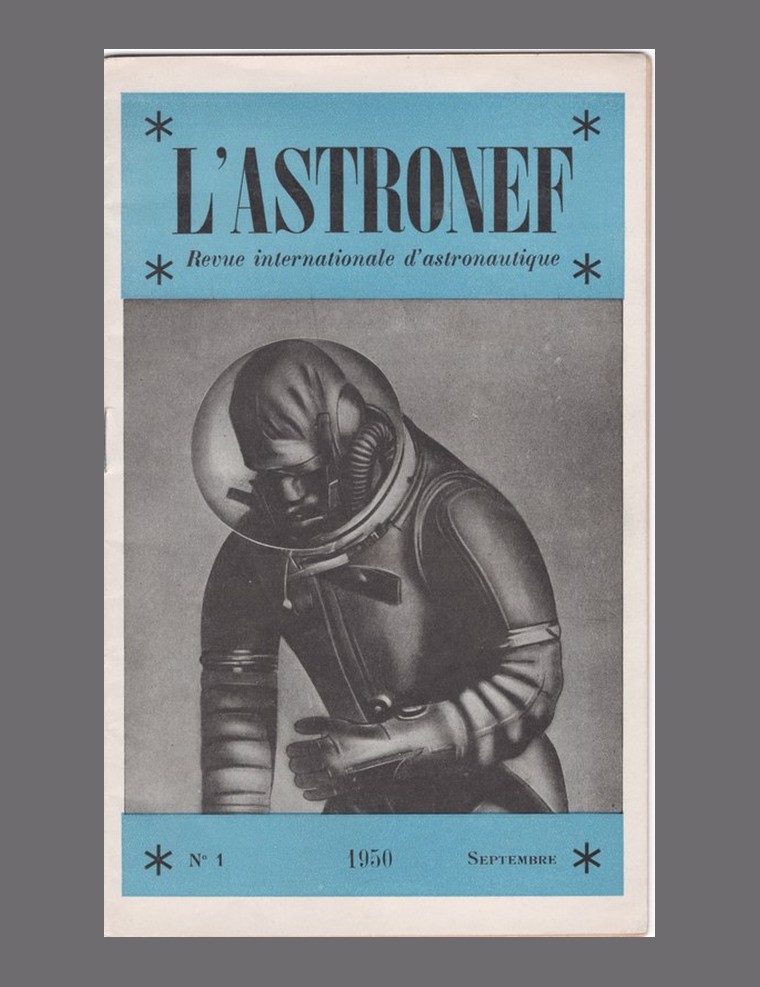
L’ Astronef.
First number of this French magazine. Special section on the First Congress of Astronautics. Minutes for the First Congress of Astronautics are available in this collection.
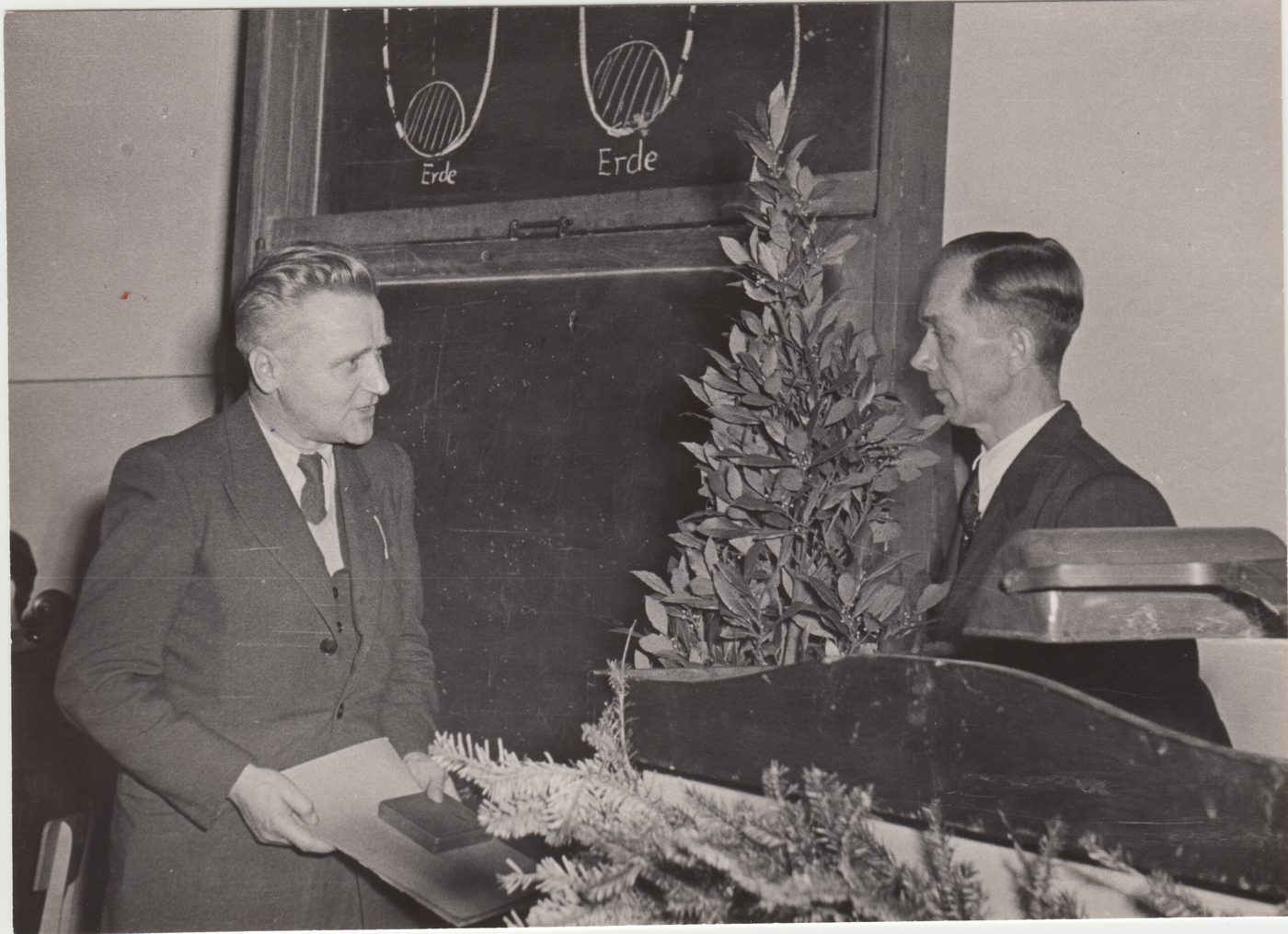 Featured
First Astronautical Congress
›
Featured
First Astronautical Congress
›
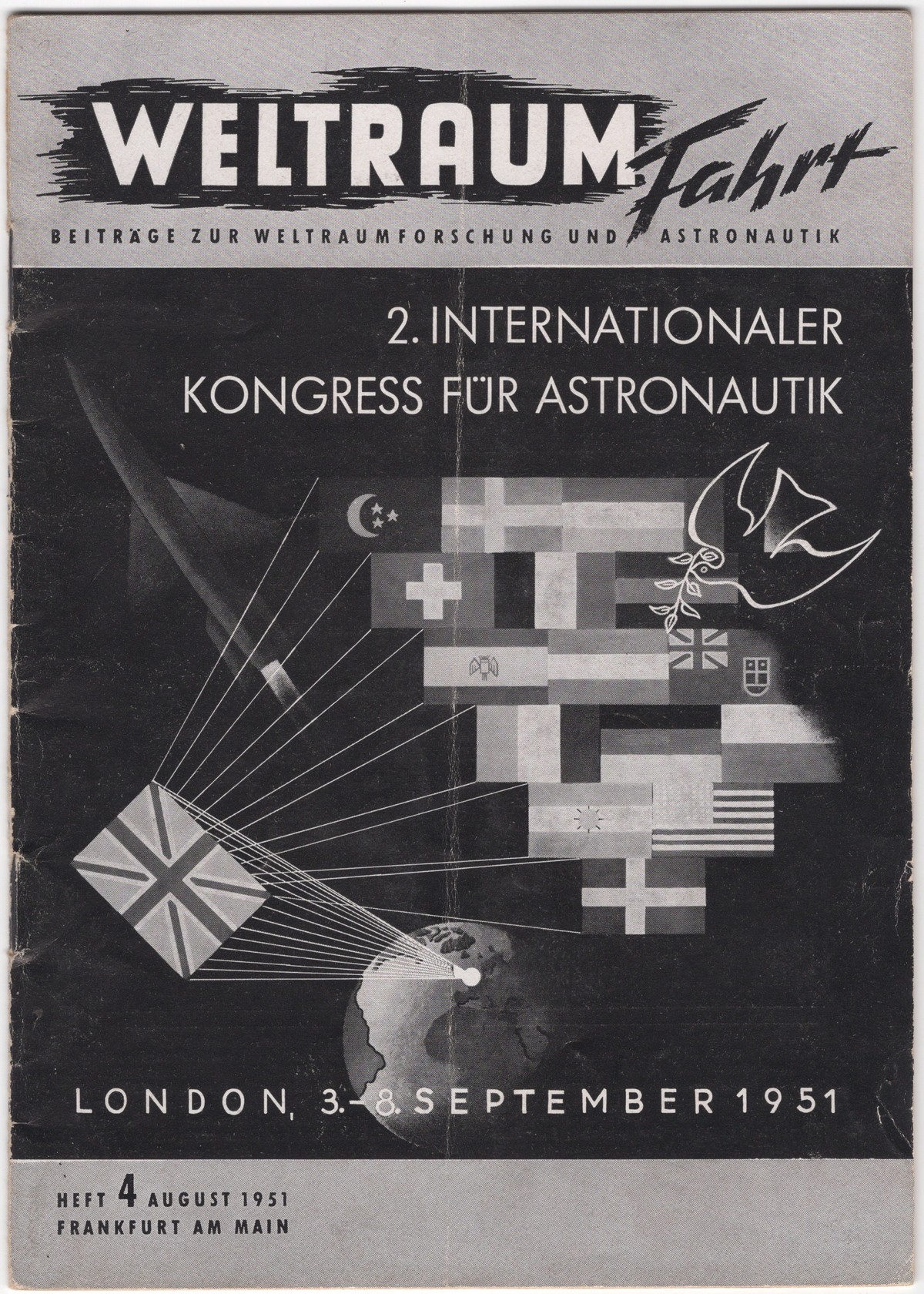
Weltraumfahrt, Heft 4, August 1951.
Preview issue ahead of the Second International Astronautical Congress, London, 3–8 September 1951 — the cover ties the flags of the participating national rocket societies to a single globe. Looks back on the first congress (Paris, 1950, also in this collection) and previews the program to come. Companion to the October issue reporting on the congress itself, also in this collection.
 Featured
The Founding of the International Astronautical Federation
›
Featured
The Founding of the International Astronautical Federation
›
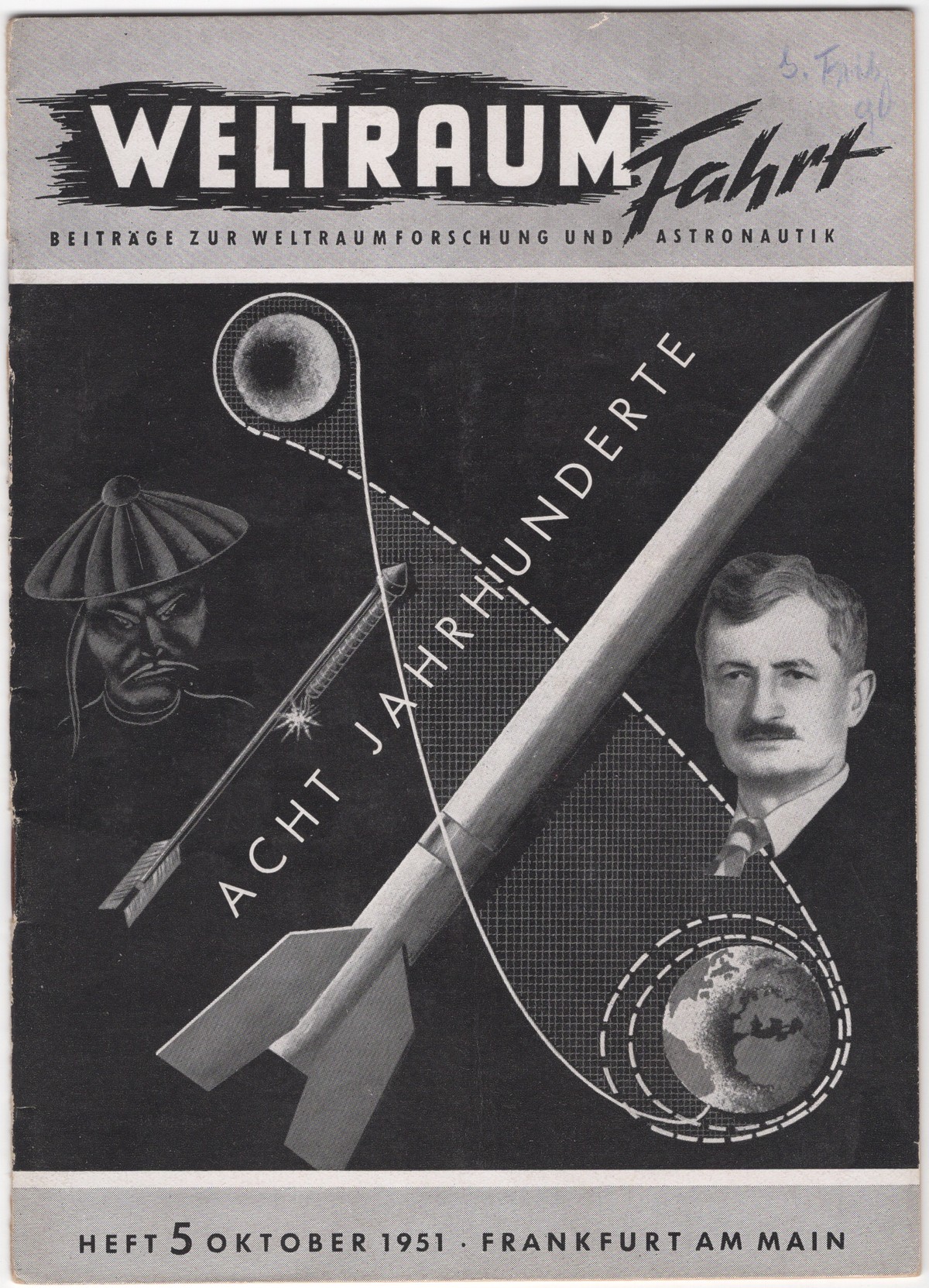
Weltraumfahrt, Heft 5, October 1951.
Reports on the Second International Astronautical Congress, London, 3–8 September 1951, where delegates from ten national rocket societies signed the founding constitution of the International Astronautical Federation (IAF) and elected Eugen Sänger its first president. Companion to the August issue previewing the congress, also in this collection.
Featured
The Founding of the International Astronautical Federation
›
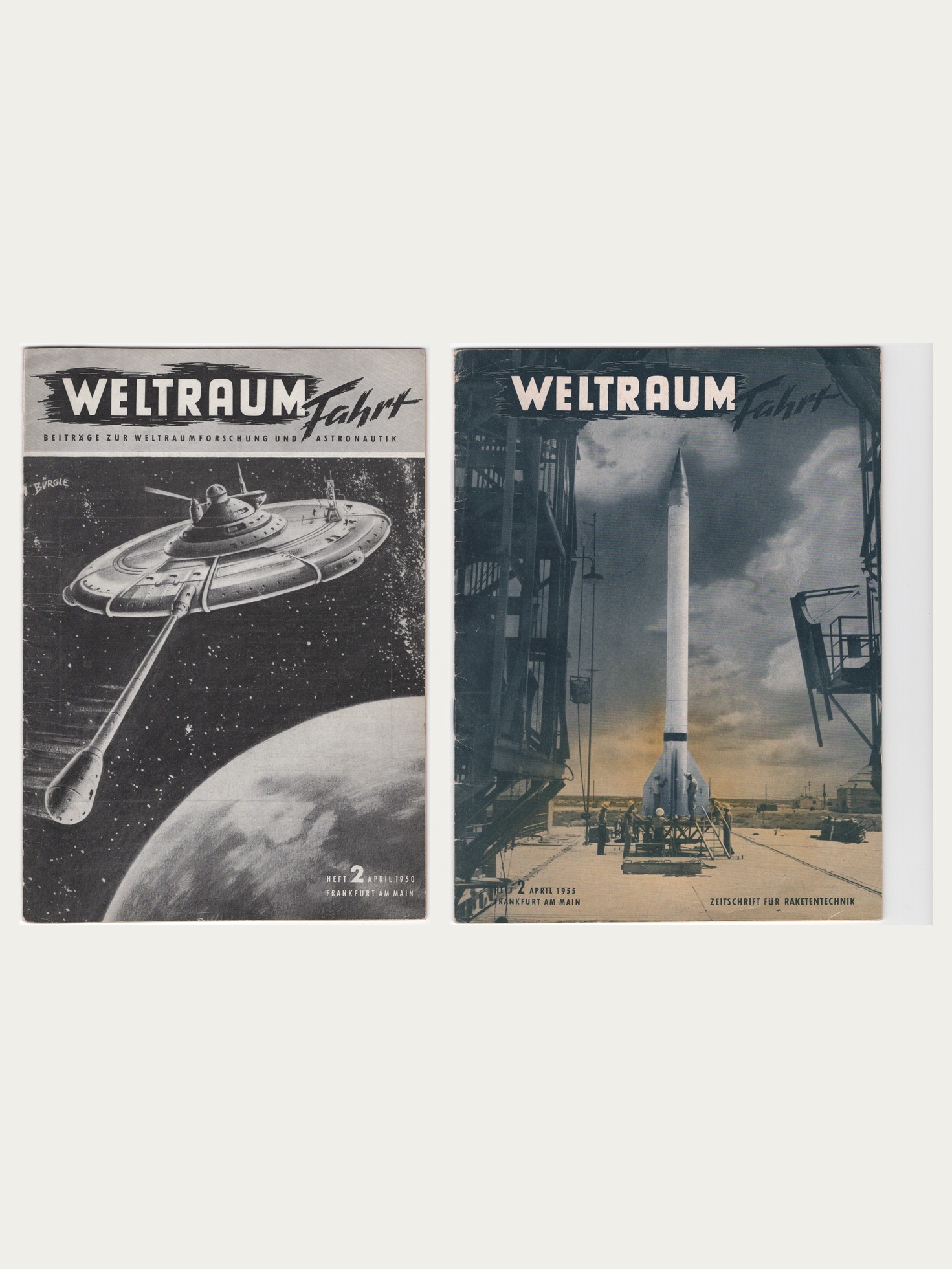
Weltraumfahrt [Space Travel], 1950–1955: Thirteen Issues.
Thirteen further issues of this GfW house organ, kept across its founding decade: Heft 2, 3, 4, and 6 of the first year, 1950; Heft 1, 2, and 6 of 1951; Heft 1 of 1952; Heft 3 of 1953; Heft 2 and 4 of 1954; and Heft 2 and 4 of 1955, the last two issued under the magazine’s later subtitle, Zeitschrift für Raketentechnik. Not a complete run, but a working set bracketing the two 1951 issues on the founding of the International Astronautical Federation, also in this collection. The regular quarterly Hefte ran in January, April, July, and October; outside that schedule, editor Heinz Gartmann and Umschau Verlag also issued a Sonderheft (special issue) in 1952 devoted to Wernher von Braun’s Mars-expedition study, published on its own as Das Marsprojekt, also in this collection.
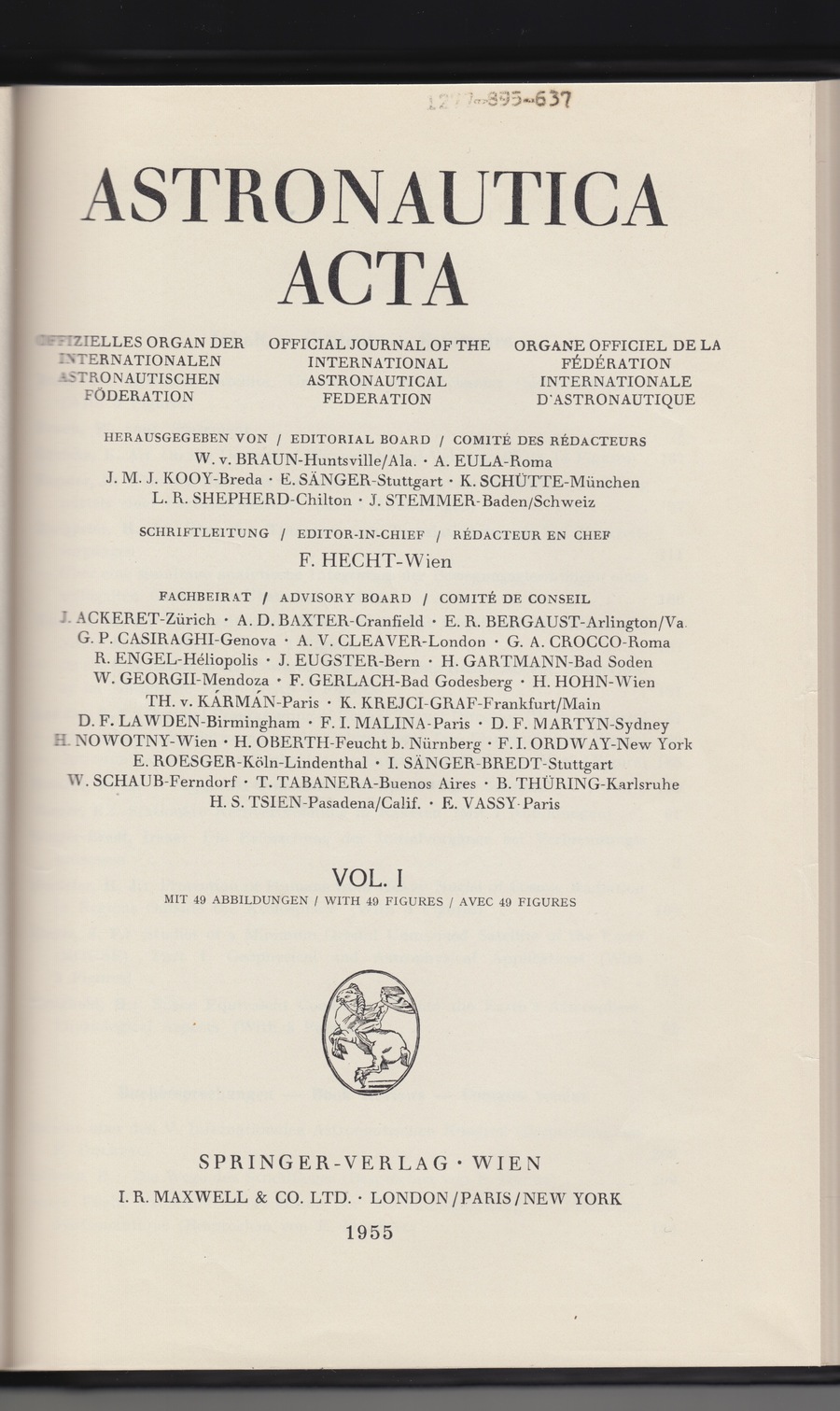
Astronautica Acta, Vol. I.
Inaugural volume of the official journal of the newly founded International Astronautical Federation, the direct publishing outcome of the founding resolution signed at the Paris 1950 congress (also in this collection). Edited by F. Hecht, with an editorial board reading like a roster of the field: von Braun, Sänger, Oberth, von Kármán, Shepherd, Cleaver, Malina, Tsien, and Tabanera among them, several already represented elsewhere in the collection. Opens with a statement by Wernher von Braun arguing for astronautics as a legitimate discipline, and includes a paper by Irene Sänger-Bredt, credited elsewhere in the collection under her maiden name, J. Bredt, as Eugen Sänger’s co-author on the antipodal-bomber report (A Rocket Drive for Long Range Bombers, 1952).
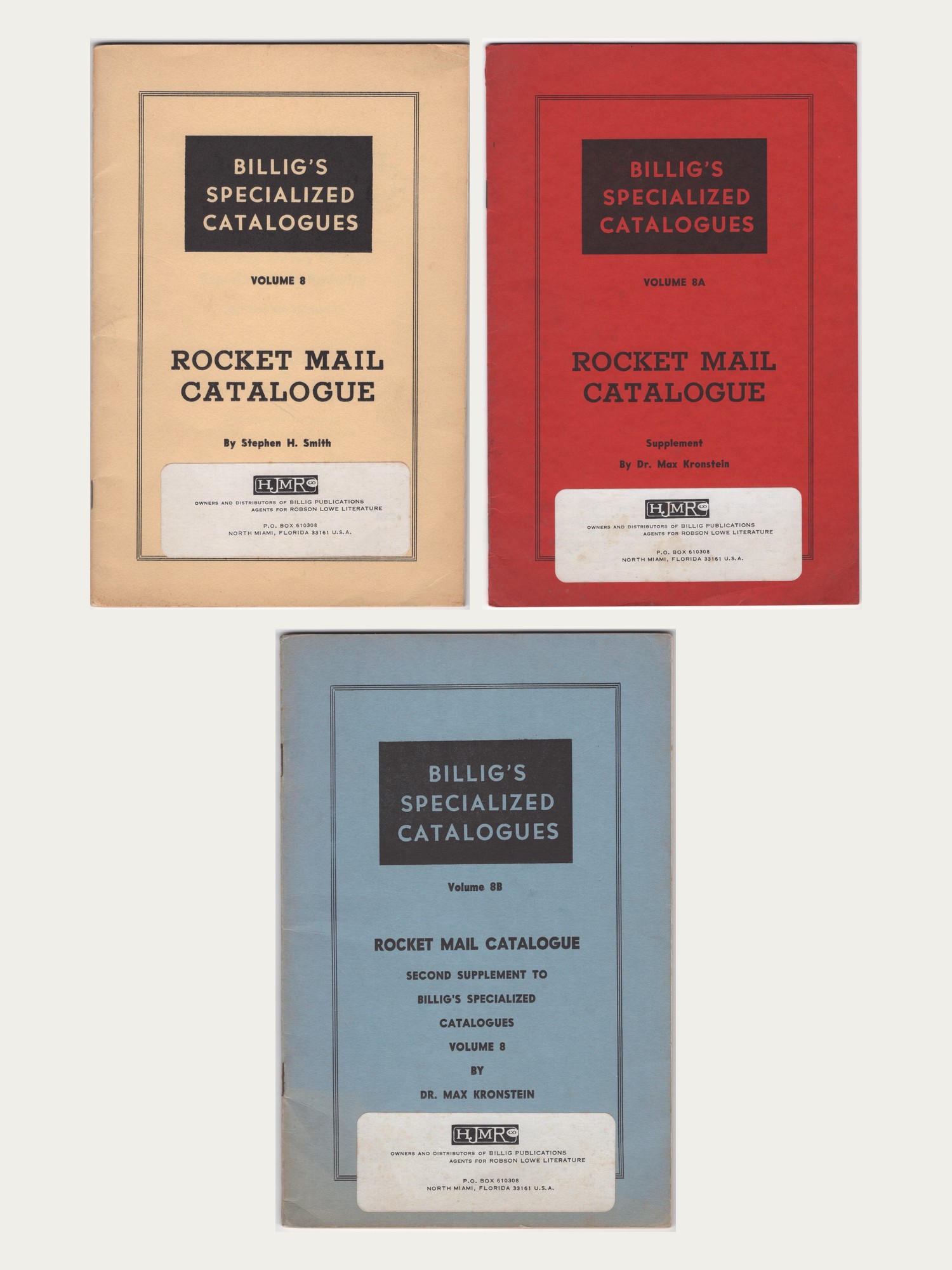
Billig’s Specialized Catalogues: Rocket Mail Catalogue. Volume 8, Volume 8A, Volume 8B.
Three volumes in one running sequence, each correcting or supplementing the last, from the specialized philatelic series founded by Fritz Billig. All three give their own account of the same event as the souvenir volume elsewhere in this collection: the July 2, 1936 rocket mail flight across the Rio Grande between McAllen, Texas and Reynosa, Mexico. Volume 8 (1955), by Stephen H. Smith, misattributes the experiment to Professor R. H. Goddard. Volume 8A (1958), Dr. Max Kronstein’s supplement, is headed “Supplemented and Corrected Text for the Whole Page 68” and restores the true experimenter, sixteen-year-old Keith E. Rumbel of the McAllen American Legion post, while adding three previously uncatalogued trial rockets flown ten days before the international flight. Volume 8B (1965), Kronstein’s second supplement, continues the sequence to July 2, 1961, a further pair of flights marking the 25th anniversary of the original crossing.
 Featured
First International Rocket Air Mail
›
Featured
First International Rocket Air Mail
›
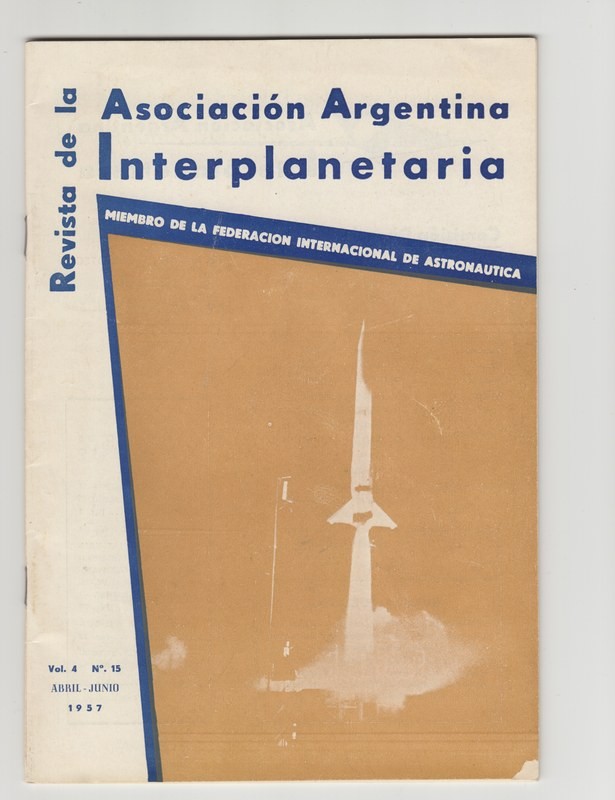
Revista de la Asociación Argentina Interplanetaria. Vol 4. No. 15.
Announces Argentina joining the International Geophysical Year of 1957, but light on details.
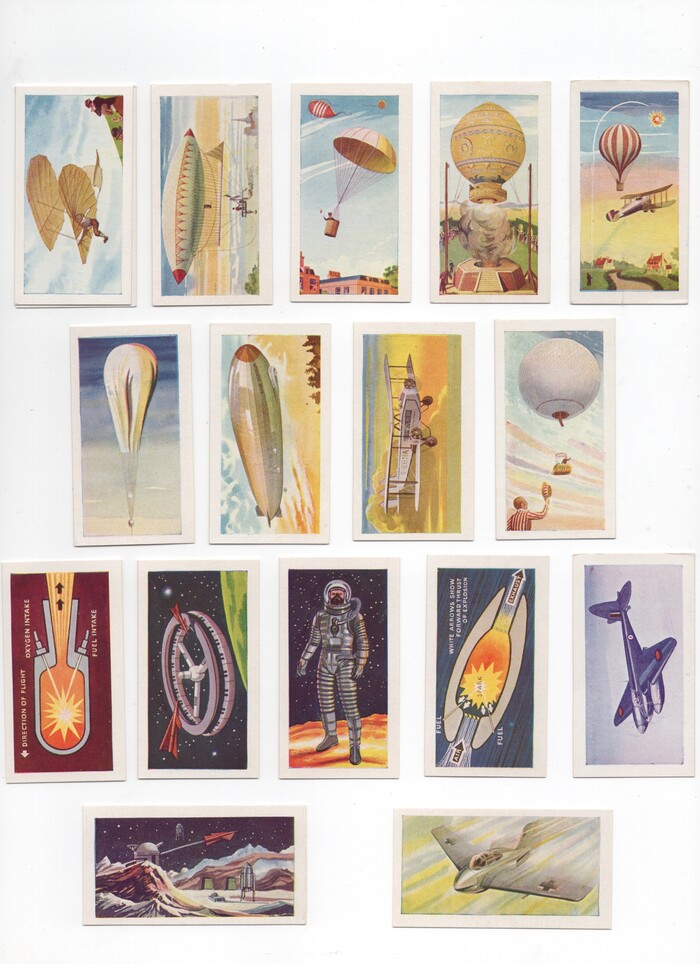
The Conquest of Space.
A complete set of 50 cards issued in 1957 with Cadet Sweets in the UK. Each card depicts steps in the conquest of air and space, from balloons, and the Martin Viking rocket, to fictional moon bases.
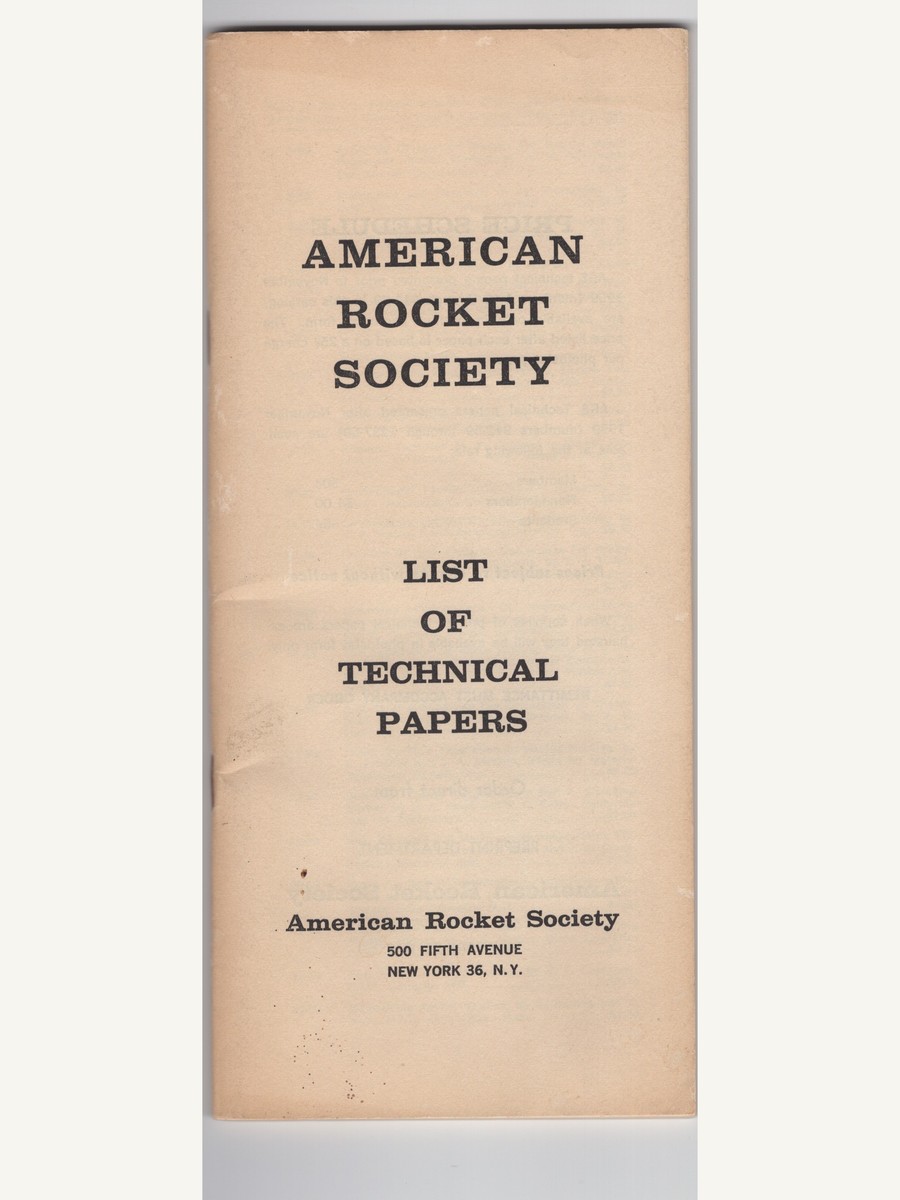
List of Technical Papers.
Undated society pamphlet listing over 600 ARS technical papers issued 1949 through 1960, each individually priced, with an order form bound into the back pages for ordering direct from the Society. The pamphlet itself carries no date, but two details narrow it: the address uses a postal zone number, “New York 36, N.Y.,” a format retired when ZIP codes arrived in 1963, and the Society itself merged into the newly formed AIAA at the end of January that same year. A pamphlet still branded American Rocket Society, listing papers no later than 1960, is unlikely to be much later than that — likely printed circa 1960–1962.
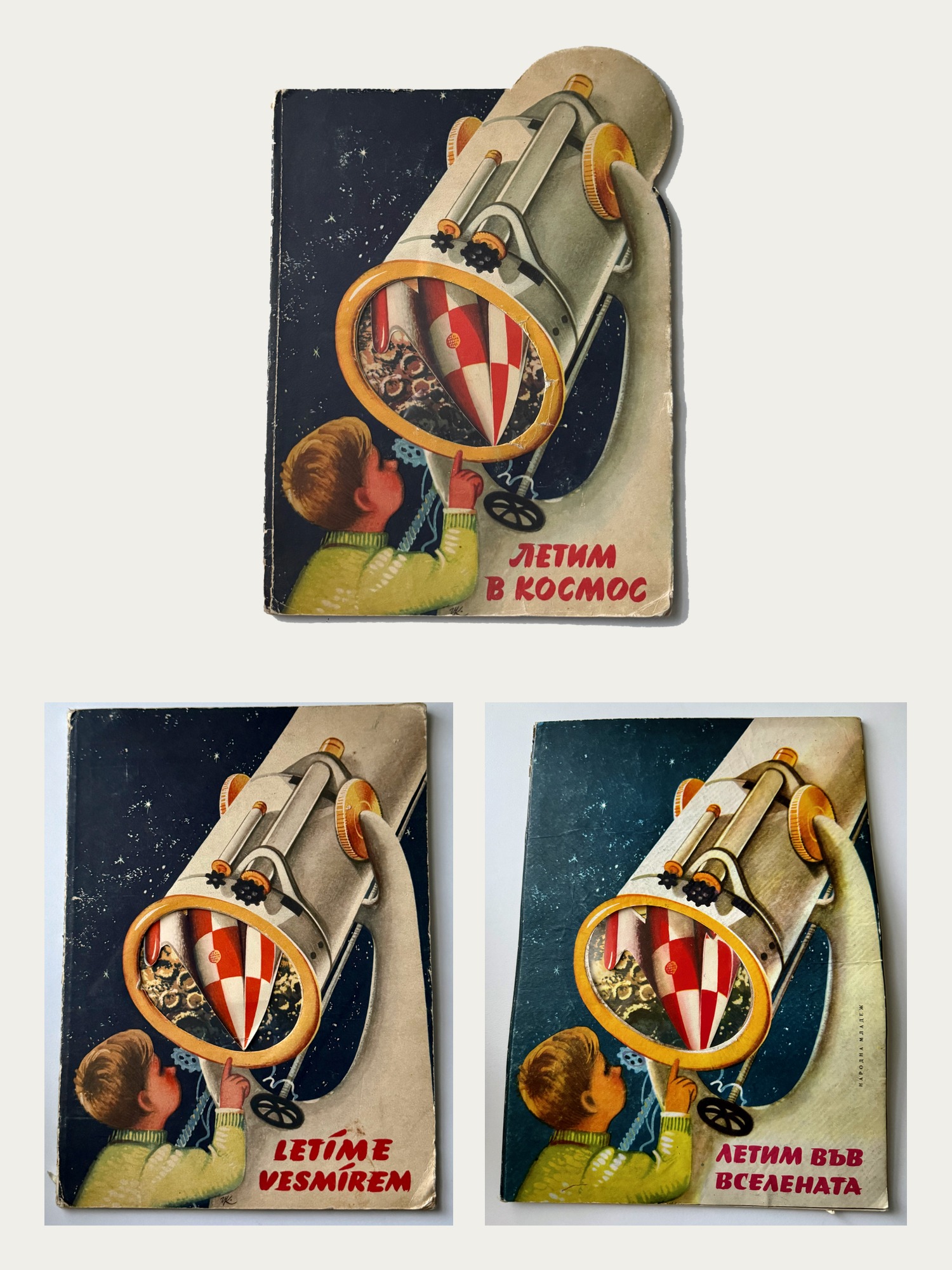
Letíme vesmírem [Flying Through the Universe]: Three Editions.
Three language editions of this Kubašta pop-up book, each with a die-cut cover framing a cellophane-windowed telescope through which a boy spies a rocket above the moon, and two interior double-page pop-ups: the rocket alone against the moon, then a full launch-pad diorama with gantry tower, crane, aircraft, and toy cars. The story follows two boys, Petr and Miloš, on an imagined space voyage guided by Petr’s father, an astronautics engineer. The Czech-language copy, translated from Čajda’s original Slovak text by R. Illnerová, was issued by Mladé letá of Bratislava as the 957th title in its “Prostorové knížky” (Spatial Books) pop-up series. The Russian edition, Letim v kosmos [We’re Flying to Space], came from Artia in Prague, crediting only Kubašta by name. The Bulgarian edition, Letim vav vselenata [We Fly into the Universe], was translated from the Slovak text by Georgi Valchev and issued by Narodna Mladezh in Sofia in a print run of 80,000. All three have functional pop-up mechanisms, with the wear typical of the format.
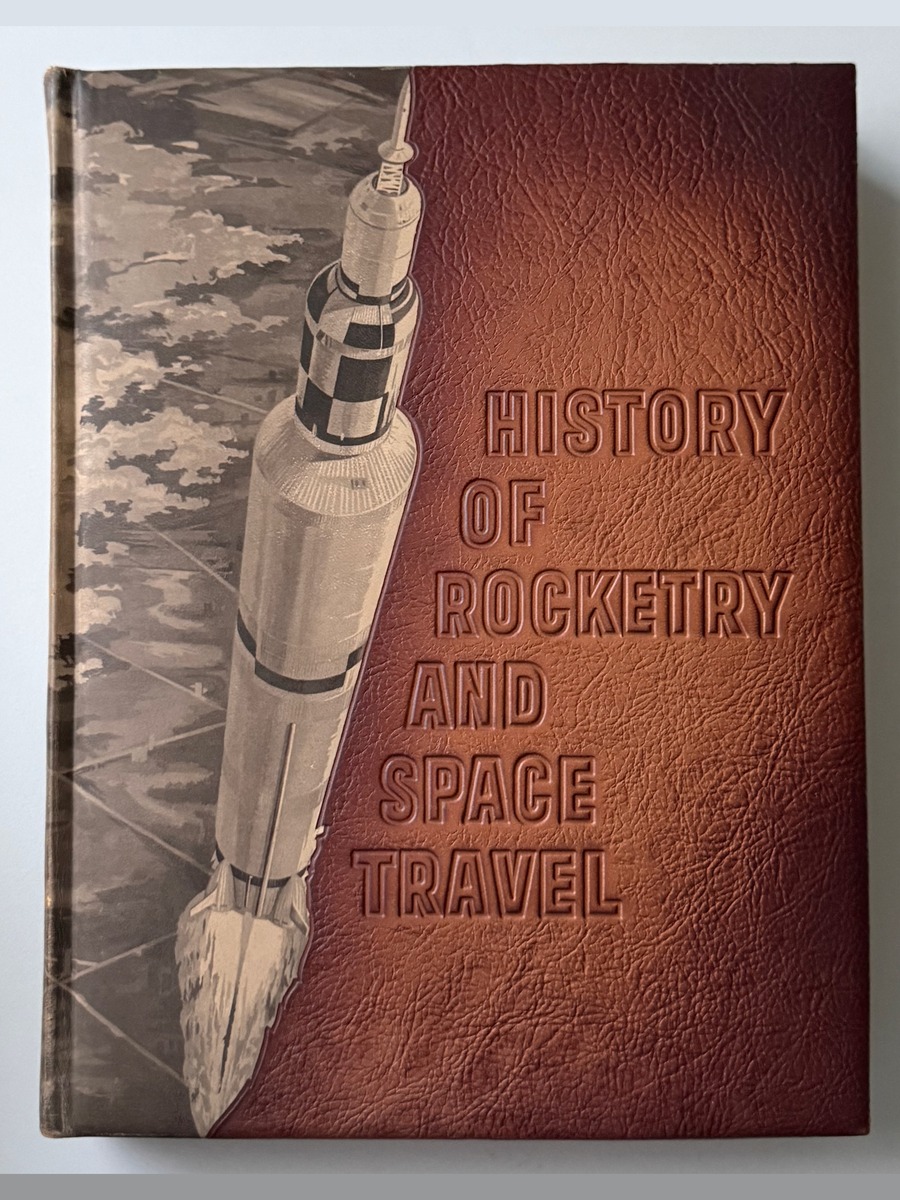
History of Rocketry & Space Travel.
Special presentation issue of the same first printing as the ordinary trade copy of this title, also in this collection (Reference Shelf) — identical text and copyright page, but bound in handcrafted “Mission Leather” by Brown and Bigelow of St. Paul, Minnesota, a division of Standard Packaging Corporation, as stated on its title page. No dust jacket, as issued; the cover’s embossed title spells out “AND” where the dust-jacketed trade edition uses an ampersand. Original illustrations by Harry H-K Lange, one of the book’s three copyright holders; introduction by Frederick C. Durant III.
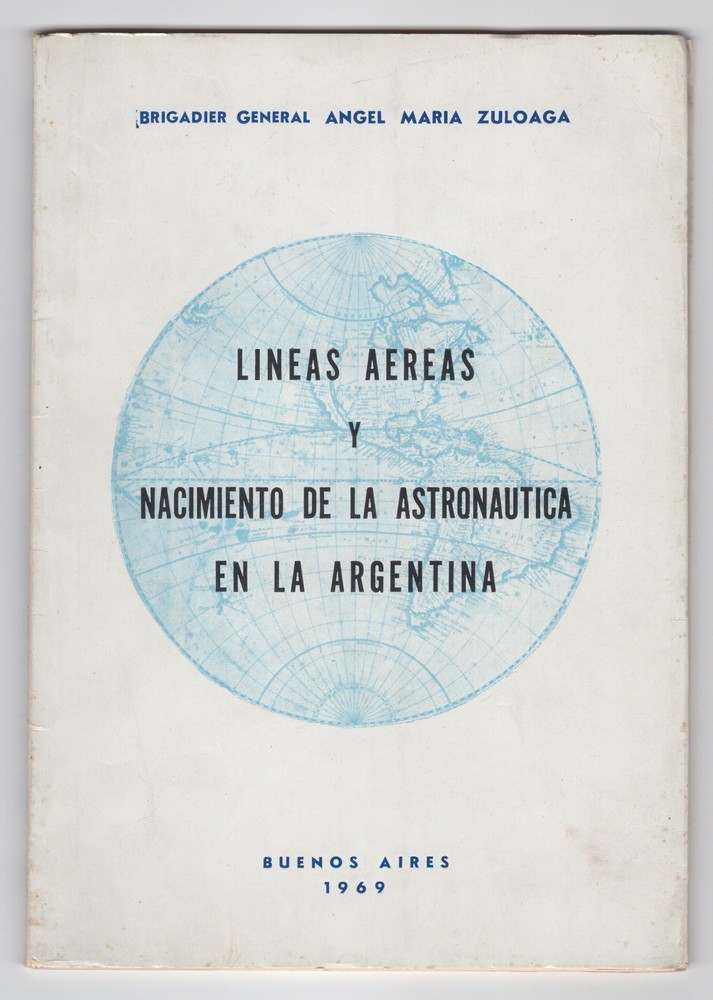
Líneas Aéreas y Nacimiento de la Astronáutica en la Argentina.
Zuloaga’s later retrospective, carrying the story of Argentine aviation from the pioneer era into the astronautics age. Retells the 1915 record flights and the 1916 Andes crossing in the author’s own words, more than fifty years on.
Featured
Crossing the Andes by Balloon
›
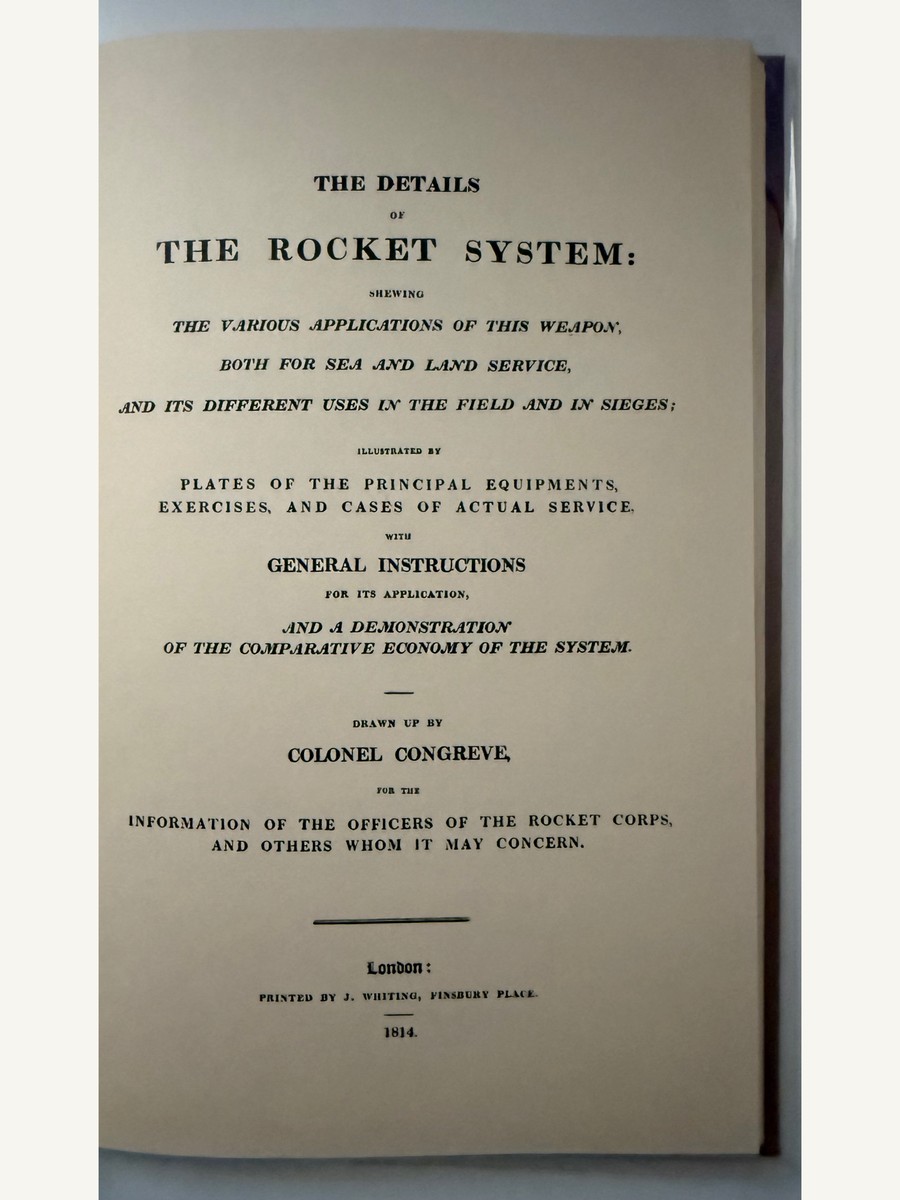
The Details of the Rocket System.
Limited facsimile edition of Congreve’s 1814 rocket manual, reset in single column from the original two-column 11 by 16 inch printing, edited and prefaced by S. James Gooding. One of 850 numbered copies; this exemplar is No. 599. Beyond Congreve’s text, the volume adds two further parts: a series of photographs of a scale model of the rocket carriage and limber, formerly in the Royal United Services Institution and now in the West Point Museum collection, and a reprint of Capt. (later Colonel) Edward Mounier Boxer’s 1860 assessment “The Congreve Rocket,” originally published in a Treatise on Artillery for Her Majesty’s Stationery Office. A companion piece to the 1815 parliamentary notice of Congreve’s rocket pension held elsewhere in this catalog.
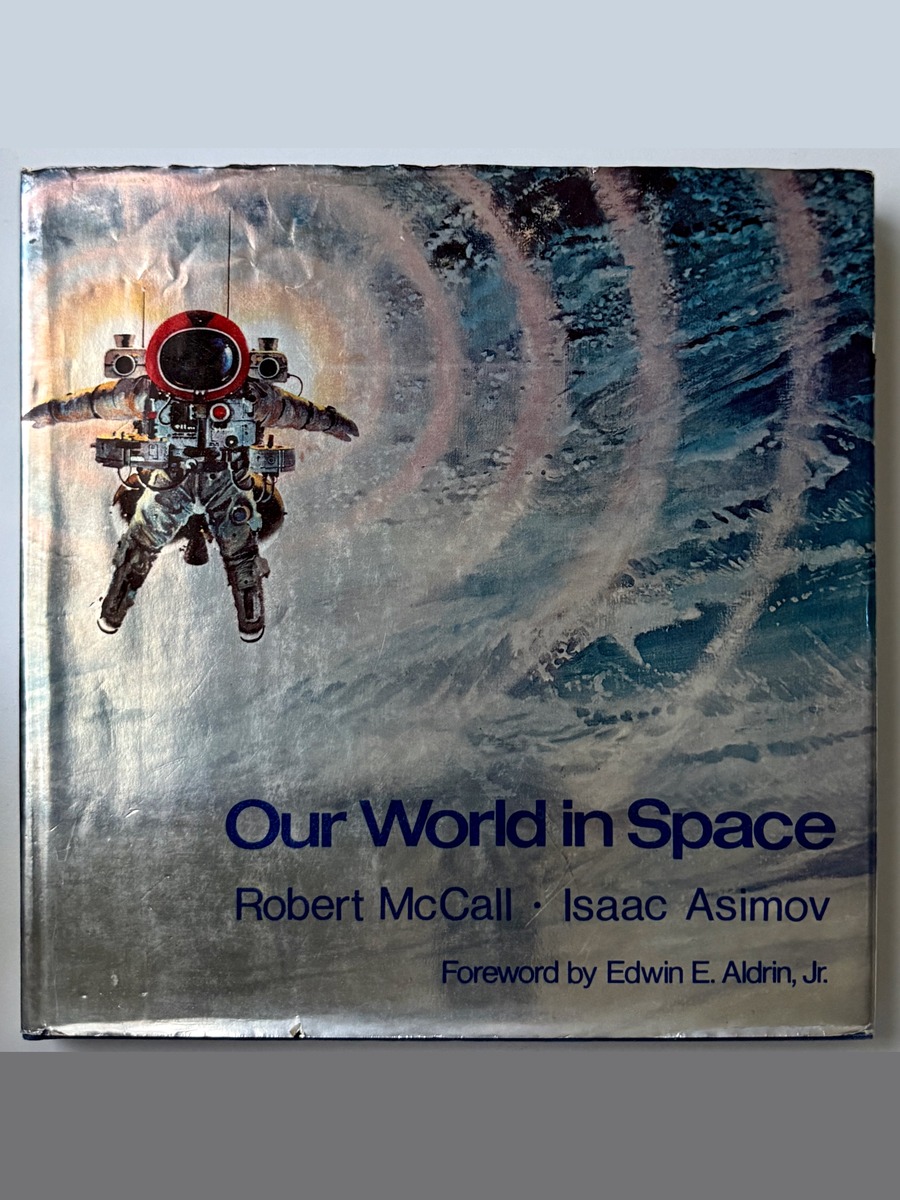
Our World in Space.
Large-format collection of more than fifty McCall space paintings — the artist NASA commissioned for its own Apollo-era commemorative stamp and whose work hangs in the Smithsonian — paired with an Asimov text that moves outward by stages: the Moon, the rocket that gets there, a lunar colony, Mars, then Ceres and Jupiter, and finally the stars, speculating on a solar system essentially colonized by 2200 A.D. Foreword by Apollo 11’s Buzz Aldrin. The metallic foil dust jacket is characteristic of McCall’s space-art books of the period and prone to creasing, as here.

Letchiki-Kosmonavty SSSR [Pilot-Cosmonauts of the USSR].
Set of thirty-eight postcards, each a color photographic portrait of a Soviet cosmonaut in flight gear, ordered by mission from Yuri Gagarin’s 1961 flight through the Soyuz 24 crew, Vyacheslav Zudov and Valery Rozhdestvensky, in 1977. Photography by Yu. Ustinov, Yu. Zharov, and A. Mokletsov; consultant Colonel A. Kuklin; design by D. Zuskov. The cover reproduces the Pilot-Cosmonaut of the USSR medal, awarded to each flyer alongside Hero of the Soviet Union. Plakat reissued and expanded this series repeatedly as the cosmonaut corps grew, to 50 cards and eventually 58 by the mid-1980s; this is the original 1978 edition of 38, printed in a run of 470,000 sets.

The Right Stuff.
Wolfe’s account of the Mercury Seven astronauts and the test-pilot culture of Edwards Air Force Base that produced them, tracing the space race from Chuck Yeager’s early supersonic flights through Gordon Cooper’s 1963 Mercury-Atlas 9 mission and setting the pilots’ own ethos against NASA’s public-relations machine. Grew out of a four-part series on the astronauts Wolfe wrote for Rolling Stone in 1973. Won the National Book Award for Nonfiction and the American Book Award; adapted as the 1983 film of the same name.
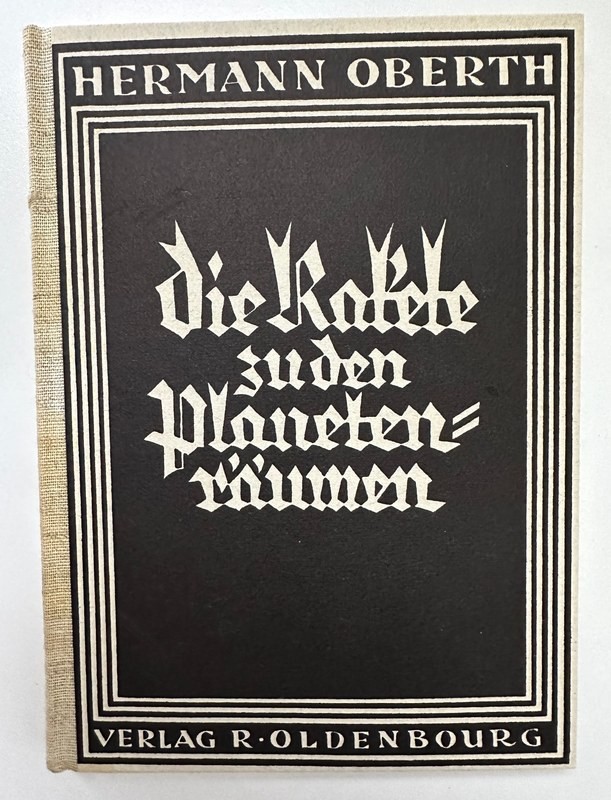
Die Rakete zu den Planetenräumen.
1984 re-edition of Oberth’s foundational work. Two exemplars in the collection; one signed and dedicated by Oberth to Kyril Serafimov of the Bulgarian Academy of Sciences.

Planet Dora: A Memoir of the Holocaust and the Birth of the Space Age.
Béon’s memoir of imprisonment at Dora, the concentration camp near Nordhausen where tens of thousands of prisoners were worked to death from 1943 to 1945 building the V-1 and V-2 rockets in an underground tunnel factory. Active in the French Resistance from age fifteen until his capture, Béon survived Buchenwald, Dora, and Bergen-Belsen; he wrote his account using only inmates’ first names, so that, in his words, “what happened to one of them happened to all of them.” First published in France as La planète Dora (Éditions du Seuil, 1985); this English edition, translated by Béon and Richard L. Fague, carries an introduction by Michael J. Neufeld, curator at the Smithsonian’s National Air and Space Museum.

Nihon Hatsu no Roketto Sentōki Shūsui: Ekitai Roketto Enjin-ki no Tanjō [Japan’s First Rocket Fighter “Shusui”: The Birth of a Liquid-Rocket-Engine Aircraft].
History of the Mitsubishi J8M1 Shūsui, Japan’s only operational rocket-powered interceptor, built from technical data on the German Me 163 Komet that reached Japan by submarine (one of the two boats carrying the plans was lost en route, leaving designers to work from an incomplete set). Conceived to climb fast enough to reach high-altitude B-29 formations, the aircraft went from data to a completed airframe in under a year. Its sole powered test flight, flown by Lieutenant Toyohiko Inuzuka at the Navy’s Oppama airfield on July 7, 1945, ended in a fatal crash; a second death followed eight days later when an engine under acceptance testing at Yamakita exploded, killing Technical Lieutenant Masada. The war ended before a production aircraft could fly. Matsuoka, a Mitsubishi Heavy Industries engineer for four decades, draws on the company’s internal archives and photographs; later chapters cover a postwar restoration of a surviving airframe and the traces of the Shūsui’s wartime base at Kashiwa.
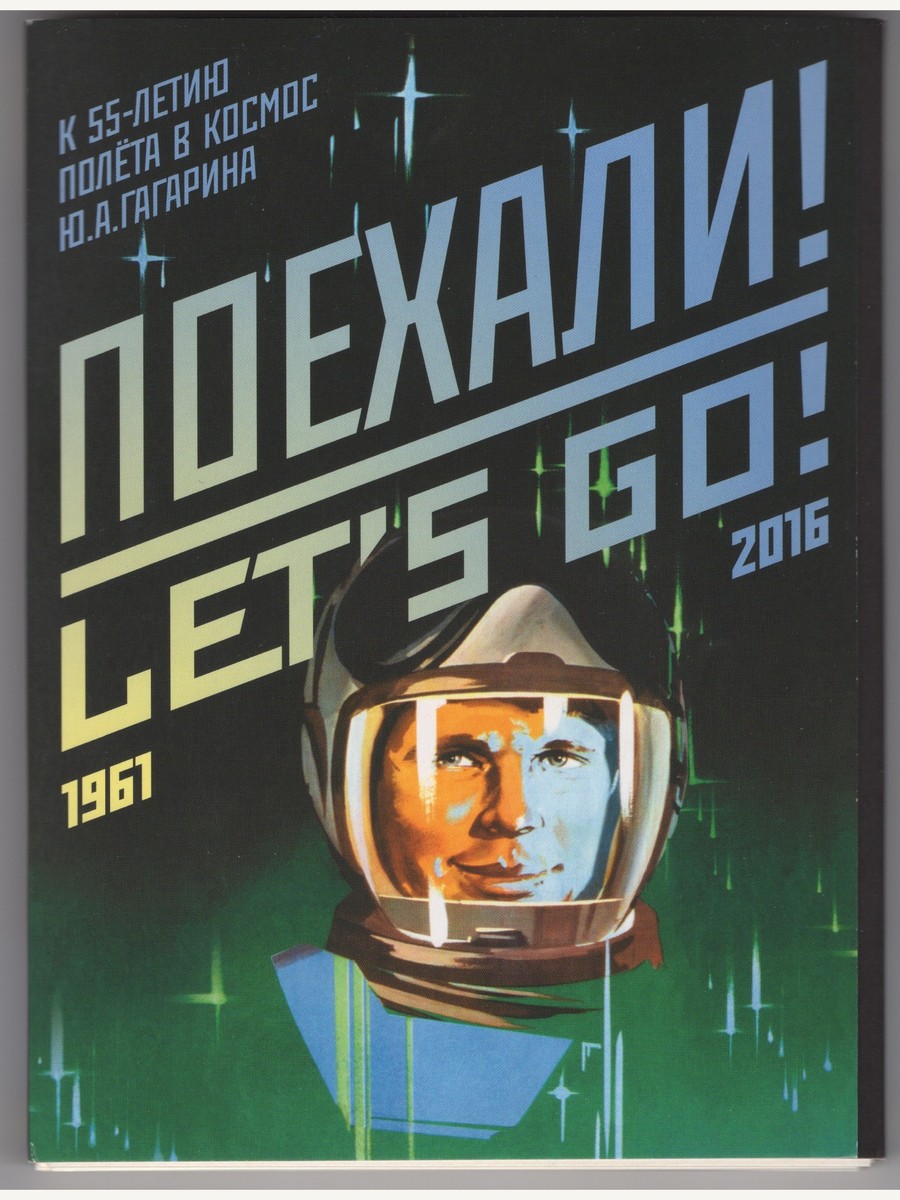
Poekhali! Let’s Go! 1961–2016.
Set of twenty-two postcards, each reproducing in full a Soviet space-program propaganda poster dated 1959 to 1982, issued for the 55th anniversary of Yuri Gagarin’s 1961 flight. Poster artists include V. Viktorov, B. Berezovsky, and M. Solovyov among others; each card carries the original Russian slogan on its front with an English translation, and a printed checklist gives artist, title, and year for all twenty-two. Designed and compiled by Alexander Utkin. Edition of 1,500 copies; cards measure 13 by 18 cm.