Catalog E · Miscellanea · Special Feature
First Astronautical Congress
Paris, 30 September – 3 October 1950
In the autumn of 1950, delegates from eight national rocket societies met in Paris for the Premier Congrès International d’Astronautique, the founding event of what became the International Astronautical Federation. Alexandre Ananoff, president of the Groupement Astronautique Français, organized the congress and secured the Sorbonne’s Grand Amphithéâtre for its opening session.
The collection holds the congress’s working papers in depth: the signed founding resolution, both working-session protocols, the full day-by-day program, a biographical dossier on the society’s neutral first president, and the German delegation’s own press coverage of the event, including several drafts by the delegate who wrote it up for publication.
Four Days in Paris
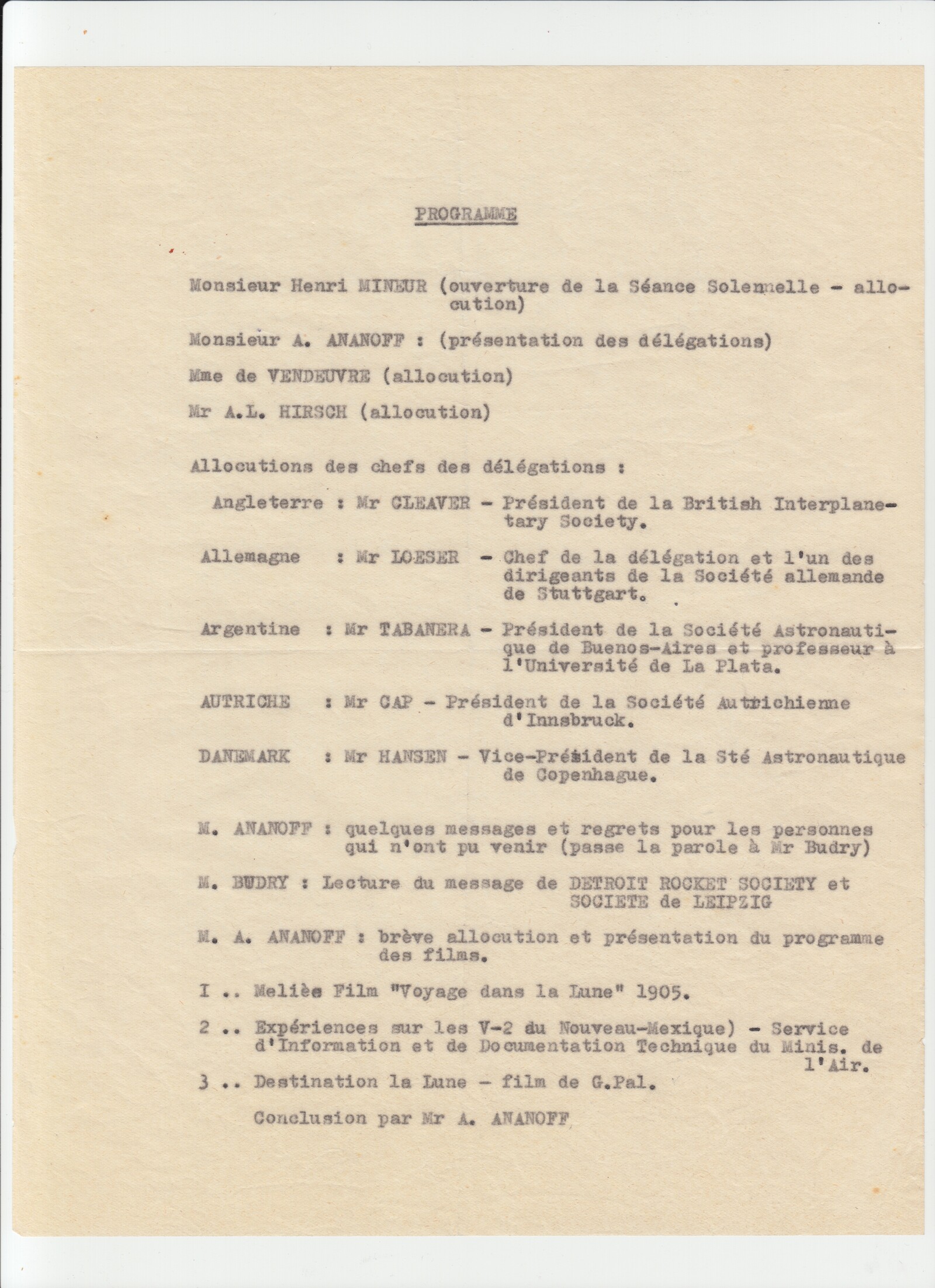
The congress opened on Saturday 30 September with a formal session in the Sorbonne’s Grand Amphithéâtre. Henri Mineur, director of the French Institute of Astrophysics, gave the opening address as honorary president, followed by Ananoff introducing each delegation and remarks from Mme de Vendeuvre and Mr. A.L. Hirsch. The delegation chiefs then spoke in turn: A.V. Cleaver, president of the British Interplanetary Society; Dr. G. Loeser, head of the German delegation and a director of the Gesellschaft für Weltraumforschung e.V. in Stuttgart (GfW); Teófilo Tabanera, president of the Sociedad Astronáutica de Buenos Aires and a professor at the University of La Plata; Mr. Cap, president of the Austrian society in Innsbruck; and Mr. Hansen, vice president of the Copenhagen astronautical society. Mr. Budry read messages of regret from societies unable to attend, including the Detroit Rocket Society and a society in Leipzig. The evening’s program closed with films: newsreel footage of V-2 test firings in New Mexico, supplied by the French Air Ministry’s technical documentation service, and the American color film Destination Moon, not yet released in Germany at the time. One surviving copy of the program has its planned screening of Méliès’s 1905 Voyage dans la Lune crossed out by hand.
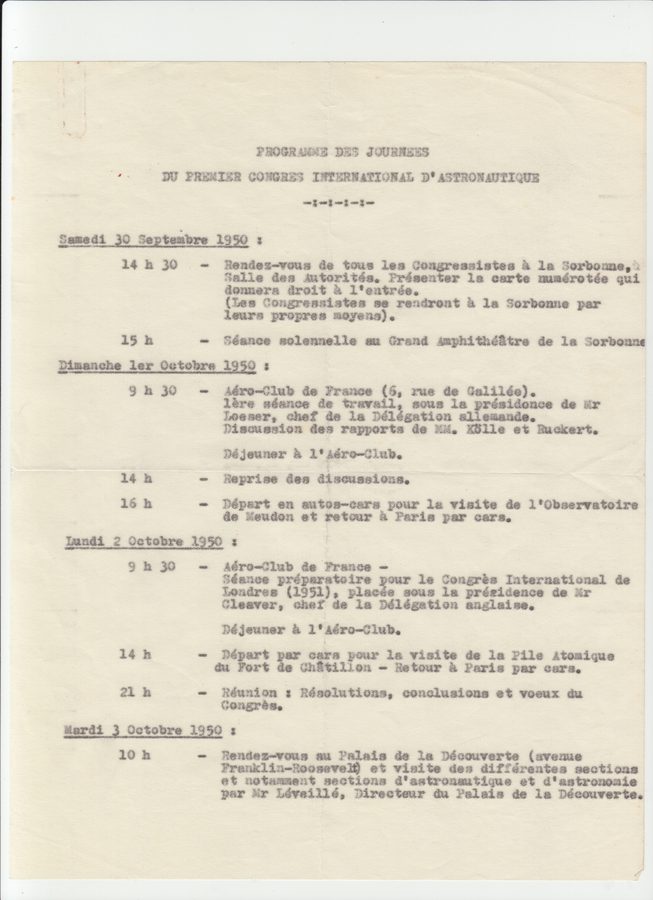
The working sessions that followed, on Sunday and Monday, were held at the Aéro-Club de France. Between sessions the delegates were taken to visit the Observatoire de Meudon on Sunday afternoon and the atomic pile at the Fort de Châtillon on Monday afternoon, a visit one German account calls especially impressive and, coming five years after the war, “a very friendly gesture.” The congress closed on Tuesday 3 October with a visit to the Palais de la Découverte, guided through its astronomy and astronautics sections by the museum’s director, Mr. Léveillé.
Two Working Sessions
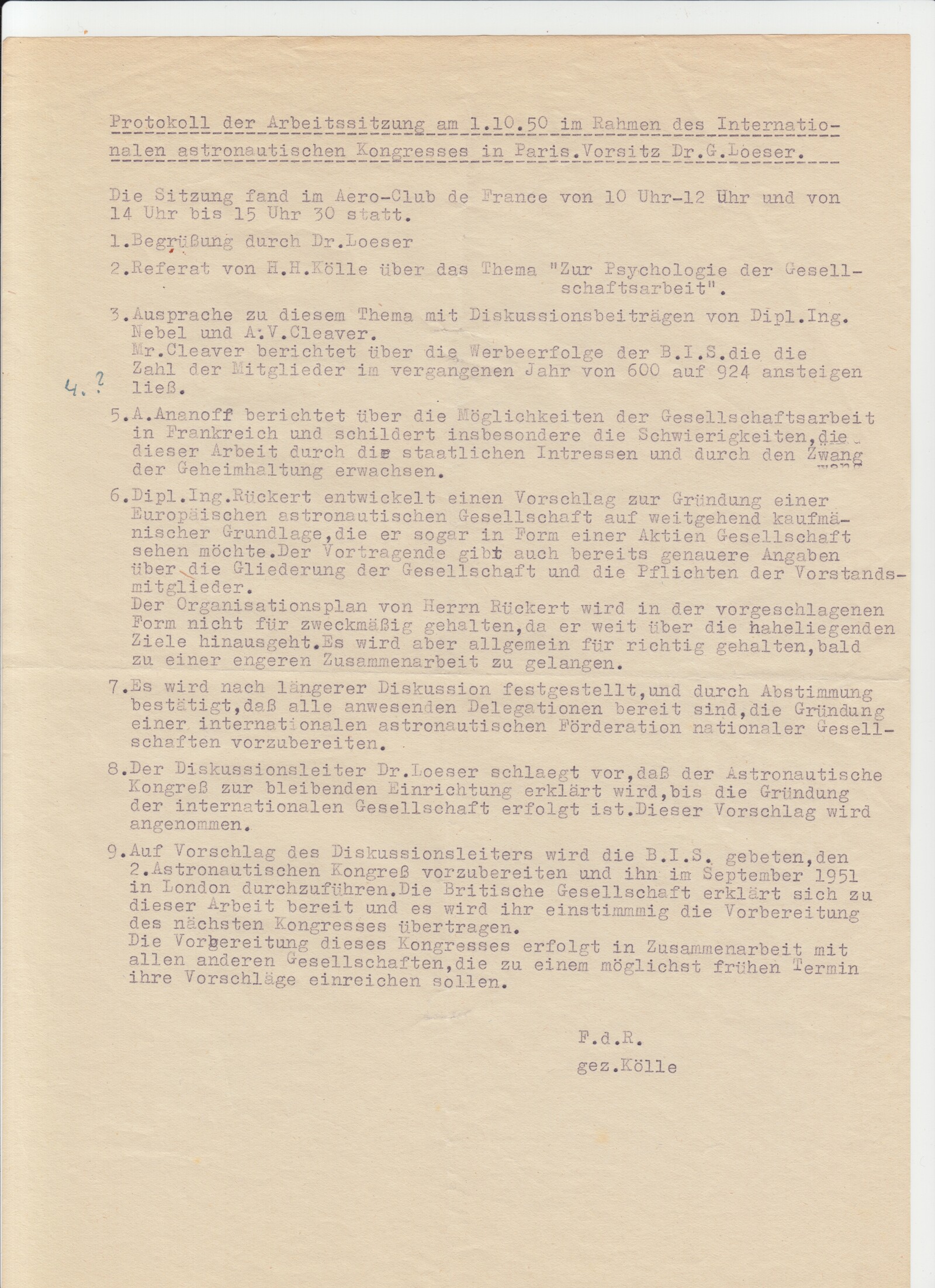
Both working-session protocols in the collection are typed and signed “gez. Kölle,” the initials of H.H. Kölle, the German delegation’s recording secretary. The Sunday session, chaired by Loeser, opened with a talk by Kölle himself, “Zur Psychologie der Gesellschaftsarbeit” (On the Psychology of Society Work), followed by discussion from Dipl.Ing. Rudolf Nebel and Cleaver. Cleaver reported that BIS membership had grown from 600 to 924 over the past year. Ananoff described the particular difficulties of astronautical work in France, where state secrecy constrained what could be published or discussed. Dipl.Ing. Rückert then proposed founding a commercially organized European astronautical society, structured along the lines of a joint-stock company, complete with a proposed division of duties among its board. The session judged the plan impractical as presented, though worth returning to in a looser form, and voted unanimously to prepare an international federation of national societies. Loeser proposed that the congress itself be declared a standing institution until that federation existed, which was adopted, and the British Interplanetary Society agreed to organize the second congress, in London in September 1951.
The Monday session, chaired by Cleaver, focused on preparing for London. Ananoff again pressed the point that a clear public resolution announcing the federation’s eventual founding was needed for outward-facing credibility. Cleaver’s own draft was adopted as the basis for that resolution, and a founding committee was formed from the chiefs of all delegations present. Dr.Ing. Eugen Sänger, described in the protocol as a neutral figure, was elected unanimously to chair it, and accepted. London was set for roughly a week in early September 1951: the first days reserved for administrative business, then a scientific program built around the Aussenstation, or Outer Station project, which every society was asked to name specialists for, coordinated on the British side by Dr. Shepherd of the BIS. A parallel standards committee was proposed to standardize astronautical terminology across languages, also to convene at the start of the London congress. The session discussed, without resolving, a proposed public lecture series under the motto Wie wird die Weltraumfahrt verwirklicht werden? (“How will space travel be realized?”), and agreed that all congress correspondence going forward should be conducted only on each society’s official letterhead with authorized signatures.
The Founding Resolution
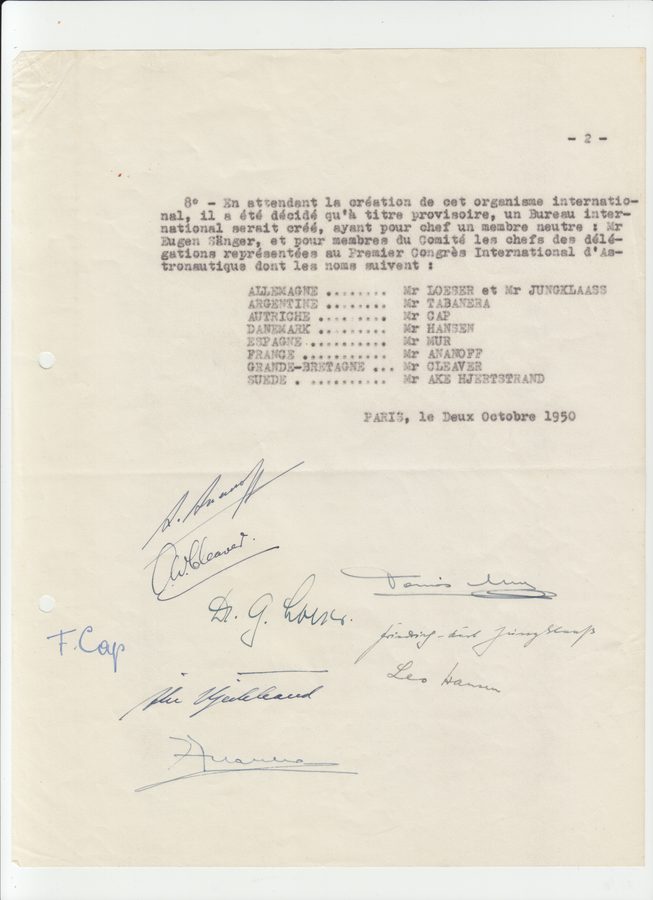
The signed resolution, dated Paris, 2 October 1950, records eight points agreed unanimously. The delegates resolved to create an international body for the study and development of interplanetary navigation, but judged there was neither the time nor the groundwork to finalize its structure at this first congress; formal founding was deferred to the second congress, in London the following September. In the meantime the British Interplanetary Society agreed to centralize and coordinate proposals from each national society, with delegates studying them in advance to keep the London floor debate short. Final decisions on the federation, to be named the Fédération Internationale des Sociétés Astronautiques, would wait for London, where its creation would “be solemnly proclaimed.”
Pending that, the eighth article created a provisional international bureau, headed by a neutral member, Eugen Sänger, with the chiefs of each represented delegation sitting as its committee: Loeser and Jungklaass for Germany, Tabanera for Argentina, Cap for Austria, Hansen for Denmark, Mur for Spain, Ananoff for France, Cleaver for Great Britain, and Åke Hjertstrand for Sweden. All eight signed the document by hand.
A Neutral President: Dr. Eugen Sänger
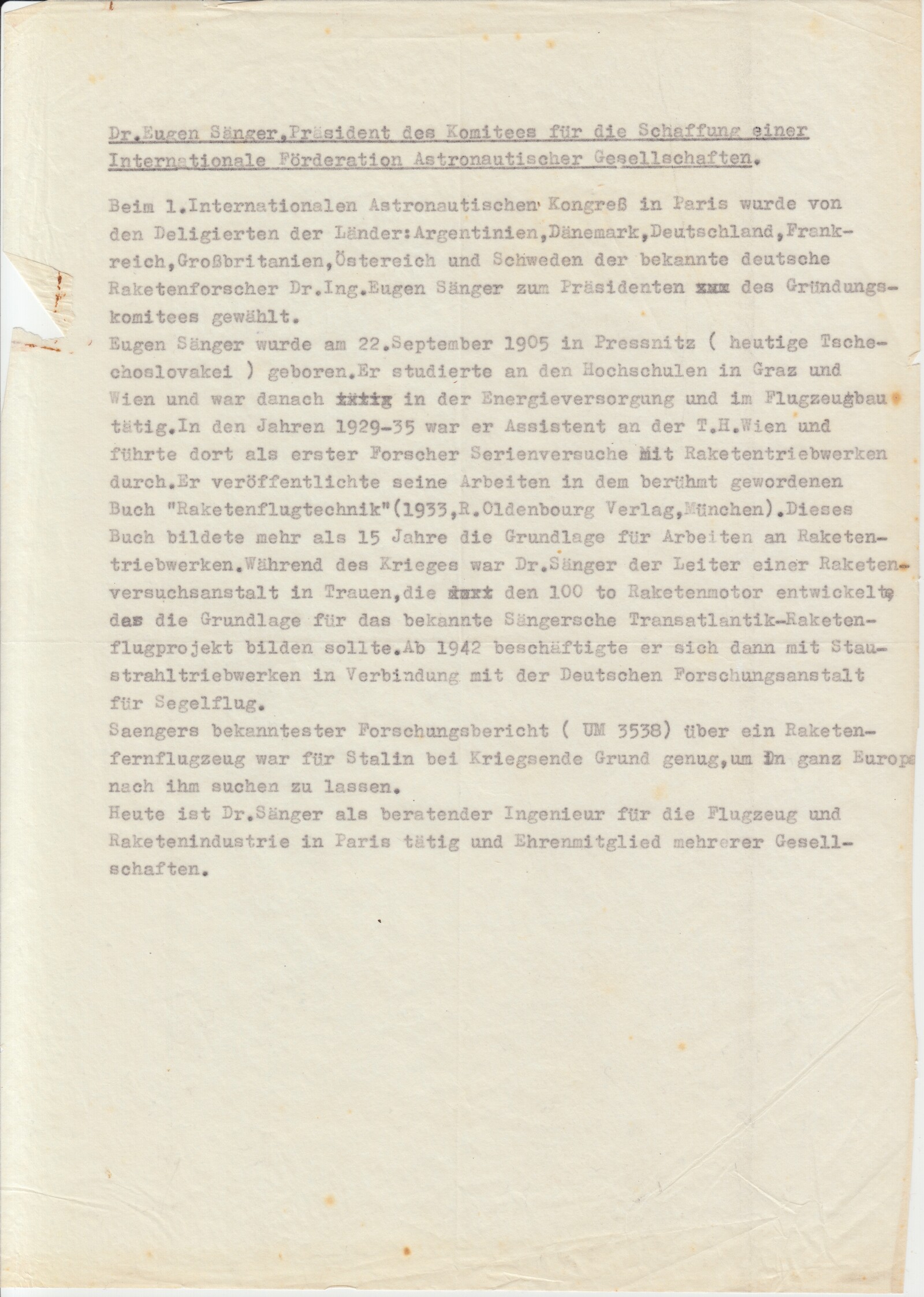
The collection holds a typed biographical dossier on Sänger, evidently prepared for circulation around the congress, that lays out why a rocket engineer with no delegation of his own was chosen to head the provisional bureau. Born 22 September 1905 in Pressnitz, then in Austria-Hungary and today in the Czech Republic, Sänger studied at the technical colleges in Graz and Vienna before working in power supply and aircraft construction. As an assistant at the Technische Hochschule Wien from 1929 to 1935, he ran what the dossier describes as the first serial tests of rocket engines, publishing the results in Raketenflugtechnik (R. Oldenbourg Verlag, Munich, 1933), a book that the dossier credits with underpinning rocket-engine work for the following fifteen years. This first edition is in the collection too, alongside two later Russian translations (1936 and 1947).
During the war Sänger led a rocket research station at Trauen that developed a 100-ton-thrust engine, the basis, per the dossier, for his well-known transatlantic rocket-aircraft project. From 1942 he worked on ramjet engines with the German Research Institute for Gliding Flight. His best-known wartime report, on a long-range rocket aircraft (catalogued as UM 3538), was according to the dossier reason enough for Stalin to have him searched for across Europe at the war’s end. That report, written with J. Bredt, is also in this collection, in its first commercially available English translation, A Rocket Drive for Long Range Bombers (Culver City: Robert Cornog, 1952). The German original, Über Einen Raketenantrieb Für Fernbomber (1944), was printed in only 100 copies for the German military and just three are known to survive; it is not in this collection. By 1950 Sänger was working in Paris as a consulting engineer to the aircraft and rocket industry, an arrangement that made him a workable neutral choice for a young federation whose member societies answered to eight different governments.
An Artificial Moon, and the Press
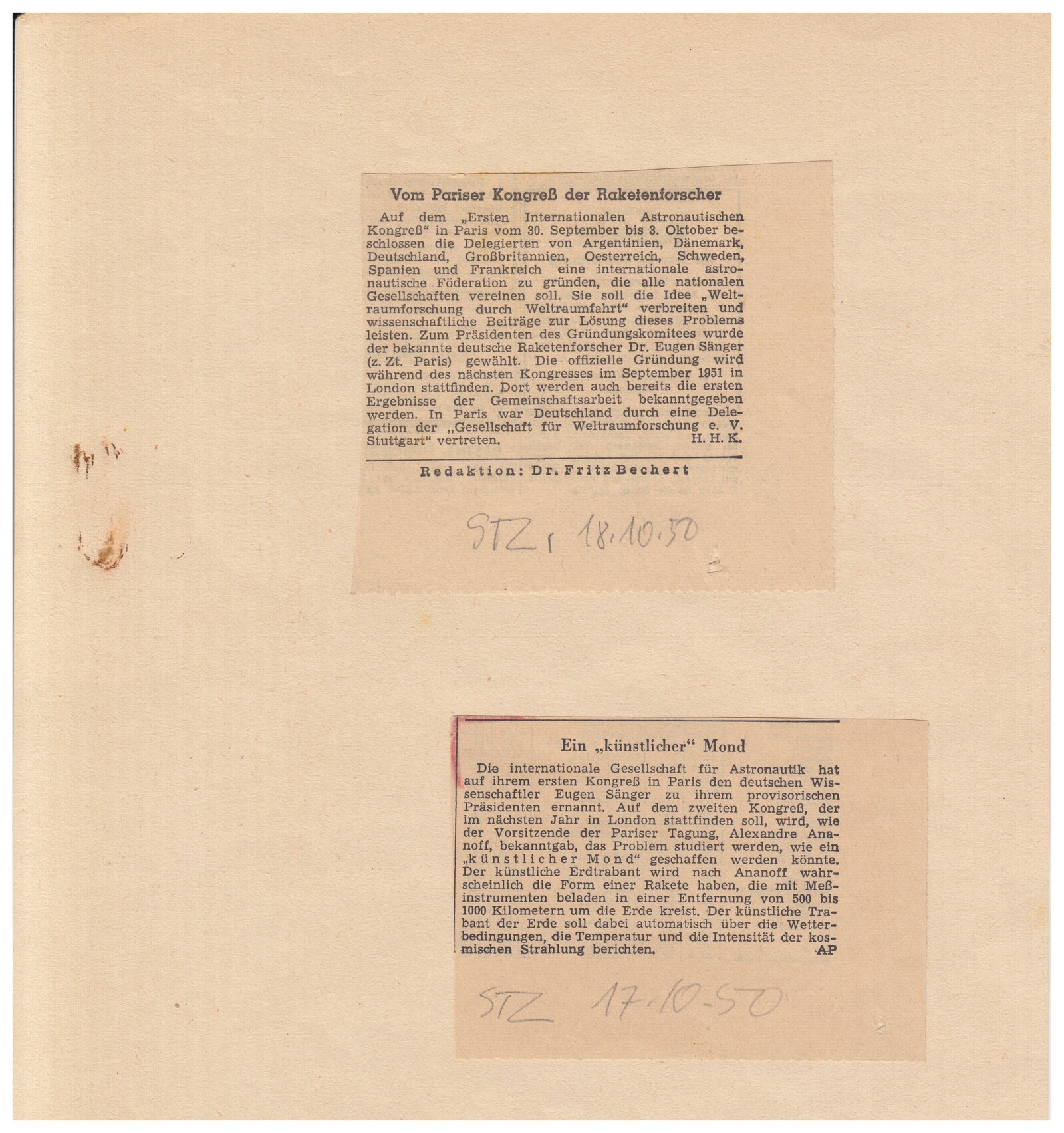
News of the congress reached Germany within days. The Stuttgarter Zeitung ran two items in mid-October: a wire report on 17 October, credited to the Associated Press, announcing Sänger’s election as provisional president and previewing a study Ananoff had announced into what the piece calls a “künstlicher Mond,” an artificial moon, a rocket-shaped satellite carrying instruments in an orbit 500 to 1,000 kilometers from Earth, automatically reporting on weather, temperature, and cosmic radiation. Seven years before Sputnik, the concept was already circulating in the German press under Ananoff’s name. The next day, 18 October, the paper ran a short first-person account of the congress itself, byline “H.H.K.”, the same Kölle who kept the session protocols.
The collection also holds Kölle’s published article in the journal Naturwissenschaftliche Rundschau, plus a publisher’s proof copy, and several of his own typed drafts of what is recognizably the same report, reworked for different outlets under titles like Der Erste Internationale Kongreß für Weltraumfahrt and Kongreß der Weltraumfahrer in Paris. Read together, the drafts return again and again to the same details: the unexpectedly warm, informal atmosphere among delegates who in several cases had corresponded for years without meeting; the German delegation’s full and equal standing, including chairing working sessions; and a closing sentiment, voiced at the Aéro-Club by both Mineur and Ananoff, that whichever scientists and engineers are first to see the Earth as a sphere suspended in space will be envoys of humanity, not of France, Britain, America, Russia, or Germany.
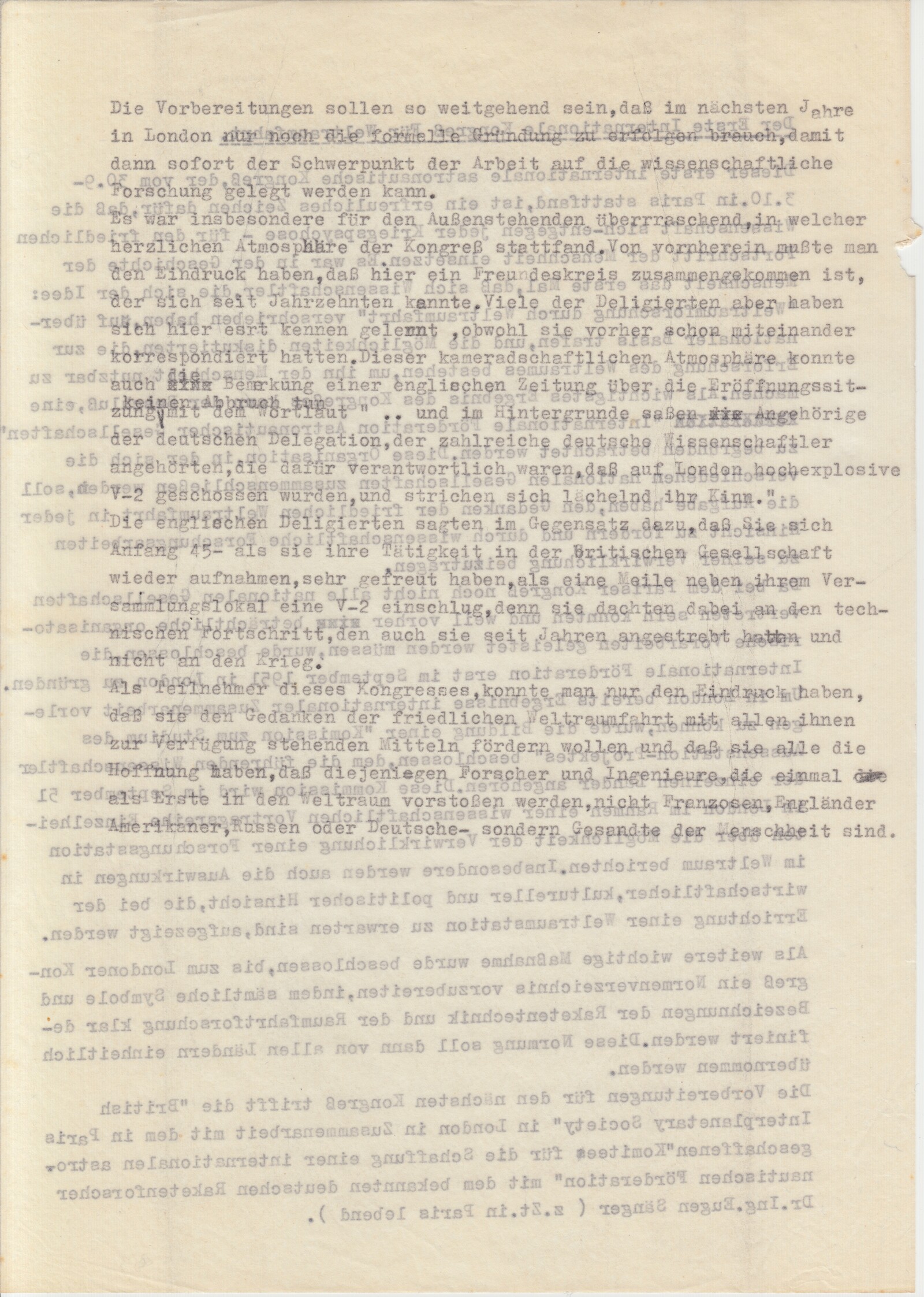
One of these drafts also passes along an aside an English newspaper made about the opening session: that German scientists responsible for the V-2s fired at London five years earlier sat in the audience, in the reporter’s words, “stroking their chins with a smile.” The same draft records the English delegates’ own account of themselves: that they had welcomed a V-2 landing near their meeting hall in early 1945, because it called to mind technical progress rather than the war. The German delegation chaired working sessions on equal footing throughout the congress, and Kölle notes the remark only as color, not complaint.
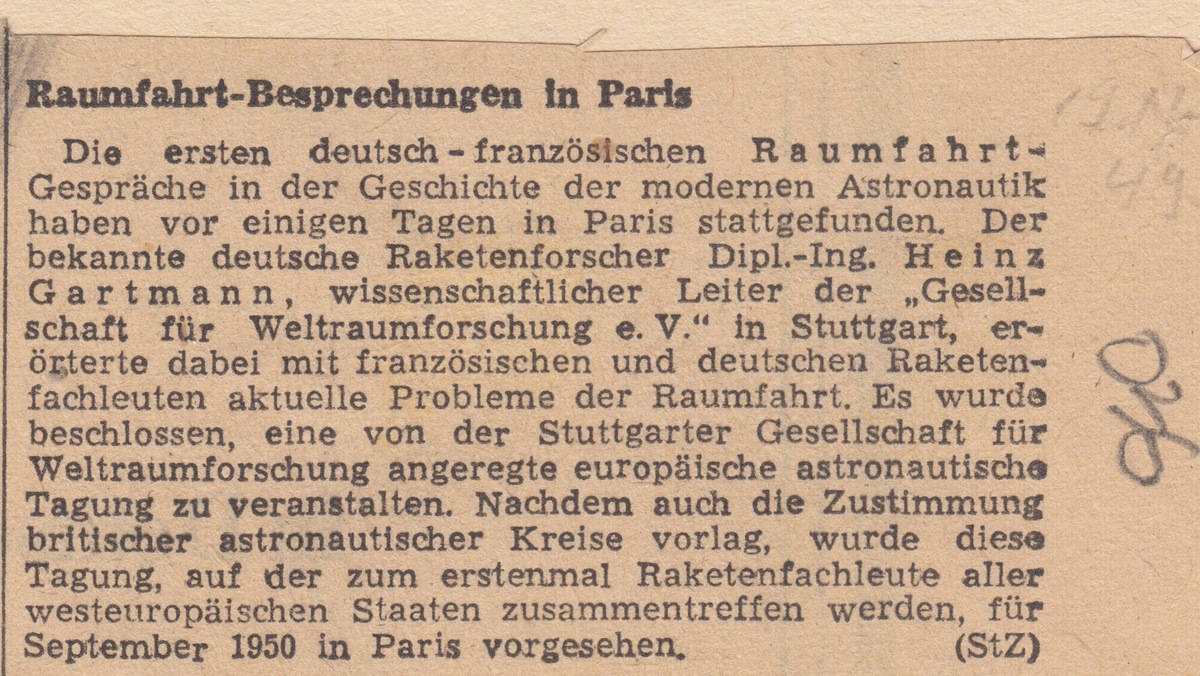
The congress itself had been a year in the making. A clipping from late 1949 reports the first German-French spaceflight talks of the modern era, held in Paris by Heinz Gartmann, scientific director of the GfW Stuttgart, with French and German rocket specialists. Once British astronautical circles also agreed to take part, the Stuttgart society’s proposal for a European astronautics conference was set for September 1950 in Paris, the piece noting it would be the first time rocket specialists from every Western European country met face to face.