Catalog E · Miscellanea · Special Feature
The Birth of the Three Laws of Robotics, and the Foundation Series
Two issues of Astounding Science Fiction, March and May 1942
Not everything in this collection is here for the rockets. These two pulp magazines came along as part of a larger lot bought mainly to close a deal on rocketry material, the kind of thing a seller sometimes asks a buyer to take off their hands. They turned out to hold two of the more consequential stories in the history of science fiction: the one that gave the Three Laws of Robotics their first explicit statement, and the one that opened what became the Foundation series. Both are by a twenty-two-year-old Isaac Asimov, two issues apart, in the same magazine, the same year.
The Three Laws, Stated Plainly
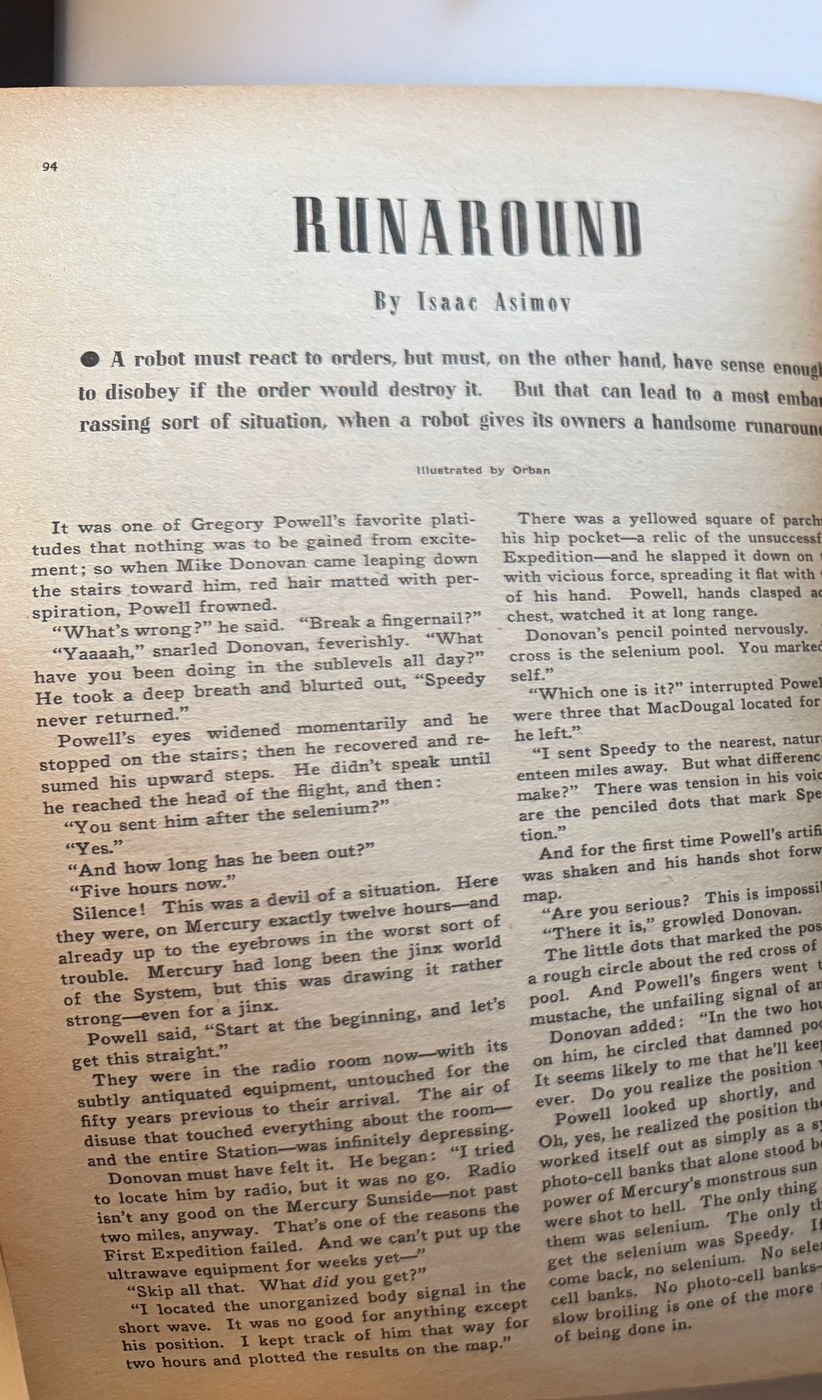
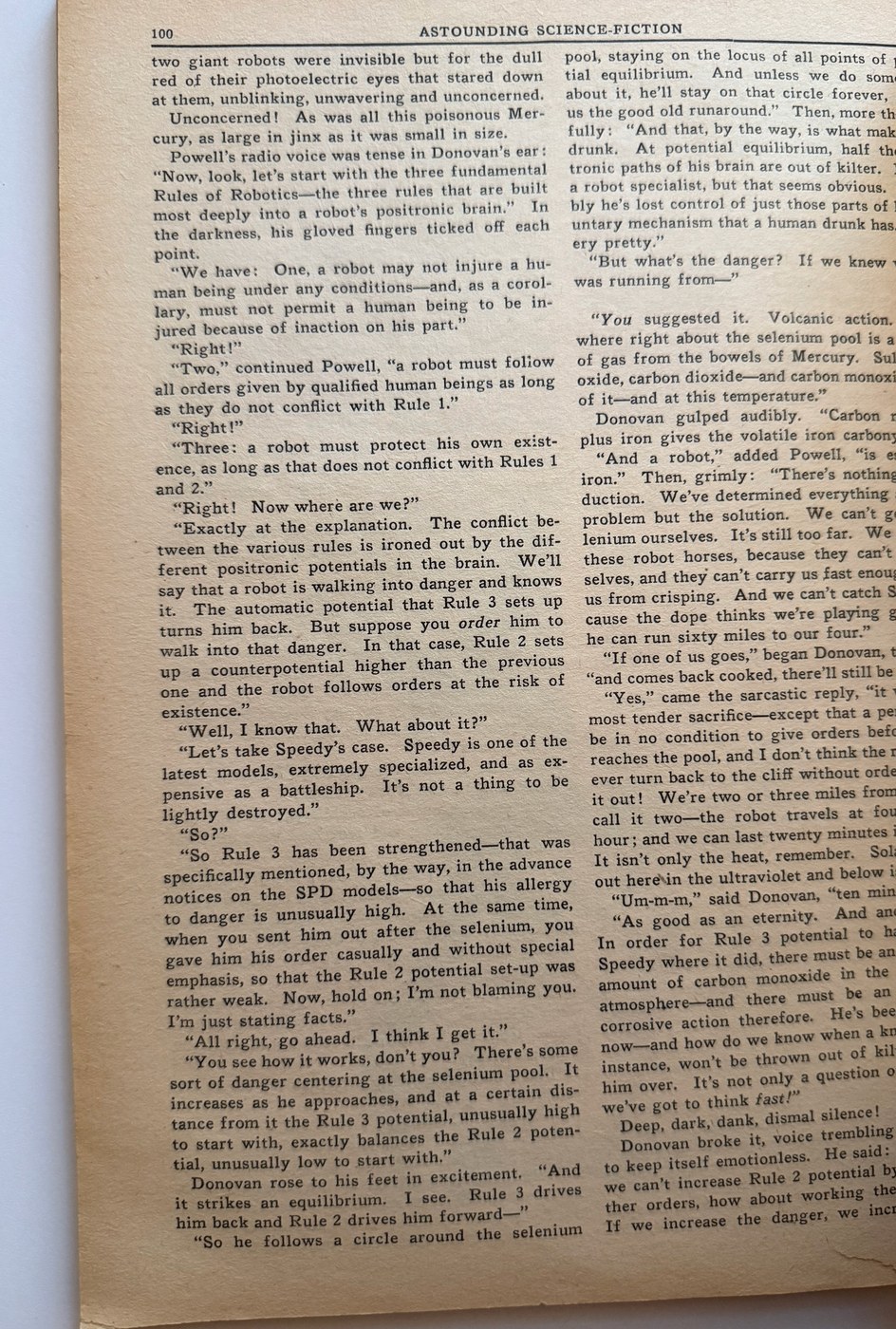
Robots had already appeared in Asimov’s fiction by 1942, and he had been working toward some governing rules for them for a couple of years, a process in which his editor, John W. Campbell, is often credited as a collaborator. But it is in “Runaround,” in the March 1942 issue, that the Three Laws first appear stated outright, as a fixed text, recited by the story’s two engineers, Powell and Donovan, as they try to talk a stranded robot out of a fatal loop on Mercury. On page 100, Powell walks Donovan through them one by one: a robot may not injure a human being, or through inaction allow one to come to harm; a robot must obey the orders given by human beings, except where doing so would conflict with the First Law; a robot must protect its own existence, as long as that does not conflict with the First or Second Law. It is a small piece of prose that outlived the story around it, cited and argued over for the rest of the century and into this one.
The First Foundation Story
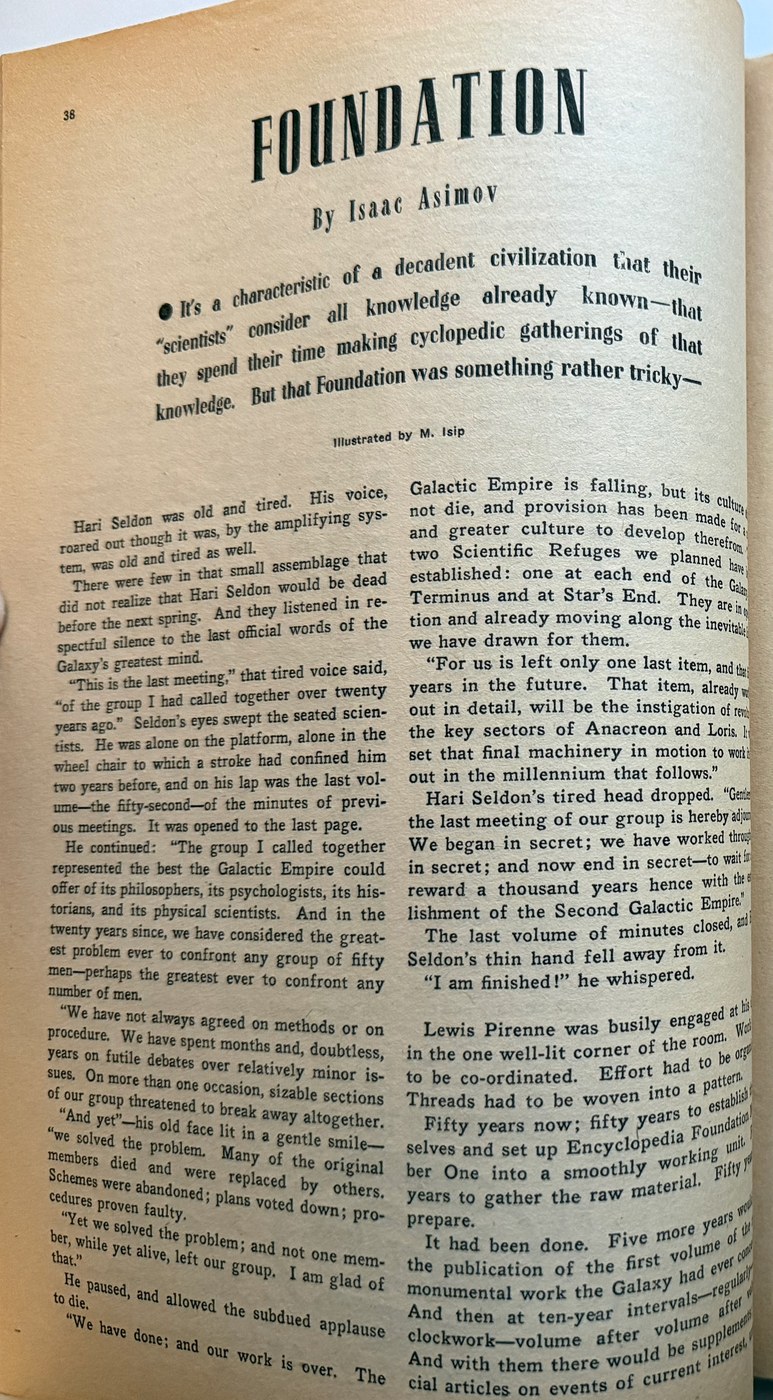
Two months later, the May 1942 issue opened with a different kind of story. “Foundation” introduces Hari Seldon, elderly and near the end of his life, presiding over the final meeting of the group that has secretly set up the Encyclopedia Foundation at the edge of the galaxy, before the story jumps forward to the crisis that confronts it decades on. It was not written as the first chapter of anything in particular; Asimov later said he had no series in mind, only Campbell’s suggestion that he try something on the scale of the fall of Rome. The story, and the five that followed it in Astounding over the next eight years, became the Foundation Trilogy, and eventually the frame for most of Asimov’s later work.
Two issues of a twenty-five-cent magazine, picked up almost as an afterthought, hold between them the start of two ideas Asimov spent the rest of his career returning to.