- Year
- 1944
- By
- National Association of Spotters’ Clubs (N.A.S.C.)
- Published
- National Association of Spotters’ Clubs.
- Edition
- English. First edition, stapled wraps.
- Ciancone
- N/A.
- Shelf
- R6
- Catalog
- Catalog B · WWII
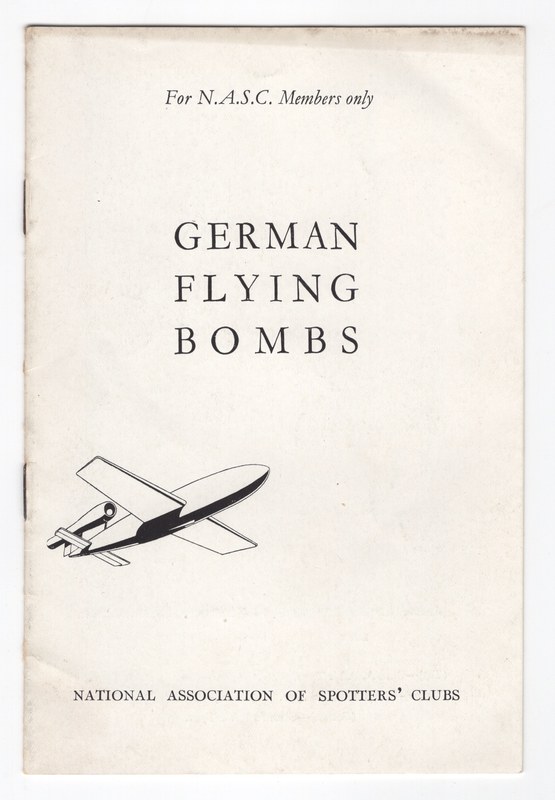
A small stapled booklet of the National Association of Spotters’ Clubs, marked on the cover “For N.A.S.C. Members only.” Its opening page divides the German flying bombs into Class A (V.1 or Vergeltungswaffe 1, controlled by pre-set automatic pilots and launched from ground bases against land targets) and Class B (guided by radio-controlled pilots from parent aircraft, used against ships). Silhouette photographs of the weapons in flight, labelled by class, face the opening text.
For the V.1 it gives dimensions (wing span 17 ft 6 in, overall length 25 ft 4½ in, with the earlier tapered-wing version spanning 16 ft), a description of the pulse-jet “dust-bin” combustion chamber with its flap valves running at about 40 cycles per second, launching from ramps with a catapult carrier because the stalling speed is about 170 mph, speeds up to 400 mph, a range of about 150 miles and an average height of 2,000 ft. It also gives advice to Raid Spotters on the sound and flight behaviour of the bomb, and on estimating the distance of an explosion by counting seconds. Class B covers the rocket-propelled Henschel Hs 293, with a 1,100 lb explosive charge, carried under Dornier, Focke-Wulf, Heinkel and Junkers aircraft, and a modified Junkers Ju 88. The wartime flying-bomb photo-essay Flying Bombs by British Information Services is also in this catalog.
Featured
Reporting the Robot Bomb ›
The V-1 and V-2 reach a wartime public