- Year
- 1944
- By
- Ley, Willy
- Published
- New York: Viking.
- Edition
- English. First edition, HC, DJ.
- Ciancone
- 136a.
- Shelf
- R4
- Catalog
- Catalog B · WWII
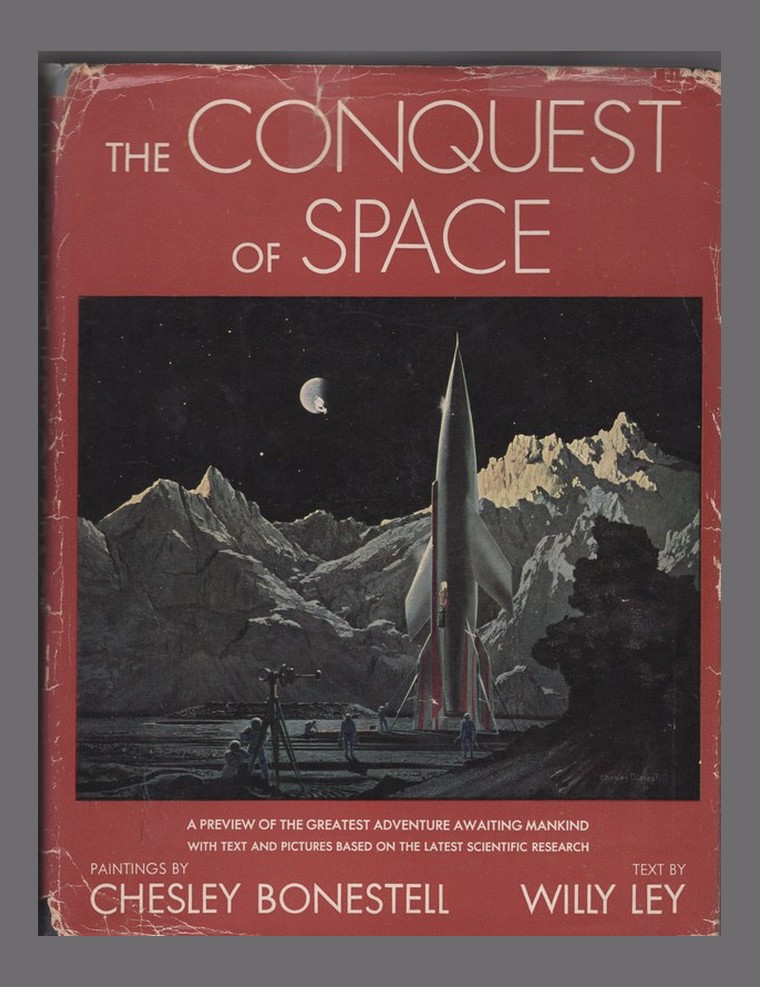
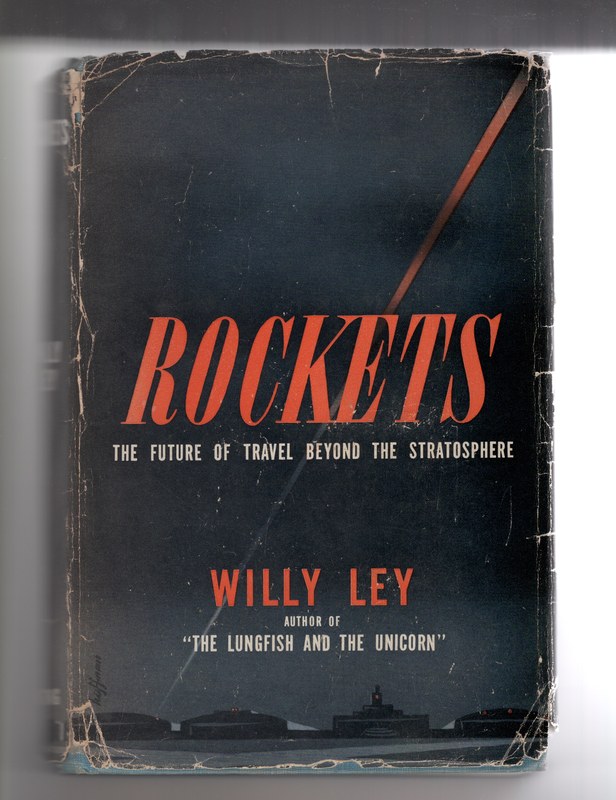
Willy Ley’s first book in English about rockets, and, as the jacket puts it, the first popular but thoroughly scientific account of the interplanetary dream published in the United States. Copyright 1944; published by the Viking Press in May 1944, with a Canadian edition from Macmillan of Canada on the same day. The copyright page notes that it was produced in full compliance with War Production Board conservation orders, and the book is dedicated “To Olga.” The jacket, designed by Immerman Studio, carries a list of questions the book answers, from why a rocket can surpass the velocity of its own exhaust to whether space travel would ever pay for itself.
Ten chapters run from “The Beginnings of an Idea” and “The Decades of the Great Dreams” through “The Rocket’s Red Glare,” “Prophets with Some Honor,” “The Battle of the Formulae,” “Success, Failure, and Politics” and the meteorological rocket to “The Rocket into Cosmic Space,” “The Spaceship” and “Terminal in Space.” Notes and Addenda cover rocket artillery, Winkler’s HW-2, Goddard’s and Tiling’s experiments, Valier’s last rocket car, Sänger’s experiments, rocket airplanes and the “Fischer Hoax,” followed by a bibliography. There are 46 line drawings and 14 plates, among them Ganswindt’s spaceship, the spaceship model built for the film Frau im Mond, Tiling with his winged rocket, Valier with his rocket sled, Schmiedl’s and Zucker’s mail rockets, the German Rocket Society’s alcohol-oxygen motor, Goddard in his laboratory, and Soviet rocket throwers from the film of the battle of Stalingrad.
Also in the collection, two of his magazine pieces: “Eight Days in the History of Rocketry” (Thrilling Wonder Stories, 1937) and the two-part “The End of the Rocket Society” (Astounding Science Fiction, 1943).