Catalog F · NASA Missions · Special Feature
Before the Fire
A 1966 North American Aviation training manual and the anatomy of the Block I crew hatch — Course A-512S, ten months before Apollo 1
Its cover art — a cutaway Block I command and service module in the clean line-drawing style of the period — invites a reflexive association with Apollo 1. But the date on the cover, April 1, 1966, places this manual roughly ten months before the fire at Launch Complex 34, and its contents are pure contractor courseware: an internal North American Aviation training package, Course A-512S, prepared for personnel in the company’s Apollo Logistics Training program at Downey, California. What it documents, in unemotional technical prose and isometric line art, is the precise mechanical configuration of the crew hatch system that would fail catastrophically ten months later — described by the engineers who designed it, before anyone had reason to suspect the danger.
A Training Document, Not a Mission Artifact
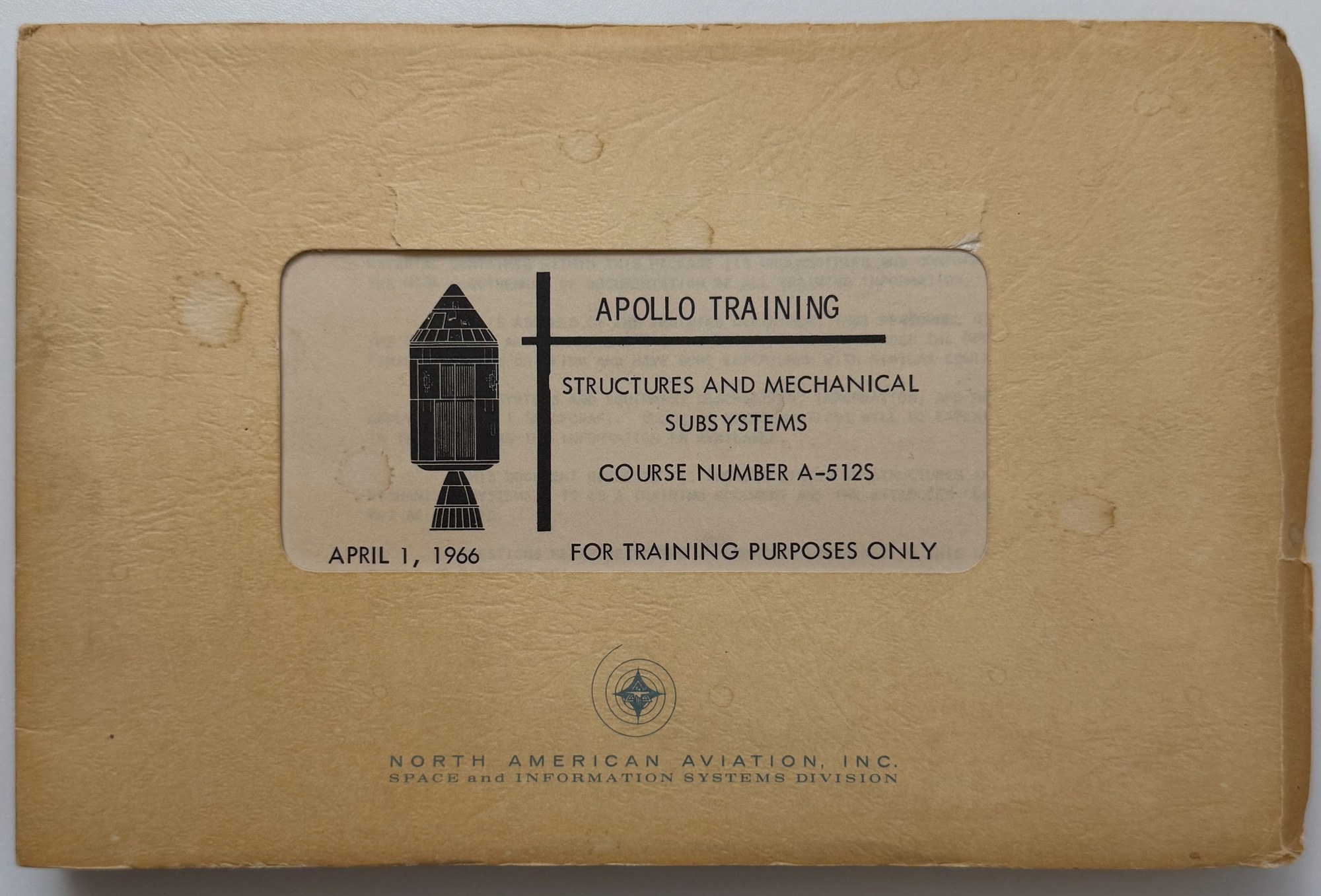
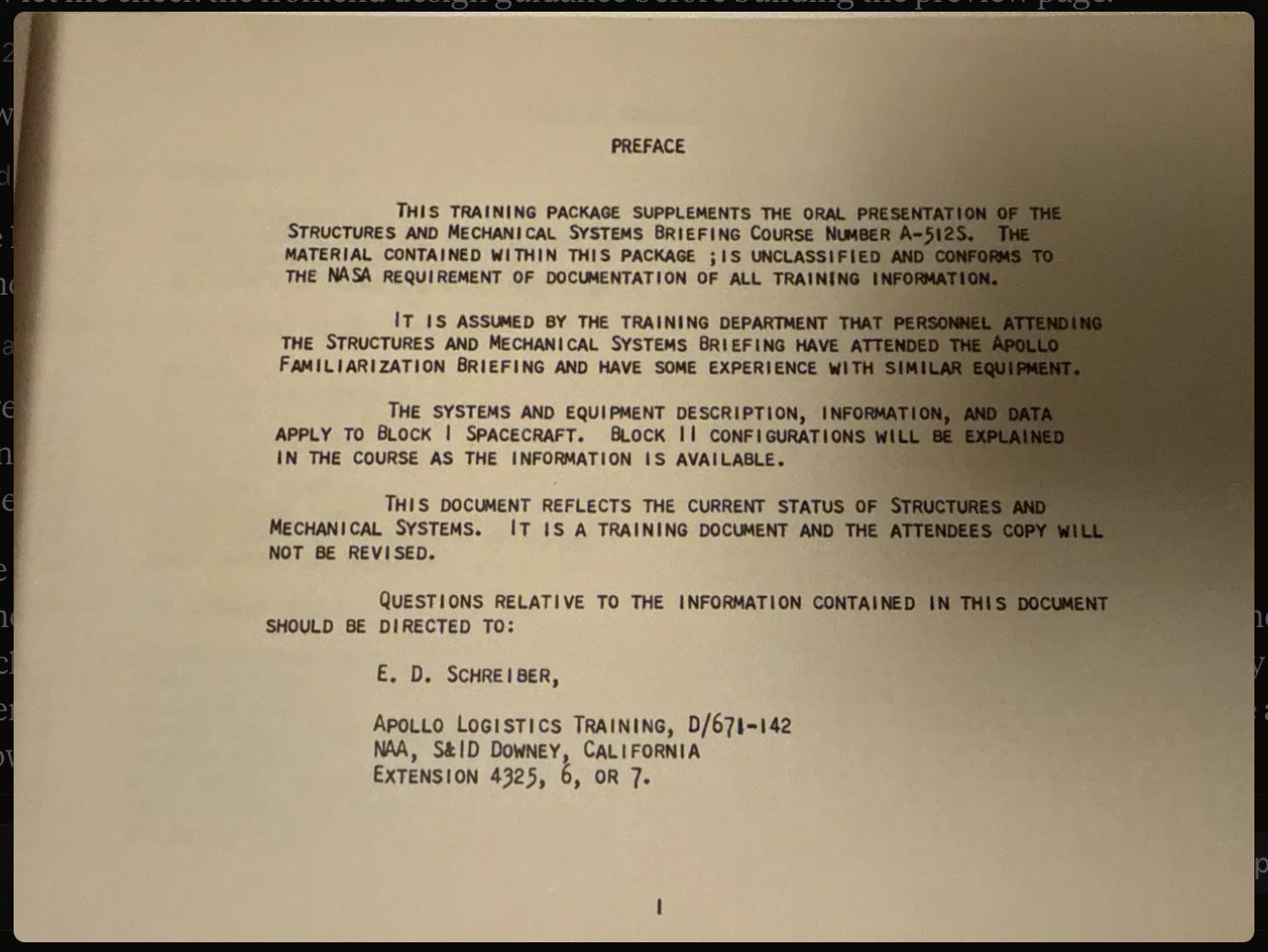
This is not an artifact from Apollo 1. It is something arguably more interesting to a collector: a document that shows the exact mechanical configuration of the systems that would fail catastrophically ten months later, drawn and described before anyone had reason to suspect the danger. The preface is explicit about its purpose and its limits — it supplements an oral briefing, assumes the trainee has already sat through an “Apollo Familiarization Briefing,” and states plainly that it is a training document that “will not be revised.” It was prepared under the direction of E. D. Schreiber of Apollo Logistics Training at NAA’s Downey facility, and its material, per the preface, applies to Block I spacecraft, with Block II configurations to be explained “as the information is available.”
The manual’s scope, per its table of contents, is comprehensive: launch escape system structures, the command module’s inner and outer structure, mechanical systems, the service module, and the spacecraft-LEM adapter. The crew hatch material is a small but pivotal part of a much larger structures curriculum — it would be easy for a feature like this one to imply the manual is narrowly about the hatch. It is not. But what it does contain, on the specific question of crew egress, is remarkably complete.
Three Hatches, Not One
A detail often lost in popular accounts of the Apollo 1 fire is that the crew was not sealed behind a single hatch, but behind three, nested one inside the other. This manual documents all three in mechanical detail.
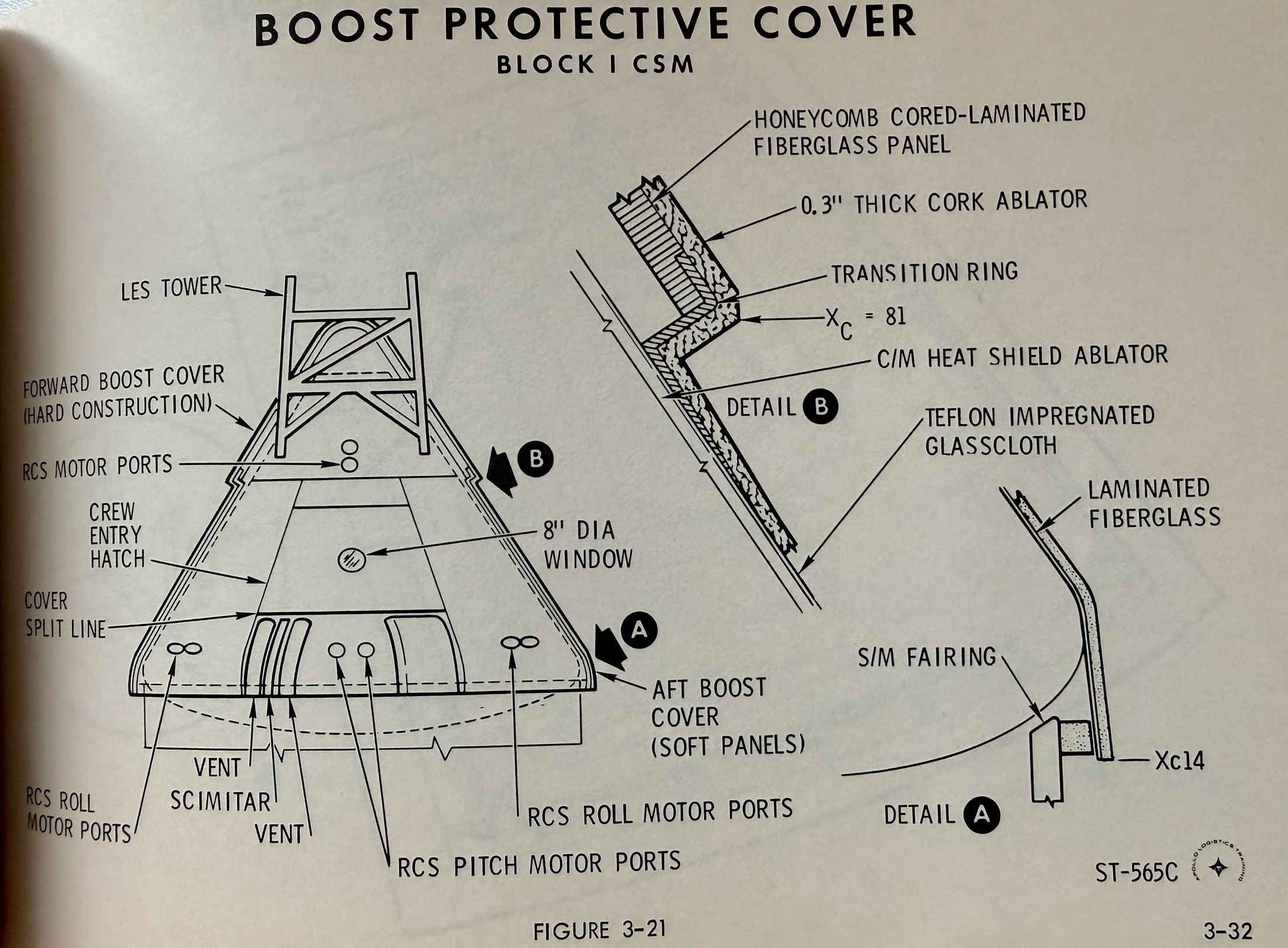
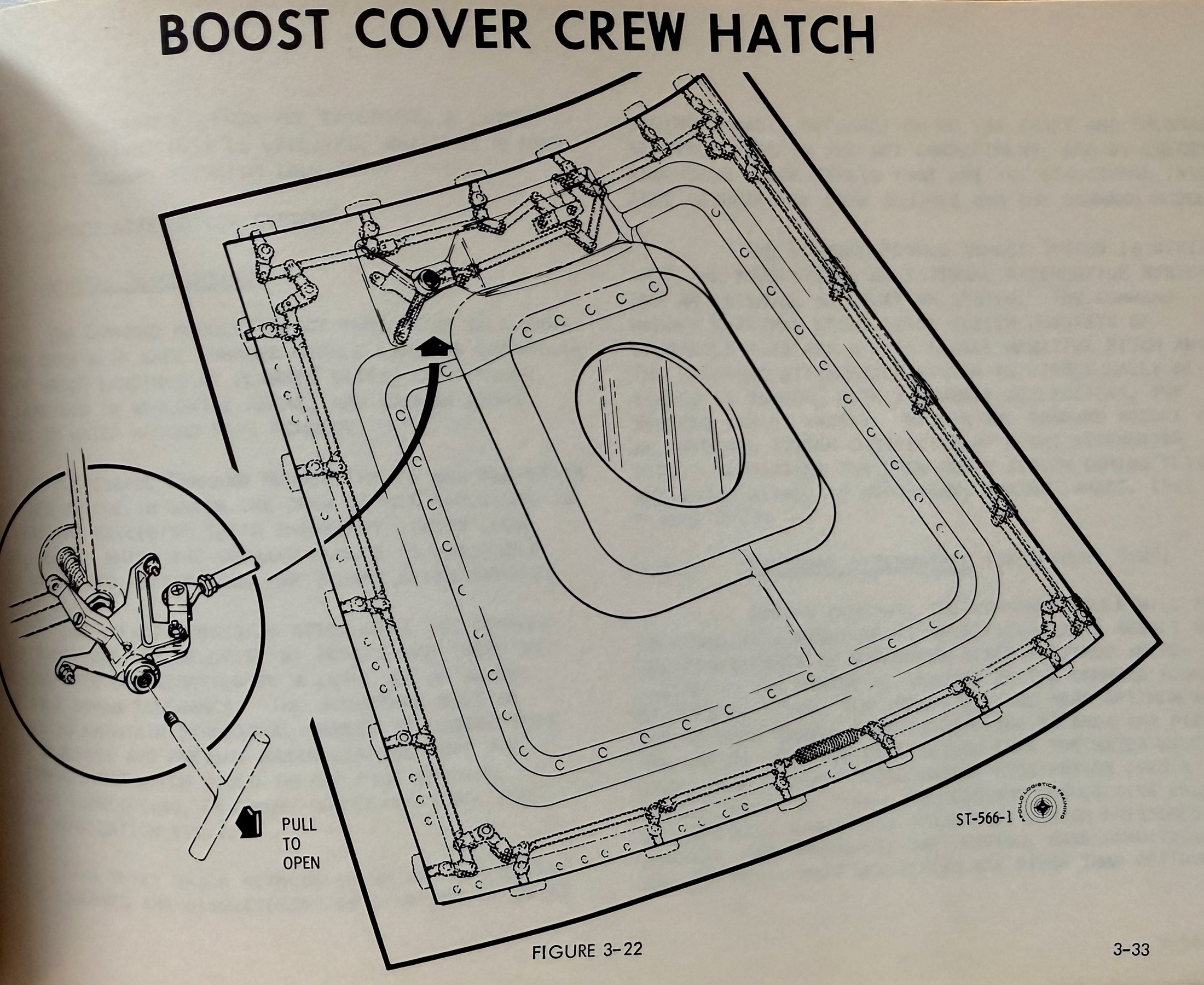
The outermost layer was the Boost Protective Cover crew hatch, part of the shroud that protected the spacecraft during ascent and was jettisoned in flight — a soft, multi-layer panel of Teflon-impregnated glass cloth, Nomex fabric, and cork ablator, mounted in a frame with a spring-loaded latching mechanism. From inside the cabin it opened with a simple “pull to open” T-handle; from outside, a dedicated latch-assembly tool was required.
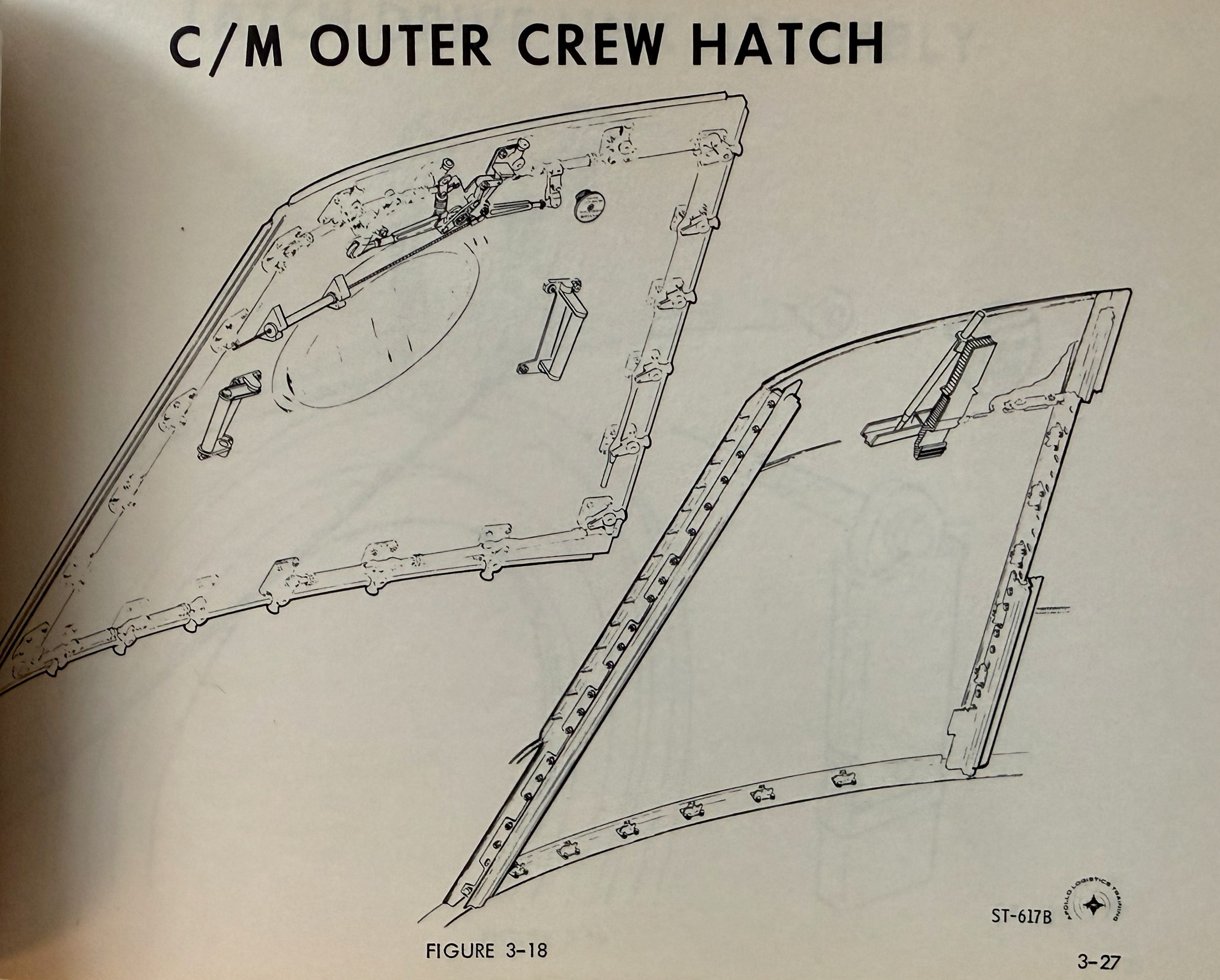
Once the boost cover was jettisoned, the command module’s own heat-shield hatch became the outermost layer: an ablative hatch operated by a hex-drive handle rotated roughly 90 degrees — clockwise to lock, counterclockwise to unlock — accessed through a plug in the ablator material.
The innermost of the three was the pressure vessel’s own seal, and the hatch most directly implicated in the crew’s inability to escape. Figure 3-7, “C/M Crew Hatch, Inner Structure,” shows the latching mechanism mounted on the hatch’s outer face, mating to matching latch assemblies fixed to the aluminum structure of the crew compartment — a mechanism the manual states explicitly “acts as a load carrying member for structural continuity while the C/M is pressurized.” It was operated with a dedicated torque wrench, normally stowed in a drawer and inserted into the hatch mechanism only just before entry: a full 360-degree clockwise rotation to lock, 360 degrees counterclockwise to unlock.
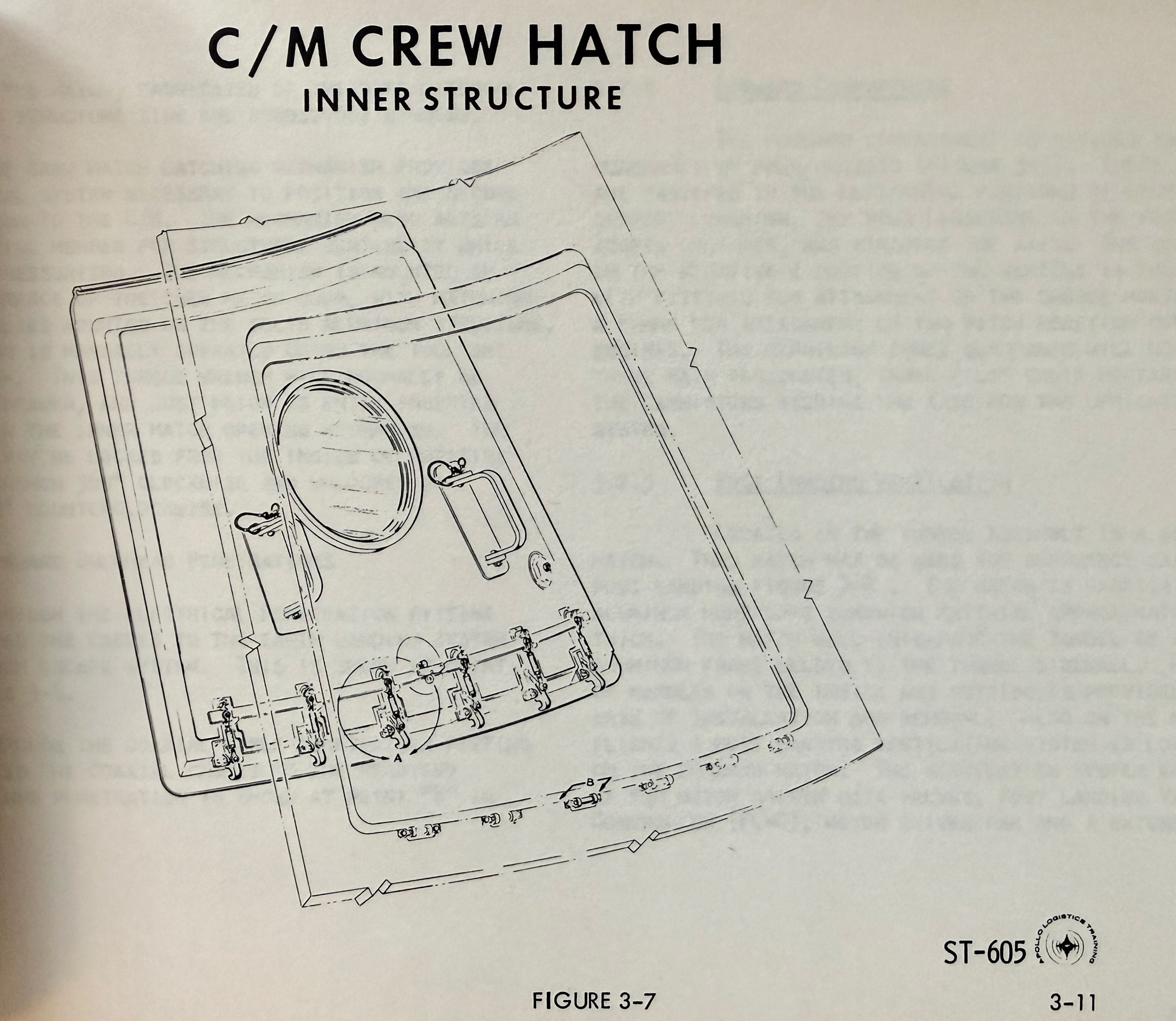
It is this last detail — a hand-cranked, full-rotation mechanical lock, requiring a separate tool retrieved from storage — that historians of the accident point to as central to the tragedy. The inner hatch was designed to open inward, and cabin pressure, however slight the differential, helped drive it more firmly into its seals; venting had to precede any attempt to remove it. None of this was a secret or a defect hidden from the engineers who built the system — it is described here, plainly, as a designed safety and structural feature. The Block I spacecraft carried no requirement to support extravehicular activity, and a 90-second egress time was, at the time this manual was written, considered entirely acceptable.
January 27, 1967
On the afternoon of the “plugs-out” test — a full rehearsal of the launch countdown, conducted with the crew sealed inside on the pad — all three of these hatches were installed and closed, exactly as this manual describes them. Command pilot Virgil “Gus” Grissom, senior pilot Ed White, and pilot Roger Chaffee entered the command module, the inner hatch was sealed, and the boost protective cover was installed over it before the cabin was pressurized with pure oxygen.
When fire broke out inside the sealed, oxygen-rich cabin, the rapid pressure rise from the fire itself worked against the crew in the worst possible way: it drove the inward-opening inner hatch even more firmly into its seals, at the exact moment speed mattered most. The crew had no realistic chance of executing the hatch’s normal opening procedure — a procedure that, as this manual documents, required a torque wrench and a full mechanical rotation even under calm conditions. Ground rescue crews, hampered by dense smoke filling the White Room, were able to work through the outer two hatches, but by the time the inner hatch was opened, the three astronauts had already died from toxic gases.
The Apollo 204 Review Board — NASA’s official investigative body, chaired by Floyd L. Thompson — reached the same conclusion in its formal findings, transmitted to the NASA Administrator on April 5, 1967: that due to internal pressure, the command module’s inner hatch could not be opened prior to rupture of the vessel, and that the crew was never capable of effecting emergency egress once that pressurization occurred. The Senate Committee on Aeronautical and Space Sciences, in its own report of January 30, 1968, added the grim mechanics of the rescue attempt: roughly five minutes to open all three hatches and remove the two outer ones, with the first firefighters arriving eight to nine minutes after the fire was reported.
The response was swift and thorough. Block II — the lunar-capable configuration that would go on to fly every subsequent Apollo mission — replaced this entire three-hatch, multi-tool system with a single, unified, outward-opening hatch, openable by the crew in three seconds, with full egress possible in thirty. It remains one of the most consequential engineering redesigns in the history of American spaceflight, and its necessity is written, unintentionally, into the pages of this April 1966 training course.
A Note on What This Manual Is and Isn’t
To be precise about the collecting claim: this volume does not mention Apollo 1, the fire, or crew safety concerns — because none of those things had happened yet. What it offers is something quieter and, to a bibliographically minded collector, more valuable: an authentic, dated, contemporaneous technical record of the exact hardware configuration in place on January 27, 1967, described by the contractor engineers who built it, in the confident, procedural language of routine training material. Read in light of what followed, that confidence is the most striking thing on the page.
It is also worth being precise about what this manual is not: it is not cited, by name, in either the Apollo 204 Review Board’s report or the Senate Committee’s report on the accident. Those investigations drew on direct engineering data, physical evidence from Spacecraft 012, and interviews with North American Aviation personnel — not on internal training courseware, which was a downstream teaching product rather than a primary engineering or investigative record. No claim is made here that this document informed the official inquiry.
What can be said, and documented, is a closer and more concrete connection: Spacecraft 012, the vehicle that burned on Pad 34, was built at the same facility that produced this manual — North American Aviation’s Space and Information Systems Division in Downey, California — with installation and final assembly of its subsystems completed between September 1965 and March 1966, immediately prior to this course’s April 1, 1966 issue date. The manual is, in effect, a contemporaneous record of how that same division was describing the spacecraft’s hatch systems to its own workforce at almost precisely the moment Spacecraft 012 was being finished.
Sources and Related Documents
Report of Apollo 204 Review Board to the Administrator, National Aeronautics and Space Administration, April 5, 1967 — the Board’s formal finding on hatch pressurization and crew egress is the primary technical corroboration for the failure mode this manual documents mechanically. A version of the Board’s report is in this collection, elsewhere in Catalog F: Apollo 204 Accident: Report of the Committee on Aeronautical and Space Sciences, United States Senate, Report No. 956, January 30, 1968, traces the Review Board’s formation and investigation in detail and provides the Senate’s own independent review of its findings, including the timeline of the rescue attempt. A digitized copy of this same NAA training manual is also held in the Apollo Flight Journal document archive at ibiblio.org, indicating the document is already recognized and used as a primary source within the spaceflight history research community independent of this collection; NASA’s own Apollo 204 history pages (nasa.gov/history/Apollo204/) were used here for the fabrication and assembly timeline of Spacecraft 012 at NAA Downey.