Catalog F · NASA Missions · Special Feature
For Latches to Engage and Lock
North American Rockwell’s 1971 customer training manual for the Skylab docking system, signed years later by the pilots of all three Skylab crews — including the one who needed eight tries to meet its own numbers
This is a training document, not a flight article: a three-ring "Customer Training" manual on the Skylab docking system, issued by North American Rockwell’s Space Division on March 22, 1971, more than two years before Skylab ever reached orbit. Its cover carries three signatures added long after the fact — Jack Lousma, Paul Weitz, and Bill Pogue, the Pilots of Skylab 3, Skylab 2, and Skylab 4 — and its pages describe, in exact numbers, the docking system that one of those three men would spend an entire day fighting to make work.
A Manual Before the Mission
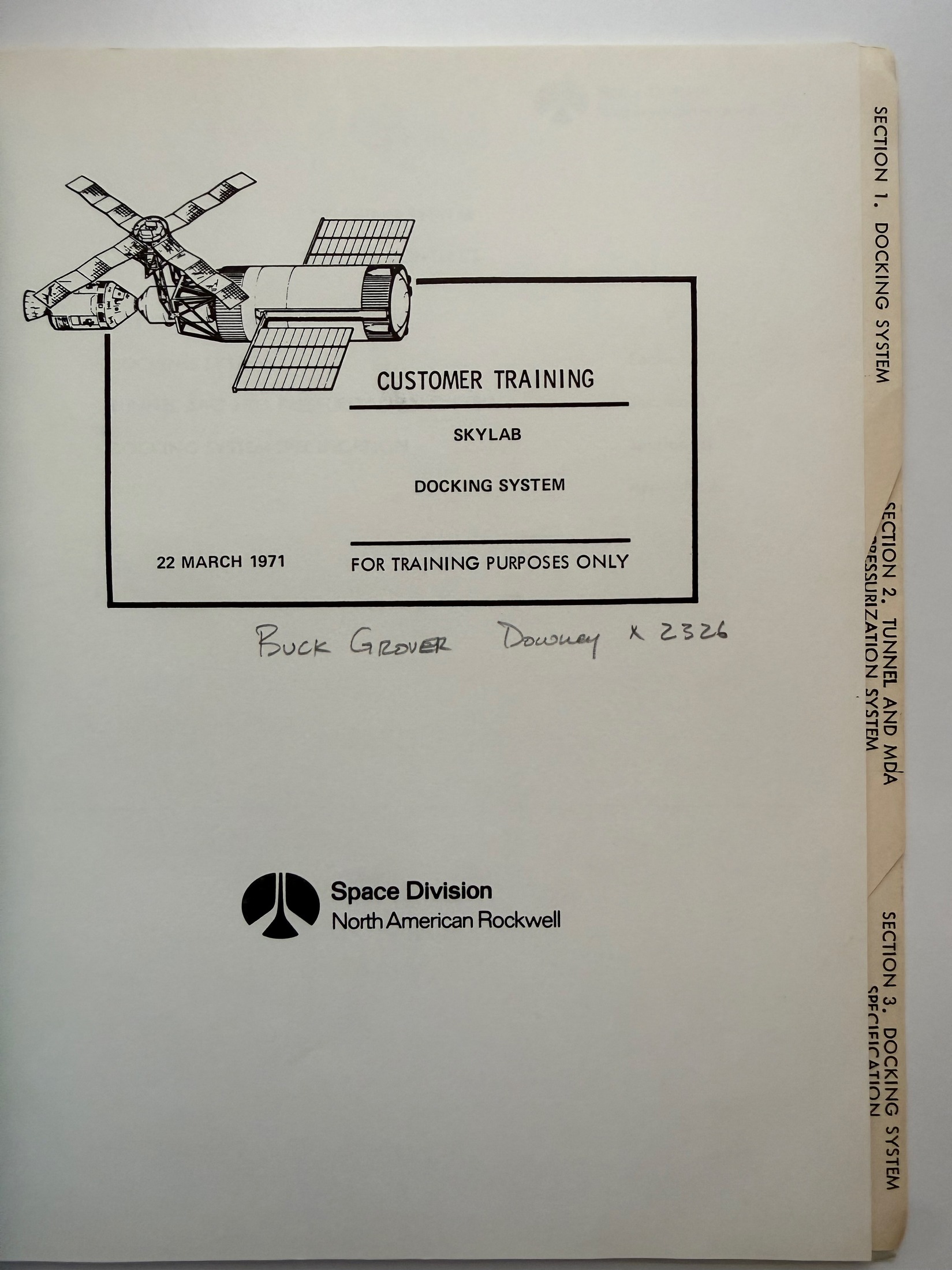
North American Rockwell built the Skylab Orbital Workshop’s docking hardware at its Space Division in Downey, California, and this manual is what the company handed to its customer — NASA — to explain how that hardware worked. "For Training Purposes Only," the cover warns, dated 22 March 1971. Three tabbed sections follow: Docking System, Tunnel and MDA Pressurization System, and Docking System Specification, illustrated throughout with the diagrams NAR’s own CSM Logistics Training program used to teach the system.
Before it belonged to an astronaut, it belonged to an engineer. Penciled beneath the title block on an interior page, in a hand distinct from any of the three signatures on the cover, is a name and a number: "Buck Grover, Downey X2326" — an internal telephone extension at NAR’s Downey plant. Whoever Grover was, this was his working copy of a customer-training manual, not yet the keepsake it would become. The cover’s three astronaut signatures, and a fourth notation reading "WEITZ" beside Paul Weitz’s, were added afterward; the manual comes from Weitz’s own personal collection, with a Certificate of Authenticity from the Astronaut Scholarship Foundation, hand-signed by Weitz, vouching for his and his crewmates’ signatures.
The System, In Diagrams
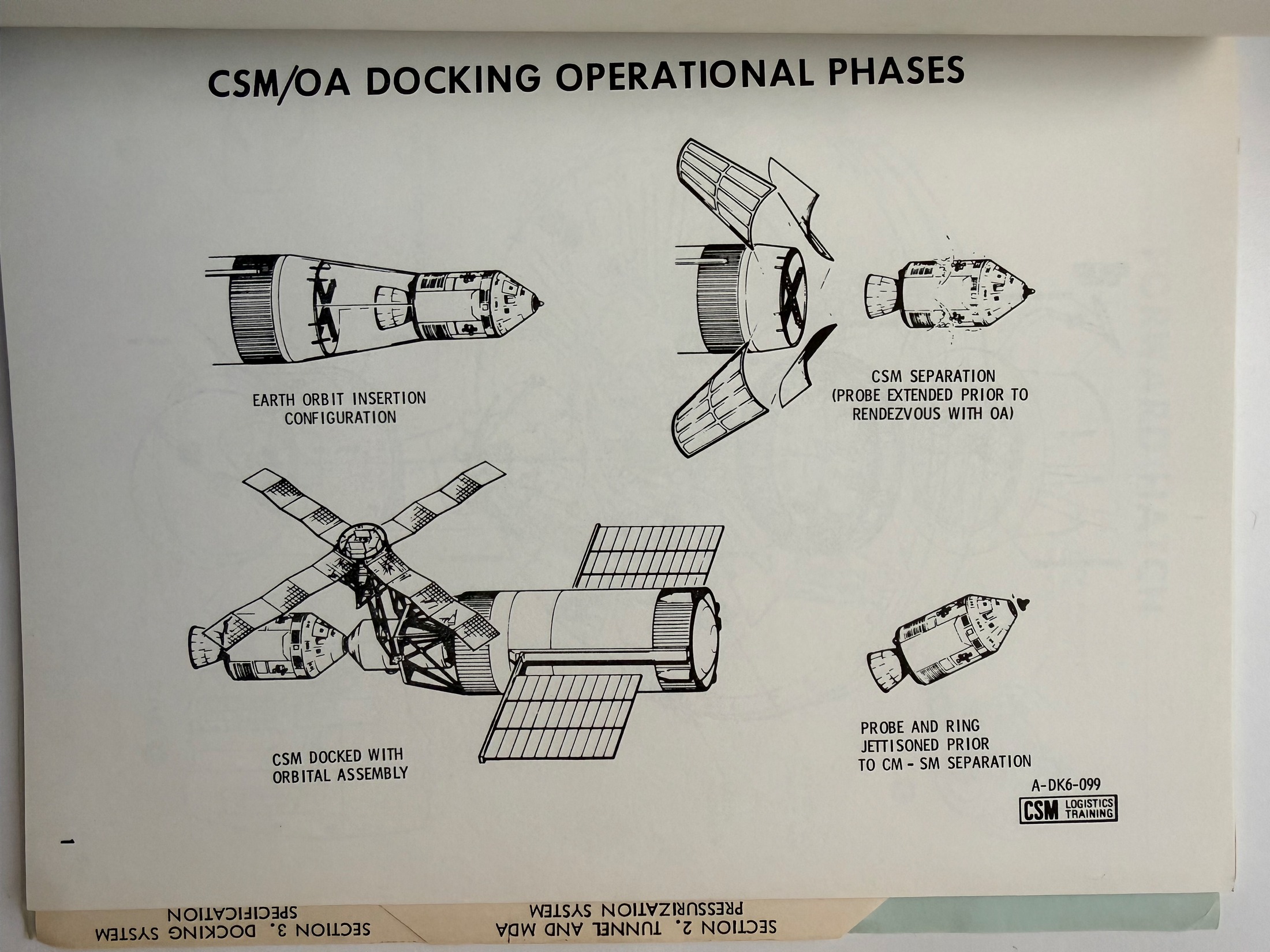
The manual lays out the docking sequence phase by phase: the Command and Service Module (CSM) in its earth-orbit-insertion configuration, its docking probe extended ahead of rendezvous with Skylab’s Orbital Assembly (OA), the CSM docked nose-to-nose with the workshop, and finally the probe and drogue ring jettisoned from the tunnel before the Command Module separates from its Service Module at the end of the mission. It is a mechanical courtship choreographed in advance, down to the geometry of the parts that have to meet.
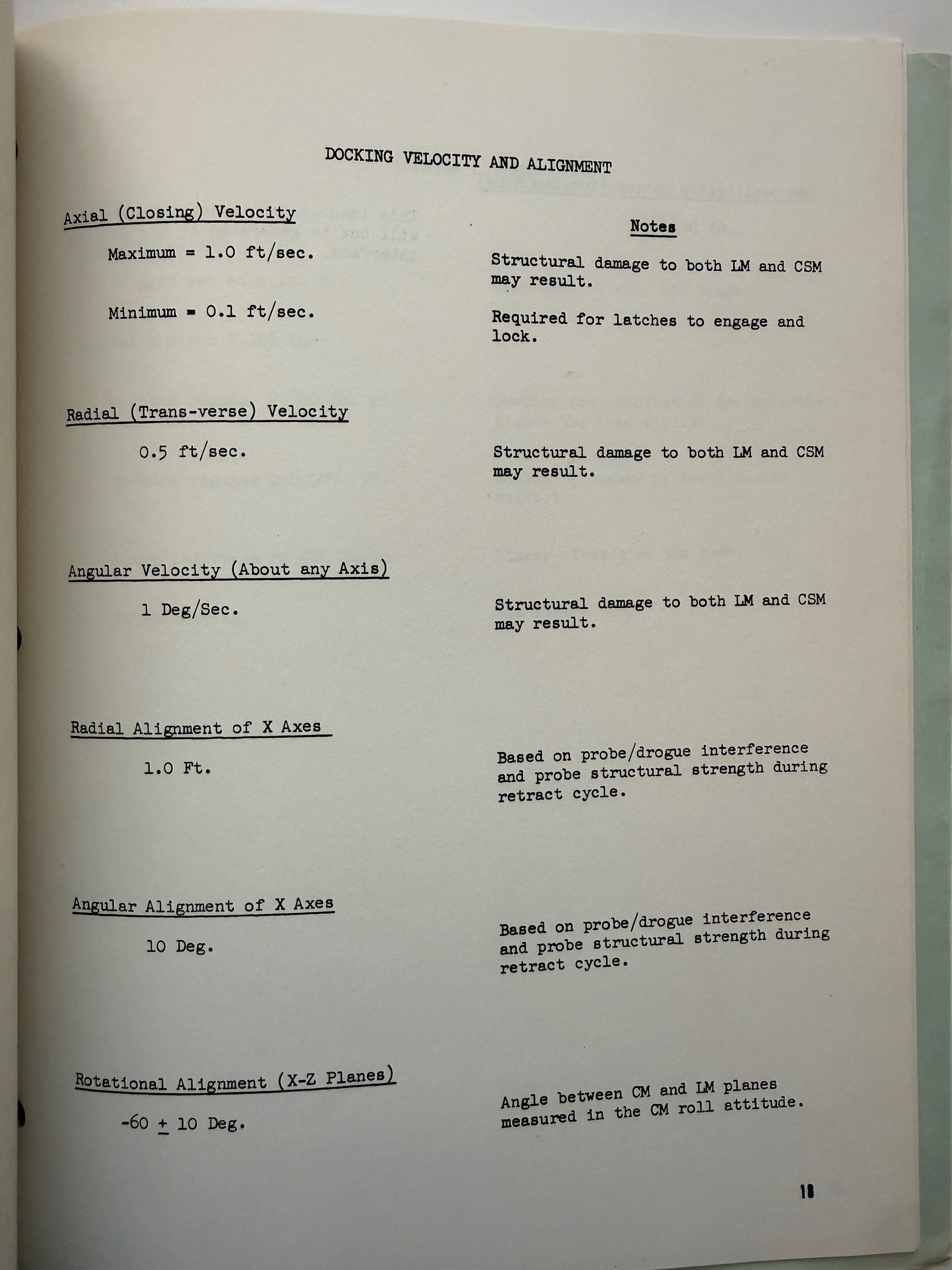
Page 18 tabulates exactly how gently, and how precisely, the two spacecraft had to meet. Axial closing velocity: a maximum of 1.0 ft/sec, beyond which structural damage to both the Lunar Module and Command/Service Module docking hardware could result — and a minimum of 0.1 ft/sec, "required for latches to engage and lock." Radial velocity was capped at 0.5 ft/sec, angular velocity at 1 degree per second, with alignment tolerances of 1 foot and 10 degrees on the docking axes and a rotational alignment of −60° ± 10° between the Command Module and the target vehicle. Numbers on a page, until they weren’t.
Eight Attempts
Skylab reached orbit on May 14, 1973, and reached it damaged: its launch had torn away the micrometeoroid shield and jammed one solar array while ripping the other completely off the workshop. Conrad, Weitz, and Kerwin — Skylab 2’s crew, with Weitz as Pilot — launched eleven days later, on May 25, having spent the delay training to rig a makeshift sunshade for an overheating station. After a flyaround inspection of the damage, Conrad flew the Command and Service Module to Skylab’s forward port for what the manual calls a soft dock: the probe engaged the drogue, but the capture latches did not. They undocked, tried and failed to free the jammed solar wing during a hazardous stand-up spacewalk with Weitz leaning out of the open hatch on the end of a pole, and returned to the docking port for another try.
The first attempt to soft dock again did not succeed. Neither did the second, the third, or the fourth. Conrad tried closing slower; he tried closing faster. Nothing engaged the latches. The crew depressurized the spacecraft a second time, opened the forward hatch, and bypassed a set of electrical connections using an emergency backup procedure — and on the eighth attempt, finally achieved a soft dock, then a hard dock. It had taken most of a 22-hour day. The manual Weitz would later sign put the answer at page 18: a closing velocity below 0.1 ft/sec would not seat the latches at all, and eight consecutive tries at Skylab’s forward port could not find the margin above it — until an improvised procedure, not the nominal one, finally did.
Three Pilots, Three Missions
"Pilot" was the title NASA gave the second-ranked crew member on each of Skylab’s three crewed missions, and it is the thread that put all three signatures on this one 1971 training manual even though the men who signed it flew nine months apart. Paul Weitz was Pilot of Skylab 2 (May–June 1973), the mission that fought the docking system to a standstill before winning on the eighth try. Jack Lousma was Pilot of Skylab 3 (July–September 1973), whose Service Module developed a propellant leak in one reaction-control thruster quad during rendezvous and a second leak six days later — serious enough that NASA readied a five-seat rescue Command Module and began training a backup crew before concluding the ailing spacecraft could still fly home safely on two good quads. Bill Pogue was Pilot of Skylab 4 (November 1973–February 1974), the final and longest mission, whose all-rookie crew docked without drama on their first attempt. A single training document, drafted before any of them had flown it for real, ended up in the hands of the three men who tested different pieces of it against three different Skylab missions.
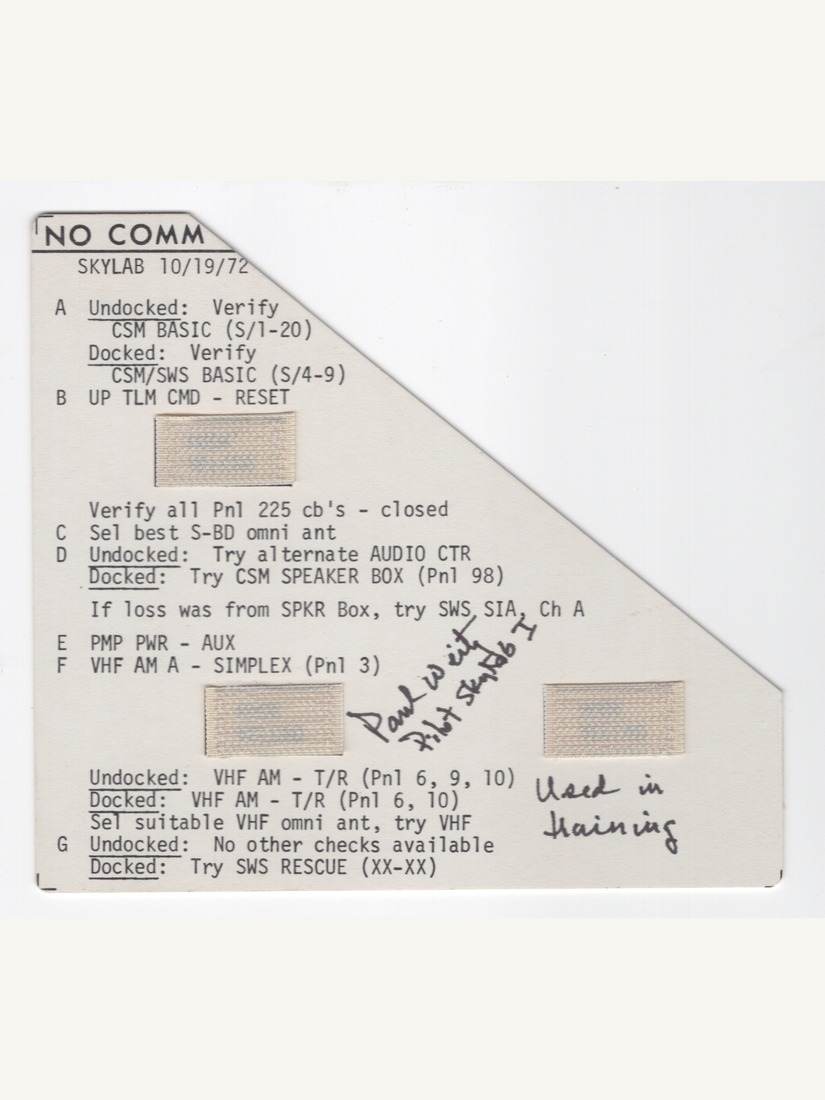
Weitz’s own Skylab checklist card, also in this collection, shows the same crew shorthand at work: he signed it "Paul Weitz, Pilot Skylab I," the informal name the first crew used for their own flight, where NASA’s official mission designation was Skylab 2.
Sources and Related Documents
Skylab: A Chronology (NASA SP-4011), the fifth volume of the Apollo Spacecraft Chronology set, is elsewhere in this collection and covers the program day by day. W. David Compton and Charles D. Benson, Living and Working in Space: A History of Skylab (NASA SP-4208, 1983), is NASA’s official history of the program and its engineering. John Uri, "50 Years Ago: Skylab 2, The 'We Fix Anything' Crew," NASA History Office, May 25, 2023, supplies the attempt-by-attempt account of the docking used above. The manual’s own text and its accompanying Certificate of Authenticity, both in this collection, supply the rest.