- Year
- 1969
- By
- NASA Manned Spacecraft Center, Crew Systems Division
- Section
- Apollo · Mission reports & chronologies
- Shelf
- Box 1
- Catalog
- Catalog F · NASA Missions
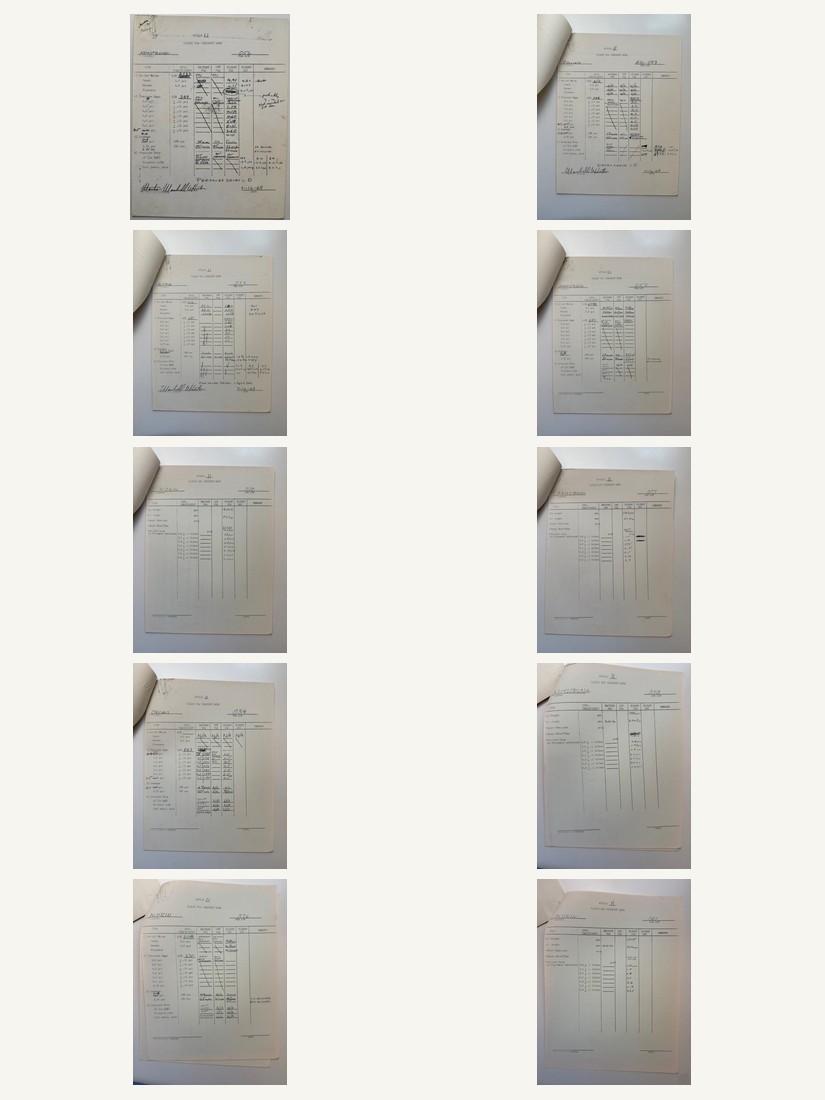
Ten internal NASA Crew Systems Division (CSD) quality-control sheets tracking the pressure garment assemblies (PGA, the A7L spacesuits) and liquid cooling garments (LCG) issued to Neil Armstrong, Michael Collins, and Buzz Aldrin for Apollo 11, each logging relief-valve crack/reseat pressures, pressure-gauge calibration at 3.0–6.0 psi increments, and leakage-rate tests against factory, Cape acceptance, and flight readings.
The serial numbers recorded match the published Apollo suit-serial registry exactly: PGA 056 was Armstrong’s flight suit, the one he wore on the lunar surface and today conserved at the Smithsonian; PGA 077 was Aldrin’s flight suit, also at the Smithsonian; and PGA A7L-033 was Collins’s flight suit. Each is paired with its backup unit (Armstrong 057, Aldrin 076, Collins 034), checked out but left unsigned, apparently because it was not the suit ultimately flown. The three flight-suit sheets are all signed by the on-site CSD Mission Manager, Marshall W. Horton, and dated July 16, 1969 — Apollo 11’s launch day.
Four accompanying LCG sheets track the water-cooled undergarments through the final week before launch: Aldrin’s first unit charged five and a half days out (July 10, 17:30), a second three and a half days out (July 12, 22:20), Armstrong’s first unit two days out (July 14, 23:07), and a replacement unit charged at 00:50 on launch morning itself, written over a crossed-out earlier time. The leakage tests distinguish intravehicular from extravehicular glove readings only for Armstrong and Aldrin, the two moonwalkers, consistent with Collins remaining in the Command Module throughout the mission.
The Crew Systems Division compiled a parallel official postflight report on Apollo 11 suit and PLSS performance, held today by NASA’s history office; these working sheets appear to be exactly the kind of underlying test data that fed it. No provenance accompanies the sheets beyond the documents themselves; pen relief visible on the reverse of the pages is consistent with original ink rather than a reproduction.