- Year
- c. 1970
- By
- Grumman
- Section
- Apollo · Print ephemera
- Shelf
- L4
- Catalog
- Catalog F · NASA Missions
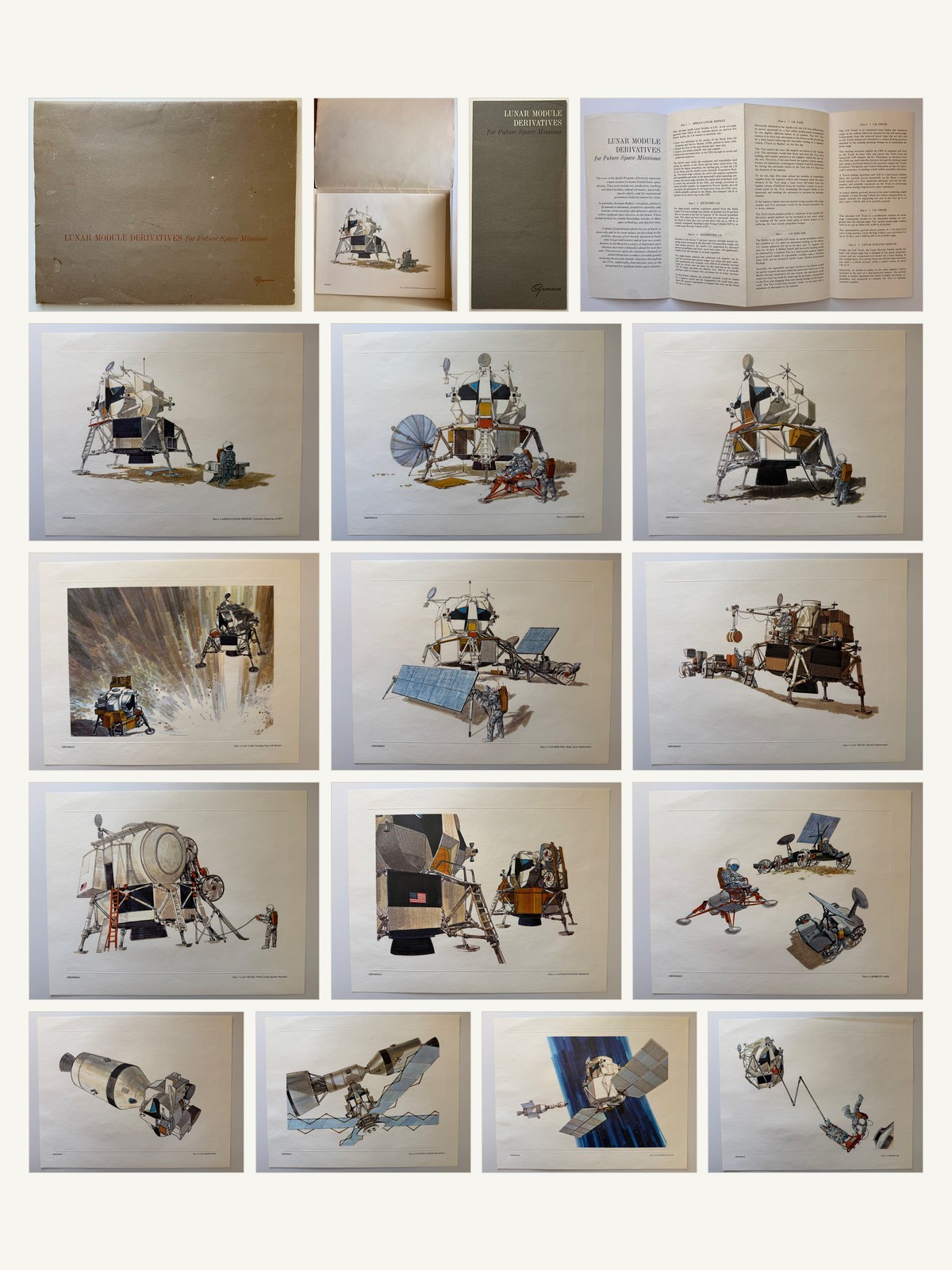
Portfolio of thirteen color plates issued by Grumman, each an artist’s rendering of a way the Apollo Lunar Module might have been adapted for missions after the first landings: on the lunar surface, in lunar or Earth orbit, and as a rescue craft. The plates are printed on heavy textured paper within a blind-embossed plate mark, captioned “Grumman” at lower left and by plate number and title at lower right. They come in a buff textured folder lettered in copper, “Lunar Module Derivatives for Future Space Missions,” over Grumman’s script logo, with a folded leaflet in an olive-gray cover that explains the concept and describes the plates. The artist is not named.
The plates run: Apollo Lunar Module (astronaut deploying the ALSEP), Extended LM, Augmented LM, LM Taxi (landing near LM Shelter), LM Shelter (solar array deployment), LM Truck, a second LM Truck (with living quarters payload), Lunar Payload Module, Mobility Aids, LM Laboratory, LM/Apollo Telescope Mount, LM/Stellar ATM, and Rescue LM.
The leaflet presents the Lunar Module’s versatility, its ability to fly manned or unmanned, its propulsive capability and its payload volume, as assets Apollo had already paid for. Its descriptions of plates 1 to 8 are specific. The standard LM sustains two men for 48 hours and lands a 300-lb scientific payload; the Extended LM stretches the stay to three days with up to 700 lb of equipment, including lunar flying vehicles or a small rover; the Augmented LM, riding an uprated Saturn V, could land over 2,000 lb of science for the same stay. The heavier concepts work in pairs. An unmanned Truck, Shelter or payload module lands first (a Shelter would lie dormant for up to 60 days, then house two men for 14), and a crewed Taxi follows on a second launch. A Truck carries a 3,700-lb payload, the alternate Truck 8,800 lb in the volume freed by deleting the ascent stage, and the Lunar Payload Module 6,700 lb.
The portfolio is undated. Auction and NASA-history sources place the Grumman presentation between 1968 and 1970, and the same text appears in NASA’s Apollo News Reference. Of the concepts shown, only the Extended LM was realized, in the heavier landers of Apollo 15 through 17, which carried the Lunar Roving Vehicle built by Boeing.
Also in the collection: the NASA/Grumman Apollo Lunar Module Color Schematic Transparencies and other Grumman Lunar Module documents in this catalog.