Catalog F · NASA Missions · Special Feature
The Apollo Spacecraft: A Chronology
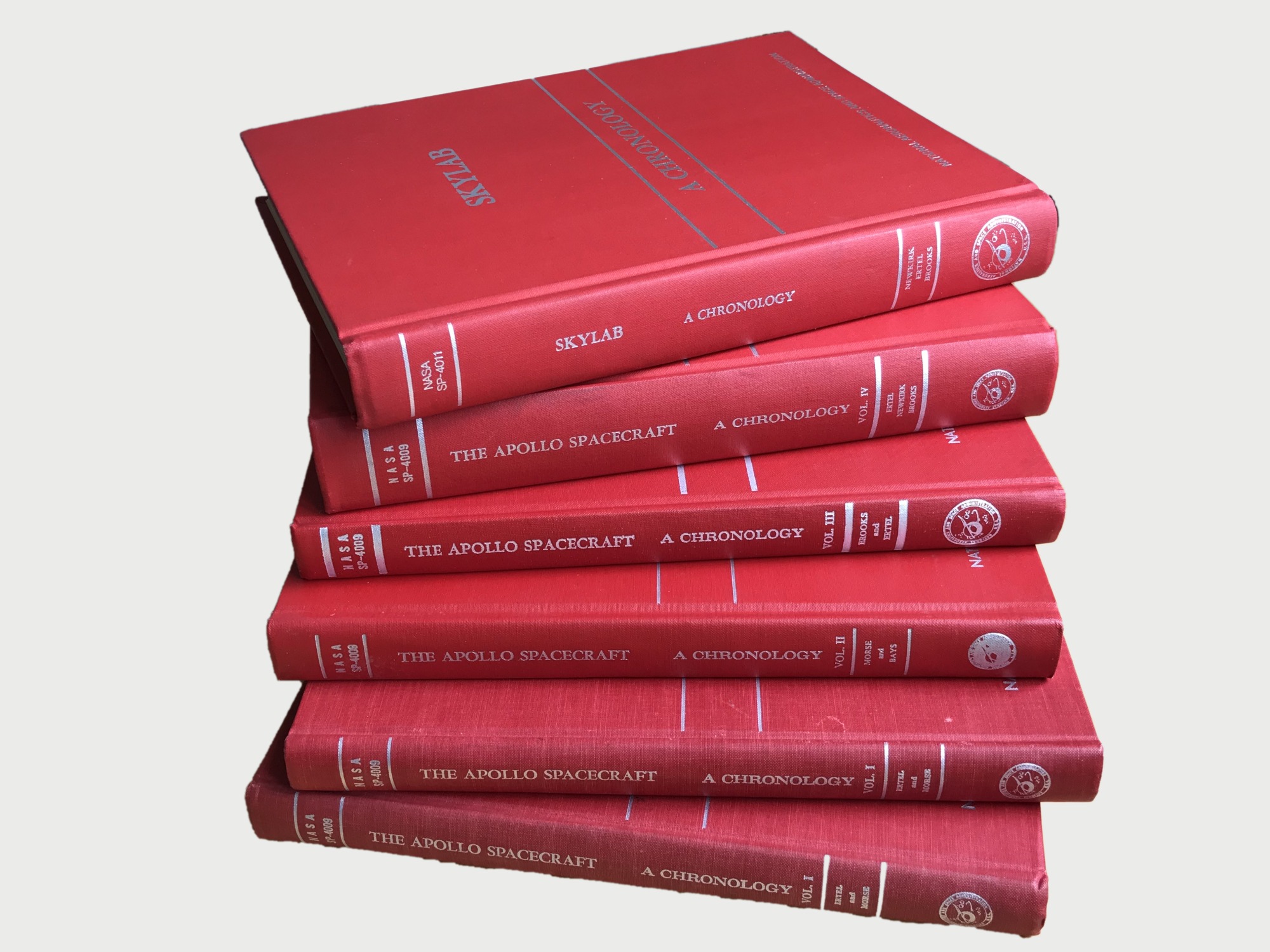
Six volumes, complete — NASA SP-4009 (Vols. I–IV) and its Skylab companion, SP-4011, 1969–1978
NASA’s history office tracked the Apollo program as it happened, publishing four sequential chronology volumes while the events they covered were still underway, then a fifth volume for Skylab once that program closed out. The four-volume Apollo set and its Skylab companion took nine years to complete, one office to compile, and, on the evidence of these copies, several changes in house style along the way. This set holds all five titles across six physical volumes: two copies of Volume I, one each of Volumes II through IV, and Skylab.
The Set
| Volume I1969 | Volume II1973 | Volume III1976 | Volume IV1978 | Skylab1977 | |
|---|---|---|---|---|---|
| Coverage | Through Nov. 7, 1962 | Nov. 8, 1962–Sept. 30, 1964 | Oct. 1, 1964–Jan. 20, 1966 | Jan. 21, 1966–Jul. 13, 1974 | Skylab program |
| Author(s) | Ertel & Morse | Morse & Bays | Brooks & Ertel | Ertel & Newkirk, with Brooks | Newkirk & Ertel, with Brooks |
| Document ID | SP-4009 | SP-4009 | SP-4009 | SP-4009 | SP-4011 |
| Pages | 269 | 277 + 2 | 286 + 2 | 463 + 2 | 458 + 2 |
All six copies: red cloth boards, silver spine stamping, no dust jacket. Trailing page counts include the two-page author-bio/publications-list back matter common to the whole set.
A Series in Flux, 1969–1978
The five volumes read as one continuous set, but NASA’s own production conventions shifted underneath it across the decade it took to publish them. The imprint line changes between Volume I and Volume II, from “Scientific and Technical Information Division” to “Scientific and Technical Information Office” — a department rename at NASA between 1969 and 1973, not a change of publisher. The stock-number format changes twice: absent on Volume I, a short four-digit form on Volume II, and the longer hyphenated GPO format from Volume III onward. Starting with Volume IV, the copyright page grows a full Library of Congress Cataloging-in-Publication block, listing all four Apollo volumes together for the first time. Two other patterns stand out: the four SP-4009 volumes all share the same LC Catalog Card Number, 69-60008, so the series was registered once, not per volume, while Skylab, issued under the separate SP-4011 number, got its own registration, 77-608101; and the price line, present through Volume III, disappears from Volume IV and Skylab, meaning that somewhere between 1976 and 1977, GPO stopped printing a retail price on this series’ copyright page.
Gregory P. Kennedy’s Copy (Volume IV)
Gregory P. Kennedy is a space historian who spent 14 years at the Smithsonian’s National Air and Space Museum, including a term as Associate Curator for Manned Space Flight, before serving as Executive Director of the International Space Hall of Fame in New Mexico and later managing aviation and space museums in Texas, Kansas, and Pennsylvania. He has authored, co-authored, or edited eight books on space history, including Apollo to the Moon, The First Men in Space, and Rockets, Missiles, and Spacecraft of the National Air and Space Museum.
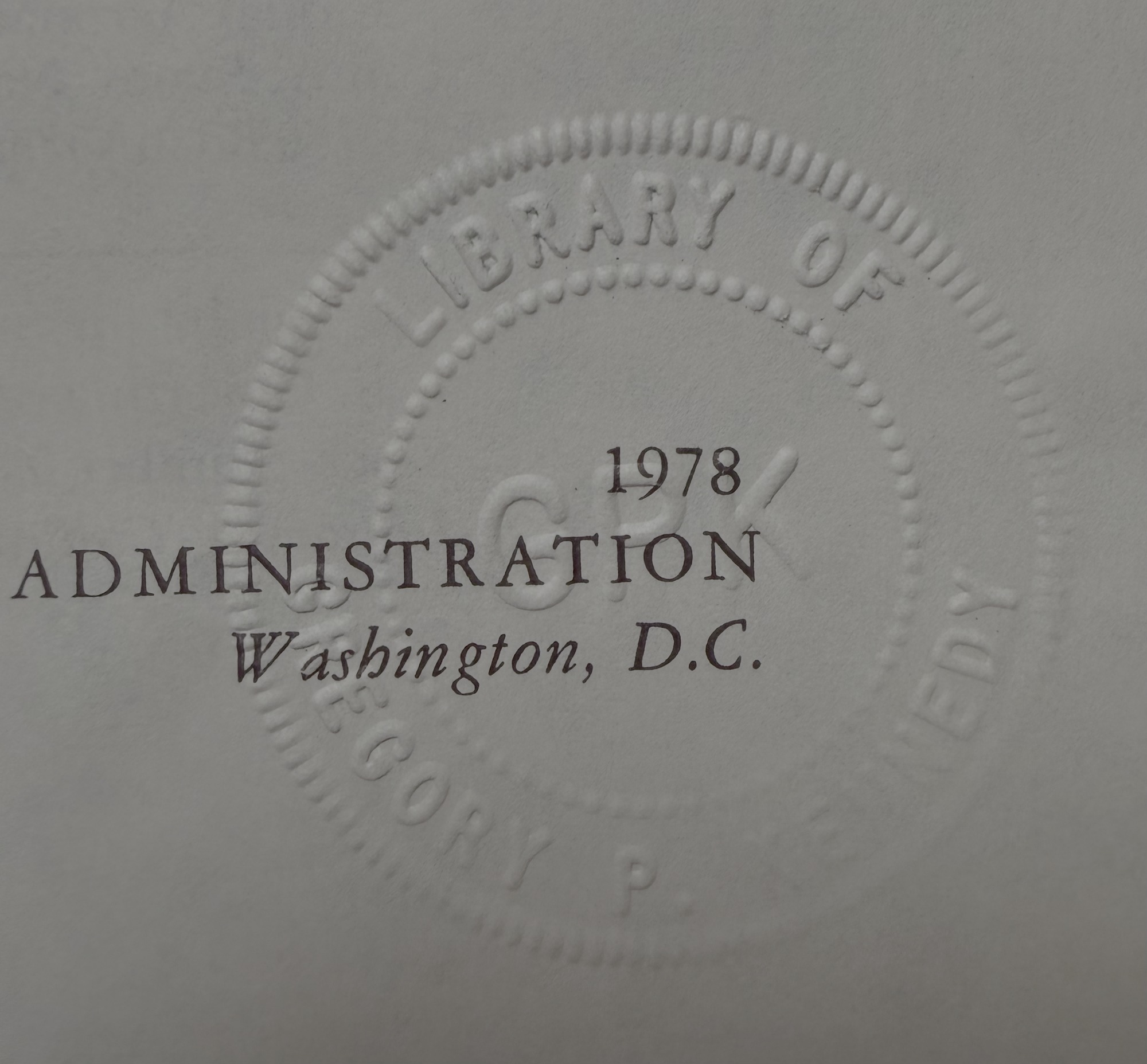
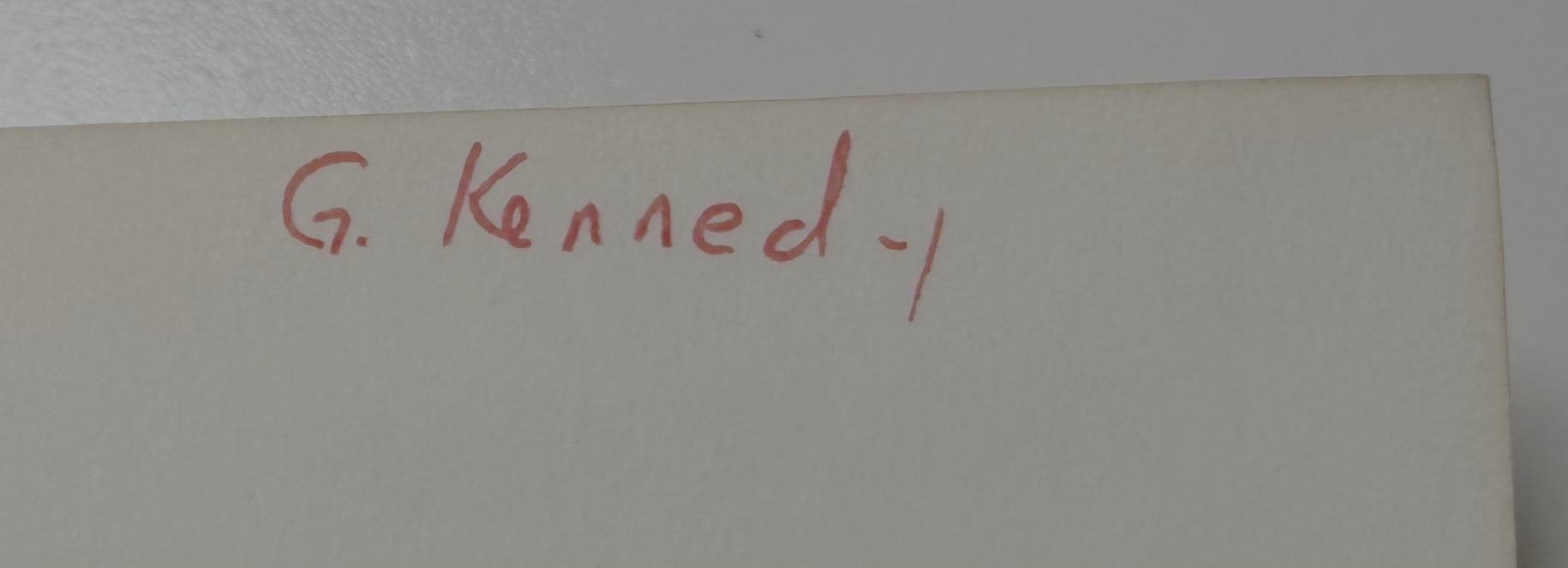
Volume IV carries two marks from his ownership: a blind-embossed circular stamp over the printed imprint block on the title/verso spread, dated 1978, with “GREGORY P. KENNEDY” embossed diagonally through its center; and, in red ink on the front free endpaper, his name written in manuscript — “G. Kennedy.”
Robert Channing Seamans Jr.’s Copy (Skylab)
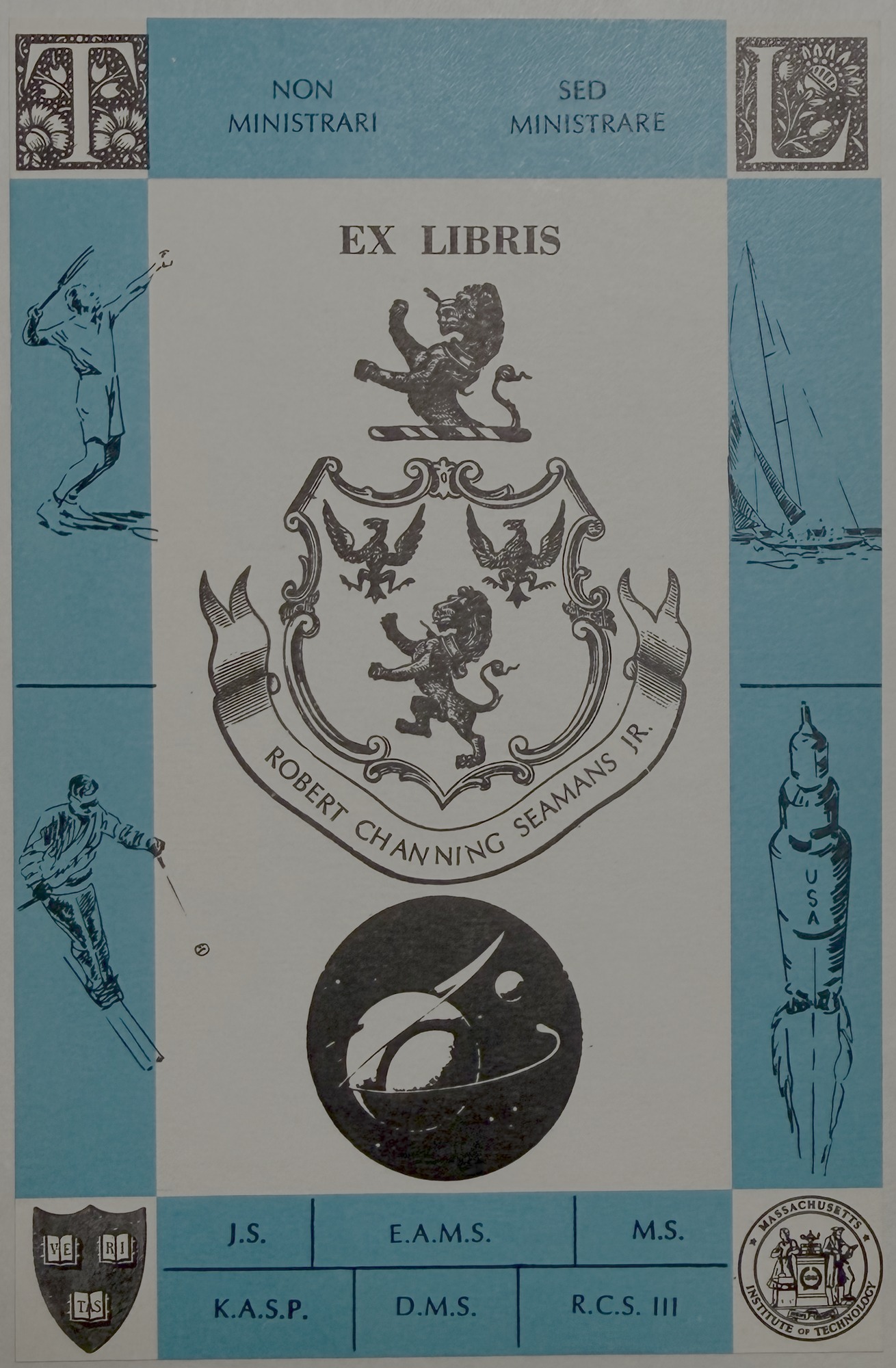
The Skylab volume carries an Ex Libris bookplate, printed in black and light blue: a crest of a lion above a shield bearing two eagles and a lion, the shield’s ribbon lettered “ROBERT CHANNING SEAMANS JR.,” over an orbit emblem, all beneath a banner reading the motto Non Ministrari Sed Ministrare (“Not to be served, but to serve”). A Harvard shield (“Veritas”) and the MIT seal anchor the bottom corners, and the side borders carry small pictorial vignettes: a tennis player, a skier, a sailboat, and a Saturn V rocket. The design is consistent with Seamans’s own biography: degrees from Harvard and MIT, NASA Deputy Administrator from 1965 to 1968, later Secretary of the Air Force. His autobiography, Aiming at Targets, is also in this collection, elsewhere in Catalog F.