- Year
- 1964
- By
- Argentine National Commission on Space Research (ed.)
- Section
- NASA — General & Institutional
- Shelf
- L9
- Catalog
- Catalog F · NASA Missions
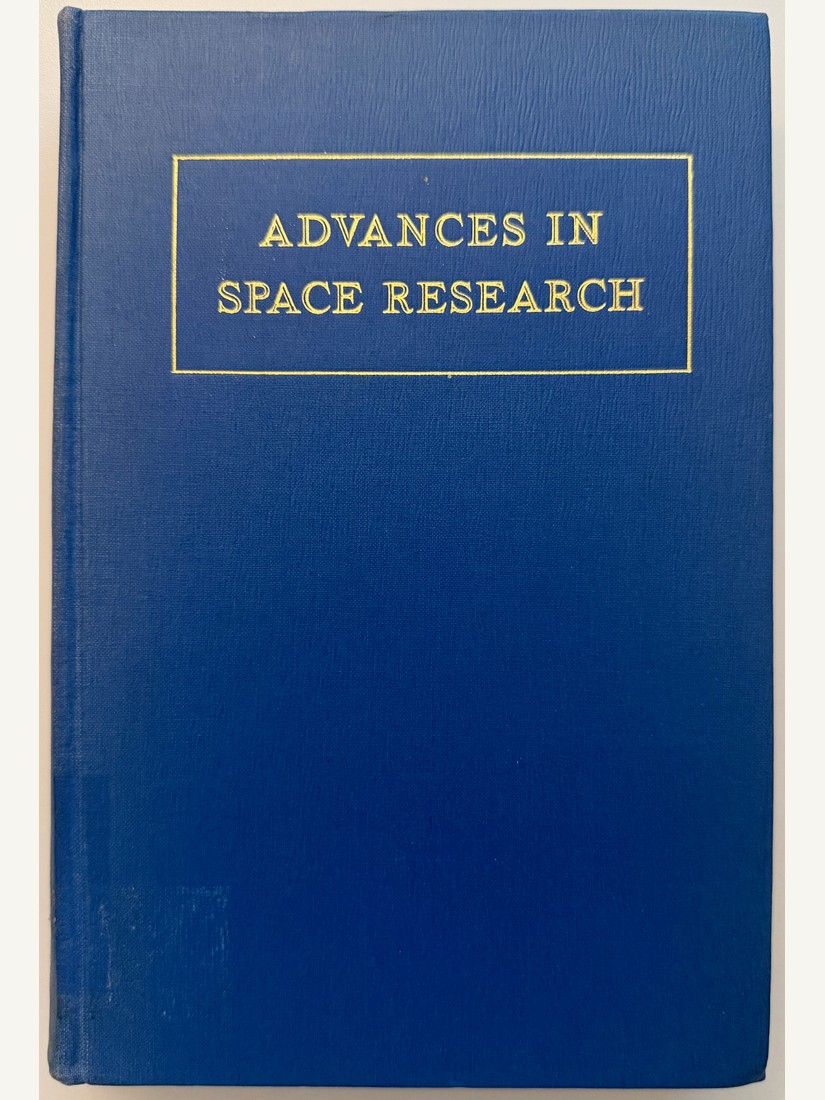
Proceedings of the First Inter-American Symposium on Space Research, held in Buenos Aires in November 1960 and published in 1964 by Pergamon Press with the support of Argentina’s National Commission for the 150th Anniversary of the May Revolution. Edited by the technical staff of the Argentine National Commission on Space Research, presided by Teófilo M. Tabanera, who writes the foreword himself, framing the sounding rocket as a tool within reach of less economically developed countries and describing Latin American participation as a route to future international cooperation.
The opening paper, Richard W. Porter’s “International Cooperation in Space Research,” surveys the region’s substantial contributions to the International Geophysical Year: cosmic-ray studies in Argentina, Brazil, and Bolivia; Antarctic research by Argentina and Chile; the geophysical institute at Huancayo, Peru; ionospheric forward-scatter studies across Argentina, Brazil, Chile, Ecuador, and Peru conducted with the U.S. Central Radio Propagation Laboratory; oceanographic work involving Argentina, Brazil, Chile, and Colombia; Andean and Altiplano seismology; and the “Moonwatch” optical-tracking teams that Porter calls almost indispensable to the IGY’s Earth Satellite Program.
The 24 papers that follow, from contributors including Hugh L. Dryden and Homer E. Newell of NASA, Donald H. Menzel of Harvard, and researchers from Bolivia’s Laboratorio de Física Cósmica in La Paz and Peru’s Instituto Geofísico de Huancayo, cover aerodynamics, solid-propellant rockets, upper-atmosphere sounding, stratospheric balloons, cosmic radiation, and space communications, closing with a U.S. Atomic Energy Commission paper on the Snap-3 radioisotope thermoelectric generator and a summary of the symposium’s panel discussion.
The appendix lists all participants by institution, spanning NASA, General Electric, Princeton, and the U.S. Naval Research Laboratory alongside Argentina’s Comisión Nacional de Energía Atómica and Universidad Nacional de La Plata, Bolivia’s cosmic-physics laboratory, Peru’s Huancayo institute, Japan’s University of Tokyo, and Britain’s National Physical Laboratory.