Catalog D · Prelude to Sputnik · Special Feature · Book of Note
The Assisted Take-Off of Aircraft
Rear Admiral Calvin Bolster surveys JATO, 1950
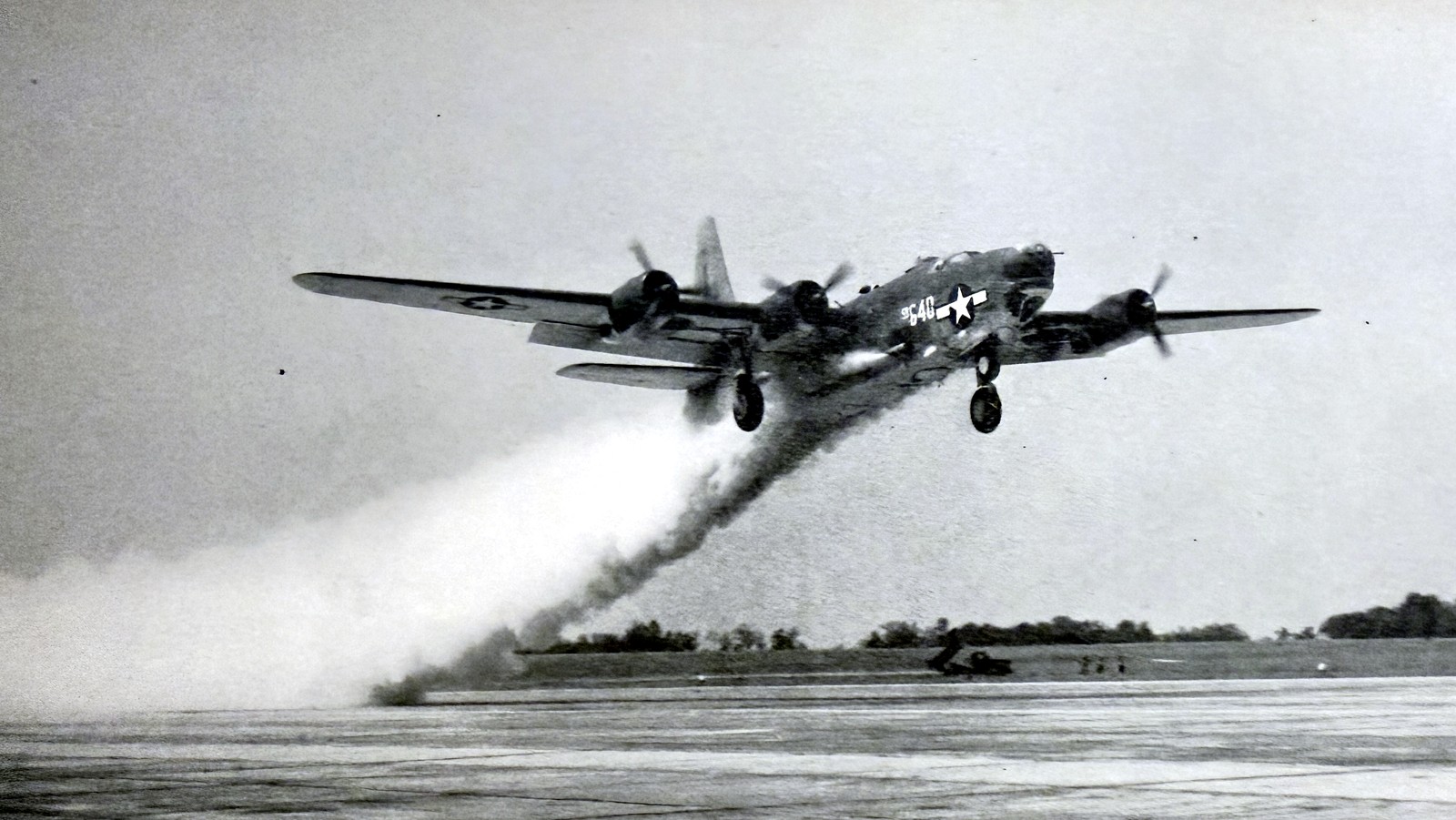
Jet- (or rocket-) assisted take-off, JATO, let heavily loaded aircraft get airborne from short or unimproved runways by supplementing their engines with a short burst of rocket thrust. This 1950 lecture was delivered by a man who had overseen its wartime development from inside the Navy’s Bureau of Aeronautics: Rear Admiral Calvin M. Bolster commanded the Ship Installations Division at BuAer during the founding years of the JATO program, working directly above Robert Truax, the officer most responsible for the Navy’s liquid-propellant rocket effort. It makes a fitting companion to the collection’s Carl Anderson OSRD 2549 report on aircraft rocket launchers: both documents come out of the same small circle of wartime rocket-assisted-flight research, from two different vantage points within it.
Publication Context
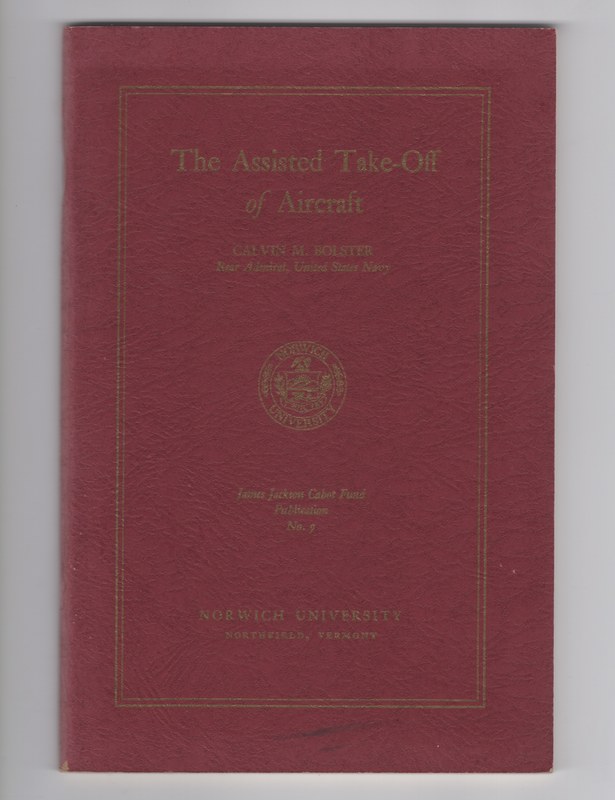
This is not the original OSRD or NDRC wartime report on assisted take-off; it is a standalone published lecture, the ninth title in a series funded by the James Jackson Cabot Fund, an aviation-education endowment established at Norwich University in 1935 by Dr. Godfrey L. Cabot of Boston, a former President of the National Aeronautic Association. The fund was named for Cabot’s son, an officer in the U.S. Flying Service killed in the First World War. According to the introductory note by fund chairman Homer L. Dodge, Cabot personally sought the advice of the late Secretary of Defense James Forrestal in choosing an author, and Forrestal’s advisers settled on Bolster as, in Dodge’s words, “the man for the job.”
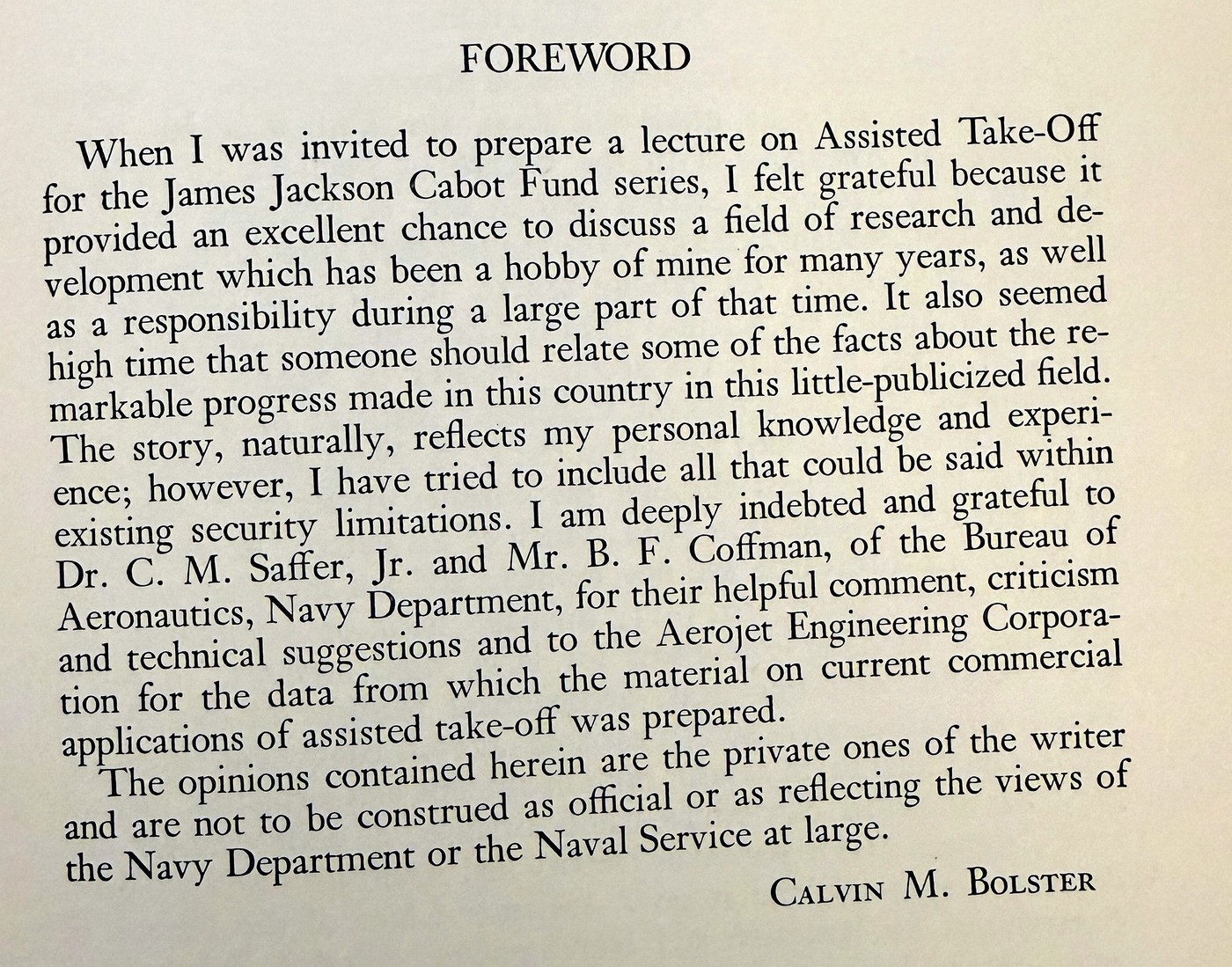
Bolster’s own foreword, dated May 1, 1950, describes assisted take-off as both a decades-long personal hobby and a professional responsibility, and credits Dr. C. M. Saffer Jr. and Mr. B. F. Coffman of BuAer’s Navy Department, along with the Aerojet Engineering Corporation, for material used in the section on commercial applications.
The Author
Calvin Mathews Bolster was born in Ravenna, Ohio, on August 17, 1897. He graduated from the U.S. Naval Academy in 1919, earned a Master of Science in Naval Construction from MIT in 1923, and a second M.S. in aeronautical engineering from Caltech in 1936. His career moved through helium repurification work (1923–25), airplane hook-on and handling equipment for the Navy’s large rigid airships (1927–32), and catapults, arresting gear, and jet-assisted take-off equipment for the WWII-era carrier fleet (1940–45). He was a qualified naval aviator in both airships and airplanes, served as Deputy and Assistant Chief of Naval Research (1947–49), and was Assistant Chief of the Bureau of Aeronautics for Research and Development at the time this lecture was published. He held the Legion of Merit (1945) and an honorary Commander of the Military Order of the British Empire (1947), and received the Robert Goddard Memorial Medal for 1949 for his work in liquid and solid propellant rockets.
From Wan Hu to the Bell X-1
The lecture runs seven short chapters. It opens with the legendary account of the 13th-century Chinese inventor Wan Hu, said to have attempted a rocket-propelled take-off using a rocket-mounted chair, the first known, if disastrous, use of jet thrust for take-off assistance, before moving through Samuel Langley’s spring-catapult launches of powered models over the Potomac near Quantico, Virginia, and the Wright Brothers’ 1903 flight at Kitty Hawk, framing both as forerunners of the take-off-assistance problem addressed later in the book. A chapter on catapult development traces shipboard catapult technology, including the forces acting on tricycle-gear aircraft during a catapult stroke, and touches on wartime advances such as nylon-cord flexible catapults.
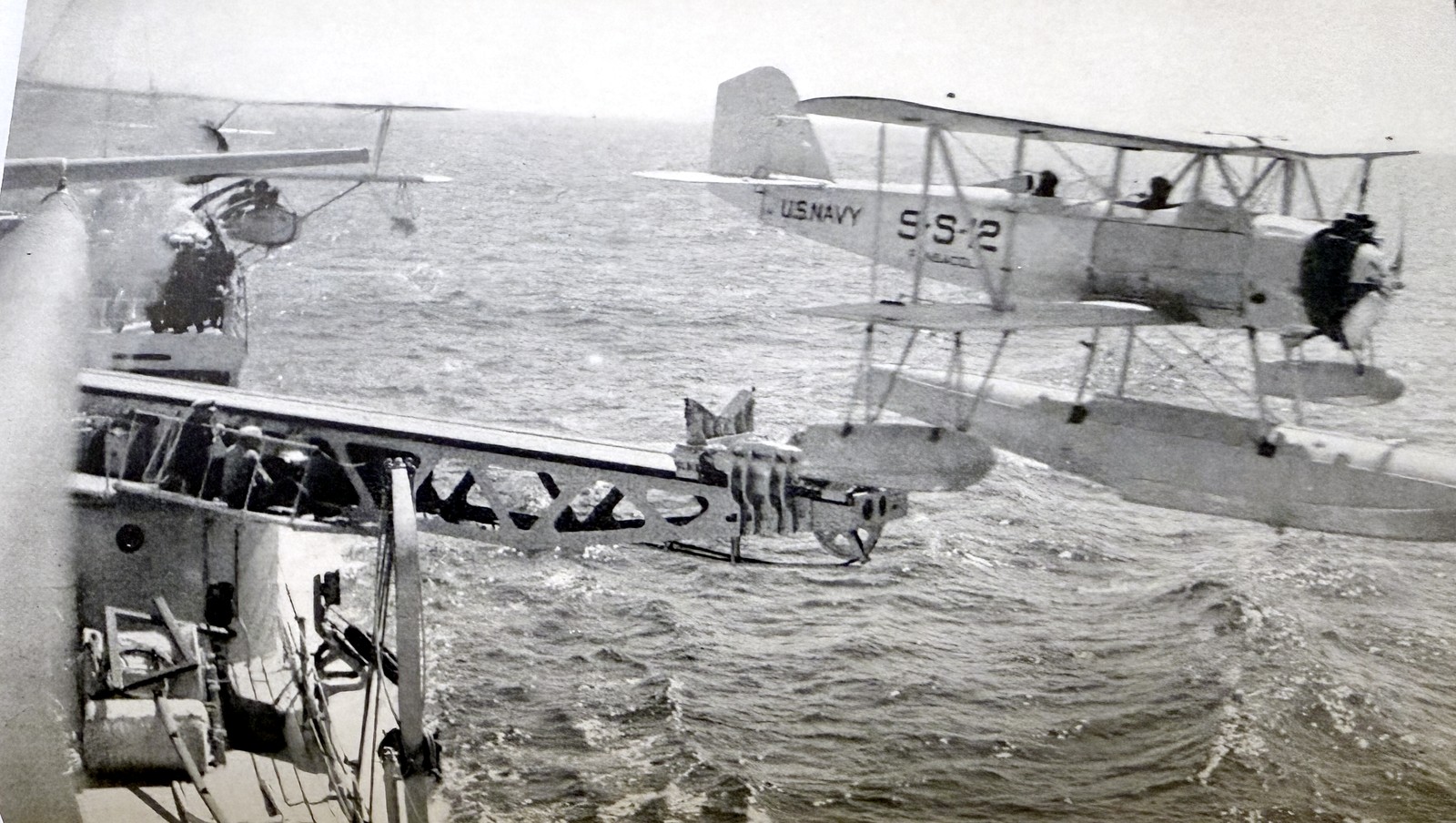
The historical core of the book is its chapter on jet-assisted-take-off development proper, which moves from Wan Hu through two 1929 German rocket-glider flights, by Friedrich (Fritz) Stamer on 11 June and by Fritz von Opel on 30 September of that year, to Hugo Junkers’ full-scale rocket-assisted seaplane test that same year, then to Jack Parsons’ potassium perchlorate–asphalt propellant work at Caltech in the late 1930s and Robert Goddard’s pioneering liquid-propellant experiments from 1919 onward. It closes with the story closest to Bolster’s own career: the 1941 founding of BuAer’s Assisted-Take-Off Section, Robert Truax’s return to Annapolis to lead a liquid-propellant JATO program (alongside Goddard himself, moved from his New Mexico seclusion to work independently at the same Annapolis facility), and Ensign Ray Stiff’s proposal of a self-igniting nitric acid–aniline propellant mix, the same hypergolic combination that would later power the Reaction Motors engine installed in the Bell X-1.
“Fritz Von Epel,” as the book prints it, is very likely Fritz von Opel, based on general knowledge of the 1929 German rocket-glider tests; offered here as a research note rather than a confirmed correction.
JATO Goes to Work
A chapter on commercial application covers the October 15, 1947 Civil Aeronautics Administration type certification of the Aerojet 14AS-1000 D-5 solid-propellant motor, “somewhat of a milestone in JATO development,” as Bolster puts it: the first solid-propellant rocket motor certified safe for civil use, and the approval of JATO attachment brackets for the DC-3 and DC-4.
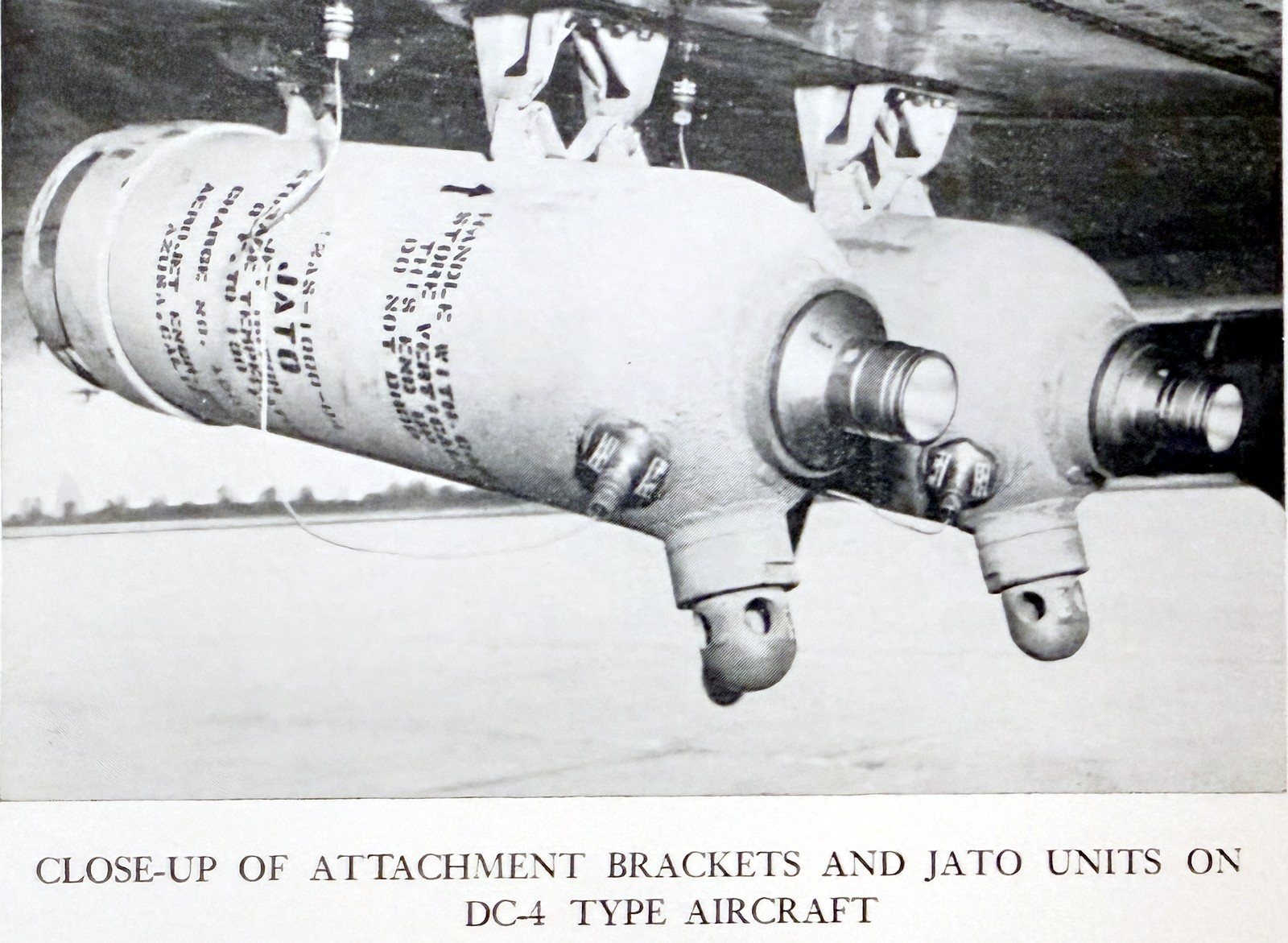
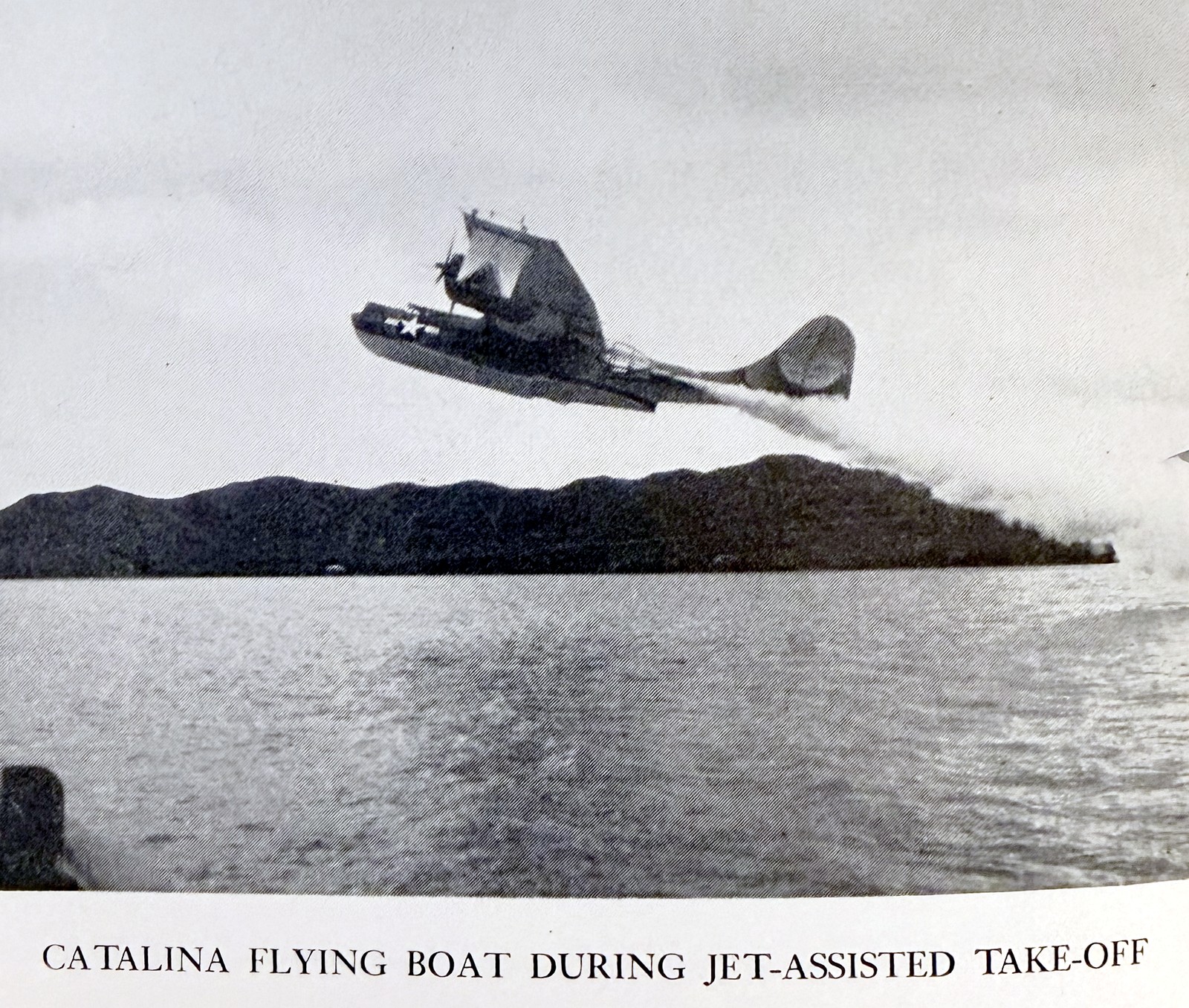
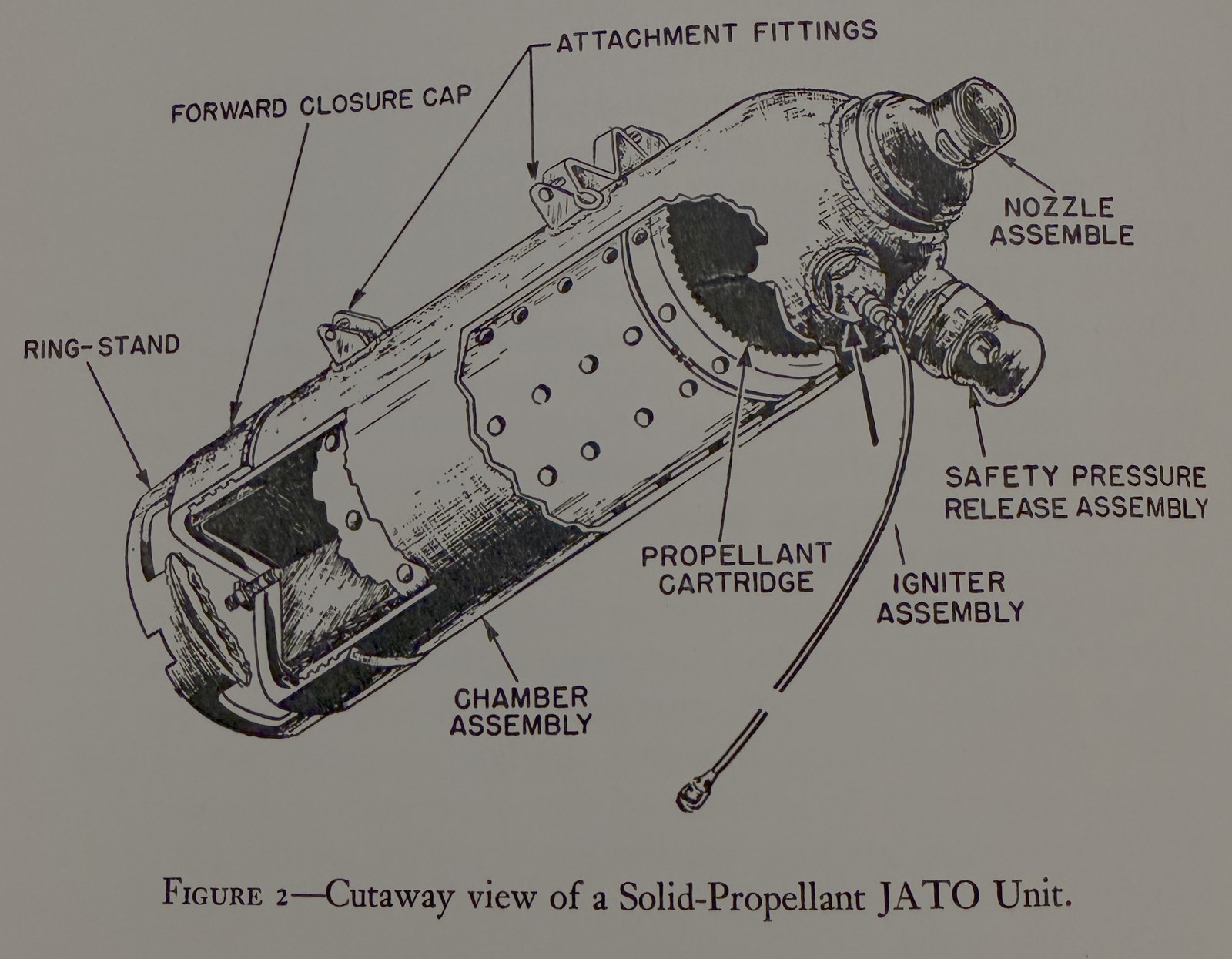
A chapter on estimating take-off characteristics with JATO is the technical heart of the book: a cutaway diagram of a solid-propellant unit and worked examples, using the Herrmann method, for calculating take-off time and distance, citing NACA technical publications by name. A closing chapter looks ahead to turbojet transport aircraft, the electric aircraft catapult then in use at the Naval Air Test Center, Patuxent River, and the potential use of JATO to assist rotating-wing aircraft during take-off and emergency-power situations.