- Year
- 1946
- By
- Joint Board On Scientific Information Policy.
- Published
- Washington, D.C.: U.S. Government Printing Office.
- Edition
- English. First edition (1946), wraps.
- Ciancone
- N/A.
- Shelf
- R5
- Catalog
- Catalog C · Postwar
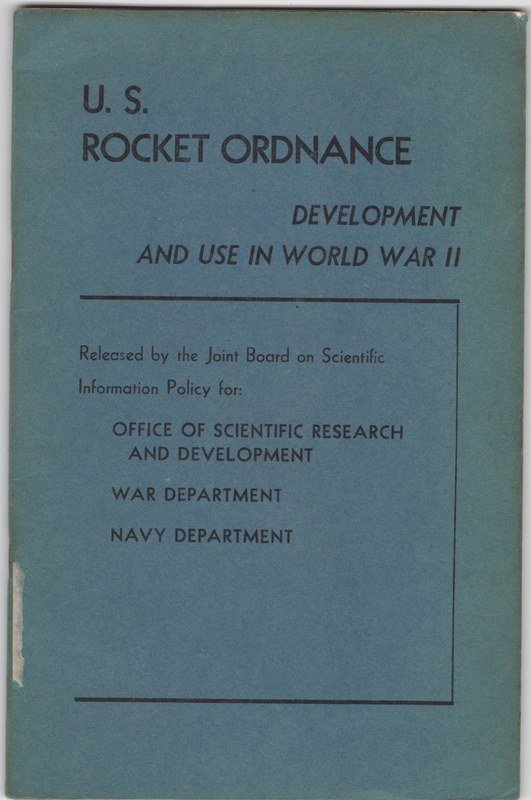
A 57-page illustrated account of American rocket ordnance in World War II, released in 1946 by the Joint Board on Scientific Information Policy for the Office of Scientific Research and Development, the War Department and the Navy Department, and printed by the Government Printing Office in teal-green wraps. The Foreword, “Rockets at War,” notes that when Pearl Harbor was attacked the Army and Navy had not a single rocket in service, yet by VJ-day the Army was procuring rockets at $150,000,000 a year and the Navy had 1,200 plants producing them. It opens with a photograph of a Navy F6F carrying a pair of “Tiny Tim” rockets.
Nine chapters follow: “The Rockets’ Red Glare,” rocket fundamentals, the organization of the rocket laboratories, rocket versus submarine (the “Mousetrap” and the rocket that fired backward), rocket armament for aircraft, rockets for amphibious warfare (Okinawa, barrage rockets, rocket-firing PT boats and the “spinner” family), the bazooka versus the tank, rockets for ground warfare, and specialized uses. Photographs show rocket-armed fighters, launchers on landing craft and the results of rocket attacks, with a cutaway of single- and double-based rockets in the fundamentals chapter.
The closing pages describe how wartime work was handed on to peacetime laboratories, including the Naval Ordnance Test Station at Inyokern and the Allegany Ballistics Laboratory, and end with “Weapons of the Future.” See also the Navy’s ordnance pamphlet Rocket Assemblies (Catalog B) and Rosser’s Mathematical Theory of Rocket Flight (below), both products of the same wartime programs.