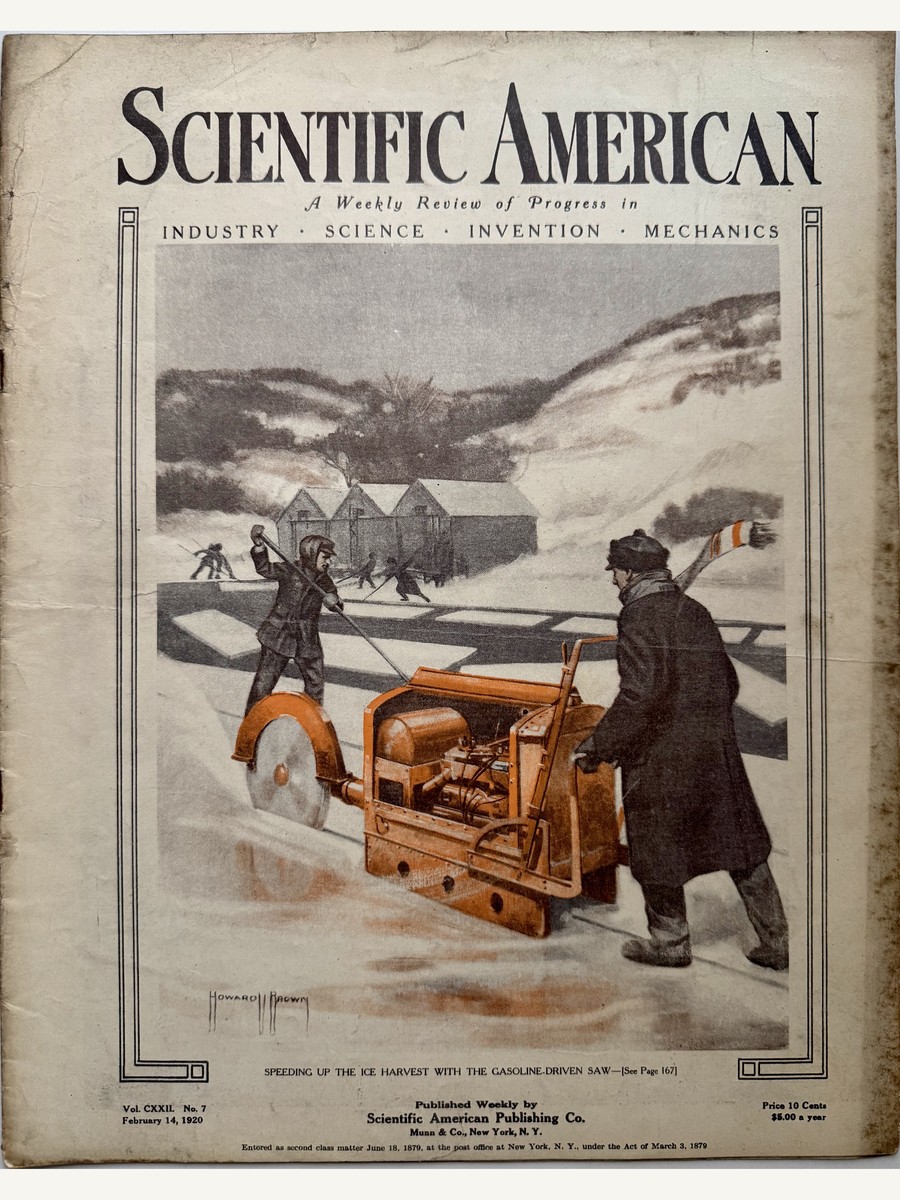
- Year
- 1920
- By
- Scientific American. Editors
- Published
- New York: Munn & Co.
- Edition
- English. Single issue, wraps.
- Ciancone
- N/A.
- Shelf
- L10
- Catalog
- Catalog E · Miscellanea
Response to the sensational press coverage that greeted Robert Goddard’s “A Method of Reaching Extreme Altitudes,” published one week after the Smithsonian released the paper and a month after the New York Times’ now-notorious editorial mocking his rocket-in-vacuum physics.
Rather than joining in, the magazine faults the daily press for seizing on Goddard’s incidental mention of a moon shot “as the feature of the story and the hook on which to hang the headlines,” walks through his mass-ratio and rocket-efficiency theory in serious technical detail, and explicitly vindicates the vacuum-thrust experiments the Times had ridiculed: “Dr. Goddard confirms what some of us at least have always known or suspected… the rocket continues to get impulse from its exploding charge even in complete vacuo.”
Vestnik Znaniya, No. 8, 1925 (elsewhere in this catalog) likewise reports on Goddard’s “lunar rocket” project. Scientific American, Vol. CXXII, No. 7, February 14, 1920, pp. 161, 178.