Catalog A · Early Pioneers · Special Feature · Book of Note
Space Rocket Trains
Tsiolkovsky’s own testament on the multi-stage rocket, Kaluga, 1929
In 1929, at seventy-two, Konstantin Tsiolkovsky sent a modest, self-published pamphlet out from Kaluga: thirty-eight pages in publisher’s wrappers, a portrait frontispiece, a biographical sketch by a local admirer. Космические ракетные поезда, Space Rocket Trains, is his fullest working-out of the multi-stage rocket, the arithmetic of what happens when a spent stage falls away and a lighter train races ahead on what fuel remains. It is dense reading. It is also, in its way, a personal letter: an old man writing directly to the “workers of astronautics, in the USSR and abroad,” naming by name the handful of people worldwide doing the work alongside him.
A Pamphlet from Kaluga
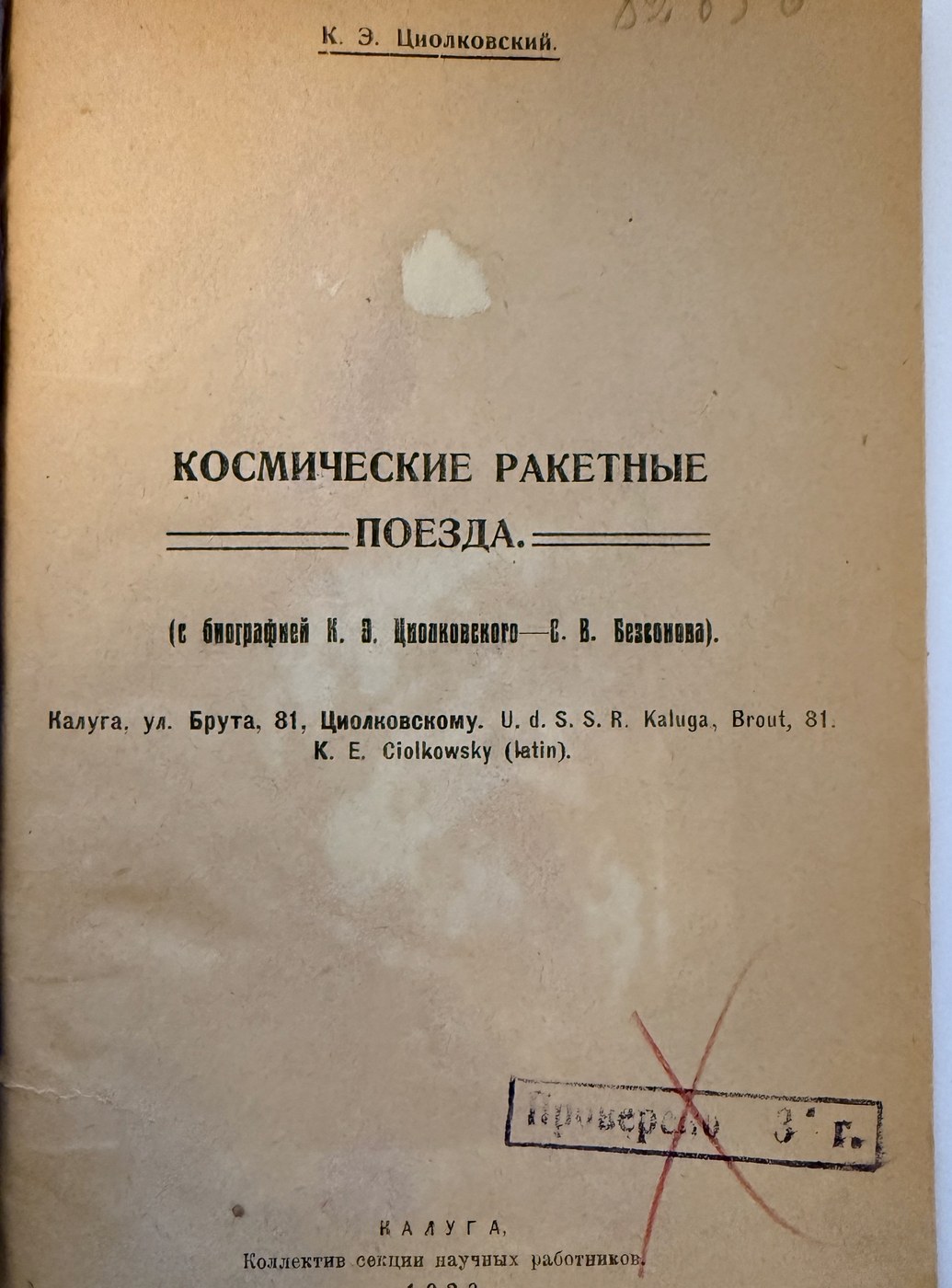
The title page names the publisher as the Kaluga Collective of the Section of Scientific Workers, a small provincial body proud enough of its one famous member to put his mailing address on the cover: “Kaluga, ul. Bruta, 81, Tsiolkovskomu. U.d.S.S.R. Kaluga, Brout, 81. K.E. Ciolkowsky (latin).” It reads less like a publisher’s imprint than an invitation for the world to write back.
The pamphlet is bound with a biographical sketch, “K.E. Tsiolkovsky,” contributed by Sergei Bezsonov, the collective’s representative. Bezsonov traces the arc familiar from every account of Tsiolkovsky’s life: the provincial schoolteacher in Kaluga's girls' school, deaf since childhood, self-taught in physics and mathematics, ridiculed for decades as an eccentric before the Soviet state began, in the mid-1920s, to treat him as a national asset, granting him a personal pension through Osoaviakhim and the Council of People’s Commissars. By 1929 Tsiolkovsky had published more than eighty works; Bezsonov singles out the 1903 paper that first laid out rocket-flight theory and the 1926 Investigation of Outer Space by Reactive Devices, the study this pamphlet extends.
A Message to the World’s Rocket Workers
The pamphlet opens with a short preface, “From the Author,” that reads more like testimony than front matter. “I am already 72 years old,” Tsiolkovsky begins. “I have long since stopped working with my own hands and no longer conduct any experiments.” What follows is his own survey of who had picked up the work since his first paper in 1903: Oberth in Germany, Goddard and Esnault-Pelterie soon after, then a longer roll call, Wolf, Valier, Hohmann, Ley, Sander, Zander, and in the Soviet Union Rynin, Tsander, and Perelman, whom he credits by name for translating and spreading his own writings.
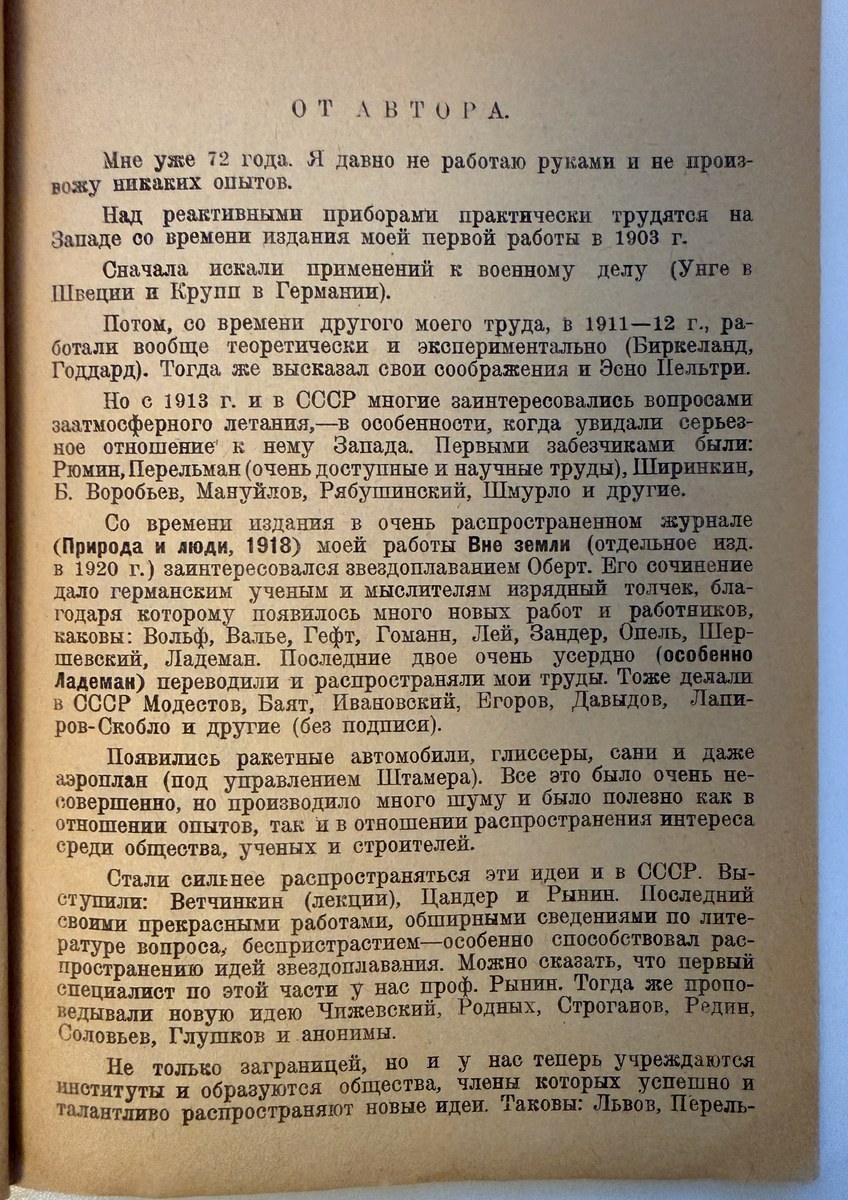
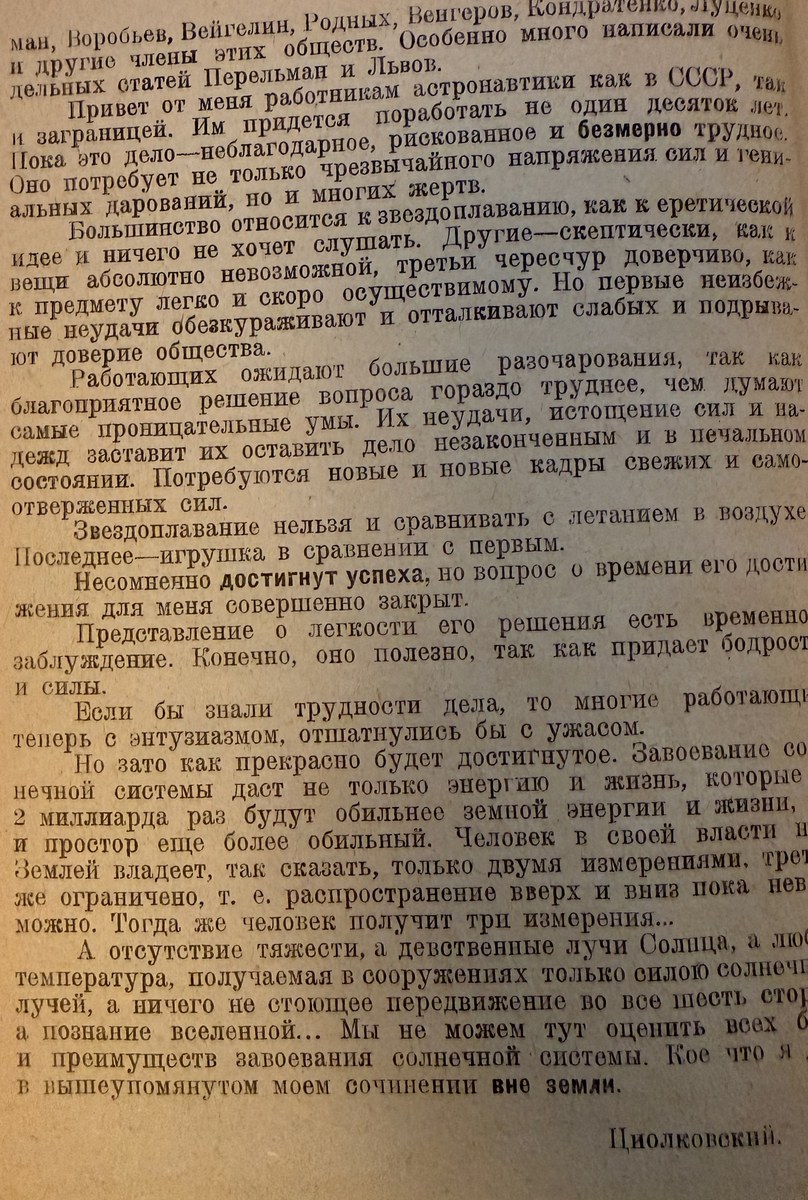
He does not oversell the work ahead. Astronautics, he writes, is for now “a thankless, risky, and immensely difficult” undertaking that “will demand not only extraordinary exertion and genuine talent, but many sacrifices.” Most people, he goes on, treat star-flight either as heresy, as an impossibility, or as something absurdly close at hand, and none of the three attitudes will serve the people who actually have to do the arithmetic. The preface closes on a different register entirely, a vision of the solar system’s energy, two billion times what Earth alone provides, opening to whoever solves the problem, and then a plain sign-off: “Greetings from me to the workers of astronautics, both in the USSR and abroad.” Signed, “Tsiolkovsky.”
The Rocket Train
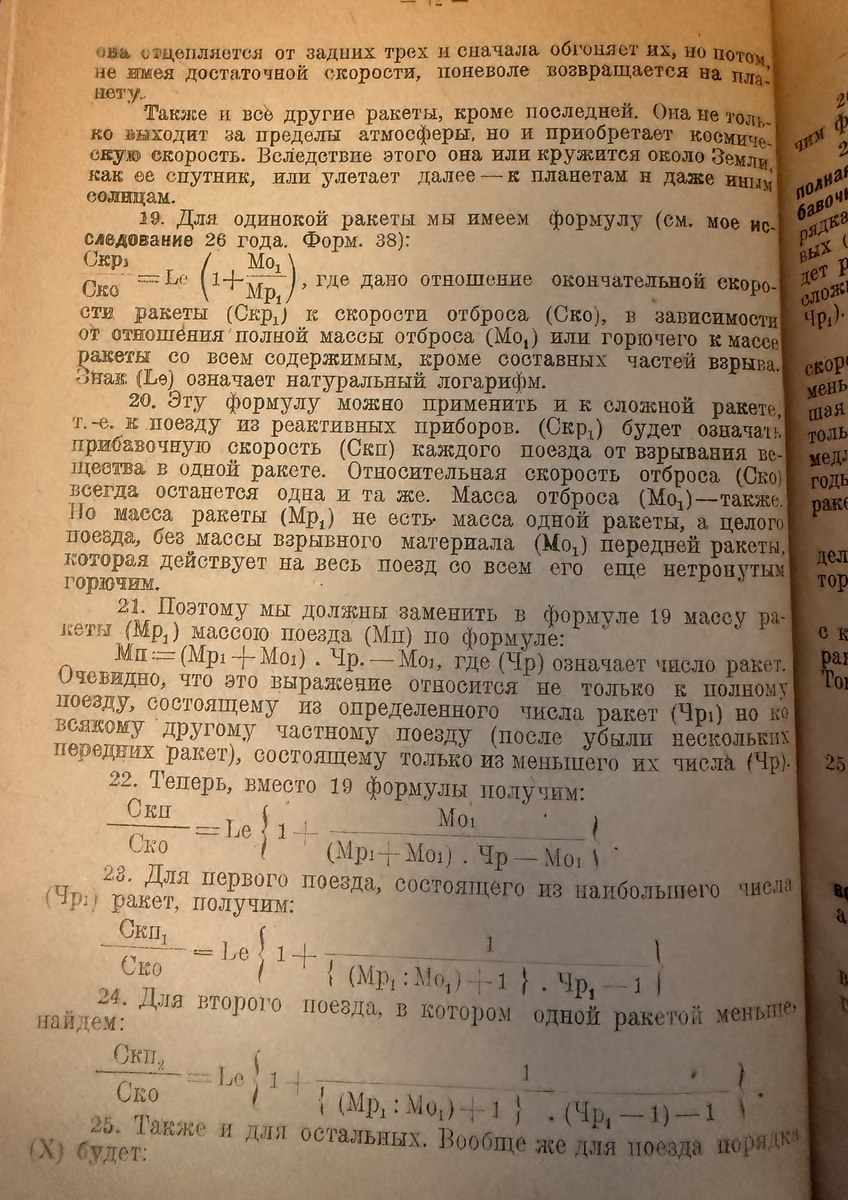
The idea at the center of the pamphlet is simple to state and hard to make precise. A single rocket has to haul its own dead weight, empty fuel tanks, spent structure, all the way to the end of its burn. Chain several rockets nose to tail instead, and each one can be cut loose the moment it runs dry, so the rockets still burning are dragging less mass behind them. Tsiolkovsky calls the arrangement a poezd, a train, and works through what it buys you: for a train of seventeen rockets, by his tables, even a modest fuel fraction of 0.2 to 0.3 per rocket is enough to reach escape velocity from the solar system, with the last rocket in the chain arriving nearly empty.
He restates his own 1926 velocity formula (“see my Investigation of ’26, Formula 38”), the same relation known today as the Tsiolkovsky rocket equation, and rebuilds it term by term for a train: first for a single rocket, then for the rocket at the head of a train of any length, then for the second rocket once the first has been shed, and so on down the chain. The tables that follow work out trains of two to ten rockets under four different schemes for how fuel is distributed along the train, which he labels simply A, B, V, and G. A closing addendum on the temperature of a rocket in space, reasoning from radiative equilibrium, argues a rotating hull could hold anywhere from near absolute zero to some 150°C depending on its orientation to the sun, or far higher if sunlight were focused through a lens.
What His Contemporaries Said
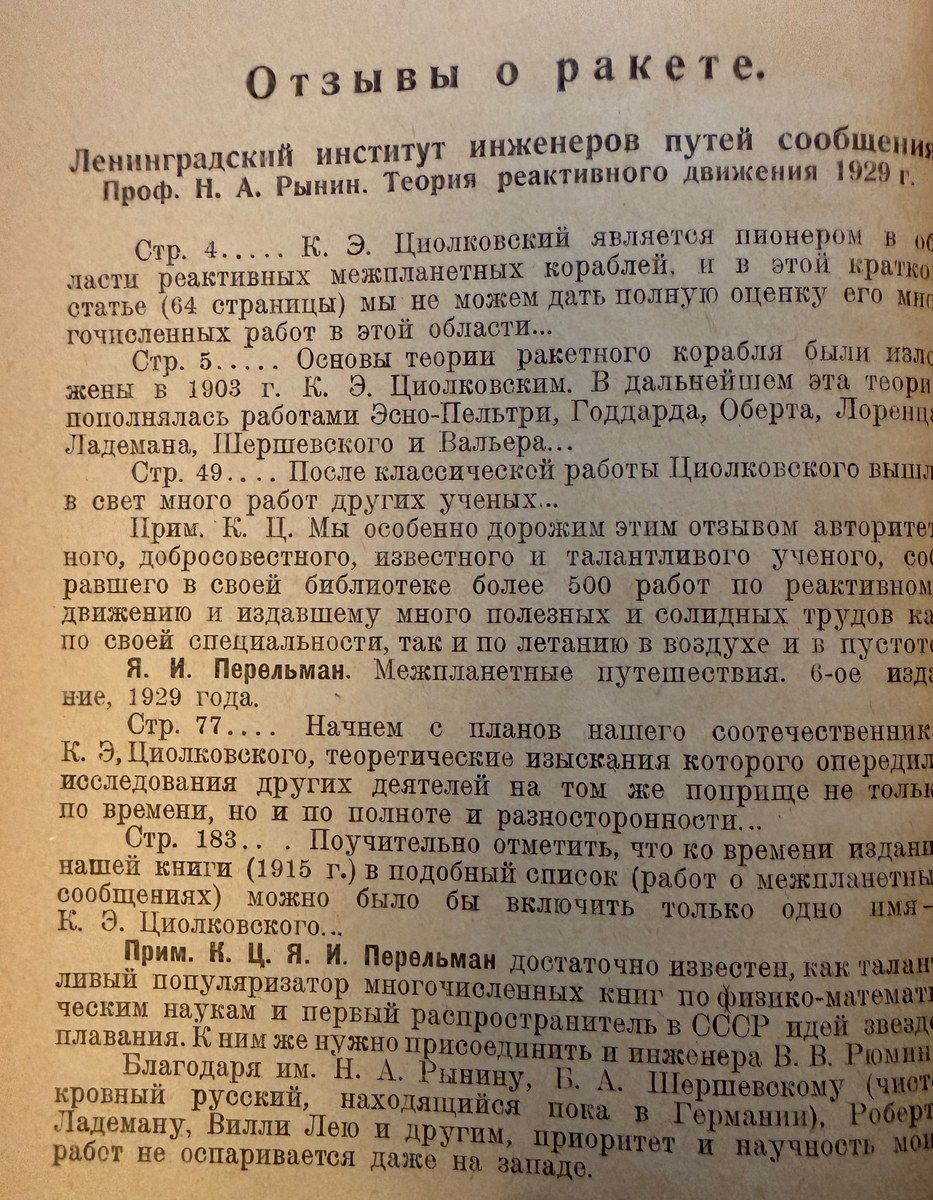
Further on, Tsiolkovsky reprints a short section of testimonials, “Отзывы о ракете” (Opinions on the Rocket), quoting other writers on his own standing in the field, and it is a more measured picture than “pioneer” alone suggests. Professor N. A. Rynin, of the Leningrad Institute of Railway Engineers, is quoted from his 1929 Theory of Reactive Motion: “The fundamentals of rocket-ship theory were set out in 1903 by K. E. Tsiolkovsky. This theory was later supplemented by the works of Esnault-Pelterie, Goddard, Oberth, Lorenz, Lademann, Shershevsky, and Vallier.” Tsiolkovsky adds his own note beneath it, calling Rynin “an authoritative, conscientious, well-known and talented scholar,” whose personal library held more than five hundred works on reactive motion. Iakov Perelman, quoted from the sixth edition of Interplanetary Travel that same year, calls him “our compatriot,” whose theoretical work anticipated other researchers’ “not only in time, but in completeness and breadth.” Perelman’s own book is in this collection as well, in its seventh (1915) and tenth (1935) editions.
A Library’s Life
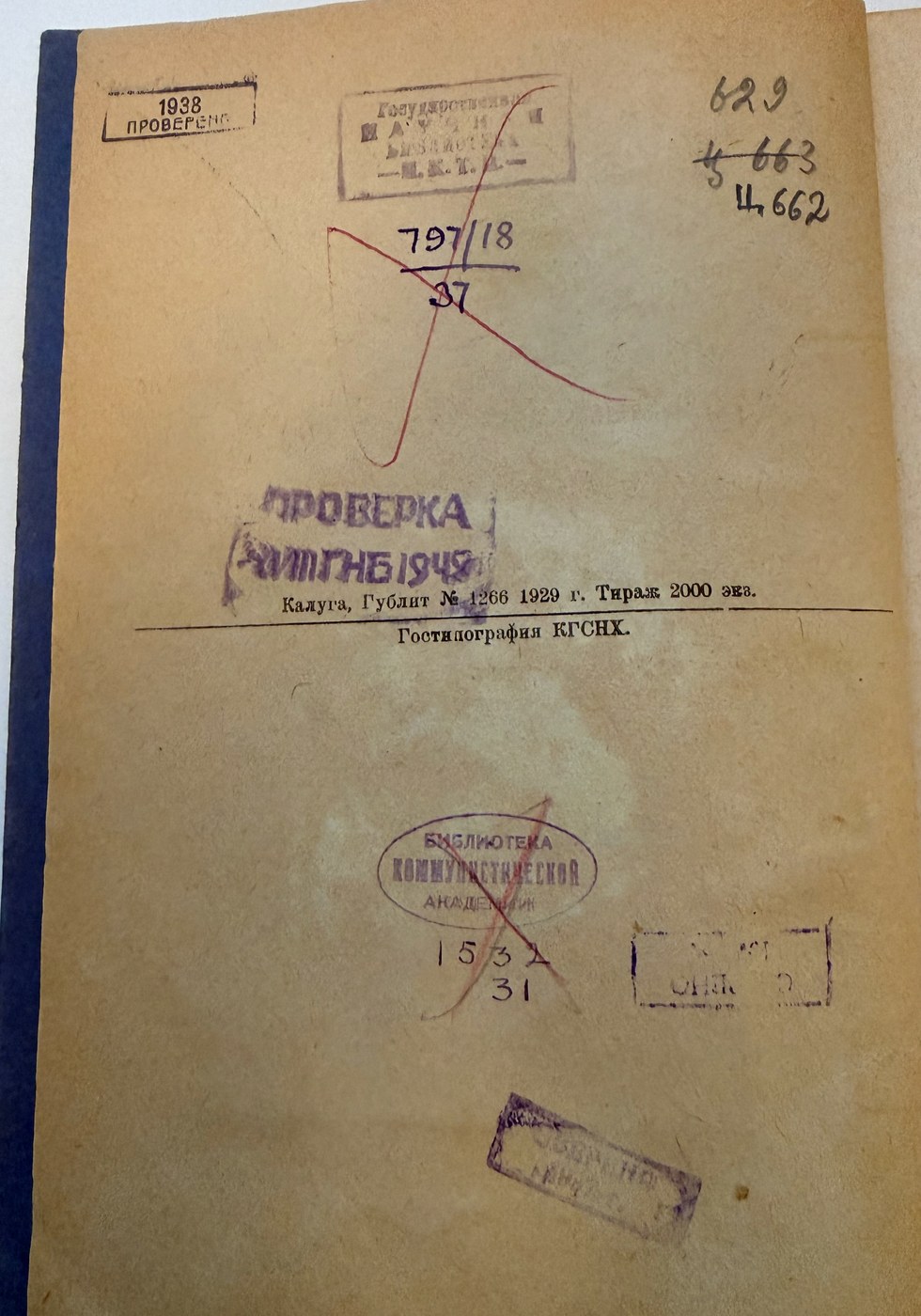
The colophon on the verso of the title page is plain enough: “Kaluga, Gublit No. 1266, 1929. Print run 2,000 copies. State Printing House of the Kaluga Provincial Economic Council.” Everything stamped around it afterward is the copy's own institutional biography. A rectangular stamp reads “State Scientific Library, People’s Commissariat of Heavy Industry,” with a shelfmark, 797/18, added in ink beside it. A second stamp, “1938 ПРОВЕРЕНО” (checked, 1938), and a third, “ПРОВЕРКА НИИГНБ 1949” (inspected, 1949), mark two later audits of the collection it belonged to. An oval stamp, “Библиотека Коммунистической Академии” (Library of the Communist Academy), with the shelfmark 153 D/31, recurs at intervals through the pamphlet and again on its final page, its accession number crossed through and reassigned at least twice: 629, then a struck-through 663, then Ц.662. On the last page, beside Tsiolkovsky’s own printed signature, a small triangular stamp in reddish ink survives but resists reading. The copy has since been rebound.
“The Reactive Engine”
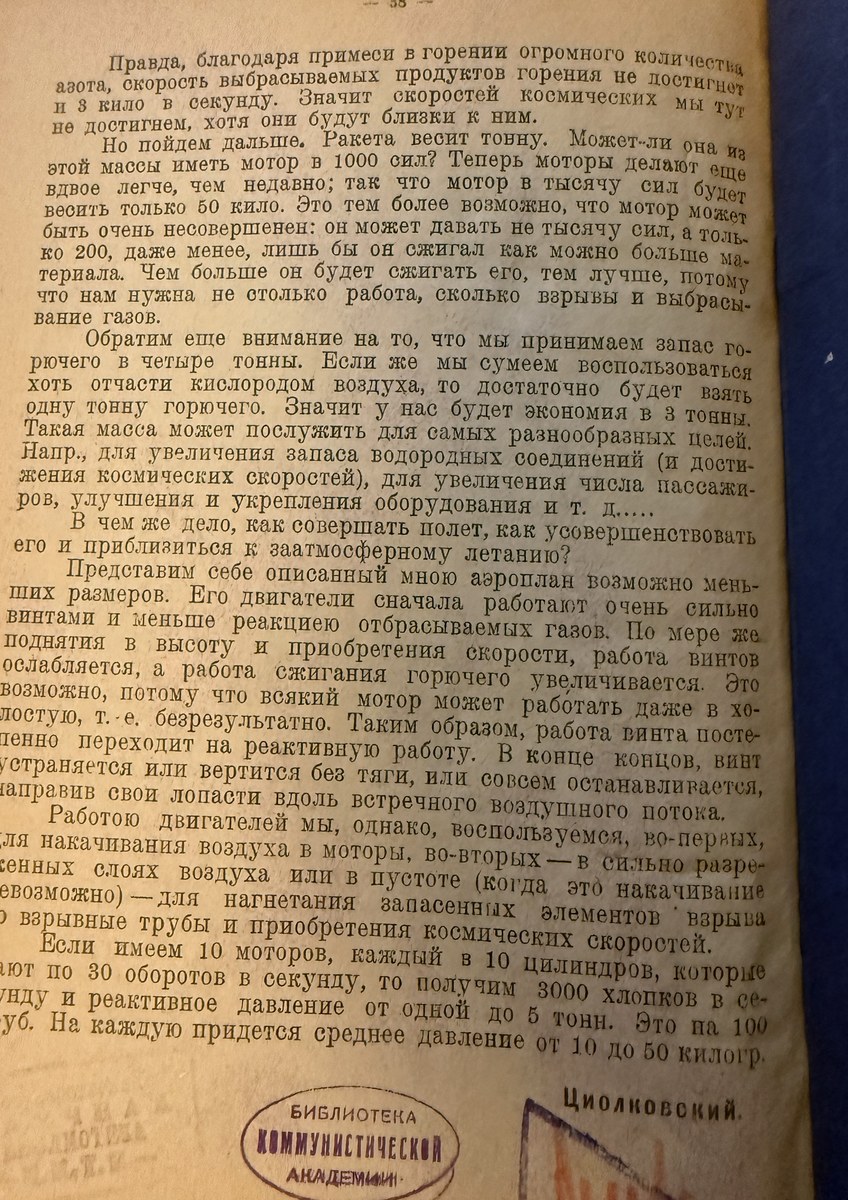
The pamphlet closes with a short essay in Tsiolkovsky’s own voice, “Реактивный двигатель” (The Reactive Engine). “I have been working on reactive devices since 1895,” he opens. “Only now, at the end of thirty-four years of work, have I arrived at a very simple conclusion.” What follows is arithmetic rather than argument: a hypothetical 1,000-horsepower engine, its fuel consumption, the mass of air it would need if burning hydrogen, the resulting exhaust velocity, worked through to a plain number, 5.6 kilograms of gas ejected per second, which he judges “a large quantity” and, he adds, “quite sufficient to obtain enormous speeds.”
The essay, and the pamphlet, break off there, mid-calculation, at the bottom of page 38, his printed signature and the Communist Academy’s stamp sharing the same last inch of paper. It is a fitting place for it to end: a book that opened with an old man’s greeting to rocket workers around the world closes with him still doing the sums himself.