- Year
- 1936
- By
- Heard, Gerald
- Published
- London: Nelson & Sons.
- Edition
- English. First edition, HC, DJ.
- Ciancone
- 97.
- Shelf
- R3
- Catalog
- Catalog A · Early Pioneers
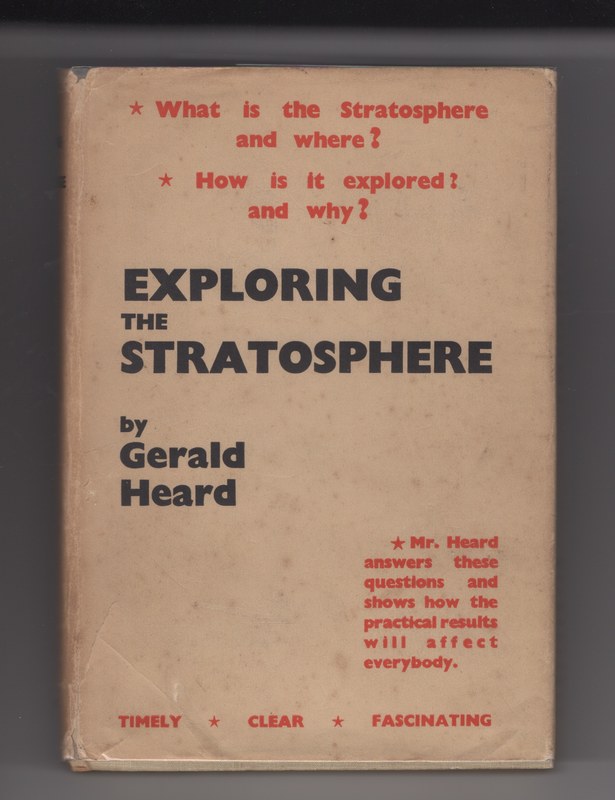
Gerald Heard — the broadcaster and popular-science writer whose The Source of Civilization is cited on the jacket — surveys the stratosphere in four short sections: what it is and where it begins; the balloon ascents that first reached it, from Professor Piccard's pioneering flights to the Soviet stratosphere balloon and the U.S. Explorer II gondola of Captains Stevens and Anderson, including the sighting of stratosphere-level storms and the death of the French Farman monoplane's pilot, M. Cognot, after a crash from 32,000 feet; its practical uses in weather forecasting, faster and safer high-altitude flight, and broadcasting; and finally what stratosphere research means for cosmic-ray physics.
The most forward-looking chapter, “Training Ground for Rocket Flight,” argues that the aeroplane is fundamentally a “self-propelling kite” that must have air to grip and so has a hard ceiling, while the rocket needs no medium at all and would work better in a vacuum than in the stratosphere's thin air — illustrating the principle with the recoil of a stone and the physics of dynamite blasting, and noting that a rocket-driven car and a rocket-propelled aeroplane had already flown in Germany. Heard works through the problem of decelerating safely on the way back down, citing the record-breaking delayed parachute jump of John Tranum as real-world evidence for how much sudden deceleration the human body can survive.
Three of the book's photographic plates are devoted to Robert H. Goddard: his moon-rocket, its launching tower, and a photograph of Goddard holding a model rocket, captioned as backed by the Guggenheim Foundation and Colonel Lindbergh.