- Year
- 1928
- By
- Rynin, Nikolai
- Published
- Leningrad: P.P. Soikin.
- Edition
- Russian. First edition, rebound.
- Ciancone
- R15.
- Shelf
- L7
- Catalog
- Catalog A · Early Pioneers
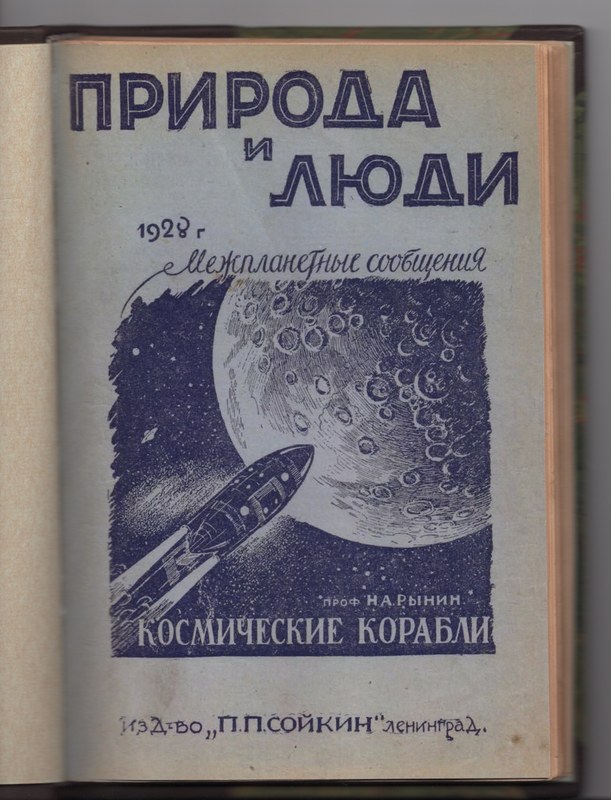
Book 2 of Rynin’s nine-volume encyclopedia Interplanetary Communication (Mezhplanetnye soobshcheniya). The volume title is Cosmic Ships, subtitled Interplanetary Communication in the Fantasies of Novelists. It was issued by P. P. Soikin, and the bound copy keeps the front wrapper of Soikin’s magazine Priroda i Lyudi (Nature and People) for 1928.
In his preface (Leningrad, 17 June 1928) Rynin says that the scientific and technical side, with calculations and designs for space ships, was worked out and ready for print but held back by lack of funds, so this volume deals only with the fiction. A footnote (p. 5) refers back to Book 1, Dreams, Legends and First Fantasies, and in the introduction he lists twelve ideas for leaving the Earth that organize the chapters: from a cannon, from a volcano, by centrifugal throwing machines, by a run on rails, by “minus and plus matter,” by light pressure, by ether vibration, by solar energy, in electric ships, in radio ships, by intra-atomic energy, and in rocket ships.
Chapter I (“From a Cannon to the Planets”) opens with a biographical sketch of Jules Verne and sets out his two gun projects, including the flight calculations from From the Earth to the Moon and Around the Moon (p. 8), then Max Valier’s critique of Verne’s cannon, Faure and Grafigny’s gun, and a centrifugal “lunar bomb” launcher in a circular tunnel. Later chapters cover the “etheronef” of A. Bogdanov (with floor plans, pp. 40–41), the vibration ship of V. Kryzhanovskaya, the electric ship of L. Afanasyev, Ridley’s comet machine, Nikolsky’s ship, and the radium rocket of Maral-Vige, a novel built on Esnault-Pelterie’s ideas.
Chapter IX (“The Cosmic Ship,” p. 111 on) treats rocket ships, beginning with Verne’s use of rockets to brake the projectile, then Armfeldt’s winged rocket launched from the sea (1927), Arelsky’s Moon rocket, the Tsiolkovsky-inspired ship of S. Grave, Belyaev’s rocket city, and Yazvitsky’s trip to the Moon and Mars. Final chapters take up the inhabitants and landscapes of other worlds, with Flammarion’s views and James Nevin Miller’s 1928 planetary scenes from Science and Invention (pp. 157–159). Rynin closes by saying that the rocket principle is the one most scientists were then pursuing, and announces a sequel on radiant energy.
Profusely illustrated, with about 160 figures and reproductions from Flammarion, Verne editions, and Soviet pulp. Ads at the back list Perelman’s Interplanetary Travels, which is also in the collection. Print run 15,000.