- Year
- 1928
- By
- Esnault-Pelterie, Robert
- Published
- Paris: Société Astronomique de France.
- Edition
- French. First edition, wraps.
- Ciancone
- 65.
- Shelf
- R6, R7
- Signed
- Inscribed by Robert Esnault-Pelterie
- Catalog
- Catalog A · Early Pioneers
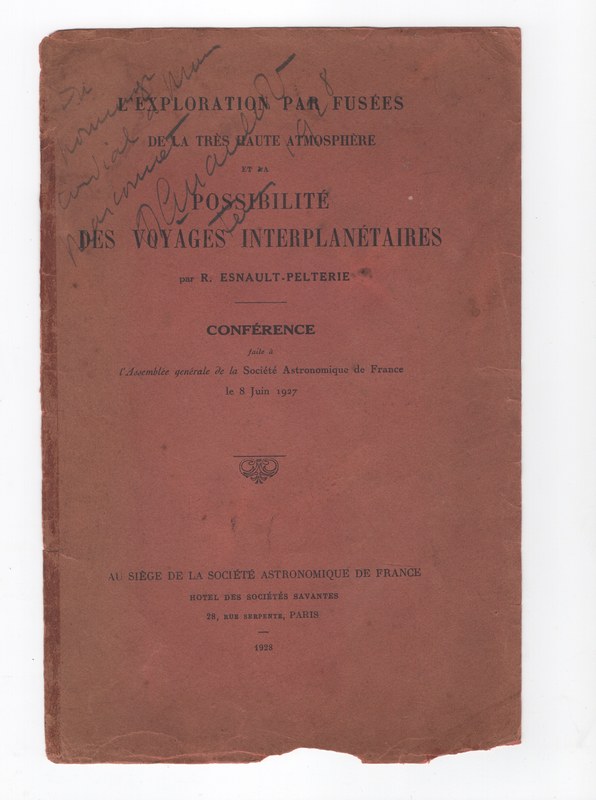
Delivered as a lecture to the Société Astronomique de France on 8 June 1927 and published the following year, this is Esnault-Pelterie's major early treatment of rocket flight: the mass-ratio equation for cylindrical and conical airframes, the effect of atmospheric drag, trajectories for reaching the Moon and the planets, and the engineering and physiological demands of a crewed interplanetary vehicle, down to anesthetizing the traveler to conserve oxygen during years-long coasting phases.
A closing “Note de l’auteur” records that he learned only in January 1928, after finishing his own work, of three 1925 publications he had not known of — Hohmann’s Die Erreichbarkeit der Himmelskörper (also in this collection), Oberth’s Die Rakete zu den Planetenräumen, and Valier’s Der Vorstoss in den Weltenraum — and compares his results with Hohmann’s point by point, finding them to agree closely up to a shared exhaust velocity of 10,000 m/sec.
Page 94 credits the novelist J.-H. Rosny Aîné with suggesting a name for this new science, which Esnault-Pelterie says he adopted on the spot: “Astronautique” — the word’s first appearance in print, two years ahead of his better-known 1930 book of that title. The same pages announce the Prix REP-Hirsch, the annual astronautics prize he had just founded with banker André Hirsch through the Société Astronomique de France.
Two exemplars: one inscribed by Esnault-Pelterie on the front wrapper, with a typed letter laid in, signed by him on his Boulogne-sur-Seine letterhead and dated 16 October 1936, inviting the engineer M. Marconnet to his laboratory; the other inscribed by him on the half-title, with the Société Astronomique de France’s own printed rules and blank engagement form for the Prix REP-Hirsch laid in.
Featured
Robert Esnault-Pelterie ›
From monoplanes to rockets