Catalog A · Early Pioneers · Special Feature
Robert Esnault-Pelterie
From monoplanes to rockets
Robert Esnault-Pelterie (1881–1957) was a French aviation and aerospace pioneer who made significant contributions to both aircraft design and space exploration theory. After studying science and engineering at the Sorbonne, he invented the aileron in 1903 as an alternative to the Wright brothers' steering methods.
In 1907, he flew one of the first monoplanes, featuring revolutionary designs including internally braced wings, a lightweight radial engine of his own invention, and the first welded-steel tube fuselage. Following a severe crash in 1908 that ended his piloting career, he co-founded the Paris Air Show in 1909.
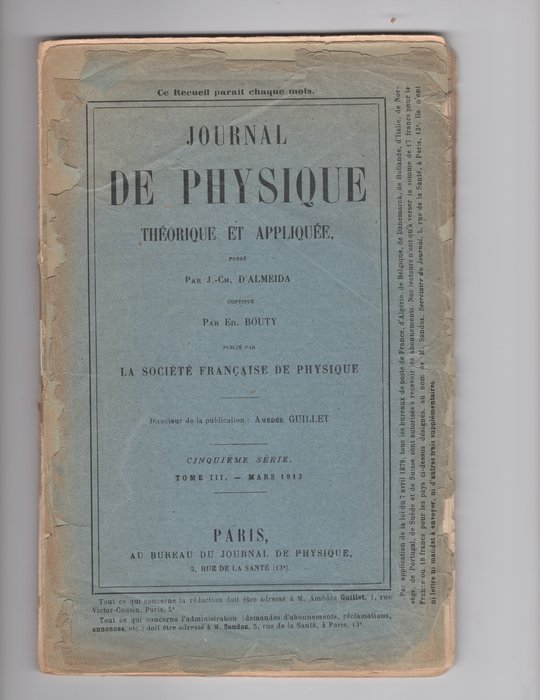
Esnault-Pelterie shifted focus to space exploration and offered an early discussion of the problems of space travel, including a proposal to use atomic energy to travel to the Moon and the planets, in a paper to the Physics Society of France in 1912. In 1927, Esnault-Pelterie, and banker Andre Louis-Hirsch established a 5,000-franc annual prize for the author of the most outstanding work on astronautics, the Prix REP-Hirsch, and the first edition of these rules can be found in the collection.
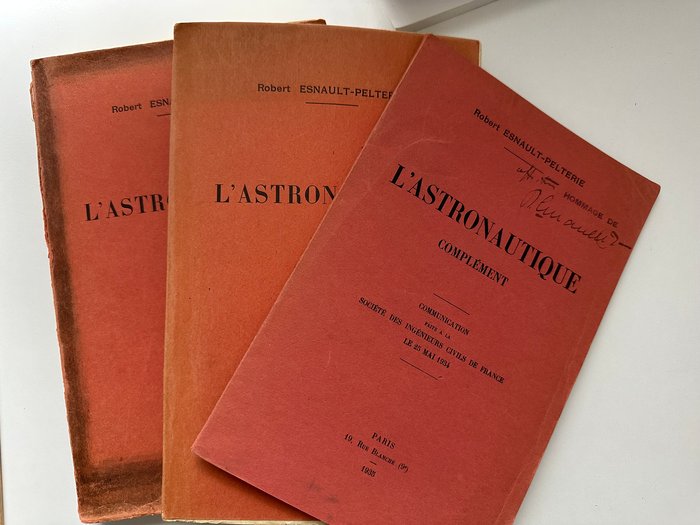
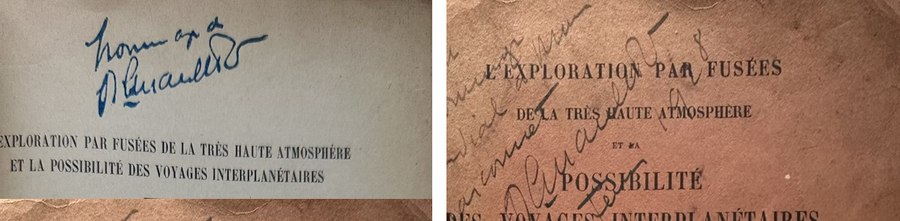
In 1929, Esnault-Pelterie came up with the concept of aero-braking, using the principle of atmospheric drag to slow a spacecraft for gravitational capture by a planet. The word “astronautics” itself he adopted two years earlier still: in L’Exploration par fusées de la très haute atmosphère (1928, also in this collection), he credits the novelist J.-H. Rosny Aîné with suggesting a name for the new science and says he adopted “Astronautique” on the spot — predating by two years his better-known 1930 book of that title, L’Astronautique, which with its 1934 supplement, L’Astronautique-Complément, covered all knowledge of rocketry and space flight at the time. The supplement's reworked trajectory chapter credits a 1934 paper by Ary Sternfeld with a counterintuitive finding: that beyond a certain orbit ratio, a spacecraft saves propellant by overshooting its destination out toward infinity before returning, rather than transferring directly — the maneuver now known as the bi-elliptic transfer, though Esnault-Pelterie himself was skeptical it had much practical use.