- Year
- 1913
- By
- Esnault-Pelterie, Robert
- Published
- Paris: Au Bureau du Journal de Physique.
- Edition
- French. First edition, wraps.
- Ciancone
- N/A.
- Shelf
- L1
- Catalog
- Catalog A · Early Pioneers
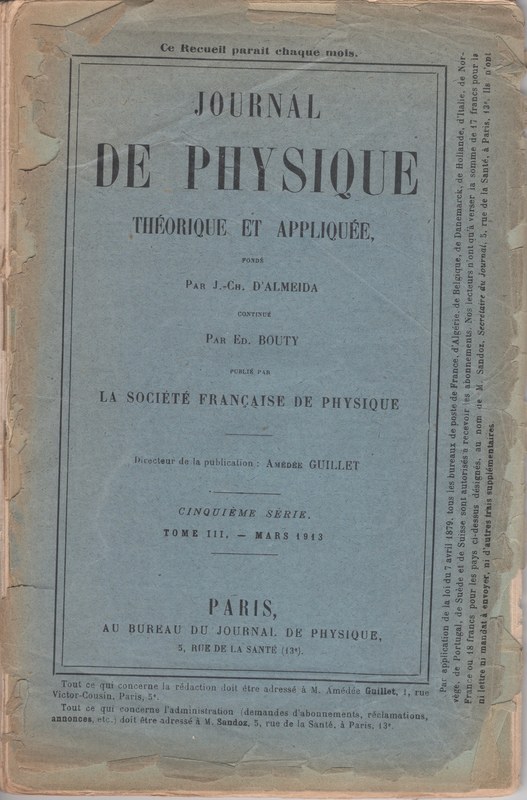
Robert Esnault-Pelterie’s first published paper on spaceflight, pp. 218–230 of the Journal de Physique Théorique et Appliquée (5th series, vol. III, March 1913), a monthly issued by the Société française de Physique. The copy retains the issue’s original printed wrapper. A footnote says the paper was first presented to the Society at its session of 15 November 1912.
The author says he was led to ask what an “indefinite lightening” of engines, meaning ever less weight per horsepower, might make possible, and notes that novelists have written of travel between worlds but nobody seems to have asked what physical demands it would make. He calls the paper only “a series of reflections supported by calculations.” Section I explains the rocket and notes that Verne’s cannon would crush its passengers. It says propulsion works as well in a vacuum as in air, derives the velocity of a mass-ejecting vehicle as a logarithm of the mass ratio, and says steering needs only a tilted or auxiliary thruster. Section II gives the work needed to lift a body clear of a planet and the 11,280 m/s escape velocity for Earth. It compares the energy in a kilogram of hydrogen-oxygen mixture, which is about a quarter of what is needed, with that of radium, which would supply 194,000 times too much. It also notes that a craft could leave Earth under a thrust less than its weight by flying first as an airplane.
Section III works out a Moon round trip in three phases: acceleration at 1.1 g up to the critical velocity, coasting, and a braking turn-over at about 250 km above the surface. It gives a total of about 48 hours 58 minutes and an engine run of only about 28 minutes each way, with the speed at the neutral point as 2,030 m/s. For a 1,000 kg vehicle with 300 kg of fuel it finds an exhaust velocity of 65,300 m/s, a power of 414,000 hp, and a fuel 133 times too weak in energy for hydrogen and oxygen. Section IV puts the transit times to Venus and Mars at 47 and 90 days at about 10 km/s.
Section V takes up the human problem: air regenerated as in submarines, a spacecraft with one polished half and one blackened half to control its temperature, and the suggestion that constant thrust equal to 1 g would supply artificial gravity. Section VI prices that option at 4.76 million hp, with peak speeds of 643 and 883 km/s and trips to Venus and Mars of 35 and 49 hours. Section VII closes by saying only the energy locked in molecules and atoms could supply such power, and that 400 kg of radium would just suffice for a Venus round trip.
Featured
Robert Esnault-Pelterie ›
From monoplanes to rockets