- Year
- 1869
- By
- Hale, Edward
- Published
- Boston: Fields, Osgood, & Co.
- Edition
- English. First edition, wraps.
- Ciancone
- N/A.
- Shelf
- R4
- Catalog
- Catalog A · Early Pioneers
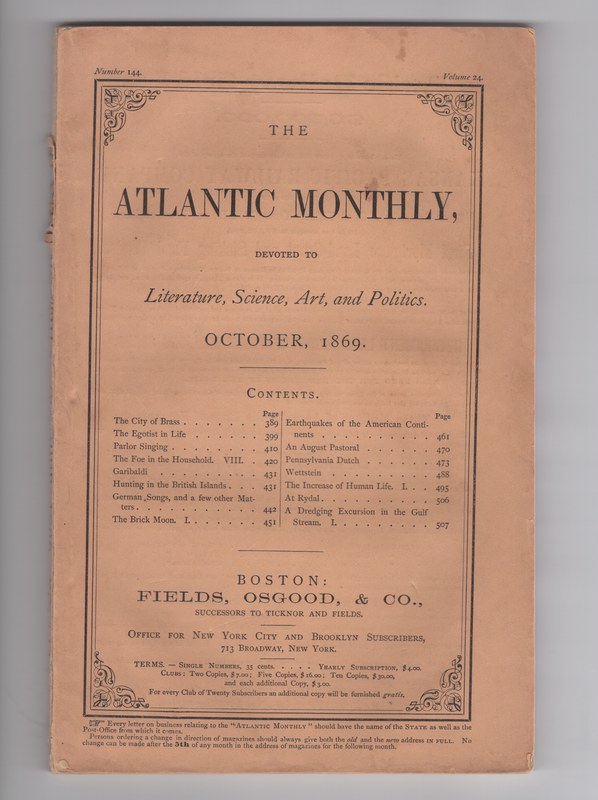
First of four installments published in The Atlantic Monthly, this one running pp. 451–460 of the October 1869 issue (Vol. XXIV, No. 144) as Part I, “Preparation,” presented as “From the Papers of Captain Frederic Ingham.”
Ingham recalls how a group of college friends, puzzling over the problem of determining longitude at sea, conceived of launching a two-hundred-foot brick sphere into a fixed orbit four thousand miles up to serve navigators as an always-visible clock in the sky — hurled aloft not by explosion but by the accumulated momentum of two giant flywheels. Seventeen years later, having priced the scheme at $250,000 (the twelve million bricks alone costing $60,000), Ingham and his now-wealthy classmate George Orcutt revive the project and raise $162,000 toward it at a public subscription meeting, aided by the persuasive but unlettered orator Ben Brannan.
Widely considered fiction’s first depiction of an artificial satellite reaching orbit.