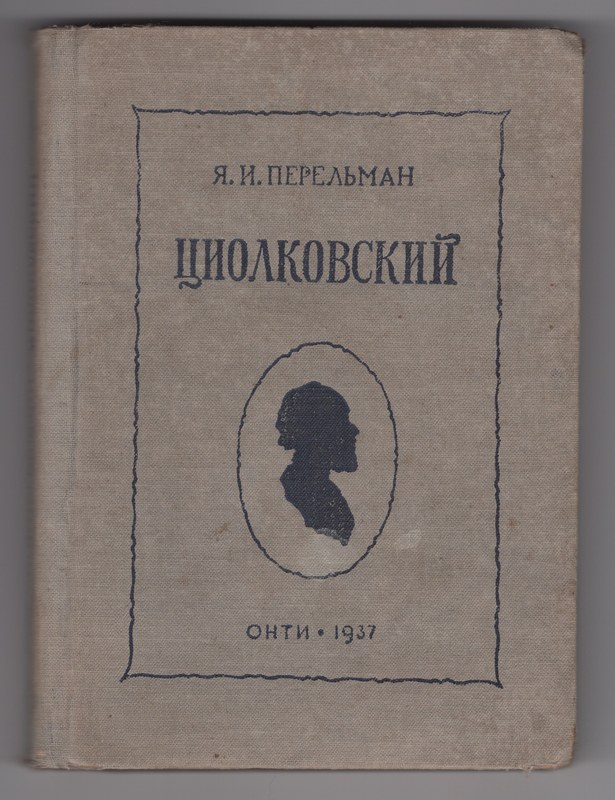
- Year
- 1937
- By
- Perelman, Iakov
- Published
- Moscow: ONTI.
- Edition
- Russian. First edition, HC, no DJ.
- Ciancone
- R70.
- Shelf
- L3
- Catalog
- Catalog A · Early Pioneers
A popular biography written within two years of Tsiolkovsky’s death on 19 September 1935, drawing on his autobiographical notes, his unpublished memoir “My Life,” and about a hundred letters he and Perelman exchanged between 1913 and 1935. Perelman’s preface says he treats only two of Tsiolkovsky’s inventive “complexes” in detail, the airship and the rocket. Drawings are by M. M. Dneprovsky and portraits by V. P. Lyubimov, both Kaluga artists.
After the chapters on childhood, self-education, and the all-metal airship, the 44-page rocket section (pp. 113-156) begins by crediting Tsiolkovsky with the first scientific theory of the rocket and noting that Kibalchich’s 1881 flying machine had already used the rocket principle. It covers the mechanics of rocket flight, the “starship” with its liquid-oxygen and petroleum or benzine fuel and a nozzle some 10 meters long, interplanetary travel, and a launch from a sloping track with an “Earth rocket” carrying the “cosmic rocket” inside it.
Pages 148-152 reproduce Tsiolkovsky’s last rocket idea, sent to Perelman on 15 December 1934 with the note “Secret. I wanted to please you”: a squadron of 512 rockets transferring propellant between themselves in flight and dropping the emptied ones, reaching 11,100 m/s after nine transfers, with a table and a 16-rocket diagram. An editor’s note doubts the transfer would be practical.
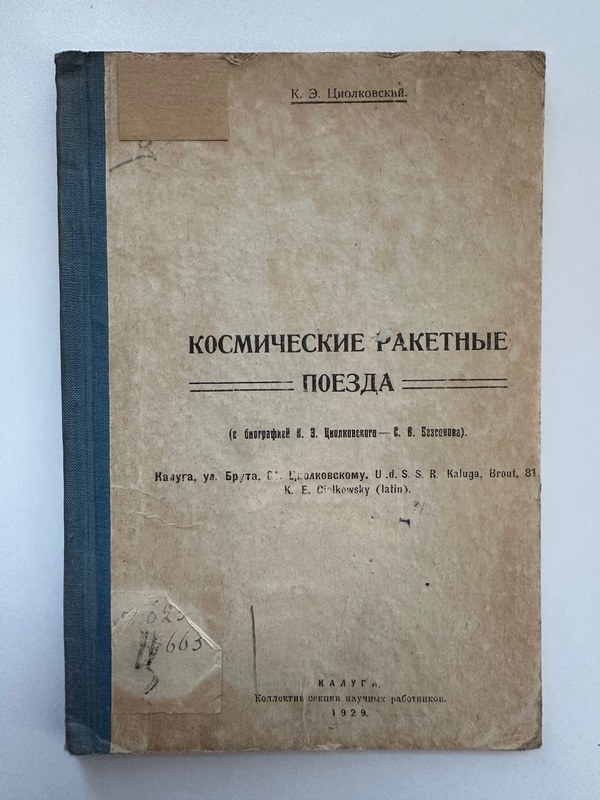
A footnote on page 146 points to his 1929 Space Rocket Trains (also in this collection) for the older staging concept. The closing “Other Ideas and Inventions” chapter lists about twenty topics, among them the stratoplane with an air compressor, a “gas compressor,” and a steam-gas engine, the subject of his Gas Compressors (1931, also in this collection). Print run 30,000, approved for press 9 April 1937 and printed at the ONTI printing house in Leningrad.
Featured
Across Two Oceans ›
American and Soviet pioneers of the early space age