- Year
- 1947
- By
- Simon, Leslie
- Published
- New York: John Wiley & Sons; London: Chapman & Hall.
- Edition
- English. First edition, HC, no DJ.
- Ciancone
- 209.
- Shelf
- R3
- Catalog
- Catalog C · Postwar
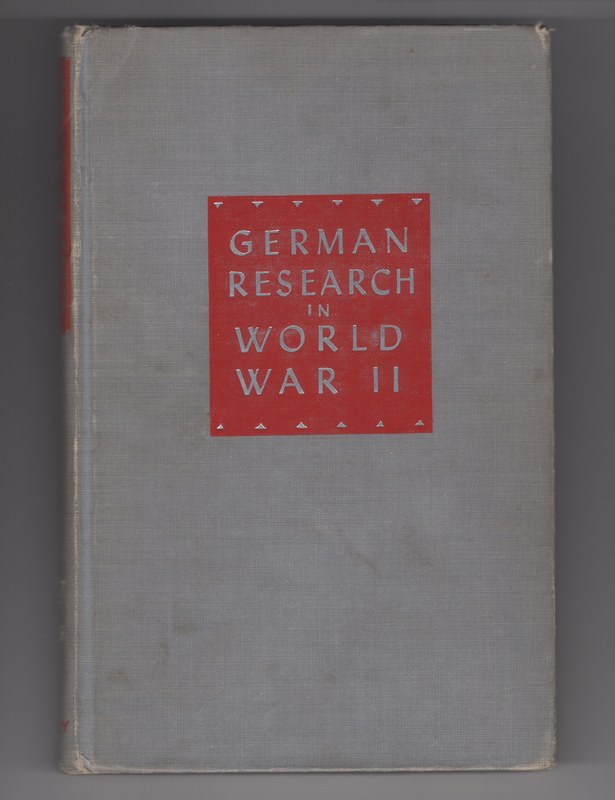
Colonel Leslie E. Simon of the U.S. Army Ordnance Department, director of the Ballistic Research Laboratories at Aberdeen Proving Ground, set out to describe how German weapons research was actually conducted, treating it as “a completed experiment” whose methods, successes and failures could be judged coldly. The Foreword is dated August 15, 1945; it explains that the book is a publishable generalization of his 200-page Report on German Scientific Establishments, a declassified form of which was available from the Office of Technical Services, U.S. Department of Commerce.
The twelve chapters survey German research at the end of the war—the Air Force research establishments near Braunschweig (LFA) and Stuttgart (LGZ), the artillery proving ground, army long-range rocket research and the Luftwaffe’s Technical Academy—then the background and organization of German research, the Speer ministry and the Reichsforschungsrat. Technical chapters summarize interior and terminal ballistics, exterior ballistics (including rockets fired from aircraft and long-range rockets), aerodynamics (jet, turbo-jet and Athodyd motors, supersonic wind tunnels, the Kochel and Mach 10 tunnels, the Ötztal tunnel), instrumentation including rocket-flight instruments, and development work, closing with comments and criticisms applicable to research in general. Photographs show bomb-damaged German laboratories and equipment.
Dedicated to the Ordnance Department and to the junior officers who interviewed German scientists with the author.