- Year
- 1957
- By
- Tabanera, Teófilo
- Published
- Madrid: Real Sociedad Geográfica.
- Edition
- Spanish. First edition (offprint), 12 pp., wraps.
- Ciancone
- N/A.
- Shelf
- R5
- Catalog
- Catalog D · Prelude to Sputnik
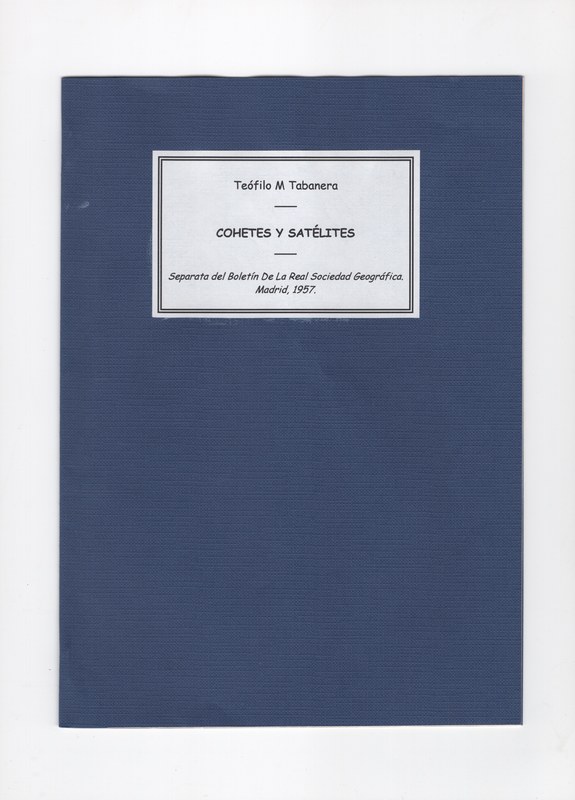
Offprint (separata) from the Boletín de la Real Sociedad Geográfica, Madrid, 1957, (12 pages) in custom blue wrappers with a typed label reading “Teófilo M. Tabanera / Cohetes y Satélites.” A footnote on the first page gives the origin: a lecture delivered at the Real Sociedad Geográfica on 14 October 1957, ten days after Sputnik 1, at the invitation of the Asociación Española Astronáutica and the Society. Tabanera opens by saying he is “simply a technician” rather than a sage, and that a lecture on the artificial satellite had been given a few days earlier by Sr. Baltá.
He traces the satellite idea back to Guido von Pirquet as the first concrete step in astronautics, recalls that the International Astronautical Federation founded at Paris in 1950 (the minutes of that congress are in the collection; see the First Astronautical Congress feature) resolved to devote its London congress to satellite work, and notes Eisenhower’s 1955 announcement of satellites for the International Geophysical Year and the Soviet follow-up. He argues that sounding rockets are limited to a few launch sites and very brief observation time, which is the case for the satellite as a scientific instrument.
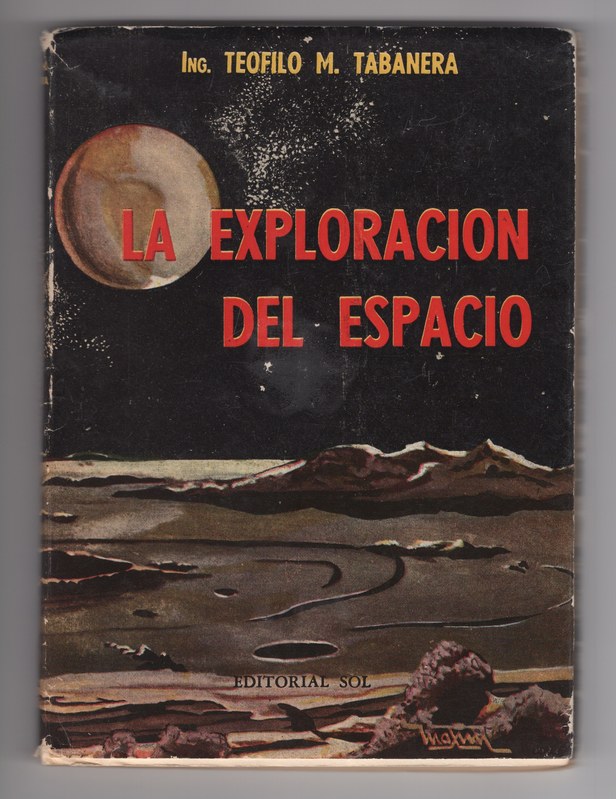
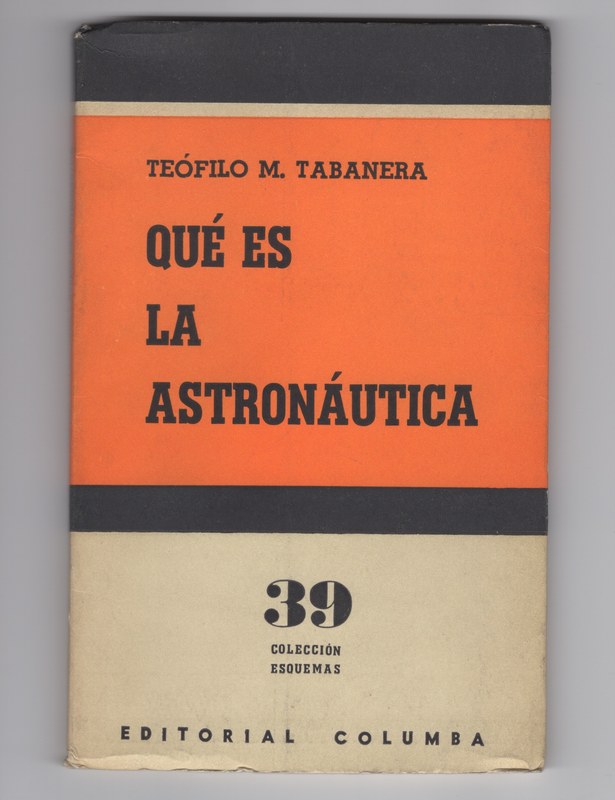
The closing pages analyze the Soviet satellite from what was then known: an orbit inclined 65 degrees to the equator against 40 degrees for the American plan, a payload that must be heavier than the roughly 5–6 kilograms of instruments of the Vanguard, and a probable apogee of 900 and perigee of 300 kilometers. Tabanera’s book La Exploración Del Espacio (1955) and Qué Es La Astronáutica (1958) are in this catalog.