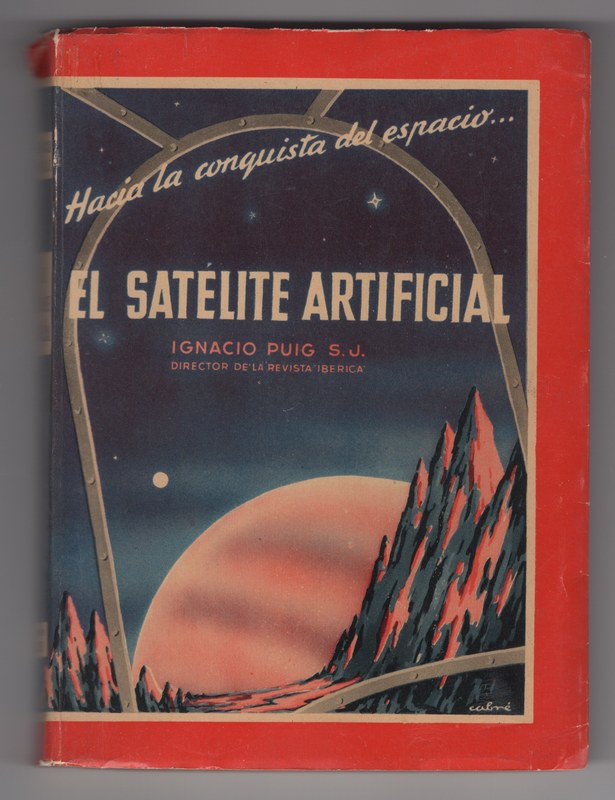
- Year
- 1956
- By
- Puig, Ignacio
- Published
- Barcelona: Ediciones Betis (printed by Ballesteros).
- Edition
- Spanish. First edition, illustrated wraps.
- Ciancone
- 249.
- Shelf
- R6
- Catalog
- Catalog D · Prelude to Sputnik
Subtitled Hacia la conquista del espacio. Ignacio Puig, S.I., is identified on the title page as director of the magazine Ibérica and former director of the San Miguel Observatory in Argentina. Ediciones Betis, Calle Bot 4 bis, Barcelona; copyright 1956; the imprint bears the Church’s “con las licencias necesarias.” The jacket flap says the book explains what is real behind the fantastic stories about interplanetary travel and the plans to launch artificial satellites in the 1957–58 Geophysical Year to study the atmosphere above 400 km. In the prologue Puig says he will treat the launching of objects from Earth and leave flying saucers for later.
The fourteen chapters begin with “Señales interastrales” and the first contacts with the stars, then ask “¿Qué es la astronáutica?,” take up scientific astronautics, the first step in the conquest of space, the usefulness and theory of the artificial satellite, the manned satellite station and the voyage to the Moon, and end with interplanetary voyages and “La Virgen en la primera expedición interplanetaria.” A conclusion (p. 180) and a bibliography follow. The back flap lists his other popular works, including ¿Existen otros mundos habitados?
The last chapter (pp. 166–179) is unusual: it reproduces an interview given by Puig to the Discalced Carmelite Fr. Carmelo de la Inmaculada for the Marian magazine Miriam (Seville, January–February 1956), which was preparing an issue on the Virgin “in the world of the stars.” Puig dismisses early schemes for signalling Mars and says interplanetary journeys will take many years, with the rocket the only workable means of propulsion in empty space. He then argues, from Church teaching, that the Church has never condemned the plurality of inhabited worlds, citing the Jesuit Stanislas Chevalier’s arguments from analogy and from God’s goodness. He holds that Mary is Queen and Mother of any such beings: if their races had sinned, the Redemption would have extended to them and so would Mary’s motherhood. He closes by wishing that the first human voyage to the stars, probably in a satellite or rocket, would carry a name such as Jesus or Mary, as Columbus’s Santa María did, and predicts that spacemen will carry medals or images of the Virgin as drivers and pilots do, praying that she bless the new inventions and accompany the travellers.