- Year
- 1931
- By
- Tsiolkovsky, Konstantin
- Published
- Kaluga.
- Edition
- Russian. First edition, softcover.
- Ciancone
- N/A.
- Shelf
- L4
- Catalog
- Catalog A · Early Pioneers
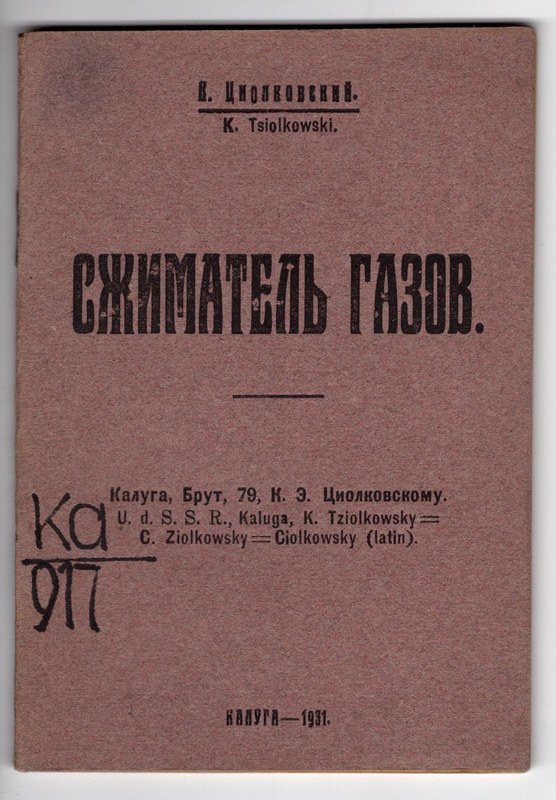
Full title Szhimatel’ gazov i ego raschet (“The Gas Compressor and Its Calculation”). The cover carries Tsiolkovsky’s own Kaluga address and his name in Latin spellings for foreign correspondents. Pages 1–25 treat a purely mathematical design, not a turbine: an axial compressor made of a long cylinder holding a row of propeller-like blades, with fixed flat partitions between them to stop the air from swirling, driven by a smaller coaxial cylinder with rounded ends.
Numbered paragraphs 1–105 derive the compression ratio from the number of blades, with tables for blade-tip speeds of 100 to 353 m/s (the practical limit he gives is 300–400 m/s, set by the strength of the material). Tsiolkovsky finds that efficiency never exceeds 50 percent, that about 12 blades compress air to a density greater than water’s, and that with cooling all gases could be liquefied with few stages (28 blades, about 6 m long, for air at water density). A table on p. 16 shows the price: starting from the −73 °C of the upper atmosphere, compression of 6, 36, 216, and 1,296 times heats the gas to +127, +527, +1,327, and +2,927 °C, so compressions of 200 to 1,000 times are unthinkable without cooling, while the modest pressures of blast-furnace blowers raise the temperature by no more than 87 °C. He defines the “utilization” of the work as the ratio of flow speed to blade speed, which is highest at the first blade and lowest at the last (p. 17). He remarks that each blade, in pushing back the gas, creates something like the artificial gravity of a planetary atmosphere (p. 3).
The final pages apply the tables to blast furnaces and to the “stratoplane,” where at an altitude with air 32 times thinner about 25 blades would restore normal density: 10,000 horsepower would need 7.5 m³ of air per second, or 240 m³ of the rarefied air, through a tube more than 1.6 m wide (p. 25). He refers readers to his own “Reaktivnyi aeroplan” (not in this collection) for the engine side (p. 23). There is no rocket theory here, but the booklet belongs to his 1930–31 work on jet-propelled stratosphere aircraft.
The second part (pp. 26–36), “Otkliki” (“Responses”), prints extracts from readers’ letters of February–April 1931: a Moscow worker-student who calls him the “first captain of the interplanetary ship” and cites Oberth, Goddard, and Valier; a New York artist who reprinted an interview in the Russian-American press; a Novgorod technical school’s interplanetary circle; a schoolteacher thrilled by a Ukrainian edition of Tsiolkovsky’s On the Moon with Perelman’s preface; and a long exchange with a correspondent on infinity, his Monism of the Universe, and Scientific Ethics, closing with Tsiolkovsky’s reply of 10 April 1931. Printed in 1,000 copies by the Kaluga printing house of Mosoblpoligraf (Raylit No. 436).