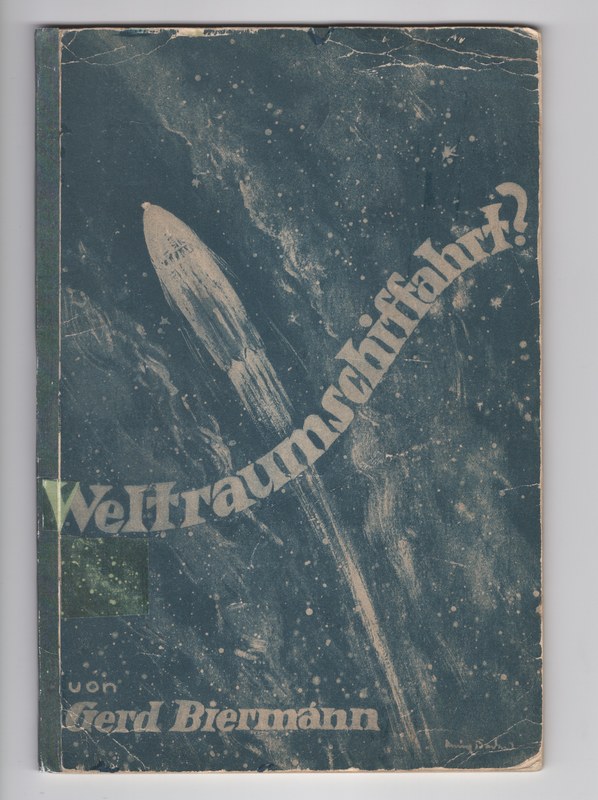
- Year
- 1931
- By
- Biermann, Gerd
- Published
- Bremen: Franz Leuwer.
- Edition
- German. First edition, wraps.
- Ciancone
- 20.
- Shelf
- R3
- Catalog
- Catalog A · Early Pioneers
A brief popular synthesis of the spaceflight question by a merchant-marine officer rather than a scientist — Biermann identifies himself on the title page as an officer of the Norddeutscher Lloyd shipping line. He surveys, in order, why humanity might want to leave Earth, the habitability of the other planets (Mars gets the most attention: its 6,900-kilometer diameter, 687-day year, and the faint traces of water vapor and oxygen — 5 and 16 percent of terrestrial levels — that American astronomers at Mt. Wilson and Mt. Whitney had detected in its atmosphere), the physical hazards of space itself (electrical space charge, Kohlhörster's cosmic radiation, the heat and cold of the void, and gravity), and the basic mechanics of rocket propulsion (the recoil principle, propellants, motor, fuel tank, and center of gravity). Its illustrations, credited on the copyright page, are reproduced from the second edition of Max Valier's Raketenfahrt.
Its most substantial chapter, “Die Entwicklung der Reaktionsfahrzeuge,” runs from Hermann Ganswindt's early “Weltenfahrzeug” to what Biermann calls the “vibration rocket,” surveying the German rocket scene as of 1931: Valier's three-stage Model B (a hydrogen rocket riding an alcohol booster atop a solid-fuel first stage, computed to reach 2,000 kilometers), Oberth's proposed crewed rocket the size of a four-story building (illustrated here, borrowed from Valier), Walter Hohmann's 1925 orbital-mechanics treatise and Willy Ley's 1928 anthology (both elsewhere in this collection), the VfR's Johannes Winkler, and Hermann Sander's solid-fuel rockets, by then up to 35 centimeters in caliber.
Biermann then works through, and dismisses, several rocket alternatives then in circulation: a Frenchman named Drouet's proposed 150-meter spinning wheel meant to sling a projectile off at 12,000 meters per second (he notes it would fly apart from centrifugal stress long before reaching that speed), the Austrian Ulinski's vortex-ring “jet reaction device,” and the electromagnetic “Solenoidgeschütz,” illustrated here in cutaway, recalling pre-war experiments in which a coil-driven iron core was fired out at high velocity — trials military authorities reportedly abandoned as impractical. He closes, in a chapter titled “Ausblick,” hoping that the first spaceship will one day leave Earth trailing the hopes of all humanity, and quotes several stanzas of verse to that effect.