- Year
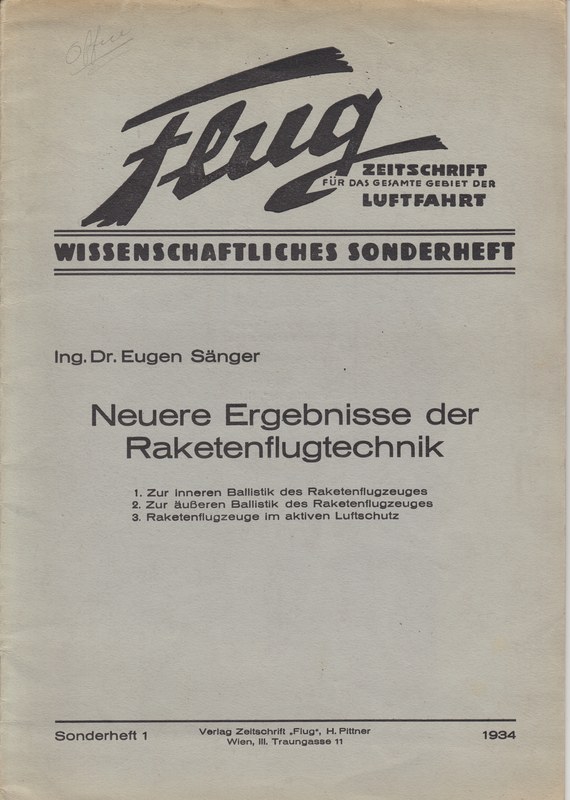
- 1934
- By
- Sänger, Eugen
- Published
- Vienna: Pittner.
- Edition
- German. First edition, wraps.
- Ciancone
- 204.
- Shelf
- L1
- Catalog
- Catalog A · Early Pioneers
The first Wissenschaftliches Sonderheft (scientific special issue) of the Vienna aviation monthly Flug, dated December 1934, devoted entirely to a 23-page paper by Eugen Sänger that updates his book Raketenflugtechnik (1933), also in this collection. Part 1, on internal ballistics, defines the effective exhaust velocity of a rocket motor, derives its theoretical limit (about 4,570 m/s for gas oil and oxygen) and discusses the losses from dissociation of the combustion gases. It then reports Sänger’s Vienna test-stand experiments on some fourteen small liquid-fuel motors burning gas oil and liquid oxygen, with thrusts up to 30 kg, photographed on the stand. These measured exhaust velocities above 3,000 m/s, and he expected to pass 5,000 m/s with better propellants.
Part 2, on external ballistics, works out the air forces on a winged rocket aircraft and calculates its climb through the subsonic and supersonic ranges, a long supersonic glide back down, and the resulting range and speed. His figures reach about 5,000 km in under an hour and a half, and he sketches a transport aircraft able to cross the world.
Part 3 considers rocket aircraft for active air defence, comparing the limits of propeller fighters with a one-man rocket interceptor and a rocket bomber that glides to its target, and ends with a warning that a war fought with such weapons leaves only losers. The issue cites Esnault-Pelterie, Cranz, Hohmann and Busemann, and its back page advertises the standard German spaceflight books of the day by Oberth, Valier, Hohmann and Sänger himself.