Catalog A · Early Pioneers · Special Feature · Book of Note
Victor Coissac's La Conquête de l'Espace
A forgotten French pioneer, 1916 and 1925
Victor Coissac's L'Évolution des Mondes suivi de La Conquête de l'Espace (Tours, Librairie de l'Intégrale, 1916) is a largely unknown but substantive early work of astronautics. Writing independently of Tsiolkovsky, Goddard, Esnault-Pelterie, and Oberth, Coissac worked out staged rocketry, orbital rendezvous between a mothership and a lander, mid-course trajectory correction, and atmospheric reentry, closing the book with a proposal for a self-sustaining generation ship bound for Alpha Centauri. The collection holds both the 1916 first edition (bound with a companion cosmology volume, L'Évolution des Mondes) and the retitled, restructured second edition, La Conquête de l'Espace alone.
Victor Coissac: A Forgotten Pioneer
Victor Coissac (1867–1941) had no scientific training. Born in Tulle (Corrèze) to a Catholic family, he was sent to Paris at fourteen to apprentice as a tailor, but took up adult-education courses instead, earned a teaching credential, and settled in Tours in 1889, teaching until 1922. Increasingly anticlerical and drawn to cooperative socialism, he developed his own theory of gradual social transformation, published in 1917 as La Réalisation du bonheur. From 1922 to 1935 he tried to put it into practice, founding the cooperative community l'Intégrale, first in Tours, later at Puch, Lot-et-Garonne.
In 1916, reasoning from Newtonian mechanics and conic-section geometry rather than fiction, Coissac wrote La Conquête de l'Espace as a technical case for interplanetary travel. He distanced it explicitly from Jules Verne, calling Verne a “prestigious novelist but insufficient astronomer.” The first edition opens with a dedication to Camille Flammarion, citing Flammarion's Terres du Ciel as a key influence.
The book went unnoticed in France for decades. Soviet historian Serguei Golotyuk found it by chance in 1987 while researching astronautics pioneer Ary Sternfeld, who had cited Coissac in his Initiation à la cosmonautique, written in manuscript in 1933 and published in a Russian edition in 1937. French engineer Jacques Villain learned of Coissac from a Russian contact in Moscow in 1990, which began the book's rediscovery in France. It was finally re-edited in France in 2017 (Nielrow éditions, Dijon).
Two Editions: What Changed
The 1916 edition bound two works together: L'Évolution des Mondes (13 chapters of cosmology and physics, pp. 1–151) followed by La Conquête de l'Espace (11 chapters plus appendix, pp. 151–261), preceded by the Flammarion dedication. The second edition (“deuxième édition, revue et augmentée”) drops L'Évolution des Mondes and the dedication, publishing La Conquête de l'Espace alone with a new descriptive subtitle and opening directly on the Préambule.
The astronautics chapters themselves are largely unchanged between editions: same chapter order, same illustrations (staged-rocket cutaway, amortisseur landing gear, lunar-trajectory diagram), simply renumbered from starting at p. 151 to starting at p. 13. Chapter I of the second edition does absorb some physics groundwork (radiative heat transfer, the vacuum-chamber discussion) that had previously lived in L'Évolution des Mondes, letting the astronautics text stand alone.
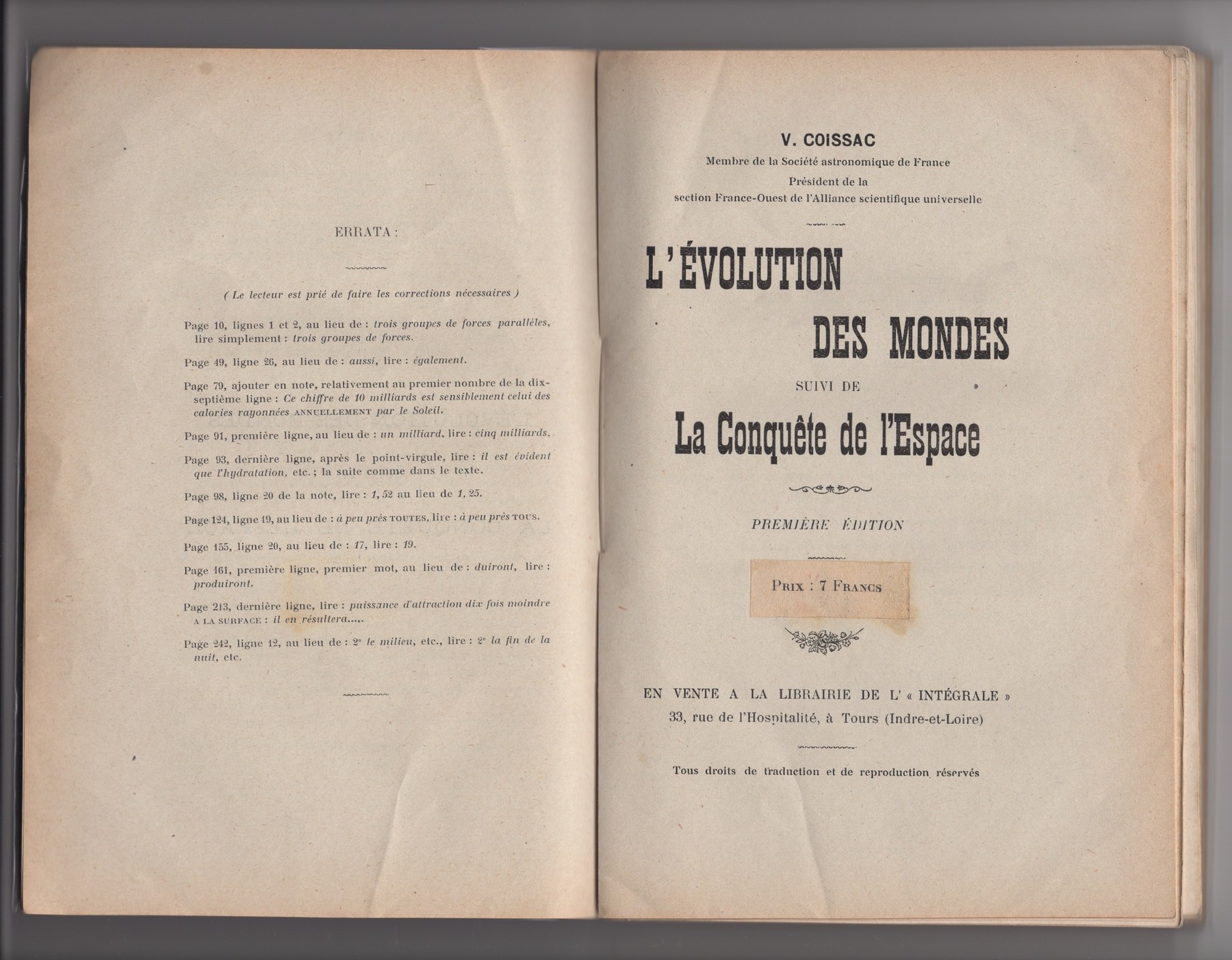
Other changes: the imprint moves from the Tours bookshop to “Groupe Morelly, à Puch (Lot-et-Garonne),” confirming the community's relocation. Price rises from 7 francs (1916) to 16 francs. The 1916 copy has an errata leaf; the second edition does not. The second edition's wrapper and title page carry no copyright page or printed year; its date, 1925, follows Ciancone's bibliography (55b) rather than anything printed in the book itself.


Propulsion and Staging
Coissac rejects Verne's cannon and any giant sling, settling on the rocket and noting that thrust works in vacuum, a point often confused in period writing. His launch vehicle is staged: a nested sequence of reservoirs (A–F), each holding a charge of solid composition fusante, consumed and jettisoned in turn so the vehicle sheds mass as it accelerates, with attention paid to keeping the center of gravity stable.


Two-Vehicle Architecture: The Command/Lander Split
Coissac describes a grand véhicule (mothership) staying in orbit while a petit véhicule (lander) detaches, descends, conducts surface excursions, and re-ascends to rendezvous with the orbiter, using optical tracking and worked relative-velocity numbers for the approach, a rough precursor to the Apollo command-module/lunar-module split.
Chapter VI treats satellisation and orbital insertion, parking in orbit before descent, as a deliberate technique decades before it became standard practice. Coissac itemizes velocity requirements for launch, ascent, satellisation, and desatellisation separately for voyages to Mercury, Venus, Mars, Jupiter, and Saturn: a genuine delta-v budget.
Lunar Transit and Mid-Course Correction
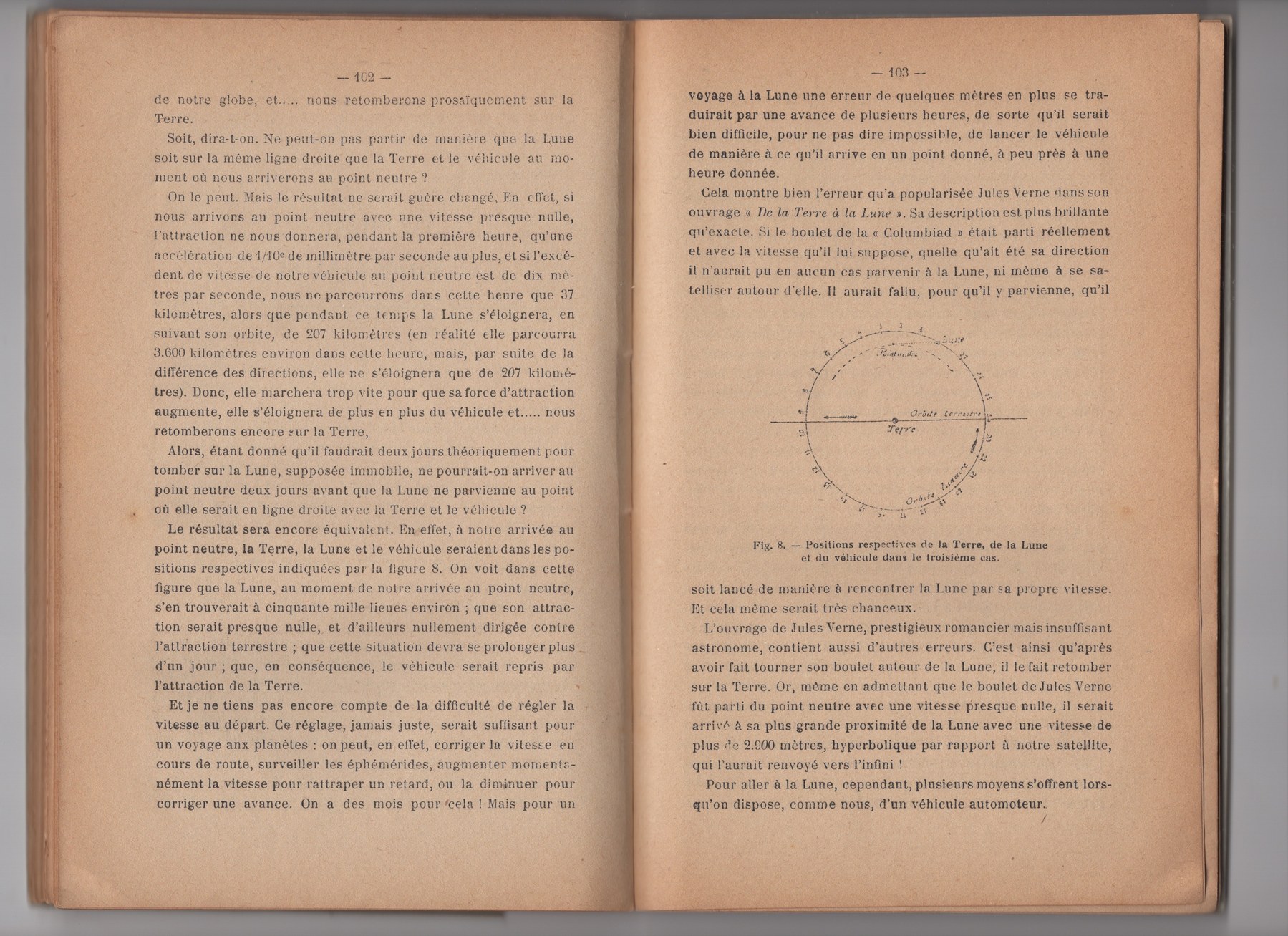
Coissac critiques Verne's Columbiad cannon-shot for its inability to correct trajectory mid-flight, and proposes tracking position against ephemerides during the voyage with velocity adjustments to correct arrival timing. His treatment of the Earth-Moon neutral point (~85,000 leagues out, requiring ~11,073 m/s to reach) uses real orbital mechanics.
Vehicle Engineering, Equipment, and Spacesuits
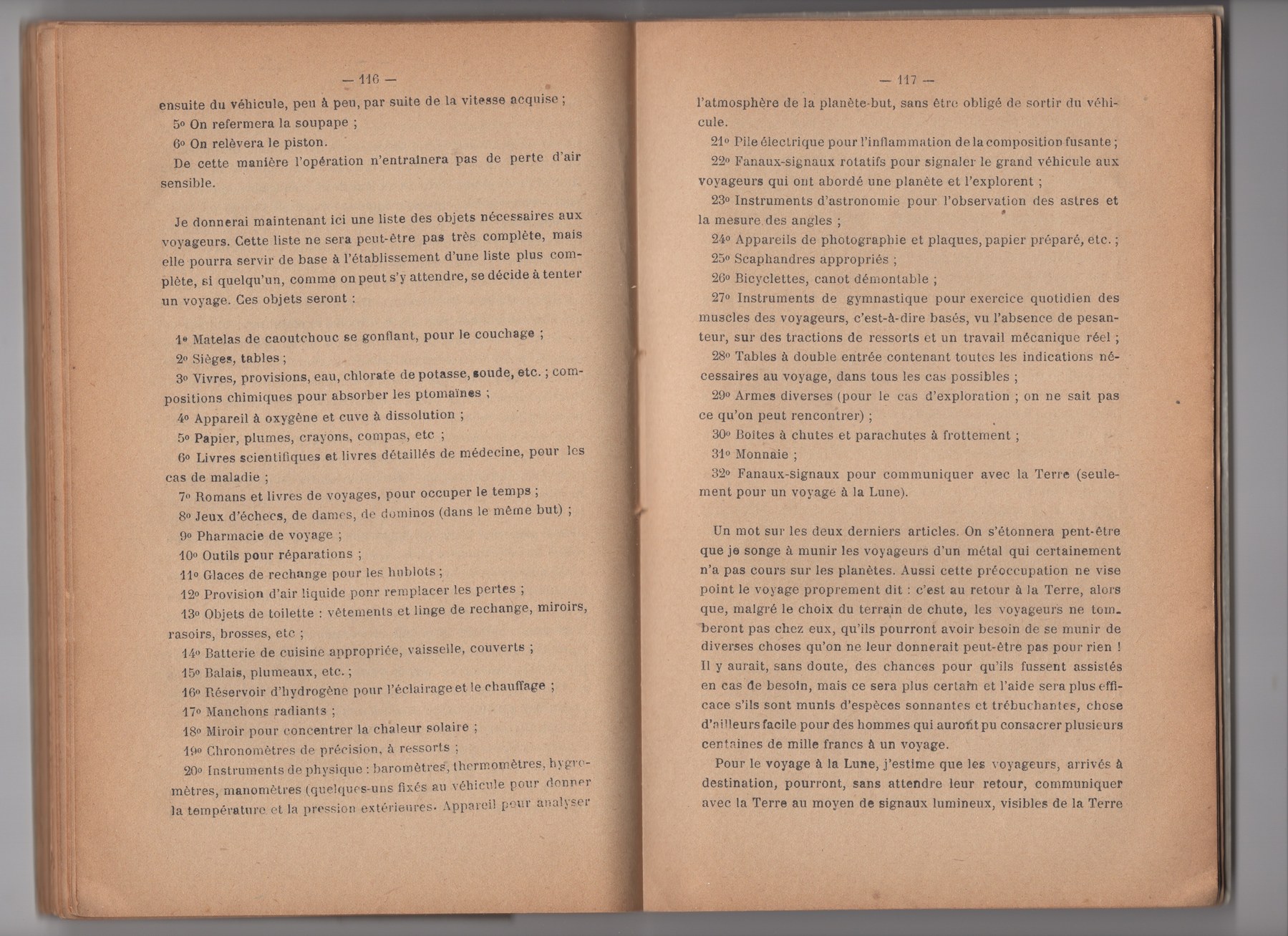
Chapter X specifies the hull (1mm steel skin on a welded frame, ~7.5 kg/m², aluminum offered as a lighter alternative), a double-hulled airlock (tambour) with hermetic doors and rubber gasketing, and a waste-ejection piston system later repurposed to correct unwanted vehicle rotation. The 32-item equipment manifest (inflatable bedding, ptomaine-absorbing chemicals, oxygen apparatus, spare glass, a hydrogen heating reservoir, a solar-concentrating mirror, precision instruments, spacesuits, bicycles, gymnastics equipment, signal beacons) is a complete outfitting list.
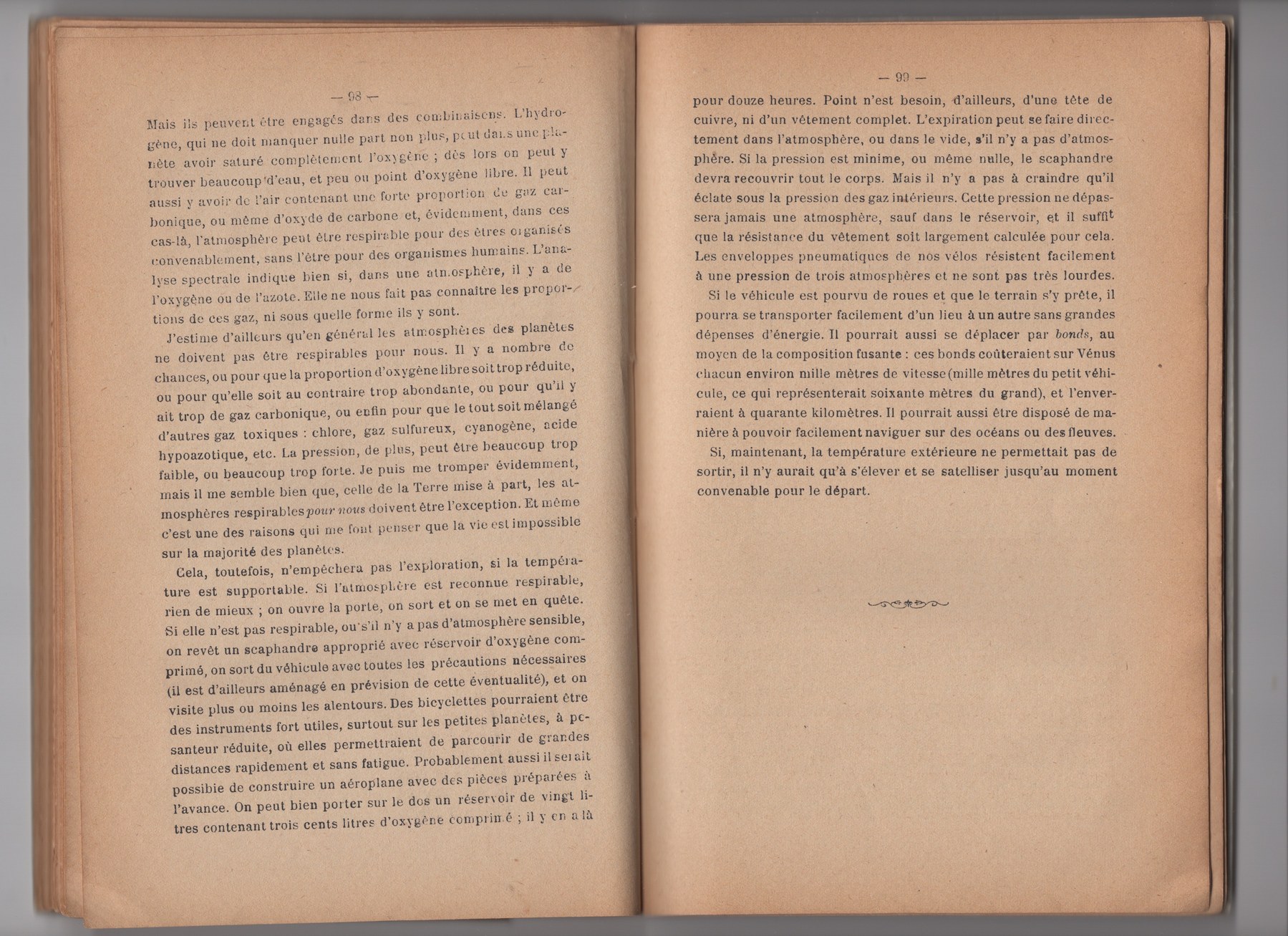
Chapter VIII details a pressurized scaphandre, breathing apparatus, and manometer-based atmosphere analysis before unsuited exit, plus compressed-gas bicycles and rocket-assisted jumps (“bonds”) for surface locomotion in low gravity.
Reentry, Landing, and the Amortisseur
Coissac derives terminal velocity through atmosphere from drag proportional to v², checks it against skydiving and artillery ballistics, and flags atmospheric friction heating on reentry as a real hazard.
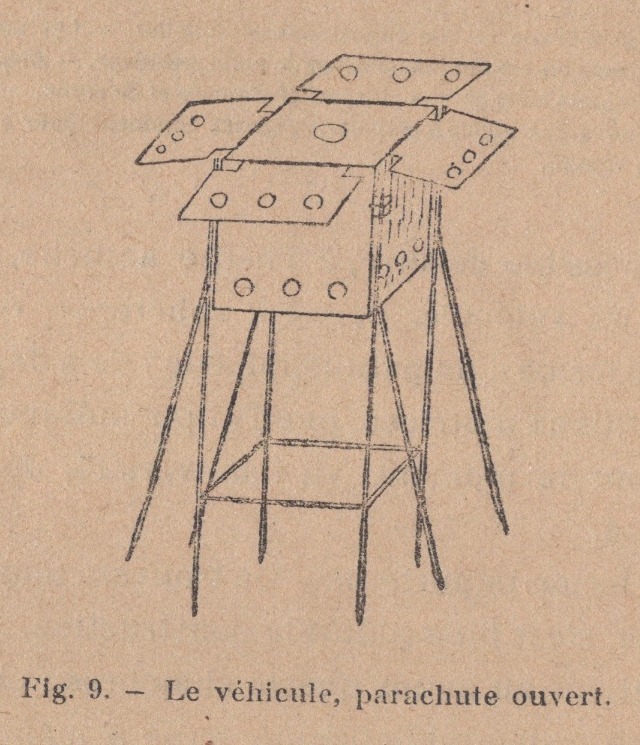
His answer for the descent itself is built into the vehicle's shape. He deliberately makes the body cubic (Fig. 9) so that a hinged supplementary skin, normally folded flat against it, can unfold on arrival at a planet with atmosphere: unfolding automatically quintuples the vehicle's surface area under air pressure during the drop, turning the whole body into a crude parachute. Reinforcing devices keep the panels from deforming under the compressed gas the descent generates, except in a direct fall.
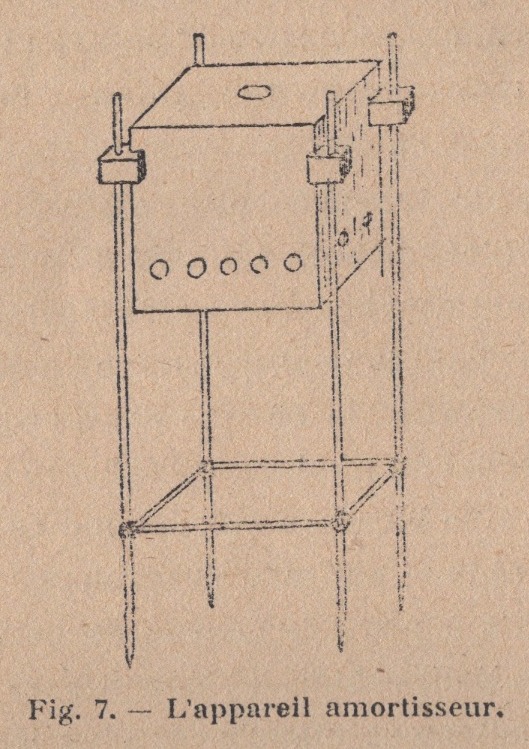
For the touchdown itself, the landing gear, the appareil amortisseur, uses four articulated rings at the vehicle's corners with cutting burins that bite into the ground on impact, designed to preserve orientation and absorb landing energy.
Conclusion: The Generation Ship
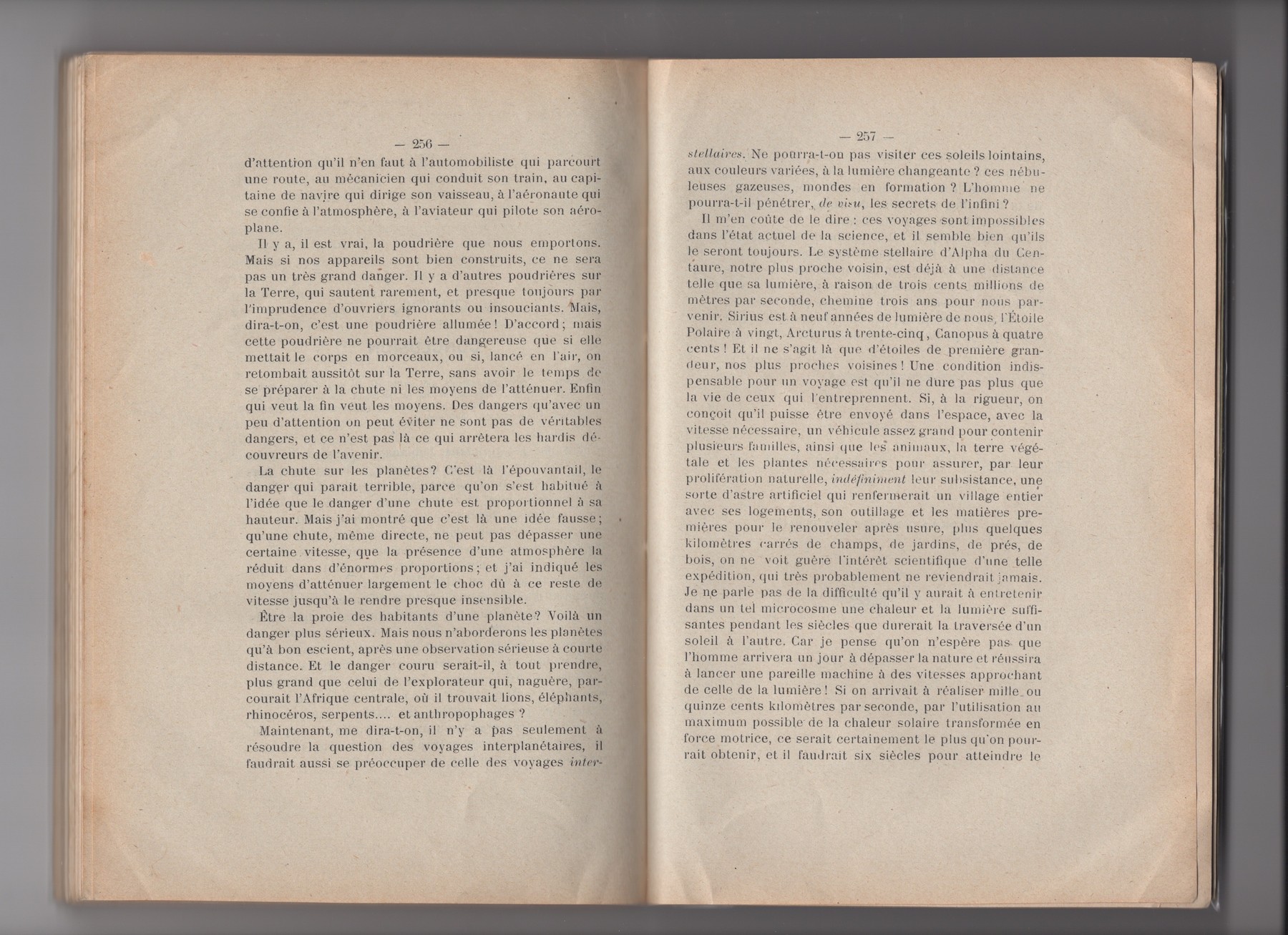
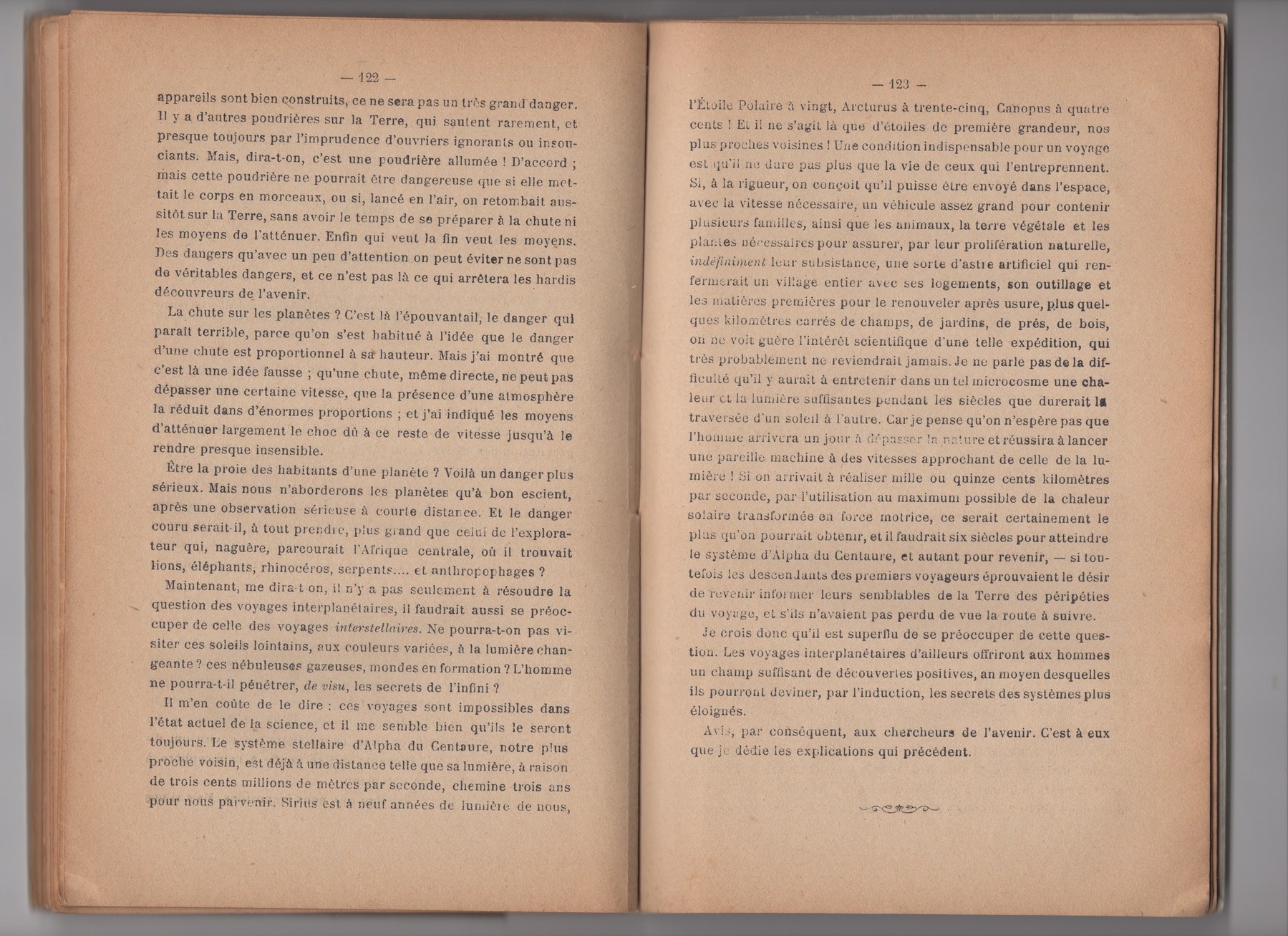
The closing chapter, unchanged between the 1916 and second editions, turns from the solar system to the stars. Coissac calculates the distance to Alpha Centauri (roughly three trillion kilometers) and, for distances beyond any near-term propulsion, proposes a vehicle large enough to hold several families, carrying its own soil, plants, and animals, self-sufficient across a voyage completed by later generations rather than the original travelers: a generation-ship concept, a dozen years before Tsiolkovsky's 1928 essay on the same idea.
The chapter's Sommaire states plainly that interstellar voyages “sont impossibles dans l'état actuel de la science, et le seront sans doute toujours” (are impossible in the current state of science, and doubtless always will be).