Catalog A · Early Pioneers · Special Feature
Rocket Societies of the 1920s
Ley, Noordung, and Hohmann
By the late 1920s, rocketry had moved from the writings of isolated visionaries to an organized, international pursuit. In Germany, the Verein für Raumschiffahrt (VfR, or “Society for Space Travel”) gathered engineers, students, and amateurs around the shared conviction that spaceflight was an engineering problem, not merely a literary one. Willy Ley, a young science writer and founding member of the VfR, became one of its most effective popularizers.
Ley’s Die Fahrt ins Weltall (1926), cataloged elsewhere in this collection in its signed first edition from N.A. Rynin’s library, went through a second, fully revised edition in 1929. The copy shown here is inscribed by Ley in Berlin on May 5, 1929, “with compliments from the author,” to the same Rynin — a Russian engineer and historian of spaceflight corresponding across the era’s political divides in pursuit of a shared idea.
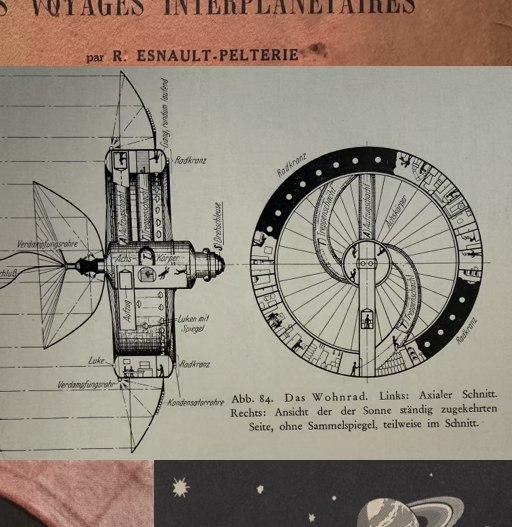
That same year, the Austro-Hungarian engineer Hermann Noordung (Herman Potočnik, writing under a pseudonym) published Das Problem der Befahrung des Weltraums, the first technically detailed engineering proposal for a habitable space station. He divided his “Raumwarte” into three separate orbiting objects, each built for its own job: a rotating, wheel-shaped “Wohnrad” that used centrifugal force to give its rooms and corridors something close to Earth-surface gravity — a 30-meter wheel turning once every 8 seconds would do it — a weightless observatory, and a machine house holding the station’s solar power plant and radio equipment. Most strikingly, Noordung placed his station about 36,000 km above a fixed point on the equator, so that it would hang permanently over the same spot on Earth: an early and essentially correct description of what is now called geostationary orbit. The Wohnrad’s design — rotation for artificial gravity, a rotating airlock at the hub, logarithmic-spiral stairways where “down” changes with distance from the axis — anticipated station concepts still used in science fiction and engineering studies today.
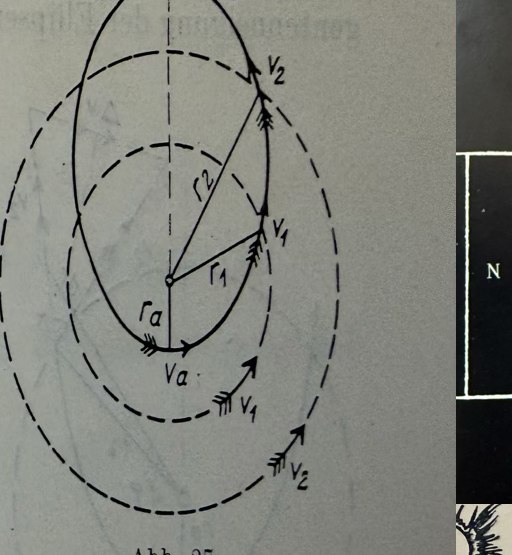
Underlying both men’s work was the orbital mechanics formalized in 1925 by Walter Hohmann, whose Die Erreichbarkeit der Himmelskrörper is also in this collection. The two-burn transfer orbit he described — still called the “Hohmann transfer” — remains the standard low-energy method for moving a spacecraft between orbits.