- Year
- 1929
- By
- Noordung, Hermann
- Published
- Berlin: Schmidt.
- Edition
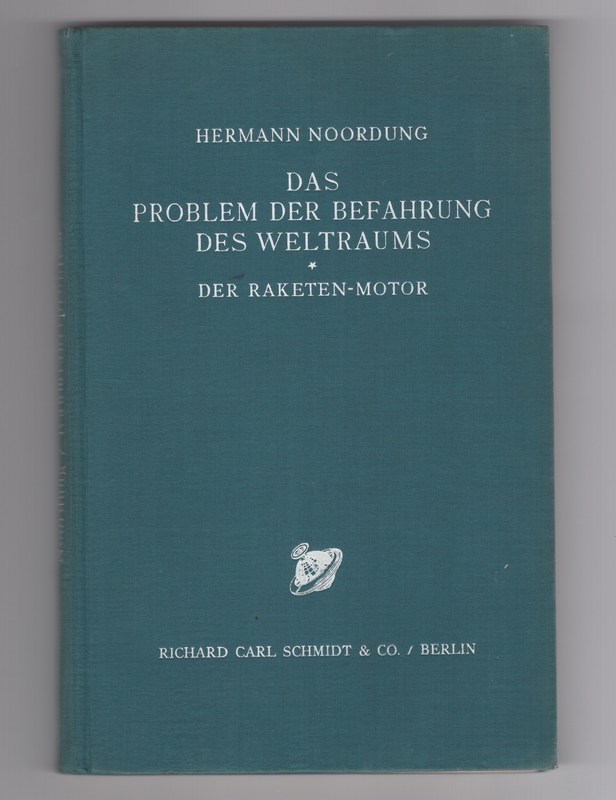
- German. First edition, green cloth, no DJ.
- Ciancone
- 175.
- Shelf
- R4
- Catalog
- Catalog A · Early Pioneers
By Herman Potočnik, a retired Austro-Hungarian army engineer writing under the pseudonym Hermann Noordung, subtitled Der Raketen-Motor and illustrated with 100 figures, some in color. The first technically detailed engineering proposal for a habitable space station, worked out as a “Raumwarte” (space outpost) divided into three separate, mutually orbiting objects to keep their design purposes and their gravitational drift apart: a rotating, wheel-shaped “Wohnrad” providing artificial gravity by centrifugal force for ordinary living quarters (Abb. 84, 89–90) — a 30-meter wheel making one revolution in about 8 seconds would match Earth-surface gravity at its rim, reached from the weightless hub by a rotating airlock (Abb. 86) and stairways following logarithmic spirals (Abb. 88) — a weightless, pressurized “Observatorium” for telescopic and terrestrial observation, freely orientable since it carries none of the sun-dependent machinery (Abb. 91), and a “Maschinenhaus” housing the station’s main solar-steam power plant, storage batteries, and radio station, fed by a fixed parabolic collecting mirror (Abb. 93).
Proposes that the station be stationed over a fixed point on the equator at an altitude of roughly 35,900–36,000 km, so that it remains permanently overhead — an early, remarkably accurate description of what is now called geostationary orbit.
Further chapters work out space-suit design (“Der Raumanzug”), a fictionalized rocket journey to and from the station, and the exceptional value such a station would offer for physics experiments in weightlessness and near-absolute-zero cold, for telescopes and Earth photography of unlimited size and resolution (with obvious application to reconnaissance and cartography), and for astronomy free of atmospheric distortion. Also sketches, following Hermann Oberth, an orbital mirror up to 100 km across for redirecting sunlight to Earth for heat, light, and weather control — and, in the same chapter, its dark twin, a concentrated solar beam as a weapon “more terrible than anything yet devised.”
Closes by arguing for a stepwise practical path from unmanned rocket flights to piloted rocket planes to the station itself, and beyond it to circling the Moon and neighboring planets. First printing, with the publication year 1929 on the title page.
Featured
Rocket Societies of the 1920s ›
Ley, Noordung, and Hohmann