- Year
- 1925
- By
- Hohmann, Walter
- Published
- Munich and Berlin: Oldenbourg.
- Edition
- German. First edition, tan wraps.
- Ciancone
- 98b.
- Shelf
- R8
- Catalog
- Catalog A · Early Pioneers
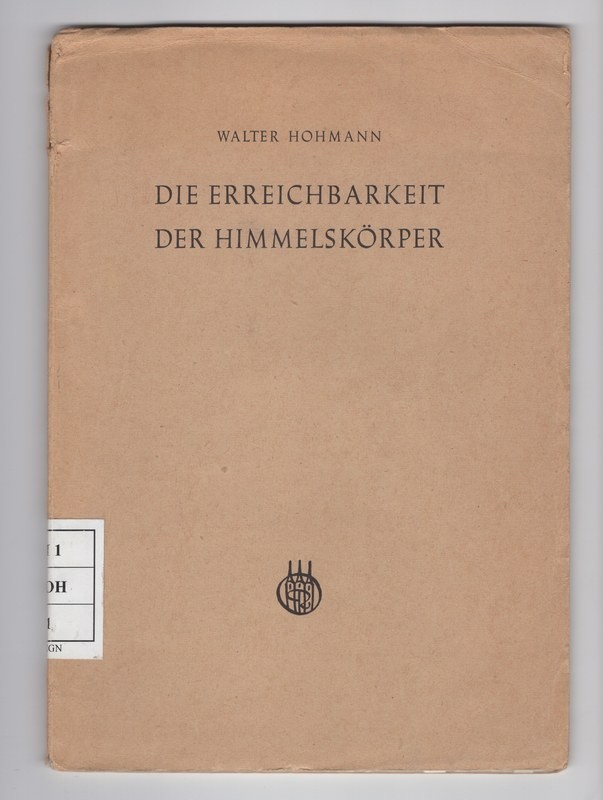
This slim monograph by civil engineer Walter Hohmann is the mathematical foundation of modern spaceflight trajectory design. Hohmann, who had worked the problem privately for roughly a decade, credits the public achievements of Goddard, Oberth, and Valier with finally prompting him to publish, and extends his exhaust-velocity assumptions beyond earlier estimates to account for solid and liquid propellants.
The book proceeds in five sections — leaving the Earth, returning to Earth, free flight through space, circling other celestial bodies, and landing on them — deriving the rocket mass-ratio equation and tabulating propellant requirements for round trips to Venus, Mars, and the Moon at exhaust velocities from 2 to 5 km/sec. Its best-known result, diagrammed as Abbildung 25, is the two-impulse minimum-energy transfer between circular orbits now universally called the Hohmann transfer orbit, still the baseline method for planning interplanetary and satellite-repositioning maneuvers a century later. A companion idea, illustrated by a sequence of nested “braking ellipses,” proposes shedding a spacecraft's excess velocity on return to Earth through repeated grazing passes through the upper atmosphere rather than a single violent reentry — a conceptual ancestor of the aerobraking techniques used by robotic missions today.
This copy carries an accession stamp and a later deaccession stamp of the Institut für Geschichte der Naturwissenschaften (Institute for the History of the Natural Sciences) at the University of Munich.
Featured
Rocket Societies of the 1920s ›
Ley, Noordung, and Hohmann